Paradigm: All DeFi products are power perpetual contracts

Original title: Everything Is A Perp
Original authors: Joe Clark (Opyn Research Director), Andrew Leone (Opyn CEO), Dan Robinson (Paradigm Research Director)
Original text Compiled by: Luffy, Foresight News
Recently, we have been thinking about the issue of power perpetual contracts (power perps). Power perpetual contracts are derivative contracts that track a power of an index, such as an index squared or an index raised to the third power. This is an interesting rabbit hole. The longer you think about power perpetual contracts, the more you’ll realize that everything in the DeFi world is similar to it.
Here, we first throw out three surprising points:
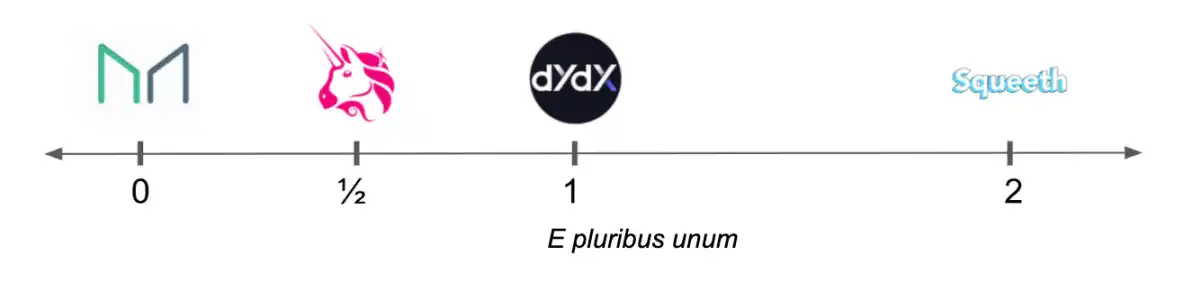
· Cryptocurrency-collateralized stablecoins (such as DAI or RAI) are like level 0 perpetual contracts.
· Margin futures (such as dYdX) are level 1 perpetual contracts.
· Constant product AMMs such as Uniswap are replicating portfolios of 0.5-order perpetual contracts, and constant geometric mean AMMs such as Balancer are replicating portfolios of power perpetual contracts of any value between 0 and 1.
This is cool because it reveals the surprisingly tight design space behind the three main primitives in DeFi. Before explaining one by one, we first need to define perpetual contracts and power perpetual contracts.
Perpetual Contract Definition: A tracking index (note: an index is usually a price, but can be anything measured in numerical form, such as the average temperature in San Francisco or the number of giraffes alive today) , and provide exposure to non-delivery contracts, the further the transaction price (mark price) is from the target price (index price), the greater the amount of the periodic payment (funding fee).
Graphically, the funding fee payment changes as the gap between the mark price and the index price changes during the funding period. If the mark price is higher than the index, longs pay shorts. If the mark price is lower than the index price, shorts pay longs.
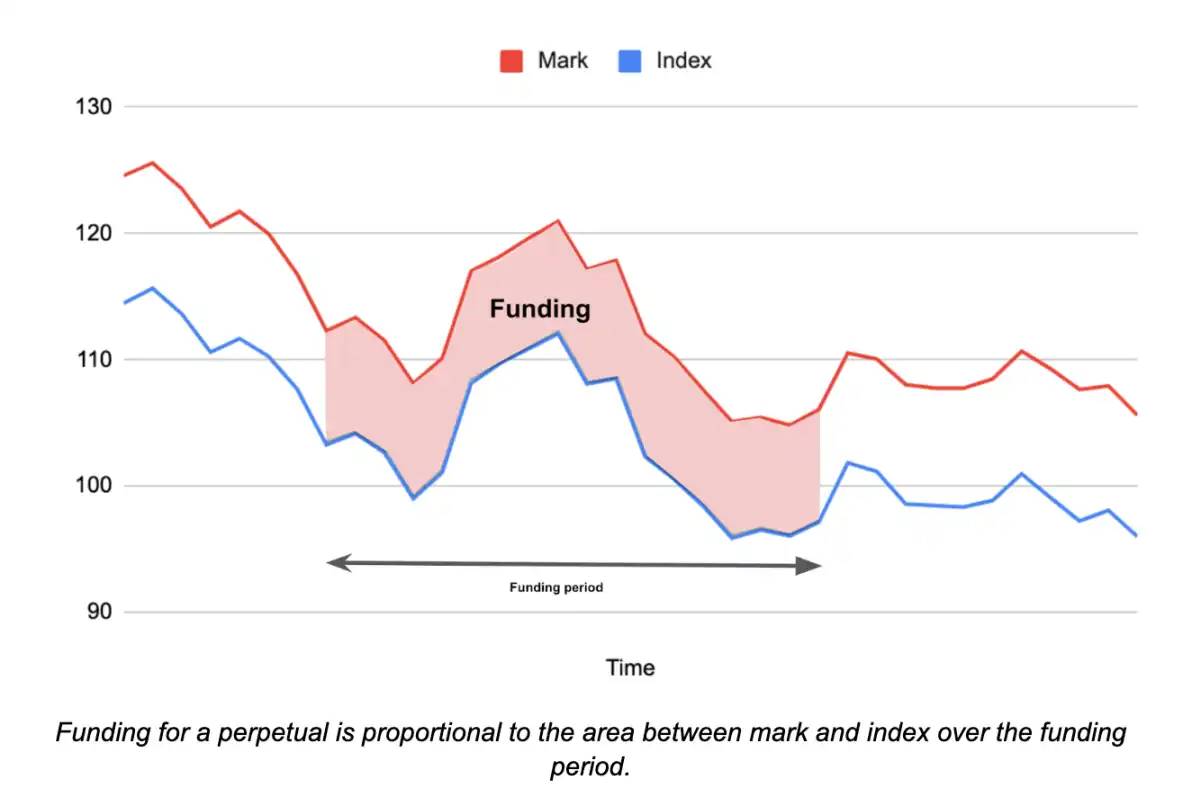
There are many mechanisms for paying funding fees (for example, cash or in-kind payments, regular or continuous funding fees, etc.), and there are also many mechanisms for setting interest rates based on prices (including Squeeth proportional mechanism used and the more complex PID controller used by Reflexer). But all mechanisms are based on the same idea: longs should pay shorts when the mark price is higher than the index price, and vice versa.
Power perpetual contract definition: A perpetual contract that tracks the index price to the power p.
To create a short position in the Power Perpetual Contract, you first lock some collateral in a vault and mint (i.e. borrow) the Power Perpetual Renew contract. This minted power perpetual contract is sold to enable shorting. If you want to go long, buy from someone who owns a power perpetual contract.
This mechanism is driven by the required collateral to debt ratio:
Collateral Ratio = Equity / Debt = ((Collateral quantity) * (Collateral price)) / ((Perpetual contract quantity) * (Index price)^p )
The ratio must remain safely above 1 so that there is enough collateral to repay the debt, otherwise the contract will liquidate the collateral by buying enough perpetual contracts to close the position.
The design space of the power perpetual contract involves power Number p, minimum collateral ratio c>1 and three asset choices:
· Collateral asset: such as US dollars
· Index asset (value Tokenized asset): For example, ETH
· Denominated asset (unit of measure of value): Typically USD
Now we Three propositions are made.
Proposition 1: Stablecoin is a 0-order power perpetual contract
Stablecoin is a A loan secured by reliable collateral. The following configuration gives an example of a USD stablecoin:
· Collateral asset: ETH
· Index asset: ETH
· Denominated asset: USD
· Collateral ratio: 1.5
· Power: 0
This Meaning we stake ETH and mint stablecoin tokens. The index is the zeroth power of the ETH price, that is, ETH^0 = 1.
If I deposit 1 ETH as collateral and ETH is trading at $3000, I can mint up to 2000 tokens.
Collateralization rate = equity/debt = ((collateral quantity) * (collateral price)) / ((power perpetual contract quantity) * (index price)^p ) = 1 * 3000/ (2000 * 1) = 1.5
The funding fee is the current trading price (mark price) of the stablecoin minus the index price raised to the power 0 .
Funding fee = mark price - index price^0 = mark price - 1
Funds The fee mechanism provides a good incentive for stablecoin trading prices to be anchored at US$1. If it trades well above $1, users sell their stablecoin holdings and then mint and sell more stablecoins for a profit. If the price is trading below $1, users can purchase the stablecoin to earn a positive interest rate and potentially sell it at a higher price in the future.
Not all stablecoins use this precise (mark price - index price) funding mechanism, but all collateralized stablecoins share it. A basic structure that uses stablecoins as good collateral for loans. Even stablecoins with interest rates set through governance will set them to a level similar to mark price - 1 to maintain their peg to $1.
Proposition 2: Margin futures are 1st order power perpetual contracts
If we will In this section, the power of the stablecoin is changed to 1, and the collateral is changed to US dollars, and we get the tokenized ETH asset:
· Collateral assets : USD
· Index asset: ETH
· Denominated asset: USD
· Collateral ratio: 1.5
· Power: 1
I staked $4,500 and minted a stable ETH (priced at $3,000).
Collateral ratio = equity/debt = ((collateral quantity) * (collateral price)) / ((power perpetual contract) * (index price) ^p ) = 4500 *1 / (1 * 3000 1) = 1.5
The funding fee of this perpetual contract is the USD trading price (mark price) minus Target index price^1.
Funding fee = mark price - index price^1= = mark price - ETH/USD price
The funding fee mechanism is a good incentive for perpetual contracts to trade at prices close to ETH. If the price of the perpetual contract increases significantly, funding fees will encourage arbitrageurs to buy ETH and short the perpetual contract. If the price of the perpetual contract drops significantly, it will encourage them to sell ETH and buy the perpetual contract.
I can sell this stable ETH asset to short the price of ETH, using USD as collateral.
From tokenized short assets to margined short perpetual assets
The stable ETH asset we built is not very capital efficient. We put up $4500 in collateral and gained short ETH exposure worth $3000 (or 1 ETH). We can be more capital efficient by selling minted ETH contract tokens (stableETH) and then using that as collateral to mint more ETH tokens.
If the minimum mortgage rate is 1.5 and ETH is 3000, we operate as follows:
· Deposit US$4,500 and mint 1 ETH contract token;
·Sell the ETH contract token for US$3,000, then use the US dollars obtained from the sale as collateral to mint 1/1.5 = 0.666 ETH contract token Coin;
· Sold ETH contract tokens at a price of $2,000 and minted (1/1.5)^2 = 0.444 ETH contract tokens;
· At a price of $1,333.33 Sell ETH contract tokens and mint (1/1.5)^3 = 0.296 ETH contract tokens.
Note: Leverage can usually be calculated by 1/(collateral ratio-1). In this example, leverage multiple =1/(1.5-1)=2 .
Ultimately, we minted and sold 3 ETH contract tokens, which was $4,500 in collateral to end up with $9,000 in short ETH exposure. This position is equivalent to opening a 2x leveraged short ETH/USD perpetual contract.
This process would be simplified if we could use flash transactions or flash loans. We can flash 3 ETH contract tokens into USD and use the proceeds as collateral to mint ETH contract tokens to pay it back.
If the collateral ratio requirement is 110%, we can open a 10x position.
Go long instead of short
If you want to go long , users can purchase ETH contract tokens. To go long leverage, users can borrow more USD using ETH contract token collateral and use the borrowed USD to purchase more ETH contract tokens, repeating the process up to 2x exposure. If using flash transactions or flash loans, this can be done in a single transaction.
This means that overcollateralized perpetual contracts can be converted into undercollateralized perpetual contracts.
Claim 3: Uniswap and other CFMMs are (almost) 0.5-order power perpetual contracts
The value of a liquidity position in a Uniswap pool is proportional to the square root of the relative prices of the two assets. For the ETH/USD pool, the value of LP (liquidity provider) is:
V = 2 * (k * (ETH price))^0.5
Where k is the product of the two token quantities. The trading pool will generate a certain amount of trading fees every cycle.
Now consider the power perpetual contract:
· Collateral asset: USD
· Index asset: ETH
· Denominated asset: USD
· Collateral ratio: 1.2
· Power: 0.5
This power perpetual contract will track the square root of the ETH price.
LP will receive the difference between the funding fee and the AMM fee. Since this trade offsets price risk, the 0.5 power perpetual contract should trade just below:
Expected Uniswap Fee = Index Price - Mark Price
p>
This gives us a good result, i.e. equilibrium Uniswap fees (note: if the annualized volatility of the trading pair is 90%, you need to pay from LP fees Earn 1/8 * 0.9^2 = 10.125% return. So if you own $100 of Uniswap LP, you need to earn $0.028 per day in fees to cover impermanent losses. The funding fee for the 0.5th power perpetual contract is per day 2.8 basis points.) should be the funding rate of the perpetual contract of 0.5. In the simplified case of zero interest rate:
Equilibrium Uniswap return = σ²/8
where σ² is the variance of the price return of one asset relative to another in the trading pool. We also get this result from a Uniswap perspective (see Appendix C here). We also introduce it in detail from the perspective of power here.
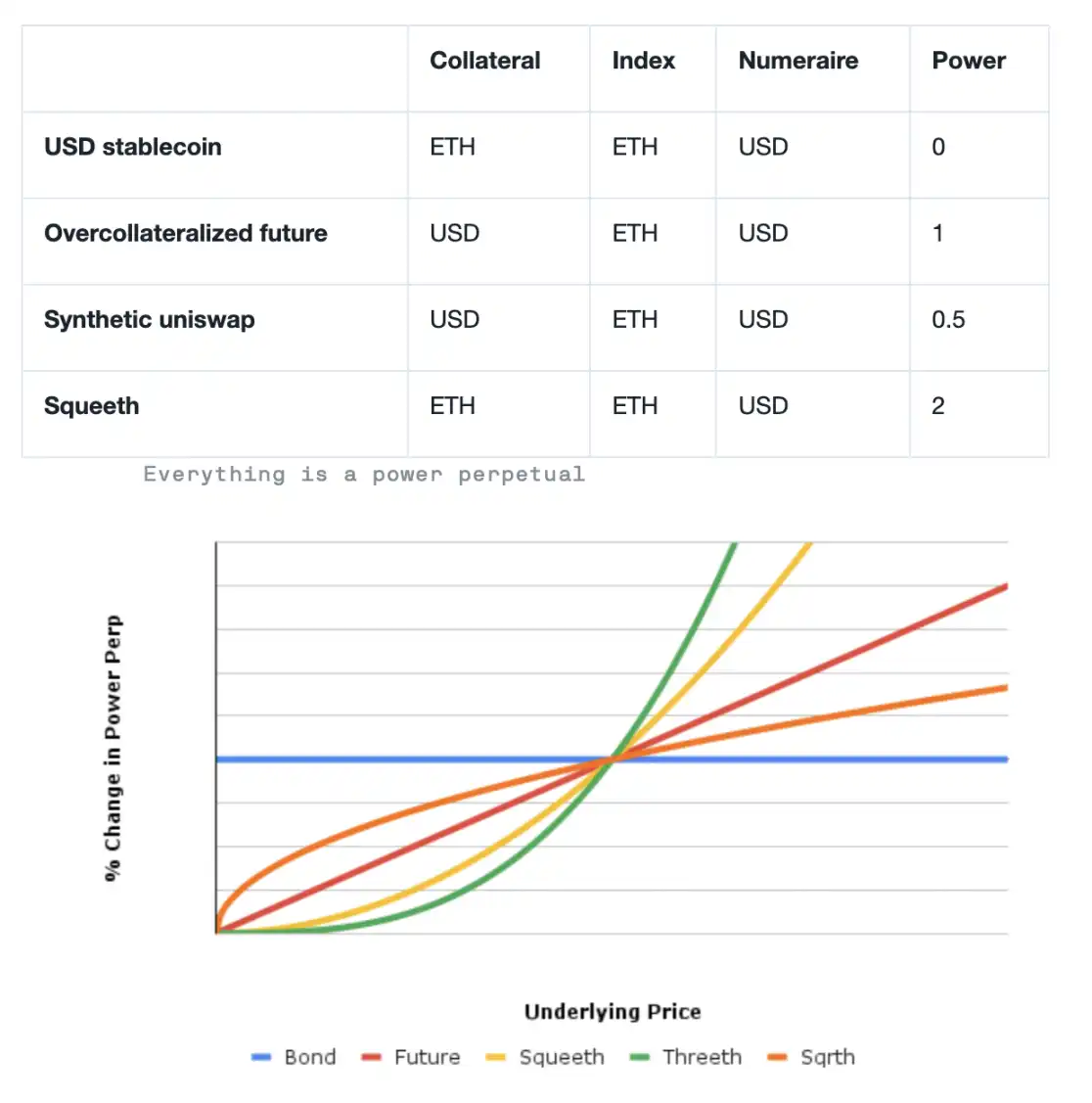
Therefore, stablecoins ( and mortgages more broadly), margined perpetual futures contracts and AMMs are all a type of power perpetual contract.
Advanced power perpetual contract: starting from the quadratic power perpetual contract. Squeeth is the first quadratic perpetual contract, providing exposure to quadratic price. By combining higher-order power perpetual contracts and 1-order power perpetual contracts with 0-order power perpetual contracts as collateral, we can get many approximations of returns.
If we need more precise results, we can simulate any function using a combination of power perpetual contracts with integer powers in Taylor series powers: sin(x ), e^x2, log(x).
What’s worth looking forward to next? How interesting would it be to have a world that allowed power perpetual contracts, collateralized assets, and Uniswap LP to coexist harmoniously.
Original link
Recommended
The Wall Street Journal: How is AI Trading Stealing the Limelight from Cryptocurrency?
Aug 15, 14:00
Tencent Still Has a Dream
Aug 15, 11:27
To Catch North Korean Hackers, They Set Up a Fake Project
Aug 15, 10:00
From Litigation to Settlement: Positive Signal Released by HTX's Negotiation with FCA
Aug 14, 19:32
11,742 Shipping Addresses Exposed Alongside Trezor Orders
Aug 14, 19:01
Founder Interview: FOMO Creator Explains How They Added 30,000 Users in One Day and Became One of the Fastest-Growing Crypto Apps
Aug 14, 18:37