Grayscale launches crypto dynamic income fund GDIF, Cosmos ecosystem may become the biggest winner

Original title: "Grayscale launches dynamic income fund GDIF, Cosmos ecosystem tokens become big winners"
Original author: Huhao Hao, Odaily Planet Daily
After successfully converting Bitcoin Trust into Bitcoin Spot ETF , Grayscale did not stop. On March 5, Grayscale announced the relaunch of the Crypto Dynamic Income Fund (GDIF), bringing the emerging fund model into traditional finance again and further integrating Web3 and Web2.
According to official documents, GDIF is Grayscale’s first actively managed fund. It uses the pledge income of a multi-token asset portfolio to provide investors with a single familiar tool. Participating in a multi-asset pledge and earning income fund model, Grayscale will distribute income (denominated in US dollars) to investors every quarter. “GDIF was created to provide investors with a way to earn PoS rewards without the operational challenges of direct PoS investing. At the same time, investors have the opportunity to hold a portfolio composed of multiple crypto assets through a single investment.”
The Grayscale GDIF portfolio currently contains 9 cryptoassets:Aptos (APT), Celestia (TIA), Coinbase Staked Ethereum ( CBETH), Cosmos (ATOM), Near (NEAR), Osmosis (OSMO), Polkadot (DOT), Sei Network (SEI), and Solana (SOL). The figure below shows the current asset proportion of the GDIF fund. Among them, OSMO accounts for 24%, SOL accounts for 20%, and DOT accounts for 24%. 14% and the remaining part accounts for 43% .

Grayscale’s criteria for selecting the above assets stem from its use of qualitative and quantitative factors to evaluate the return of the crypto asset, specifically reflected in aspects such as staking rewards, market value and liquidity. However, judging from the composition of the above tokens, most of them are projects with outstanding performance in the last bull market cycle (Polkadot, Near, Cosmos, Solana, Osmosis), and a small number of star projects with outstanding performance in this cycle ( Celestia, Aptos, etc.).
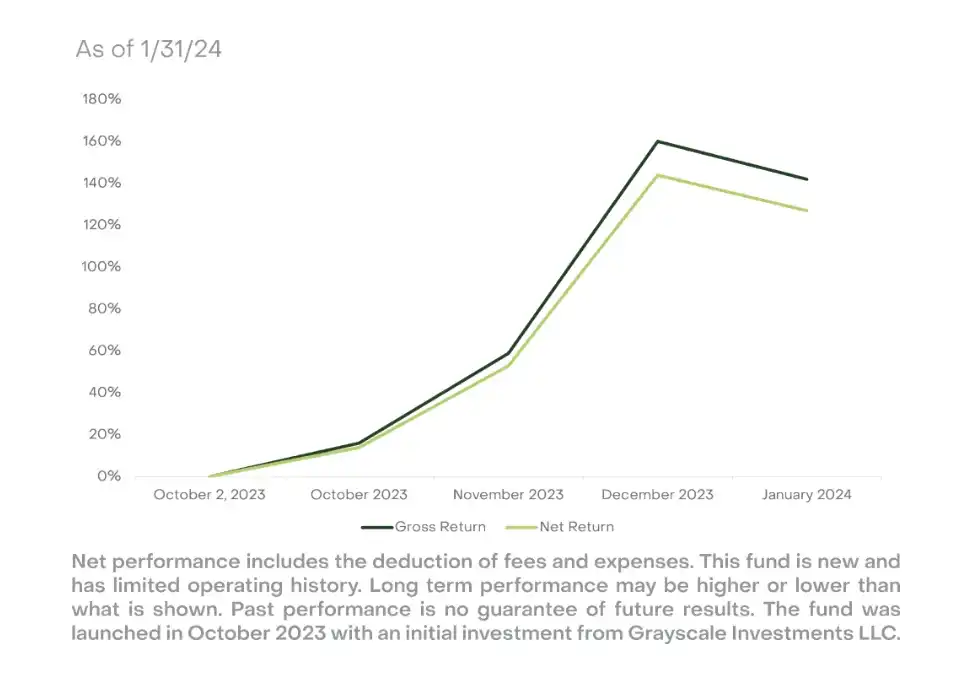
As can be seen from the picture below, the fund has been launched in October 2023. Grayscale used internal funds to provide start-up capital for the fund in the early stage. The fund's current highest gross profit rate is approximately 160%, and after deducting corresponding expenses, the net profit rate is 140%.
However, the fund is not fully open to the outside world, and investors have certain investment requirements. threshold. According to Grayscale's official website, "qualified investment customers" means that the investor's asset management scale needs to be more than US$1.1 million, or the net assets must be more than US$2.2 million.
Cosmos ecology may become the biggest winner
The GDIF fund was introduced above Asset composition, there are four types of projects related to Cosmos, including Celestia, Sei Network, Cosmos and Osmosis.
(1) Osmosis (OSMO)
Osmosis Using Cosmos’ IBC cross-chain technology Conduct cross-chain asset transactions and provide LP with higher APR income through multiple pledge mechanisms. In addition, Osmosis provides cross-chain transactions in the Cosmos ecosystem and the Ethereum ecosystem, and has partnered with Axelar to expand to other ecosystems. Currently, according to data from DefiLlama, Osmosis ranks tenth in TVL in the DEX sector of the entire network, with TVL totaling US$228 million.
Osmosis accounts for as much as 24% of assets in Grayscale Funds , mainly due to the pledge income of Osmosis in DEX Secondly, as the largest cross-chain DEX in the Cosmos ecosystem, its radiation range is relatively wide, which is conducive to operational choices.
(2) Sei Network (SEI)
Sei Network is DeFi L1, which is built on Cosmos, is more like being in the middle of the public chain and the application chain. As the first L1 in the Cosmos ecosystem to support order books, Sei Network aims to become a high-speed chain dedicated to transactions to help decentralized exchanges run better.
(3) Cosmos (ATOM)
Cosmos As an early representative project of multi-chain interconnection, its Cosmos SDK has become the preferred model for building many new public chains and applications. Although it experienced a fork storm last year due to the issue of staking income, it was generally not affected. The ecological scale of Cosmos is only smaller than that of the Ethereum ecosystem, and its token staking rights are sought after by many users.
(4) Celestia (TIA)
Celestia As a modular system focused on data availability A representative project of the blockchain, it is built through the Cosmos SDK. Most of Celestia's team members come from Cosmos. Since its launch last year, the token TIA has increased more than 10 times.
According to the above introduction, it can be found that the Cosmos ecosystem is far better than other public chains in terms of underlying technology and ecological development (second only to Ethereum), and can provide There are many ways to obtain staking income; in contrast, in Ethereum, although there are many second-tier projects, there are fewer projects that can obtain native staking income. Because of this, Grayscale Dynamic Income Fund accounts for a relatively high proportion of Cosmos-related assets.
Perhaps due to the influence of Grayscale GDIF, the tokens of Cosmos, Sei Network and Osmosis have generally increased by 10% in the past 24H ; Left and right: ATOM is currently quoted at 13.7 USDT, with a 24H increase of 10.34%; SEI is now quoted at 0.81 USDT, with a 24H increase of 11.8%; OSMO is now quoted at 1.75 USDT, with a 24H increase of 9.72%.
Summary
Grayscale launched a new fund GDIF to gradually transform itself from passively receiving crypto fluctuations For Grayscale, the move to actively participate in obtaining crypto-native returns is to further explore the sources of revenue from crypto assets and gradually introduce them to traditional finance to increase the diversity of fund management.
For the encryption market, these 9 crypto-asset projects included may gradually move into the mainstream market due to Grayscale’s participation in staking. Compared with the trust launched by Grayscale earlier, the Bitcoin Trust was successfully launched in the form of spot ETF, and the subsequent Ethereum Trust may follow the pace of Bitcoin. Excluding BTC and ETH, the remaining crypto assets are still relatively unfamiliar to the huge traditional finance, and still need the promotion of mainstream asset management companies such as Grayscale to help the crypto market become mainstream as soon as possible.
Another question is whether Grayscale’s launch of funds to provide pledge services will trigger regulatory nerves?
In February 2023, Kraken was sued by the U.S. SEC for providing crypto staking services. It eventually paid a fine of US$30 million and suspended U.S. domestic staking services. Kraken finally Independent subsidiaries are established overseas to provide pledge services to non-U.S. customers. Coincidentally, in July last year, Coinbase was also sued by multiple states in the United States for violating the Securities Act of 1933 for providing pledge services. Now that Grayscale has openly launched a pledge service to challenge the SEC, regulatory pressure may come soon (after all, Grayscale and the SEC have deep disputes, and they will win or lose in court).
But on the bright side, Grayscale’s approach may make it impossible for supervision to start. After all, the staking revenue services provided by Coinbase and Kraken as exchanges are fully managed staking services, that is, users deposit relevant tokens into the cold wallet addresses of Coinbase and Kraken and they will do it on their behalf. To implement the pledge service of the target chain, the relevant keys are in the hands of their exchange.
What Grayscale provides is a fund. Investors purchase the fund in U.S. dollars, and finally pay the proceeds in U.S. dollars, which does not involve cryptocurrency rights. transfer. Grayscale also seems to be deliberately avoiding supervision and looking for legal gray areas, but it is still unclear whether it will be able to do so in the end.
Original link
Recommended
The Wall Street Journal: How is AI Trading Stealing the Limelight from Cryptocurrency?
Aug 15, 14:00
Tencent Still Has a Dream
Aug 15, 11:27
To Catch North Korean Hackers, They Set Up a Fake Project
Aug 15, 10:00
From Litigation to Settlement: Positive Signal Released by HTX's Negotiation with FCA
Aug 14, 19:32
11,742 Shipping Addresses Exposed Alongside Trezor Orders
Aug 14, 19:01
Founder Interview: FOMO Creator Explains How They Added 30,000 Users in One Day and Became One of the Fastest-Growing Crypto Apps
Aug 14, 18:37