Ponzi is making a comeback after the collapse. Can the OHM team still bring the code of wealth?

Market enthusiasm is still surrounding memes. In just one weekend, the new meme currency YES on Blast triggered FOMO in the community. Even Adam Cochran (AC), partner of Cinneamhain Ventures, discussed with the community on Discord and read Complete all the code of Baseline.
Baseline’s predecessor, Jimbos protocol, announced its intention to be a permissionless algorithmic market maker protocol after changing its name last year. The protocol extends POL (Protocol Owned Liquidity) and uses smart contracts to manage token liquidity within a centralized liquidity pool. This market-making mechanism also allows YES to achieve the Ponzi effect of "only rising but not falling", no liquidation mechanism, and multiple leverage.
Related reading: "Revealing the trading techniques of the team behind the popular meme project YES on Blast, the myth of "it only goes up but not down"》
POL This concept originated from Olympus DAO (OHM), and for this reason, many people believe that Baseline has a close connection with the Olympus team. However, Smokey The Bera, the founder of Berachain, deliberately distances himself from the relationship between OHM and Baseline. He believes that projects that draw on POL ideas should not be famous for OHM, but should build their own projects in a down-to-earth manner.
But if you pay attention to DeFi, you may notice that in this round of stories, "former OHM core members" or "former OHM developers" etc. Rhetoric seems to have become the new code of wealth.
Olympus It is a decentralized reserve currency protocol based on OHM tokens. Its vision is to become a new reserve stable currency.
In the DeFi summer at the end of 2020, various Various decentralized platforms have launched "liquidity mining" one after another. Before OHM launched POL, countless projects could not avoid the problem of unstable liquidity, but POL did it through the new pledge and Bond mechanism, becoming its own liquidity. controller. OHM once held more than 99% of OHM-DAI bond liquidity, which can be said to have led DeFi into the 2.0 era.
Under the different choice games of the two incentive mechanisms of staking and Bond, OlympusDAO was born with a 3v3 game model. For the specific principles of this model, please refer to "Interpretation of Ve(3,3), "Curve+Olympus"》. Suddenly, the first text meme (3,3) spread all over Twitter and was imitated by countless communities. This set of 3v3 games also made OHM's APY reach 70,000%, and spawned a lot of forks on other public chains. "3, 3" also turned into "4, 4" or even "9, 9". It makes the APY measured in thousands of percent seem insignificant.
Related reading: "APY 70,000%, DeFi 2.0 dominated by OHM forks》
Ultra-high APY naturally attracts funds factors, but it also brings inflationary pressure, and the question of whether OHM is a Ponzi scheme is gradually increasing. In the end, OHM was sold by a huge amount, causing the price to fall by more than 98% at one time. However, the algorithmic currency that hit the bottom from the high point will find it difficult to return to the original level without the support of the owner behind it.
After the currency price crash, OlympusDAO lowered OHM’s pledge APY and stated that in the future OlympusDAO will focus on three aspects: stability, sustainability and widespread adoption. . In addition, OlympusDAO also changed APY (annualized yield) to BR (basic interest rate), which represents the annual inflation rate of OHM.
In "Can the algorithmic stablecoin OlympusDAO solve the death spiral problem? ” explained in the article that the price of OHM does not need to be linked to a specific asset. It uses DAI as a reserve. In theory, one OHM is only backed by one DAI and is worth 1 US dollar. Of course, it is precisely because of its uncertainty that some people regard it as a non-sovereign currency.
Starting from Ponzi, leading DeFi 2.0 and experiencing a crash, it returned to its original roots and transformed into a reserve stablecoin. It seems that OlympusDAO has really completed all its missions and "disappeared" In a bear market.
Although there is little voice from OlympusDAO now, it The 3,3 model and POL mechanism that it once promoted have always affected the DeFi field. Just like the popularity of YES, there are still many projects where the shadow of the OHM team can be seen, or based on the Ponzi effect, rhetoric such as "former OHM core members" and "former OHM developers" seem to have become the key to the project's rise. one of the reasons.
Berachain
Berachain has recently launched its public test network "Artio". Discussions have once again started among the encryption community. The extremely cult-style community has made it attract the attention of Degen people in the circle since its launch in late 2021.
According to Berachain Lianchuang Smokey’s description, the team is a group of OHM early investors who met in the Olympus DAO community. At first, it was just a group of community members. NFT project. In order to pay tribute to OHM's Ponzi mechanism, the first NFT was named Bong Bears, and "Bera" was deliberately misspelled in order to pay tribute to the old encryption stalker "Hodl".
Berachain has now developed into a high-performance EVM-compatible blockchain, built based on the Proof-of-Liquidity (PoL) consensus mechanism, with the goal of It is to adjust the network incentive mechanism by strengthening the synergy between Berachain validators and the project ecosystem. Additionally, Berachain’s technology is based on Polaris, a high-performance modular framework for building EVM-compatible chains on top of the CometBFT consensus engine.
Related reading: "Exploration of cutting-edge public chains: Berachain’s technology, community and ecological projects》
On April 20, Berachain completed 42 million USD financing, led by Polychain Capital, OKX Ventures, Hack VC, Dao5, Tribe Capital, Shima Capital, Robot Ventures, Goldentree Asset Management, former partner of Dragonfly Capital, Celestia founder Mustafa Al-Bassam, Tendermint co-founder Zaki Manian and 20 other DeFi project founders participated in the investment.
Eefi Finance
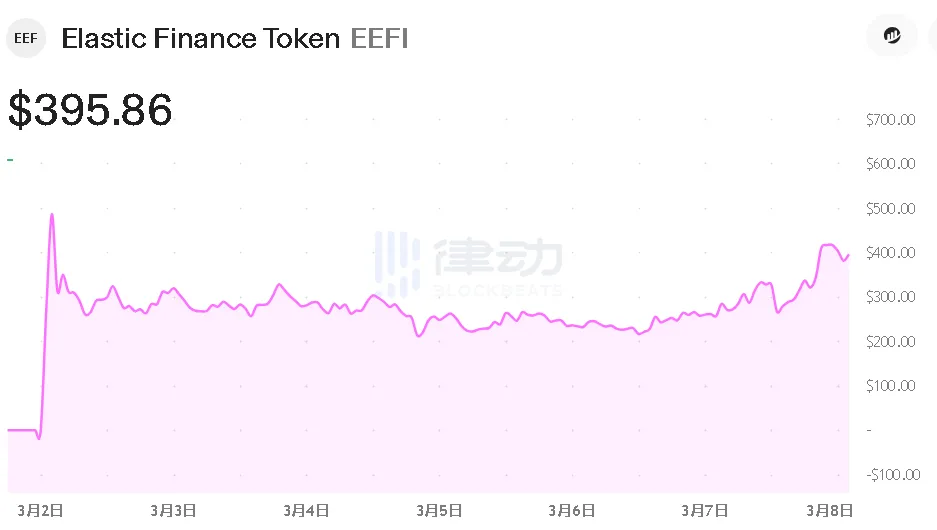
Eefi Finance is a flexible treasury protocol built on AMPL, which also uses OHM tokens and EEFI forms a trading pair. According to the official website of Eefi Finance, its ecological partners also include OHM, and it is said that community members will participate.
Elastic Finance launches the income token EEFI, which can amplify and extend income under all market conditions. Its (E, E) game theory is (3,3) An upgrade to game theory. The total token supply is 170,000, of which 25,000 are allocated to the LBP event, which is hosted in partnership with Olympus DAO and Bond Protocol. According to uniswap data, as of writing, the EEFI price is $395.86, a 24-hour increase of 35%.
Peapods Finance
Peapods is a decentralized, permissionless, trustless on-chain volatility mining protocol with zero reliance on oracles or external price feeds. Peapods Finance has launched Volatility Farming, a new DeFi model that enables users to take advantage of the volatility of cryptocurrency markets to unlock yield opportunities on liquid assets.
Peapods uses OHM instead of DAI as the basic trading pair for all listed tokens. The community also interacts and cooperates frequently. It recently launched Arbitrum and continues to receive support from OHM. According to uniswap data, as of writing, the price of PEAS is $395.86, a 24-hour increase of 4.2%.
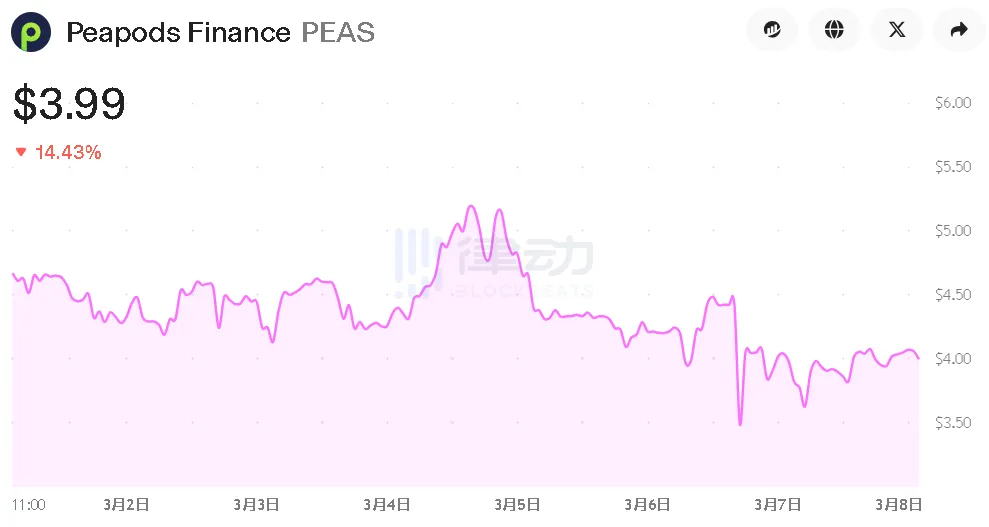
Peapods Finance supports users in Permissionless creation of weighted and unweighted index positions called “Pods” on Ethereum makes it easy for anyone to gain exposure to popular asset allocations by making these positions liquid. Users can stake these positions to earn deflationary PEAS tokens, which enable value capture by charging fees for the expansion or contraction of Pods supply, as well as ongoing arbitrage between Pods prices and their underlying assets.
On January 26, Peapods Finance announced that it would use pOHM as a core integrated part of its new v2 Green Arrow pod, a move that will fundamentally improve the liquidity mechanism of all Pods. The new pOHM integration provides an option for all Pod products to now use pOHM as a liquid pairing asset. Pods paired with pOHM inherit OHM’s superior LP characteristics beyond anchored assets, including the reduction of impermanent losses (IL) and asset appreciation. The free-floating nature of OHM also provides greater arbitrage opportunities for Pods, thereby enhancing the volatility mining of Pods.
Recommended
The Wall Street Journal: How is AI Trading Stealing the Limelight from Cryptocurrency?
Aug 15, 14:00
Tencent Still Has a Dream
Aug 15, 11:27
To Catch North Korean Hackers, They Set Up a Fake Project
Aug 15, 10:00
From Litigation to Settlement: Positive Signal Released by HTX's Negotiation with FCA
Aug 14, 19:32
11,742 Shipping Addresses Exposed Alongside Trezor Orders
Aug 14, 19:01
Founder Interview: FOMO Creator Explains How They Added 30,000 Users in One Day and Became One of the Fastest-Growing Crypto Apps
Aug 14, 18:37