Arthur Hayes: Ethena will subvert the currency printing machine

Original title: Dust on Crust Part Deux
Original author: Arthur Hayes, founder of BitMEX
Original compilation: Qin Jin
The dust on the earth's crust returns to Hokkaido, Japan as scheduled. It was sunny and warm during the day, but freezing cold at night. This weather pattern creates severe snow conditions known as "crust dust." Underneath the seemingly beautiful and flawless snow, there is ice and brittle snow lurking. nausea.
As winter turns to spring and the pace accelerates, I would like to review the article "Dust on the Earth's Crust" published a year ago. In this article, I propose how to create a human-backed fiat stablecoin that exists independently of the TradFi banking system. My idea is to combine crypto long and short perpetual futures contract position hedging to create a synthetic fiat currency unit. I named it "Nakadollar" because I envisioned using "perpetual" short futures contracts on Bitcoin and XBTUSD as a way to create synthetic dollars. At the end of the article, I promise to do everything in my power to support a credible team to bring this idea to life.
What a big change in one year. Guy is the founder of Ethena. Prior to founding Ethena, Guy worked at a $60 billion hedge fund investing in specialty areas such as credit, private equity, and real estate. Guy discovered the Shitcoin problem during the DeFi Summer that started in 2020, and has been out of control ever since. He came up with the idea to launch his own synthetic dollar after reading the book Dust on Crust. But like all great entrepreneurs, he wanted to improve upon my original idea. He wants to create a synthetic USD stablecoin that uses ETH instead of BTC. At least at first.
Guy chose ETH because the Ethereum network provides native revenue. To provide security and process transactions, Ethereum network validators are paid a small amount of ETH per block directly through the protocol. This is what I call ETH staking yield. Furthermore, since ETH is now a deflationary currency, there is a fundamental reason why ETH/USD forwards, futures, and perpetual swaps trade at a continued premium compared to spot. Short perpetual swap holders can capture this premium. Combining physical ETH collateral with a short ETH/USD perpetual swap position creates a high-yielding synthetic USD. As of this week, spot ETH USD (sUSDe) has an annual return of ~50%.
No matter how good the idea is, it will be empty talk without a team that can execute it. Guy named his synthetic dollar “Ethena” and has assembled a star team to launch the protocol quickly and securely. In May 2023, Maelstrom became a founding advisor and in exchange we received governance tokens. I have worked with many high quality teams in the past and the people at Ethena cut corners and get the job done brilliantly. Fast forward 12 months later, the Ethena stablecoin USDe was officially launched. Just 3 weeks after the mainnet went live, the circulation has reached nearly 1 billion (TVL is 1 billion US dollars; 1USDe = 1 US dollar).
Let me put aside my knee pads and have a candid discussion about the future of Ethena and stablecoins. I believe that Ethena will surpass Tether to become the largest stablecoin. This prophecy will take many years to come true. However, I want to explain why Tether is the best and worst business in cryptocurrency. It's the best because it's probably the most profitable financial intermediary per employee in TradFi and cryptocurrencies. The reason it’s the worst is because Tether exists to please its poorer TradFi banking partners. Bank envy and the problems Tether creates for the guardians of America’s peaceful financial system could spell immediate doom for Tether.
To all those Tether FUDsters out there who are misinformed, I want to make this clear. Tether is not a financial fraud and does not lie about its reserves. Additionally, I have great respect for those who founded and run Tether. But, IMHO, Ethena will disrupt Tether.
This article will be divided into two parts. First, I will explain why the U.S. Federal Reserve, the U.S. Treasury, and large politically connected U.S. banks want to destroy Tether. Second, I’ll dive into Ethena. I’ll briefly cover how Ethena is built, how it maintains its peg to the U.S. dollar, and its risk factors. Finally, I will provide a valuation model for Ethena’s governance token.
After reading this article, you will understand why I believe Ethena is the cryptocurrency ecosystem’s best choice for providing synthetic USD on a public chain.
Note: Physically supported fiat currency stablecoins refer to currencies in which the issuer holds fiat currency in a bank account, such as Tether, Circle, and First Digital (ahem. .....Binance) etc. Synthetically backed fiat stablecoins are coins where the issuer holds a cryptocurrency that is hedged with short-term derivatives, such as Ethena.
Tether (code: USDT) is the largest stablecoin by token circulation . 1 USDT = 1 US dollar. USDT is sent between wallets on various public chains such as Ethereum. To maintain the peg, Tether holds $1 in bank accounts for each unit of USDT in circulation.
Without a U.S. dollar bank account, Tether cannot fulfill its functions of creating USDT, custody of the U.S. dollars backing USDT, and redeeming USDT.
Creation: Without a bank account, USDT cannot be created because traders have nowhere to send their USD.
USD Custody: Without a bank account, there is nowhere to keep the US dollars backing USDT.
Redeeming USDT: Without a bank account, there is no way to redeem USDT, because there is no bank account to send USD to the redeemer.
Having a bank account is not enough to ensure success because not all banks are created equal. There are thousands of banks around the world that accept U.S. dollar deposits, but only some have master accounts with the Federal Reserve. Any bank wishing to conduct U.S. dollar clearing through the Federal Reserve to fulfill U.S. dollar correspondent banking obligations must hold a master account. The Fed has complete discretion over which banks have access to master accounts.
I will briefly explain how agent banking works.
There are three banks: Bank A and Bank B, which are headquartered in two non-U.S. jurisdictions. Bank C is a US bank with a master account. Bank A and Bank B want to be able to move dollars within the fiat currency financial system. They each applied to use Bank C as their correspondent bank. Bank C evaluates the customer base of both banks and approves it.
Bank A needs to transfer $1,000 to Bank B. The flow of funds is a transfer of $1,000 from Bank A's account at Bank C to Bank B's account at Bank C.
Let's change the example slightly and add Bank D, which is also a US bank with a master account. Bank A uses Bank C as its correspondent bank, while Bank B uses Bank D as its correspondent bank. Now, what happens if Bank A wants to send $1000 to Bank B? The flow of funds is a transfer of $1,000 from Bank C's account at the Federal Reserve to Bank D's account at the Federal Reserve. Bank D eventually deposits $1,000 into Bank B's account.
Typically, banks outside the United States use correspondent banks to wire U.S. dollars worldwide. This is because when dollars move between jurisdictions, they must be cleared directly through the Fed.
I have been exposed to cryptocurrency since 2013. Usually, the banks where cryptocurrency exchanges store fiat currencies are not banks registered in the United States, which means that it You need to rely on a US bank with a master account to handle deposits and withdrawals of fiat currency. These smaller, non-U.S. banks are hungry for deposits and crypto companies’ banking business because they can charge high fees without paying out any deposits. Globally, banks are often eager to access cheap U.S. dollar funding because the U.S. dollar is the global reserve currency. However, these smaller foreign banks must interact with their correspondent banks to handle U.S. dollar deposits and withdrawals outside of their location. While correspondent banks tolerate these fiat currency flows related to cryptocurrency businesses, sometimes certain cryptocurrency customers are kicked out of smaller banks at the behest of correspondent banks, for whatever reason. If smaller banks don't comply, they lose correspondent banking relationships and the ability to move dollars internationally. Banks without dollar liquidity are like zombies. Therefore, small banks will always dump cryptocurrency customers if asked to do so by correspondent banks.
This growth in agent banking is critical when we analyze the strength of Tether’s banking partners.
Tether’s banking partners:
· Britannia Bank & Trust
· Cantor Fitzgerald
· Capital Union
· Ansbacher
· Deltec Bank and Trust
Of the five banks listed, only Cantor Fitzgerald is a bank registered in the United States. However, none of these five banks has a Fed master account. Cantor Fitzgerald is a primary dealer that helps the Fed conduct open market operations, such as buying and selling bonds. Tether’s ability to move and hold U.S. dollars is entirely at the mercy of fickle correspondent banks. Given the size of Tether's U.S. Treasury portfolio, I believe their partnership with Cantor will be critical to continued access to this market.
The CEOs of these banks would be fools if they didn't negotiate for equity in Tether in exchange for banking services. You'll understand why when I introduce Tether's revenue per employee metric later.
This covers why Tether’s banking partners are underperforming. Next, I want to explain why the Fed doesn’t like Tether’s business model and why, fundamentally, this has nothing to do with cryptocurrencies and everything to do with how the U.S. dollar money market works.
From a TradFi perspective, Tether is a Full reserve banks are also known as narrow banks. Full reserve banks only accept deposits and do not make loans. The only service it provides is money transfers. It pays almost no interest on deposits because savers face no risk. If all depositors demand their money back at the same time, the bank can fulfill their demands immediately. Therefore, it is called "full reserves." In contrast, fractional-reserve banks have more loans than deposits. If all depositors simultaneously asked a fractional reserve bank to return their deposits, the bank would fail. Fractional-reserve banks pay interest to attract deposits, but depositors face risks.
Tether is essentially a fully-reserved U.S. dollar bank that provides U.S. dollar trading services powered by a public chain. That's it. No loans, no fun stuff.
The Fed doesn't like fully-reserve banks, not because of who their customers are, but because of how these banks handle their deposits. To understand why the Fed abhors a fully-reserved banking model, I must discuss the mechanics of quantitative easing (QE) and its impact.
Banks failed during the 2008 financial crisis because they did not have enough reserves to cover losses on bad mortgages. Reserves are funds held by banks with the Federal Reserve. The Fed monitors the size of bank reserves based on total outstanding loans. After 2008, the Fed ensured that banks would never run out of reserves. The Fed accomplishes this by implementing QE.
QE is the process by which the Federal Reserve purchases bonds from banks and credits the banks with reserves held by the Fed. The Fed engaged in trillions of dollars worth of QE bond purchases, causing bank reserve balances to swell. great!
Quantitative easing hasn’t caused wild inflation in the obvious way that COVID stimulus checks have because bank reserves stay at the Fed. COVID stimulus measures are put directly in the hands of the people to use as they please. If banks loaned out these reserves, inflation would rise immediately after 2008 because the money would be in the hands of businesses and individuals.
Fractional reserve banks exist to make loans; if banks don’t make loans, they can’t make money. So, other things being equal, fractional reserve banks prefer to lend their reserves to paying customers rather than keep them at the Fed. The Fed has a problem. How do they ensure that the banking system has nearly unlimited reserves without causing inflation? The Fed chose to "bribe" the banking industry instead of lending.
Bibbing banks to require the Fed to pay interest on excess reserves in the banking system. To calculate the amount of the bribe, multiply the total bank reserves held by the Fed by the interest on reserve balances (IORB). The IORB must hover between a lower and upper bound on the Fed funds rate. Read my article Kite or Board to find out why.
Loans are risky. Borrowers will default. Banks would rather earn risk-free interest income from the Fed than lend to the private sector and suffer possible losses. As a result, as QE progresses, outstanding loans in the banking system do not grow at the same rate as the Fed's balance sheet. However, success does not come cheap. When the Fed funds rate is 0% to 0.25%, the cost of bribery is not high. But now, with the Fed funds rate at 5.25% to 5.50%, IORB bribes cost the Fed billions of dollars a year.
The Fed maintains "high" policy rates to curb inflation; however, as the cost of IORB increases, the Fed becomes unprofitable. The U.S. Treasury Department, as well as the American public, directly funded the Federal Reserve to bribe banks through the IORB program. When the Fed makes money, it sends those payments to the U.S. Treasury. When the Fed loses money, the U.S. Treasury lends money to the Fed to cover its losses.
Quantitative easing solved the problem of insufficient bank reserves. Now, the Fed wants to reduce the amount of reserves banks hold in order to curb inflation. This is Quantitative Tightening (QT).
QT is when the Fed sells bonds to the banking system, paying for them with reserves held by the Fed. Quantitative easing increases bank reserves, while quantitative tightening reduces bank reserves. As bank reserves fall, so do IORB's bribe costs. Obviously, the Fed wouldn't be happy if bank reserves were rising while it was paying high interest rates due to IORB.
A fully-reserve banking model runs counter to the Fed’s stated goals. Fully-reserve banks do not make loans, meaning 100% of deposits are held as reserves at the Fed. If the Fed starts issuing full-reserve banking licenses to banks doing business similar to Tether, it will exacerbate the central bank’s losses.
Tether is not a licensed U.S. bank and therefore cannot deposit directly into the Federal Reserve and earn IORB. But Tether can deposit cash into money market funds, and money market funds can use reverse repurchase programs (RRPs). The reverse repo program is similar to the IORB in that the Fed must pay an interest rate between the federal funds floor and ceiling to determine exactly where short-term rates trade. Treasury bills (T-bills) are zero-coupon bonds with maturities of less than one year and trade at yields slightly above the RRP rate. So while Tether is not a bank, its deposits are invested in instruments that require interest payments from the Federal Reserve and the U.S. Treasury. Tether has nearly $81 billion invested in money market funds and T-bills. Tether goes against the Fed. And the Fed doesn't like it.
Tether is fighting the Fed because Tether pays 0% interest on USDT balances but earns interest at approximately the Fed funds rate cap. This is Tether’s net interest margin (NIM). As you can imagine, Tether was overjoyed by the Fed's rate hike, as NIM went from essentially 0% to nearly 6% in less than 18 months (March 2022 to September 2023).
Tether is not the only stablecoin issuer taking on the Fed. Circle (ticker: USDC) and every other stablecoin that accepts USD and issues tokens is doing the same thing.
If banks abandon Tether for some reason, the Fed will not be able to help. In fact, the Fed governors' cheese will be bigger than Sam Bankman-Fried's chubby little bump on Tiffany Fong's non-marital visit.
What about "bad woman" Yellen? Does her Treasury have any issues with Tether?
U.S. Treasury Secretary Janet Yellen A well-functioning Treasury market is needed. That way she could borrow the money necessary to pay for the trillion-dollar annual government deficit. After 2008, the size of the U.S. Treasury market expanded along with the fiscal deficit. The larger the scale, the more fragile it becomes.
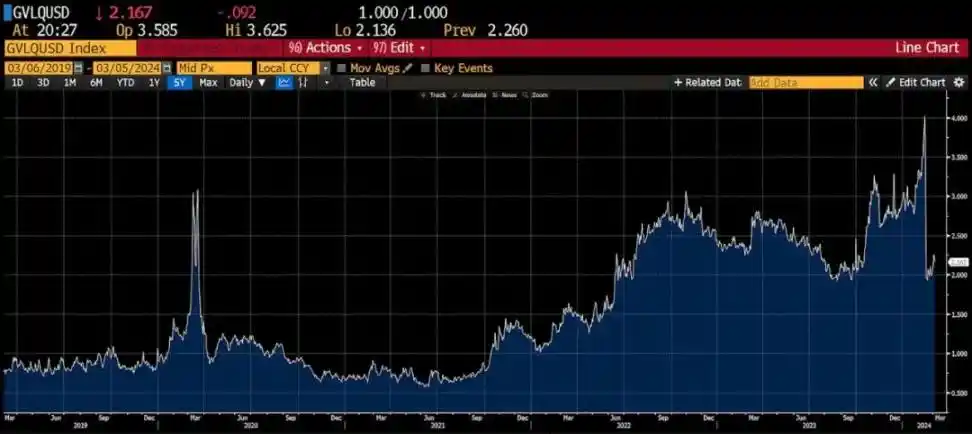
U.S. Government Securities Liquidity The index chart clearly shows the decline in liquidity in the Treasury market since COVID (the higher the number, the worse the liquidity situation). It only takes a small amount of selling to disrupt the market. What I mean by disrupting the market is a rapid drop in bond prices or a rise in yields.
Tether is now one of the 22 largest holders of U.S. Treasuries. If Tether had to sell off its holdings quickly for whatever reason, it could cause chaos in global bond markets. I say global because all fiat debt instruments are priced against the U.S. Treasury curve to some degree.
If Tether’s banking partners abandon Tether, Yellen may intervene in the following ways:
· Perhaps she will provide for giving Tether a reasonable amount of time to remain a customer so that it is not forced to sell assets to meet redemption requests quickly.
· Maybe she will freeze Tether’s assets so that it can’t sell anything until she thinks the market can absorb Tether’s holdings.
But what Yellen certainly won’t do is help Tether find another long-term banking partner. The growth of Tether and similar stablecoins serving the cryptocurrency market poses risks to the U.S. Treasury market.
If Tether decides to buy bonds that no one wants, long-term bonds with maturities greater than 10 years, instead of short-term notes that everyone wants, Yellen Maybe on their side. But why would Tether take this maturity risk to earn less money than a short-term Treasury bill? This is because the yield curve is inverted (long-term interest rates are lower than short-term interest rates).
The most powerful arm of the American peaceful financial machine would rather Tether did not exist. And none of this has anything to do with cryptocurrencies.
The talented analysts at Maelstrom produced the following for Tether Speculative balance sheet and income statement. They combined Tether’s publicly disclosed information with their own judgment to create this report.
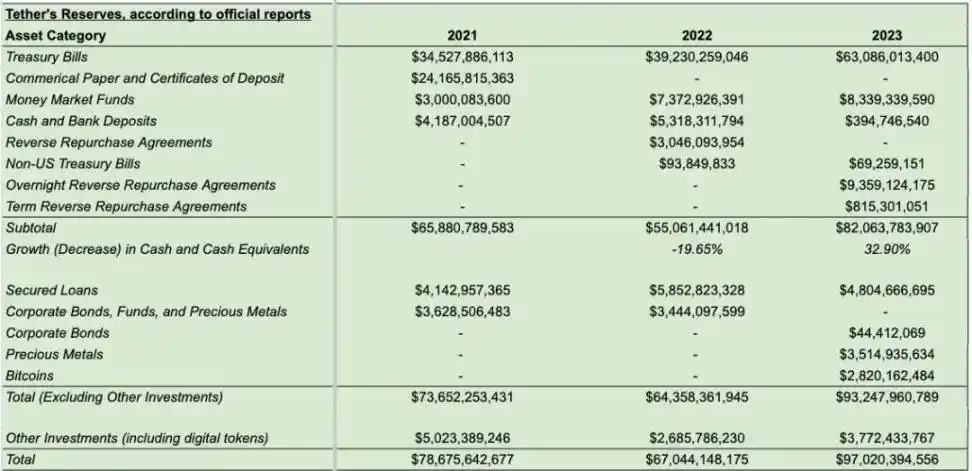
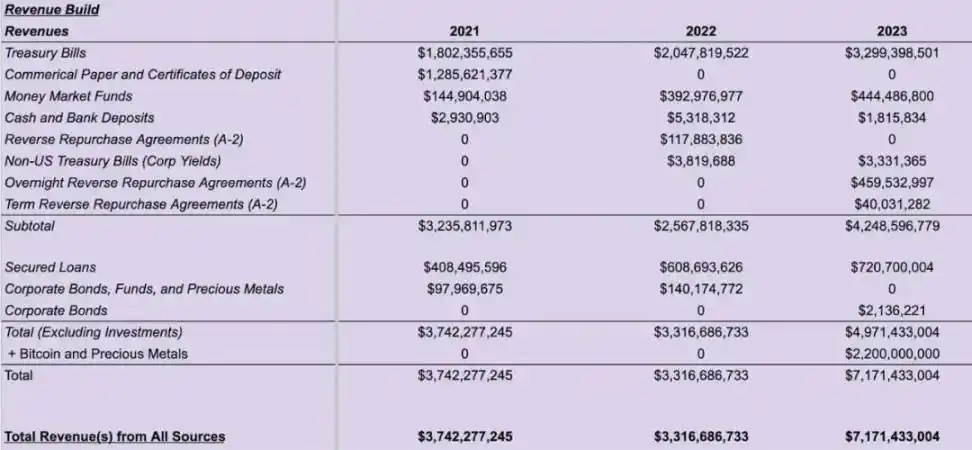
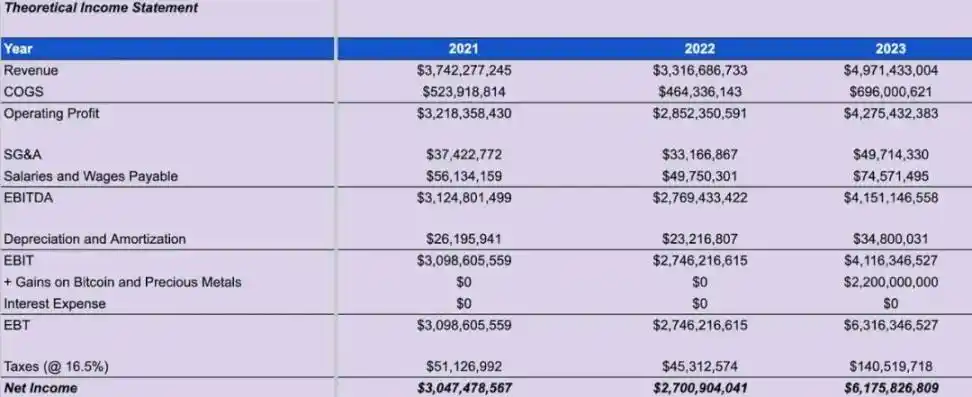
The following is a table of eight "too big to fail" (TBTF) banks. Controls the U.S. economic and political system, as well as their net income for fiscal year 2023.
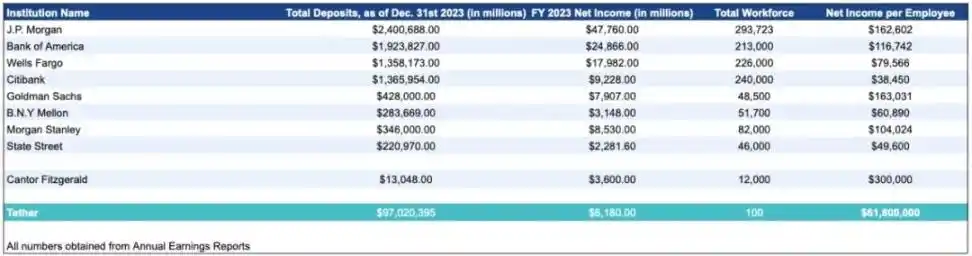
Cantor Fitzgerald is not a bank; Rather, they are primary dealers and trading houses. There are only 23 primary dealer banks. Therefore, in the "Total Deposits" column, Cantor's figure represents the value of its balance sheet assets. I obtained Cantor's net revenue and headcount from Zippia.
Tether’s revenue per employee is $62 million. No other bank on this list comes close. Tether’s profitability is another example of how cryptocurrencies will impact the largest transfer of wealth in the history of human civilization.
Why don’t any of these TBTF banks offer competing fiat-pegged stablecoins? Tether earns more per employee than these banks, but without these banks and others like them, Tether cannot exist.
Instead of asking Tether to debank, maybe one of these banks could buy Tether. But why do they do this? Certainly not for the sake of technology. Due to the transparency of the public chain, the code to deploy the smart contract Tether clone is already on the Internet.
If I were the CEO of a US bank supporting the existence of Tether, I would immediately withdraw their bank accounts and offer a competing product. The first US bank to offer a stablecoin will quickly capture the market. As a user, holding JP Morgan Coin is less risky than holding Tether. The former is the responsibility of the "too big to fail" banks and is essentially the responsibility of the empire. The latter is the responsibility of a private company, scorned by the entire U.S. banking system and its regulators.
I have no reason to believe that a US bank is plotting to overthrow Tether. But doing so is trivial. Why is it that Tether, whose owners are crypto puppets hanging out in the Bahamas, and whose existence relies 100% on access to the U.S. banking system, can make more than Jamie Dimon in a few trading days? Things that make your heart flutter, well....
As the cryptocurrency bull market progresses, any stock related to the cryptocurrency business will soar. A U.S. bank whose stock price is slipping amid fears over bad commercial real estate loans would see its valuation boosted if it entered the crypto stablecoin market. That could be all the motivation a U.S. bank needs to finally compete directly with Tether, Circle, and others.
If Circle's IPO goes well, the banking system is expected to face challenges. Stablecoin ventures like Circle and Tether should trade at a discount to their earnings due to the lack of a competitive moat. Circle's success in going public is a comedy in itself.
I just explained why It would be easier for the US banking system to destroy Tether than to beat Caroline Ellison at the Math Olympiad. But as a cryptocurrency ecosystem, why would we create another fiat-pegged stablecoin?
Thanks to Tether, we know that the crypto capital market is hungry for a fiat-pegged stablecoin. The problem is, the service provided by banks is terrible because without competition, banks cannot do better. With Tether, anyone with an internet connection can pay in U.S. dollars 24/7.
· Users cannot get any share of Tether’s NIM.
· Even if Tether plays by the book, the U.S. banking system could shut it down overnight.
To be fair, users of any currency generally do not share in seigniorage revenue. Holding U.S. dollar cash doesn't entitle you to a share of the Fed's profits... but there certainly are losses. Therefore, USDT holders should not expect to receive any NIM in Tether. There is one user group that should be compensated, though, and that's cryptocurrency exchanges.
Tether’s primary use case is as a funding currency for cryptocurrency transactions. Tether also provides a way to transfer fiat currencies nearly instantaneously between trading venues. Exchanges as cryptocurrency exchanges give Tether utility, but they get nothing in return. There is no Tether governance token that can be purchased that provides holders with a claim to NIM. Unless an exchange somehow acquired an equity stake in Tether in its early days, it would not have been able to share in Tether's success. This is not a sad story about why Tether sends money to exchanges. Instead, this prompts exchanges to support stablecoin issuers, transferring a large portion of NIM to holders, and provides exchanges with the opportunity to purchase governance tokens at cheap valuations in the early stages of an issuer’s development.
Quite simply, if you want to surpass Tether, you have to pay a large portion of NIM to stablecoin holders and sell cheap governance tokens to exchanges. This is how vampire squid attacks stablecoins backed by physical fiat currencies.
Ethena follows this playstyle exactly. USDe holders can directly hand over USDe to Ethena for custody and earn most of the NIM. Major exchanges are investing in Ethena in its early funding rounds. Ethena’s investors include Binance Labs, Bybit via Mirana, OKX Ventures, Deribit, Gemini, and Kraken.
In terms of market share held by these exchanges, they cover approximately 90% of ETH’s open interest on major exchanges.
· Ethena is a synthetic fiat crypto dollar.
· ETH = Ethereum
· stETH = Lido-pledged ETH derivatives
· ETH=stETH
· ETH=stETH =10,000 USD
· ETH/USD perpetual swap contract value = 1 USD worth of ETH or stETH = 1 / ETH or stETH USD value
Peg
USDe is issued by Ethena A stablecoin designed to be pegged 1:1 to the U.S. dollar.
Ethena has various authorized participants (APs). Authorized participants can mint and burn USDe at a 1:1 USD ratio.
Minting:
Currently, stETH Lido, Mantle mETH , Binance WBETH and ETH are all accepted. Ethena then automatically sells the ETH/USD perpetual swap contract to lock in the USD value of ETH or ETH LSD. The protocol then mints an equivalent amount of USDe that matches the dollar value of the short perpetual swap hedge.
For example:
AP deposits 1 stETH, worth $10,000.
Ethena sells 10,000 ETH/USD perpetual swap contract = 10,000 USD / 1 USD contract value.
AP receives 10,000 USDe because Ethena sold 10,000 ETH/USD perpetual swap contract.
Burning:
To burn USDe, AP will USDe is deposited into Ethena. Ethena will then automatically cover part of the ETH/USD perpetual swap short position, thereby releasing a certain amount of USDe value. The protocol will then burn USDe and return an amount of ETH or ETH LSD based on the total USD value unlocked minus execution fees.
For example:
AP deposits 10,000 USDe.
Ethena buys back 10,000 ETH/USD perpetual swap contracts = 10,000 USD/1 USD contract value
AP receives 1stETH = 10,000 * 1 USD / 10,000 stETH/ USD, minus execution fees
For Understanding why USDe should initially be trading slightly higher than USD on stablecoin trading platforms like Curve, I will explain why users would want to hold USDe.
USDe Yield
ETH Staking Yield and ETH A combination of /USD perpetual swap funds equates to a high synthetic USD yield. To earn this yield, USDe holders can stake directly on the Ethena app. It takes less than a minute to start earning money.
Since sUSDe’s yield of ~30% at launch is very high, users who already hold lower-yielding USD stablecoins will switch to sUSDe. This will create buyer pressure and drive up the price of USDe in the curve pool. When the trading premium of USDe is large enough, AP will step in and arbitrage the difference.
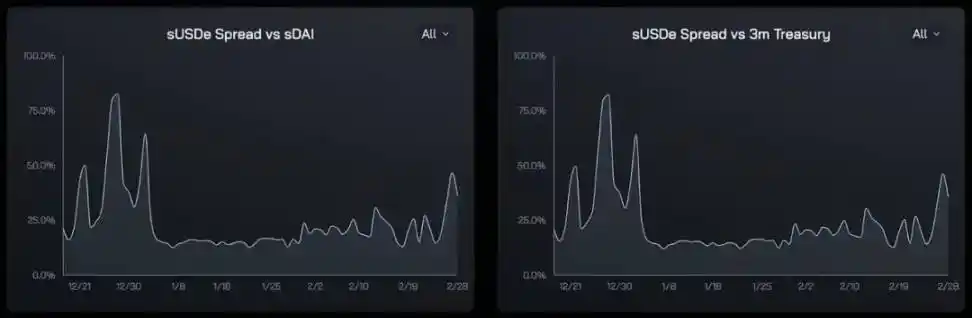
As you can see, The yield on sUSDe (custodial USDe) is much higher than sDAI (custodial DAI) and the 1-month US Treasury note.
Source: Ethena Ethena
Imagine this: 1 USDe = 2 USDT. If an AP can create 1 USDe with 1 USDT worth of ETH or stETH, they can earn a risk-free profit of 1 USD. The process is as follows:
· Transfer USD to the exchange.
· Sell $1 for ETH or stETH.
· Deposit ETH or stETH on the Ethena app and receive 1 USDe.
· Deposit USDe on Curve and sell for 2 USDT.
· Sell 2 USDT for 2 USD on the exchange and then withdraw the USD to your bank account.
If users believe that Ethena is safe and the rate of return is real, then in this hypothetical example, the USDT in circulation will decline, and the USDe in circulation will will rise.
UST Yield
Too many people in the cryptocurrency space think Ethena will Failed like UST. UST is a stablecoin attached to the Terra/Luna ecosystem. Anchor is a decentralized money market protocol within the Terra ecosystem that offers 20% annual yield to those who hold UST. People can deposit UST and Anchor will lend that deposit to borrowers.
Any stablecoin issuer will have to convince users why they should switch from the usual Tether to a new product. High revenue is what prompts users to convert.
UST is powered by Luna and Bitcoin purchased by selling Luna. Luna is the governance token of the ecosystem. The Foundation possesses a large number of Lunas. Since the price of Luna is higher, the Foundation sells Luna in exchange for UST to pay the high interest rate on UST. The interest rate is not paid physically in USD, but instead you earn more UST tokens. Although UST maintains a 1:1 peg to the U.S. dollar, the market believes that if you hold more UST, you are holding more U.S. dollars.
As the total value of Anchor’s locked UST grows, its UST interest expense also grows. The foundation's continued sale of Luna to subsidize Anchor's UST returns has become unsustainable. Gains only come from the market thinking Luna should be worth billions of dollars.
The death spiral for algorithmic stablecoins began when the price of Luna began to fall. Since Luna is minted and burned to maintain UST's 1:1 peg to the U.S. dollar, it becomes increasingly difficult to maintain UST's U.S. dollar peg as Luna's value declines. Once the mechanism anchoring the U.S. dollar is broken, all interest accumulated by UST on Anchor will become worthless.
Ethena Yield
USDe generates income in the same way UST is completely different. Ethena holds two income-producing assets.
Pledge ETH:
ETH is pledged using liquid pledge derivatives such as Lido (stETH) . Deposit ETH into Lido. Lido runs validator nodes capitalized on ETH deposits and remits ETH paid by the Ethereum network to stETH holders.
Perpetual swaps:
A perpetual swap is a series of Continuous short-term futures contracts. The funding rate for most perpetual swaps resets every 8 hours. The funding rate is based on the premium or discount of the perpetual contract relative to the spot. If the option was in 1% premium relative to spot during the previous 8 hours, the funding rate for the next period would be +1%. If the funding rate is positive, longs pay shorts; if funding rates are negative, longs pay shorts.
Ethena holds a perpetual swap airdrop position to lock in the USD value of its ETH holdings. Therefore, if the funds are positive, Ethena will earn interest income. If it is negative, interest will be paid. Obviously, as USDe holders we want to believe that Ethena will earn interest, not pay interest. The question is, why is ETH/USD forward trading at a premium?
ETH is now a deflationary currency. The dollar is an inflationary currency. If ETH decreases and USD increases in the future, then the ETH/USD forward trading price should be higher. This means that any leveraged forward derivatives, such as perpetual swaps, should trade at a premium to spot. Funds should be positive in most cases, meaning Ethena received interest. The data proves it.
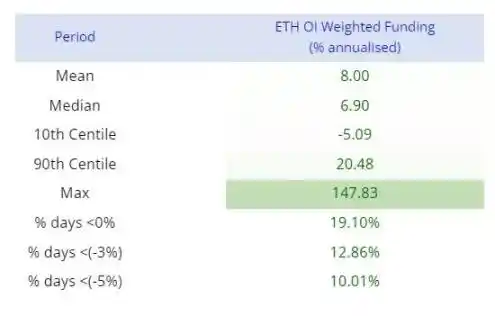
What causes ETH to change from deflation to inflation? If Ethereum's network usage drops dramatically, then significantly less Ethereum gas will be burned per block. In this case, the ETH block reward will be greater than the ETH gas consumption.
What causes the US dollar to change from an inflationary currency to a deflationary currency? American politicians need to stop spending so much money just to get re-elected. The Fed must reduce its balance sheet to zero. This will lead to a serious shrinkage in the circulation of US dollar credit currency.
I think both scenarios are unlikely to occur; therefore, for most periods in the foreseeable future, it is reasonable to expect financing rates to be exactly reasonable.
USDe is not UST.
The combination of ETH staking yield and positive perpetual swap funding produces USDe’s yield. The yield is not based on the value of the Ethena governance token. USDe and UST generate revenue in completely different ways.
Summary!
Ethena is subject to exchange counterparty risk. Ethena is not decentralized, nor does it attempt to be. Ethena holds a short swap position on the Centralized Exchange for Derivatives (CEX). If these CEXs are unable to pay out profits on swap positions or return deposited collateral for various reasons, Ethena will suffer a capital loss. Ethena attempts to reduce the counterparty risk of direct exchanges by storing funds in third-party custodians such as Tether:

Tether's counterparty risk is borne by TradFi Bank. Ethena’s counterparty risk is borne by derivatives CEXs and cryptocurrency custodians.
CEX is an investor in Ethena and has a vested interest in not being hacked and ensuring that derivatives pay out properly. Derivatives CEX are the most profitable cryptocurrency companies and they want to keep it that way. It's not good business to screw your customers over. As Ethena grows, open interest in derivatives will grow, increasing CEX’s fee income. All motivations are aligned. CEX wishes Ethena well.
Tether’s products help the functioning of cryptocurrency capital markets. Cryptocurrencies exist to disintermediate TradFi Bank. TradFi Bank Wants Cryptocurrencies to Fail. Fundamentally, Tether’s banking hastened the demise of TradFi. Incentives are inconsistent. TradFi Bank doesn’t want Tether to do well, and neither do their regulators.
Ethena is For Us, By Us, aka FUBU.
Tether is "for us, by them", also known as "FUBAR".
LSD Smart Contracts and Risk Reduction
Ethena holds ETH LSD. It faces smart contract risks. For example, something could go wrong with Lido, rendering StETH worthless. In addition, there is the risk of bargaining. Halting occurs when an Ethereum node network validator breaks certain rules. As a penalty, the Ethereum capital held by validators will be reduced, that is, slashed.
Negative Funding
As I mentioned earlier, perpetual swaps Funding rates may remain negative for a long period of time. Funding rates could become negative, such that Ethena’s NAV is less than the USDe issued. In this way, the US dollar against the euro will break through the pledge mechanism downwards.
Ethena Smart Contract Risks
Like Tether, Ethena Smart contracts are also run on the public chain. There may be vulnerabilities in the code that cause unexpected behavior and ultimately cause losses to USDe holders. Typically, hackers will try to mint a ton of stablecoins for free and then exchange them for another cryptocurrency on platforms like Uniswap or Curve. This would result in the peg being broken, as the supply of the stablecoin increases without a corresponding increase in the assets backing the stablecoin.
However, Ethena smart contracts are relatively simple, and most of their complexity is concentrated in off-chain engineering. The on-chain mint/redemption contract is only about 600 lines of code, and only approved participants can interact with the most sensitive contracts on the chain, which helps reduce the risk of blocking malicious unknown parties from interacting with it.
Growth limit
The circulating supply of USDe can only As large as the total open interest of ETH futures and perpetual swaps on the exchange. The circulating supply of physically-backed fiat stablecoins is approximately $130 billion. The total ETH open interest value across all exchanges Ethena trades on is approximately $8.5 billion, and the total ETH open interest value across all exchanges is approximately $12 billion. Additionally, once Ethena decides to put BTC as collateral, they also Take advantage of the $31 billion in open interest in BTC contracts. The total value of Ethena’s BTC and ETH open interest is approximately $43 billion, and it is impossible for Ethena to occupy the number one position under current market conditions. While Ethena starts with ETH, BTC and SOL are also easily added to their system, it's just a matter of sequencing.
While the above is true, remember that I said Ethena would be crowned king many years later. As cryptocurrencies grow as an asset class, total open interest will grow exponentially. Some believe that cryptocurrencies, as an asset class, will reach $10 trillion during this cycle. Given that ETH is the second-largest cryptocurrency by fiat market capitalization, it’s not ridiculous that ETH’s open interest could exceed $1 trillion at this level.
Ethena will grow with the growth of cryptocurrencies.
Insurance Fund
The role of the insurance fund is to reduce the risk of Economic losses caused by the above risks. If funding rates turn negative or the synthetic dollar depreciates, the fund will bid for dollars in the open market. The fund consists of stablecoins (USDT and USDC), stETH, and USD/USD LP positions. Currently, the insurance fund is capitalized by funds raised by Ethena Labs and a portion of the proceeds generated by USDe, which are not pledged. In the future, as the USDe circulation increases, the fund will be capitalized with long-term yields. As of this writing, the insurance fund is $16 million.
Neither USDT nor USDe are risk-free. But the risks are different. Tether and Ethena may eventually fail, but for different reasons.
As people begin to believe that USDe’s yield is not deceptive, more and more USDe will be in circulation.
The next step is to own a part of the kingdom. This is where the upcoming Ethena governance token comes into play.
Evaluating Ethena
Like other currency issuers, Ethena lives and dies by her monetary income. This is the difference between the cost of creating money and the actual goods that money can buy. I'd like to come up with a simple model to value Ethena based on these FX earnings. For those who might be buying Ethena’s governance token in the coming months, they should at least try to build a model to value the protocol.
Any issued USDe can be staked and earn ETH staked plus perpetual funding returns. Currently, Ethena distributes the income generated by assets backing sUSDe, while the income generated by assets backing uncollateralized USDe is fed into the insurance fund. I estimate that the long-term distribution ratio will be: 80% of the revenue generated by the protocol goes to the staked USDe (sUSDe), and 20% of the revenue generated goes to the Ethena protocol.
Ethena protocol annual income = total income * (1-80% * (1 - sUSDe supply/USDe supply))
If 100% of USDe is pledged, that is, sUSDe supply = USDe supply:
Ethena protocol annual income = total income * 20
Total income = USDe supply * (ETH pledge income + ETH perpetual swap funds)
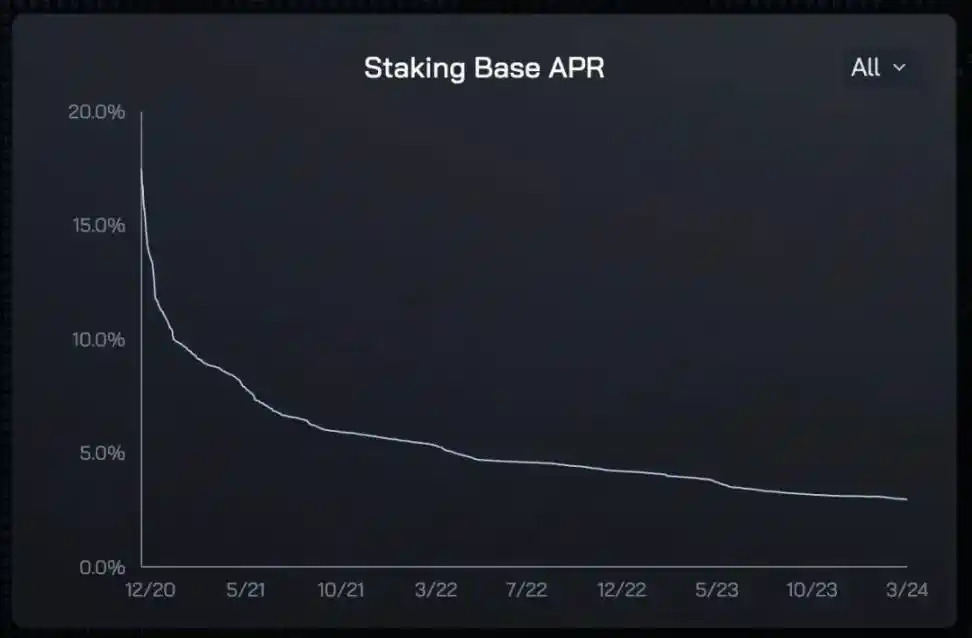
ETH staking yield and ETH perpetual swap funds are variable interest rates. Recent history can help us understand future possibilities.
ETH staking yield - I assume the PA yield is 4%.
ETH Perpetual Swap Funding - I assume PA is 20%.
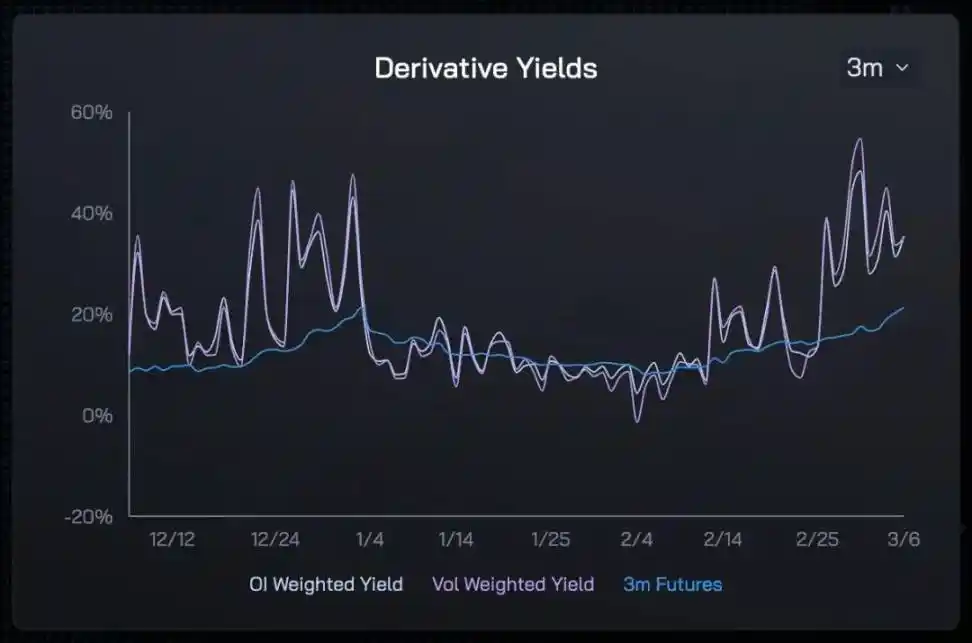
Staking percentage - currently, Only 28% of USDe is staked. I expect that to increase over time. I assume 50% of USDe will be staked going forward.
The key part of the model is that the fully diluted valuation (FDV) to revenue ratio should be used. This is always a guessing game, but I will suggest some future paths based on comparable DeFi stablecoin projects.
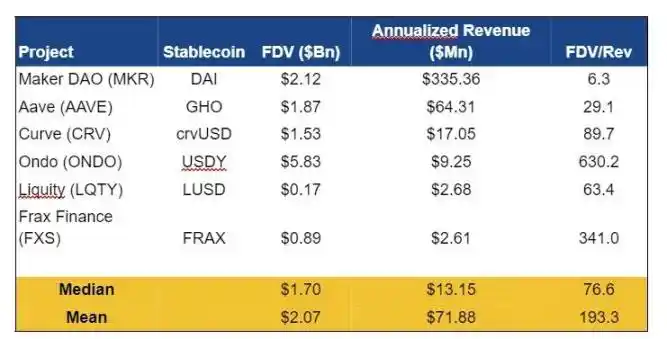
Use these multiples as a guide , I created the following potential Ethena FDV.
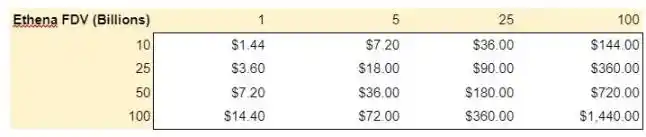
The horizontal axis is based on ten USDe supply in billions. The vertical axis is FDV/Rev magnification.
Ondo is the newest and most popular stablecoin. It has FDV of about $6 billion, revenue of just $9 million, and trades at a multiple of 630x. Woowzers! Can Ethena's valuation reach similar heights?
Ethena’s $820 million in assets generated a 67% return this week. At a 50% USD/EUR supply rate, Ethena’s annualized revenue in one year would be approximately $300 million. Using a valuation similar to Ondo's, the FDV is $189 billion. Does this mean Ethena’s FDV at launch will be closer to $200 billion? No, but it does mean that the market will pay a huge amount of money for Ethena's future revenue.
Yachtzee!
If you remember nothing else from this article, remember this:
Ethena is For Us, By Us, aka FUBU.
Tether is For Us, By Them, also known as FUBAR.
It’s up to you whether to go long or short USDe or the eventual Ethena governance token. I hope this article illustrates Ethena’s mission and why it is critical to the success of cryptocurrencies.
With that, I said goodbye to everyone because I had to concentrate on not ruining my thighs while shredding all this crusty snow.
Original link
Recommended
The Wall Street Journal: How is AI Trading Stealing the Limelight from Cryptocurrency?
Aug 15, 14:00
Tencent Still Has a Dream
Aug 15, 11:27
To Catch North Korean Hackers, They Set Up a Fake Project
Aug 15, 10:00
From Litigation to Settlement: Positive Signal Released by HTX's Negotiation with FCA
Aug 14, 19:32
11,742 Shipping Addresses Exposed Alongside Trezor Orders
Aug 14, 19:01
Founder Interview: FOMO Creator Explains How They Added 30,000 Users in One Day and Became One of the Fastest-Growing Crypto Apps
Aug 14, 18:37