How to speculate on Ethereum after Cancun? An article summarizing community views

Due to the crazy rise of Bitcoin, this bull market is also nicknamed the "Bitcoin Bull Market." Since the adoption of the Bitcoin ETF, a large amount of money has poured into the Bitcoin ecosystem. This is an unprecedented bull market phenomenon. Bitcoin continues to rise in response to memes, and other crypto tracks such as AI and gamefi have taken turns to pull the market, but L2 seems to still be sleeping.
On March 13, according to Etherscan data, the block height of the Ethereum mainnet has reached the Dencun upgrade scheduled epoch (269568).
The main goals of the "Dencun" upgrade are to improve the scalability and modularity of the L2 network, enhance the security features of the Ethereum network, and improve overall usability. The proposal that has attracted the most attention is EIP-4844 (Proto-Danksharding), which is a pre-plan for the full version of sharding expansion Danksharding. The entire set of sharding solutions revolves around Rollup for on-chain expansion, aiming to expand L2 Rollup, help L2 reduce fees, and Increase throughput and pave the way for full sharding.
Simply put, the biggest positive factor of Dencun is the reduction of L2 transaction fees.
Ethereum core developer eric.eth once said that the implementation of EIP-4844 will cause the gas cost of Ethereum-based L2 transactions to drop to about $0.01. . According to the website launched by Optimism, the transaction cost of executing a swap on Uniswap will be from the real-time $0.59 reduced to $0.01.
According to on-chain analyst @0xCryptoChan, as the price of Bitcoin continues to rise, BTC holders who have held the currency on the chain for more than 155 days have The total number of coins as a percentage of the total circulation of BTC is declining, which means that liquidity is shifting away from Bitcoin.
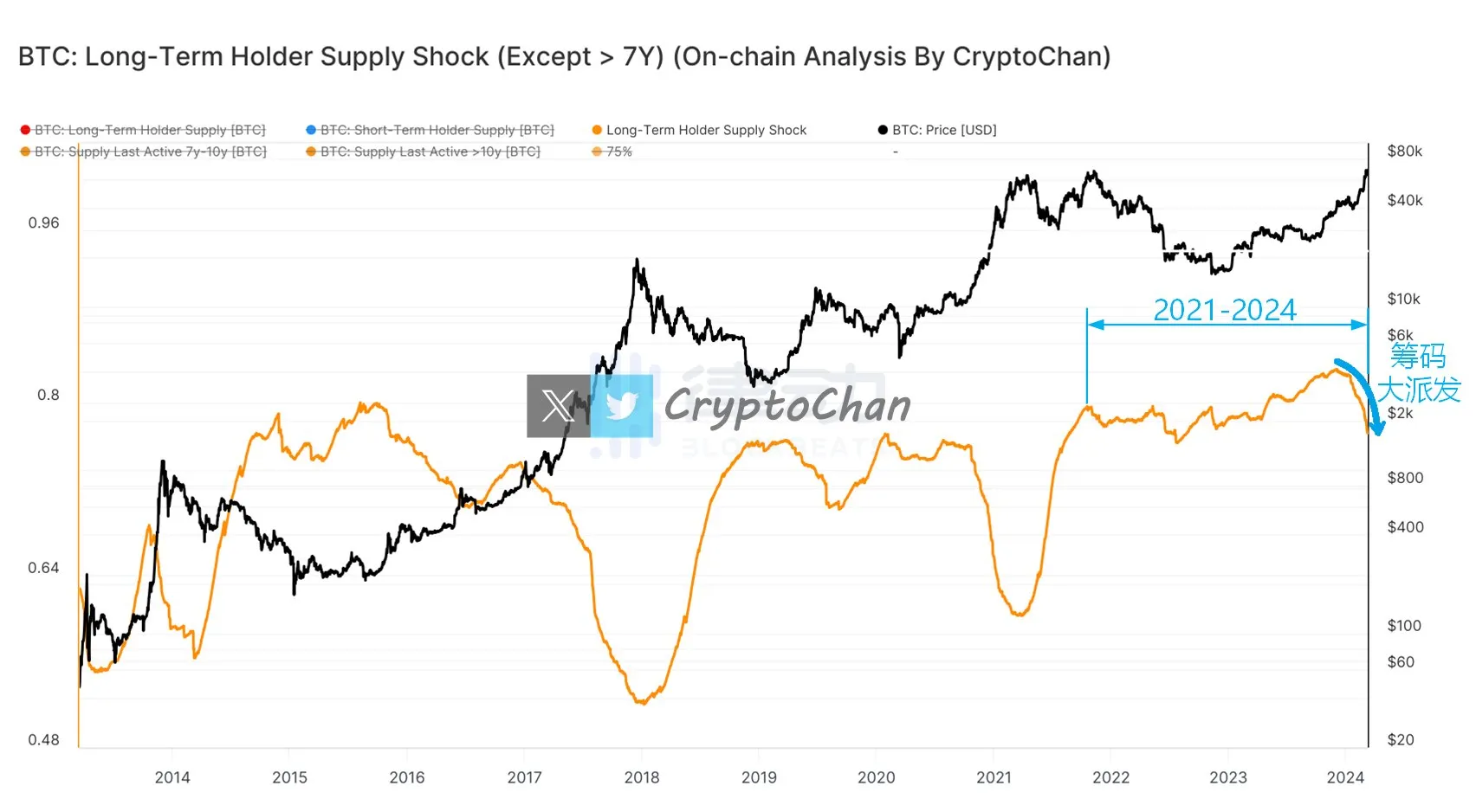
In Decun Upgrade and Ethernet Under the dual expectations of ETF, Ethereum rose from US$2,300 to US$4,000. Now that Dencun has been activated on the mainnet, gas has been reduced, which is expected to encourage users to participate in more applications and increase their on-chain activities.
For this reason, some people in the community believe that EIP-4844 will reduce the overall income of Ethereum.
While it is true that the fees L2 pays for DA on Ethereum will decrease, this reduction is unlikely to have a significant impact on Ethereum's total fee generation. L2’s DA fees only account for approximately 7-10% of Ethereum’s total fee revenue. For example, in February 2024, of the $355 million in total fees, only $33 million was attributed to L2 publishing data on Ethereum, with the majority of fees generated by on-chain activity on the Ethereum mainnet.
In addition, with the airdrop craze in full swing, lower gas fees on L2 may further incentivize airdrop farmers to increase their on-chain interactions to increase their Opportunities to get assigned. This increase in activity, in turn, has the potential to increase the overall value generated within the network, benefiting Ethereum and its ecosystem.
On the other hand, according to @cheng_shutong, it can be seen from the contract funding rate that the rate of most altcoins has reached an annualized rate of 100% or even more High, indicating that most retail investors, stimulated by Bitcoin and Ethereum's successive breakthroughs to new highs, are competing for the collective growth of copycats.

One view is that after the Cancun upgrade, more Dapps will independently make a Rollup, which will be conducive to the prosperity of the RaaS market. Previously, Charles d'Haussy, CEO of the dYdX Foundation, also told BlockBeats that if ecological technology wants to develop further, it needs to build its own chain.
Related reading: "Exclusive interview with dYdX Foundation: Only by building your own chain can you truly move forward》
Dencun’s hype selling point is essentially EIP -4844 and Blob carry transactions introduce three key enhancements. In addition to lowering transaction fees, this includes enhancing Ethereum’s scalability and enabling the community to test the Ethereum network’s ability to handle increased data loads in production and prepare for a full sharding upgrade.
EIP-4844 and Blob carrying transactions utilize block space more efficiently than existing methods. Additionally, since blobs are a different type of transaction entirely, they have their own fee market and are not affected by the increase in regular transaction activity on the Ethereum mainnet.
Bankless analysts wrote in an article Article points out that in the long term, as L2 becomes more affordable, it will open up design space for unique applications to be built on it. For example, many applications with high throughput requirements such as AI and dePIN projects can choose to be built on L2, or even L3.
According to L2BEAT data, as of the time of writing, after the Cancun upgrade, the DA layer in the head L2 has been switched to the Ethereum mainnet Blob, with ZK Rollup ZkSync and Starknet of the system, Optimism and Base of the Optimistic Rollup system. According to actual measurements, after the switch, the gas fees of the four L2 companies dropped by 1 order of magnitude.
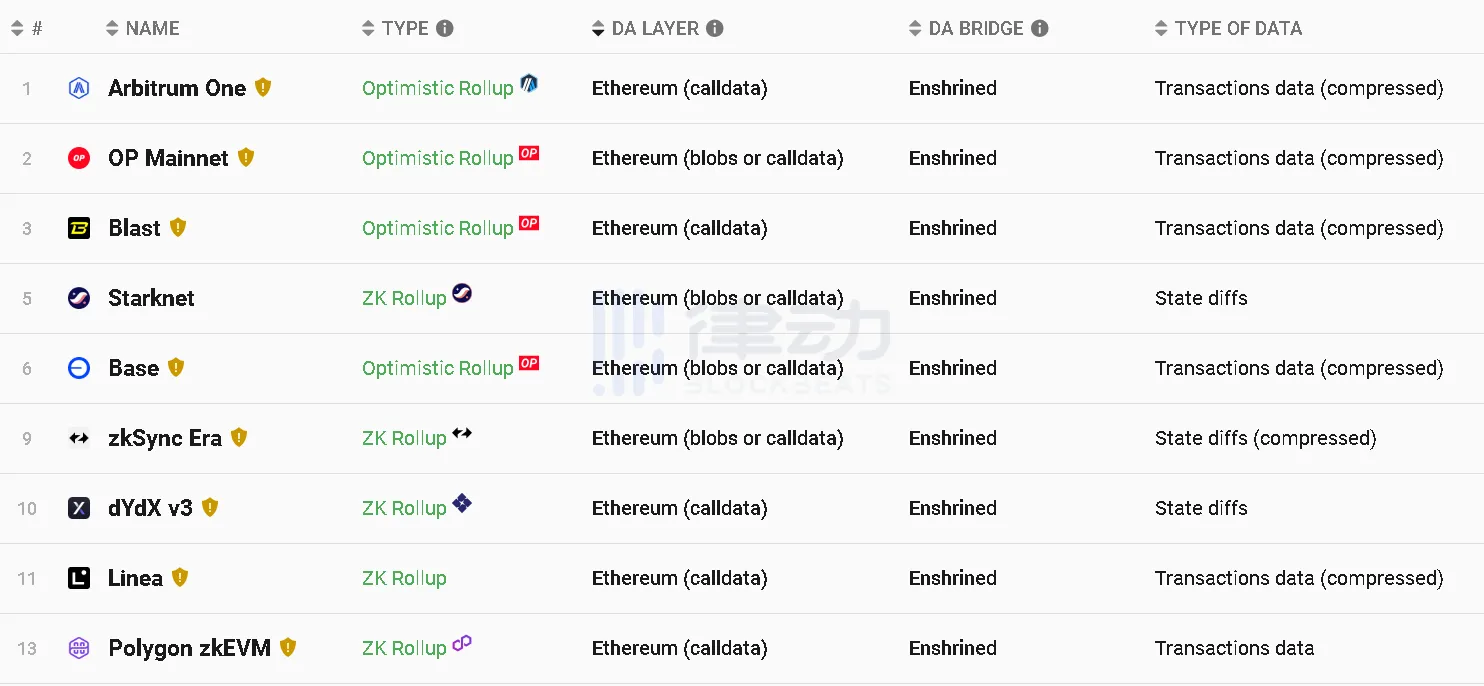
But @0xNing0xmeans that the effect of existing gas fee reduction is in the large DA consumers Arbitrum, Blast and so on are implemented without switching the DA layer, and the current DA cost is still two orders of magnitude more expensive than Celesita DA.
In addition, Arbitrum said ArbOS Atlas also introduces additional Arbitrum fee reductions for Arbitrum One, which will be activated on March 18. Upon activation, the L1 remaining charge per compressed byte will be reduced from 32 gwei to 0, and the L2 base charge minimum will be reduced from 0.1 gwei to 0.01 gwei.
Therefore, the specific effectiveness of the Dencun upgrade will not be judged until all head L2s have successively switched to the DA layer, and the Rollup parameters have been adjusted and the market competition strategy game has been balanced.
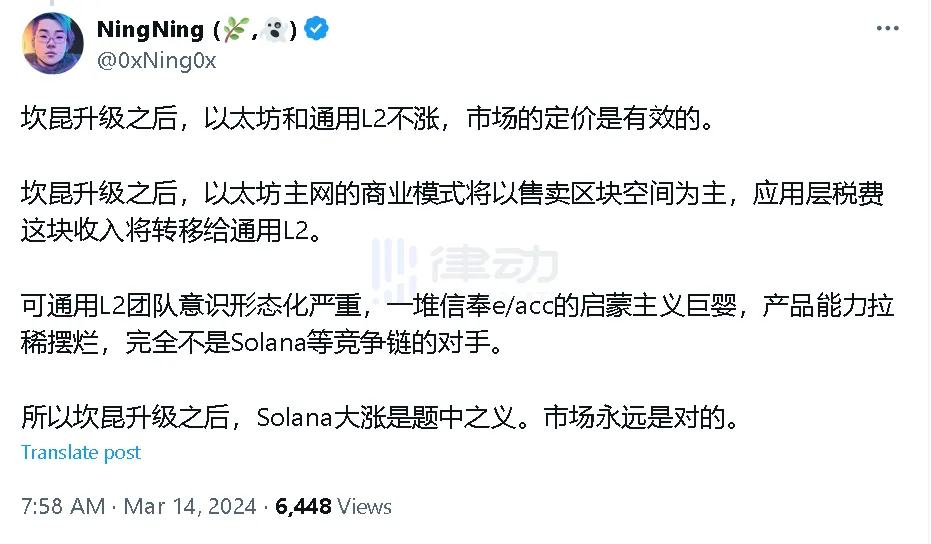
And judging from the current market performance, Ethereum and general L2 have not increased much. @0xNing0x believes that after the Cancun upgrade, the business model of the Ethereum mainnet will be based on selling block space, and the revenue from application layer taxes will be transferred to the general L2. The general L2 team is highly ideological and is no match for competitive chains such as Solana.
The price of SOL is here The cycle has been rising steadily, and even the token prices of the entire Solana ecological project have also experienced a general increase. Other ecological projects have also followed Solana’s pace and been steadily launched. DeFi, Depin, AI and other sectors have blossomed, allowing Solana's TVL has been rising all the way, with TVL reaching $3.6 billion at the time of writing.
Recommended
The Wall Street Journal: How is AI Trading Stealing the Limelight from Cryptocurrency?
Aug 15, 14:00
Tencent Still Has a Dream
Aug 15, 11:27
To Catch North Korean Hackers, They Set Up a Fake Project
Aug 15, 10:00
From Litigation to Settlement: Positive Signal Released by HTX's Negotiation with FCA
Aug 14, 19:32
11,742 Shipping Addresses Exposed Alongside Trezor Orders
Aug 14, 19:01
Founder Interview: FOMO Creator Explains How They Added 30,000 Users in One Day and Became One of the Fastest-Growing Crypto Apps
Aug 14, 18:37