The AI mirage in the crypto world

Original title: Crypto's AI Mirage
Original source: Coinbase institutional
· Between Artificial Intelligence (AI) and Cryptocurrency The intersection of is very broad, but people often know little about it. We believe that different sub-sections of this intersection have distinct opportunities and development timelines.
· We generally believe that for artificial intelligence products, decentralization alone is not enough to bring competitive advantage – it must also be achieved in some other key ways. The field achieves the same functions as centralized products.
· Our contrarian view is that due to the widespread attention the AI industry has received, the value potential of many AI tokens may be exaggerated, and many AI tokens There may be a lack of sustainable demand-side drivers in the short to medium term.
In recent years, the continuous breakthroughs in artificial intelligence, especially in the field of generative artificial intelligence, have attracted great attention to the artificial intelligence industry and provided opportunities for both Crypto projects at the intersection offer opportunities. We previously covered some of the possibilities for the sector in an early report in June 2023, noting that overall capital allocation in cryptocurrencies appeared to be underinvesting in artificial intelligence. The field of cryptographic AI has grown tremendously since then, and we feel it’s important to point out some of the practical challenges that may hinder its widespread adoption.
Rapid changes in artificial intelligence make us cautious about bold claims that cryptocurrency-centric platforms are uniquely positioned to disrupt the industry; this This makes us believe that the path to long-term and sustainable value appreciation for most AI tokens is full of uncertainty, especially for projects with fixed token economic models. Conversely, we believe that some emerging trends in artificial intelligence may actually make cryptocurrency-based innovations more difficult to adopt, given broader market competition and regulation.
That said, we believe that the point between artificial intelligence and cryptocurrency is broad and has different opportunities for certain sub-sections. Adoption is likely to be faster, although many of these areas lack tokens that are already on the market. Still, that doesn't seem to be dampening investor interest. We find that the performance of AI-related crypto tokens is supported by AI market headlines and can have positive price action even on days when Bitcoin is trading lower. Therefore, we believe that many AI-related tokens can continue to trade as representations of AI progress.
Main Trends in Artificial Intelligence
One of the most important trends in the field of artificial intelligence (related to crypto-AI products) is the ongoing culture around open source models. More than 530,000 models are exposed on Hugging Face for researchers and users to manipulate and fine-tune. Hugging Face’s role in AI collaboration is no different than relying on GitHub for code hosting or Discord for community management (both widely used in the crypto space). Barring serious mismanagement, this situation is not likely to change in the near future.
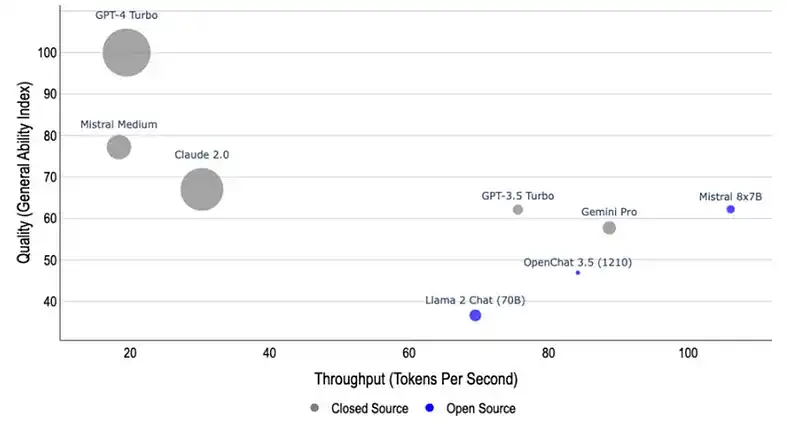
Models available on Hugging Face range from Large Language Models (LLMs) to generative image and video models, including major industry players such as Open AI, Meta and Google and the creations of independent developers. Some open source language models even have performance advantages over state-of-the-art closed-source models in terms of throughput (while maintaining comparable output quality), ensuring a degree of competition between open source and commercial models (see Figure 1). Importantly, we believe this vibrant open source ecosystem combined with a highly competitive commercial sector has enabled an industry where bad models are driven out of competition.
The second trend is The continued improvement in quality and cost-effectiveness of smaller models (highlighted in an LLM study back in 2020 and in a recent paper from Microsoft) also aligns with an open source culture to further enable high-performance, locally-running Artificial intelligence model. Some fine-tuned open source models can even outperform leading closed source models on certain benchmarks. In such a world, some AI models could be run locally, maximizing decentralization. Of course, incumbent technology companies will continue to train and run larger models on the cloud, but the design space between the two will require trade-offs.
In addition, given the increasing complexity of the task of benchmarking AI models (including data contamination and different test scopes), generating model output may ultimately be controlled by the free market best evaluation by end users. In effect, end users can use existing tools to compare model output side-by-side with benchmark companies that perform the same operations. A rough idea of the difficulty of generative AI benchmarks can be gained from the growing variety of open LLM benchmarks, including MMLU, HellaSwag, TriviaQA, BoolQ, etc., each testing different use cases such as common sense reasoning, academic topics, and a variety of question formats.
The third trend we observe in the field of artificial intelligence is that existing platforms with strong user stickiness or solving specific business problems are able to benefit from the integration of artificial intelligence. Gain disproportionate benefits. For example, GitHub Copilot's integration with code editors enhances an already powerful developer environment. Embedding AI interfaces into other tools, from email clients to spreadsheets to customer relationship management software, are also natural use cases for AI (for example, Klarna’s AI assistant does the work of 700 full-time customer service staff) .
But it is worth noting that in many of these scenarios, AI models will not lead to new platforms, but only enhance existing ones. Other AI models that improve traditional business processes internally (e.g., Meta's Lattice system, which helped restore Apple's ad performance to old levels after it launched App Tracking Transparency) also often rely on proprietary data and closed systems. These types of AI models will likely remain closed source because they are vertically integrated into the core product and use proprietary data.
In the field of artificial intelligence hardware and computing, we see two other related trends. The first is the shift in computing usage from training to inference. That is, when artificial intelligence models are first developed, vast amounts of computing resources are used to "train" the model by feeding it large data sets. Now we have moved on to deploying and querying the model.
NVIDIA’s February 2024 earnings call showed that about 40% of their business is used for inference, Satya Nadella’s Microsoft earnings call the month before January Similar remarks were made at the conference, noting that "most" of their Azure AI usage is for inference. As this trend continues, we believe entities seeking to monetize models will prioritize platforms that can reliably run models in a secure and production-ready manner.
The second major trend is the competitive landscape surrounding hardware architecture. Nvidia's H200 processors will be available starting in the second quarter of 2024, with the next-generation B100 expected to further double performance. In addition, Google's continued support for its own Tensor Processing Unit (TPU) and Groq's newer Language Processing Unit (LPU) may also increase its market share as alternatives in this space in the coming years (see Figure 2). Such developments could change cost dynamics in the AI industry and could benefit cloud service providers who can quickly pivot, procure hardware in bulk and set up any associated physical network requirements and developer tools.
In general, the field of artificial intelligence is an emerging and rapidly developing field . Less than 1.5 years after ChatGPT was first released to the market in November 2022 (although its underlying GPT 3 model has been around since June 2020), the rapid growth in the space since then has been astounding. Despite some questionable behavior regarding the biases behind some generative AI models, we could see poorer performing models being phased out by the market in favor of better alternatives. The rapid growth of the industry and the potential for upcoming regulations mean that the industry's problems are changing regularly as new solutions become available.
For such a rapidly innovating field, the oft-touted “decentralized solution [XXX]” as a foregone conclusion is premature. It also preemptively solves a centralization problem that may not necessarily exist. The reality is that the AI industry has achieved a large degree of decentralization across technology and business verticals through competition between many different companies and open source projects. Furthermore, due to the nature of their decision-making and consensus processes, true decentralized protocols advance at a slower pace than centralized protocols on both a technical and social level. This could create obstacles in the quest to balance decentralization and competitive products at this stage of AI development. That said, there are some synergies between cryptocurrencies and artificial intelligence that can be meaningfully realized over the longer time horizon.
Determining the opportunity scope
Broadly speaking, we consider the Intersection points fall into two broad categories. The first category is use cases where AI products improve the crypto industry. This includes scenarios ranging from creating human-readable transactions and improving blockchain data analysis, to leveraging on-chain model output as part of a permissionless protocol. The second category is use cases where cryptocurrencies aim to disrupt traditional AI pipelines through decentralized computing, verification, identity, etc.
The use cases for the former category of business-related scenarios are clear, and we believe that, although significant technical challenges remain, in more complex on-chain inference model scenarios There are also long-term prospects. Centralized AI models can improve cryptocurrencies like any other technology-focused industry, from improving developer tools and code auditing to translating human language into on-chain actions. But investment in this area usually flows into private companies through venture capital, so it is often ignored by public markets.
However, the implications and benefits of how crypto could disrupt existing AI pipelines are less certain to us. Difficulties in the latter category are not just technical challenges (which we believe are generally solvable in the long term), but also uphill battles with broader market and regulatory forces. Much of the recent attention on artificial intelligence and cryptocurrencies has been focused on this category, as these use cases are better suited to owning liquid tokens. This is the focus of our next section, as there are currently relatively few liquidity tokens relevant to centralized AI tools in cryptocurrencies.
The role of cryptocurrencies in artificial intelligence pipelines
At the risk of oversimplification Risks, we believe the potential impact of cryptocurrency on artificial intelligence in the four main stages of the artificial intelligence pipeline:
1. Data collection, storage and processing,
2. Model training and inference,
3. Verification of model output,
4. Tracking the output of the artificial intelligence model.
A large number of new crypto-AI projects have emerged in these areas, although many will face demand-side generation and disruption from centralized companies and open source solutions in the short to medium term. Fierce competition for programs poses two serious challenges.
Proprietary Data
The data is for all artificial intelligence models foundation, and may be a key differentiator in the performance of professional AI models. Historical blockchain data itself is a new rich source of data for models, and some projects like Grass also aim to leverage crypto incentives to curate new data sets from the open internet. In this regard, encryption has the opportunity to provide industry-specific data sets and incentivize the creation of new valuable data sets. (We believe Reddit's recent $60 million per year data licensing deal with Google bodes well for the future of dataset monetization.)
Many early models (e.g. GPT 3) uses a mix of open datasets such as CommonCrawl, WebText2, Books, and Wikipedia, as well as similar datasets freely available on Hugging Face (currently hosting over 110,000 options). However, possibly to protect commercial interests, many recent closed-source models have not yet released their final training dataset composition. The trend toward proprietary data sets, especially in business models, will continue and increase the importance of data licensing.
Existing centralized data marketplaces are already helping to bridge the gap between data providers and consumers, enabling new decentralized data marketplace solutions The opportunity space is sandwiched between open source data catalogs and enterprise competitors. Without the support of a legal structure, a purely decentralized data market would also need to build standardized data interfaces and pipelines, verify data integrity and configuration, and solve the cold start problem of its products - while balancing the differences between market participants. Token incentives.
In addition, decentralized storage solutions may eventually find a place in the artificial intelligence industry, although there are still many challenges in this regard. On the one hand, pipelines for distributing open source datasets already exist and are widely used. On the other hand, many owners of proprietary data sets have strict security and compliance requirements. The reality is that there currently is no regulatory path for hosting sensitive data on decentralized storage platforms such as Filecoin and Arweave. Many enterprises are still transitioning from on-premises servers to centralized cloud storage providers. On a technical level, the decentralized nature of these networks also currently does not comply with certain geolocation and physical data silo requirements for sensitive data storage.
While price comparisons between decentralized storage solutions and established cloud providers suggest that decentralized storage units are cheaper per unit, this ignores a significant premise . First, the upfront costs associated with migrating systems between providers need to be considered on top of day-to-day operating expenses. Second, encryption-based decentralized storage platforms need to match better tooling and integration with mature cloud systems developed over the past two decades. Cloud solutions also have more predictable costs from a business operations perspective, offer contractual obligations and dedicated support teams, and also have a large pool of existing developer talent.
It’s also worth noting that a cursory comparison with the “big three” cloud providers (Amazon Web Services, Google Cloud Platform, and Microsoft Azure) is incomplete . There are also dozens of lower-cost cloud companies vying for market share by offering cheaper basic server racks. We believe these are the real near-term major competitors for cost-conscious consumers.
That said, recent innovations such as Filecoin’s data computing and Arweave’s ao computing environment may set the stage for upcoming exploits of less sensitive data sets. Greenfield projects or the most cost-sensitive (possibly smaller) companies that are not yet suppliers come into play.
So while there is certainly room for new crypto products in the data space, the most recent technological disruption will occur where they can generate unique value propositions. Areas where decentralized products compete head-to-head with traditional and open source competitors will take more time to make progress.
Training and Inferencing Models
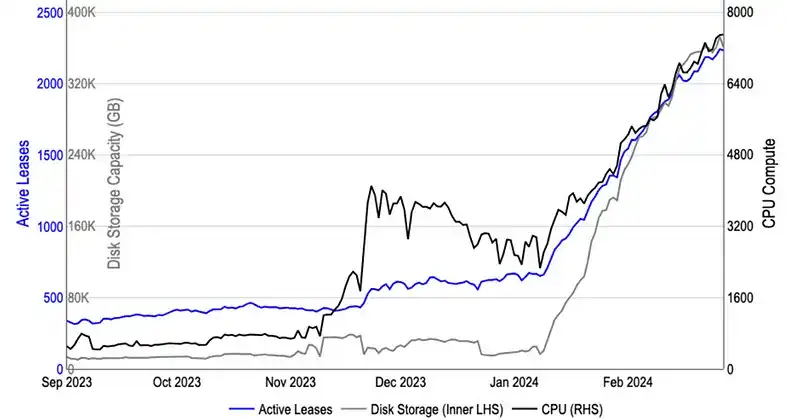
Decentralization of the Crypto Industry The field of decentralized computing (DeComp) also aims to be an alternative to centralized cloud computing, in part due to the tight supply of existing GPUs. One proposed solution to this shortage is to repurpose idle computing resources in collective networks and reduce costs at centralized cloud providers, with protocols such as Akash and Render applying similar solutions. Based on preliminary indicators, use of such projects appears to be increasing, both by users and providers. For example, Akash has tripled its active leases (i.e. number of users) so far this year (see Figure 3), primarily due to increased usage of its storage and compute resources.
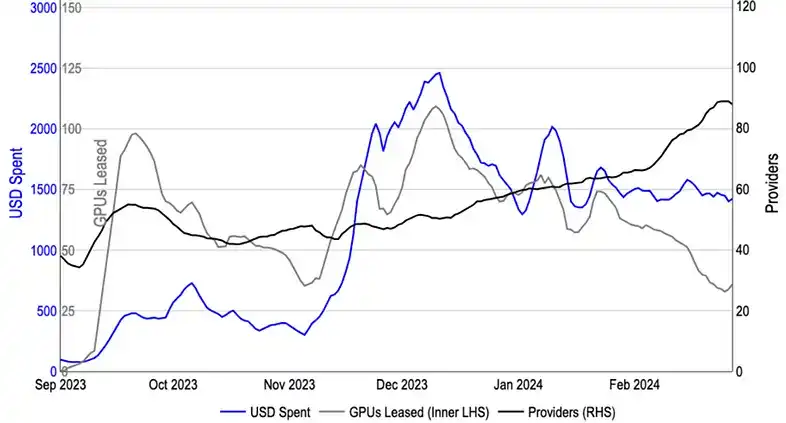
However, since the peak in December 2023, payments to the network have Costs actually decreased because the supply of available GPUs outpaced the growth in demand for these resources. That said, as more providers join the network, the number of GPUs rented (which appears to be the largest revenue driver proportionally) has declined (see Figure 4). For networks where computational pricing can change based on changes in supply and demand, it’s unclear where sustained, usage-driven demand for native tokens will eventually emerge if supply-side growth exceeds demand-side growth. While the long-term impact of such changes is unclear, such token economic models may need to be revisited in the future to optimize for market changes.
On a technical level, decentralized computing solutions also face the challenge of network bandwidth limitations . For large models that require multi-node training, the physical network infrastructure layer plays a crucial role. Data transfer speeds, synchronization overhead, and support for certain distributed training algorithms mean that specific network configurations and custom network communications (such as InfiniBand) are required to facilitate high-performance execution. When exceeding a certain cluster size, it is difficult to implement in a decentralized manner
In general, the long-term success of decentralized computing (and storage) faces challenges Fierce competition from centralized cloud providers. Any adoption will at least be a long-term process similar to the cloud adoption timeline. Given the increasing technical complexity of decentralized web development, combined with the lack of similarly scalable development and sales teams, fully executing on the decentralized computing vision will be a difficult journey.
Validating and Trusting Models
With artificial intelligence models As they become more and more important in life, people are increasingly worried about their output quality and bias. Some crypto projects aim to find a decentralized, market-based solution to this problem by leveraging a set of algorithms to evaluate different categories of outputs. However, the above-mentioned challenges surrounding model benchmarking, as well as the obvious cost, throughput, and quality trade-offs, make head-to-head comparisons challenging. BitTensor, one of the largest AI-focused cryptocurrencies of its kind, aims to solve this problem, although there are a number of outstanding technical challenges that may hinder its widespread adoption (see Appendix 1).
Also, trustless model inference (i.e. proving that model outputs were actually generated by the claimed model) is another active area in the overlapping area of crypto-AI field of study. However, as open source models shrink in size, such solutions may face requirements challenges. In a world where models can be downloaded and run locally and content integrity verified via sophisticated file hashing/checksum methods, the role of trustless inference is less clear. Granted, many LLMs are not yet accessible for training and operation from lightweight devices such as mobile phones, but powerful desktop computers (such as those used for high-end gaming) can already be used to run many high-performance models.
Data Provenance and Identity
With generative artificial intelligence The output of intelligence is becoming increasingly difficult to distinguish from human output, and the importance of identifying and tracking AI-generated content has gradually become the focus of attention. GPT 4 passes the Turing test 3 times faster than GPT 3.5, and it is almost inevitable that we will one day be unable to tell the difference between robots and humans. In such a world, determining the identity of online users and watermarking AI-generated content will be key capabilities.
Decentralized identifiers and identity proofing mechanisms like Worldcoin aim to solve the previous problem of identifying humans on-chain. Likewise, publishing hashes of data to the blockchain can help determine the origin of the data by verifying the time stamp and provenance of the content. However, similar to the previous section, we believe that the feasibility of encryption-based solutions must be weighed against centralized alternatives.
Some countries, such as China, link online personalities to government-controlled databases. Although the rest of the world is not as centralized, a consortium of know-your-customer (KYC) providers could also offer identity proofing solutions that are independent of blockchain technology (possibly in conjunction with the trusted systems that form the cornerstone of today’s internet security). The certificate authority is similar). Research is also underway on AI watermarking to embed hidden signals in text and image output so that algorithms can detect whether the content is AI-generated. Many leading AI companies, including Microsoft, Anthropic, and Amazon, have publicly committed to adding such watermarks to the content they generate.
Additionally, many existing content providers are already mandated to strictly record the metadata of their content to meet compliance requirements. As a result, users often trust the metadata associated with social media posts (but not their screenshots), even though they are stored centrally. The caveat here is that any encryption-based data provenance and identity solution needs to be integrated with user platforms to be broadly effective. Therefore, while encryption-based solutions for proving identity and data provenance are technically feasible, we also believe that their adoption is not a given and will ultimately depend on business, compliance and regulatory requirements.
Trading the AI Narrative
Despite the above difficulties, But starting in the fourth quarter of 2023, many AI tokens have outperformed Bitcoin and Ethereum, as well as major AI stocks like Nvidia and Microsoft. This is because AI tokens typically benefit from strong relative performance in the broader crypto market and related AI news headlines (see Appendix 2). Therefore, even if the price of Bitcoin falls, the prices of AI-focused tokens may fluctuate upward, which can lead to upward volatility during Bitcoin declines. Figure 5 visually shows the dispersion of AI tokens during Bitcoin trading declines.
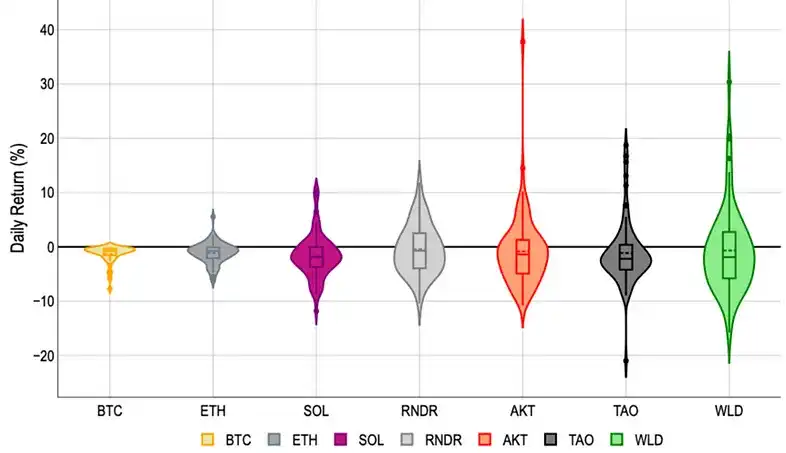
Overall, there is still a lot of short-term sustained demand missing from the AI narrative trade driving factors. The lack of clear adoption forecasts and metrics has led to widespread meme-based speculation, which may not be sustainable in the long term. Eventually, price and utility will converge – the open question is how long that will take, and whether utility will rise to meet price or vice versa. That said, the continued building of the cryptocurrency market and the outperforming AI industry will likely sustain a strong cryptocurrency AI narrative for some time.
Conclusion
The role of cryptocurrencies in artificial intelligence does not exist in a vacuum - any decentralization Platforms are all competing against existing centralized alternatives and must be analyzed within the context of broader business and regulatory requirements. Therefore, replacing centralized providers purely for the sake of “decentralization” is not enough to drive meaningful progress. Generative AI models have been around for a few years and have retained a degree of decentralization due to market competition and open source software.
A recurring theme in this report is the recognition that encryption-based solutions, while often technically feasible, still require significant work to achieve The same capabilities as a more centralized platform, without the platform standing still in the future. In fact, centralized development is often faster than decentralized development due to consensus mechanisms, which may pose challenges in a rapidly developing field like artificial intelligence.
With this in mind, the overlap between AI and cryptocurrencies is still in its infancy and is likely to continue in the coming years as the broader AI field develops. Change happens quickly. As many in the crypto industry currently envision, a decentralized AI future is not guaranteed—in fact, the future of the AI industry itself remains largely uncertain. Therefore, we believe it is prudent to navigate such a market with caution and delve deeper into cryptocurrency-based solutions and how they can truly offer better alternatives, or understand the underlying trading narrative.
Original link
Recommended
The Wall Street Journal: How is AI Trading Stealing the Limelight from Cryptocurrency?
Aug 15, 14:00
Tencent Still Has a Dream
Aug 15, 11:27
To Catch North Korean Hackers, They Set Up a Fake Project
Aug 15, 10:00
From Litigation to Settlement: Positive Signal Released by HTX's Negotiation with FCA
Aug 14, 19:32
11,742 Shipping Addresses Exposed Alongside Trezor Orders
Aug 14, 19:01
Founder Interview: FOMO Creator Explains How They Added 30,000 Users in One Day and Became One of the Fastest-Growing Crypto Apps
Aug 14, 18:37