Crypto under "Financial Nihilism": The ideological trend of a generation of young Americans

Original author: Travis Kling, founder of Ikigai
Original compilation: Frank, Foresight News
First of all, a brief introduction to "Financial Nihility" "Financial Nihilism" is a concept: the cost of living is breathtaking for most Americans; upward social mobility is out of reach for an increasing number of people; the American Dream is largely a thing of the past; and The ratio of the median home price to the median household income is at a completely unsustainable level.
Because the concept of "financial nihilism" has generated a lot of discussion and resonates with people, we will explore this concept in more detail. Let me start by saying that this is not an original term, host kofinas first coined the concept at least two and a half years ago.
"Financial nihilism" goes hand in hand with populism, a political approach designed to appeal to ordinary people who feel ignored by established elites. Populism is a topic I’ve discussed many times in the past, perhaps most pointedly in my February 2021 monthly report on Gamestop. Discussing that the drivers behind financial nihilism and populism are the same, I don't think the system is right for me, so I want to try something very different (like buying SHIB or voting for Trump).
Let us analyze the driving factors of "financial nihilism". As mentioned before, in my opinion, the median house price and the median household income A chart that best symbolizes this emotion is the ratio of numbers, which is shown below with some notes added for reference:
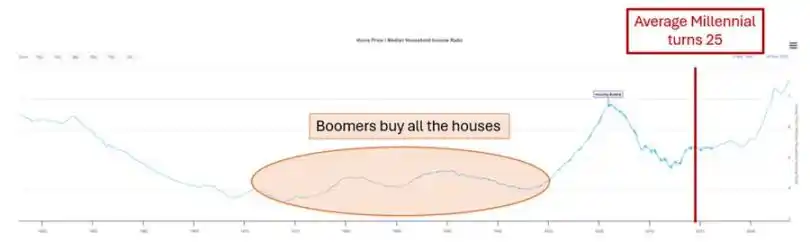
Baby boomers (and Gen Eventually the bubble burst. Shortly thereafter, Millennials entered the workforce and began buying homes at 5.5 times their annual income. Then Covid happened and the Fed printed $6 trillion, resulting in home prices now at 7.5 times annual income, much higher than even the peak of the housing bubble. For millions of Americans under the age of 40, buying a home is a distant dream.
We can delve further into the real estate situation. The following chart shows the share of the total real estate value of each generation in the United States:
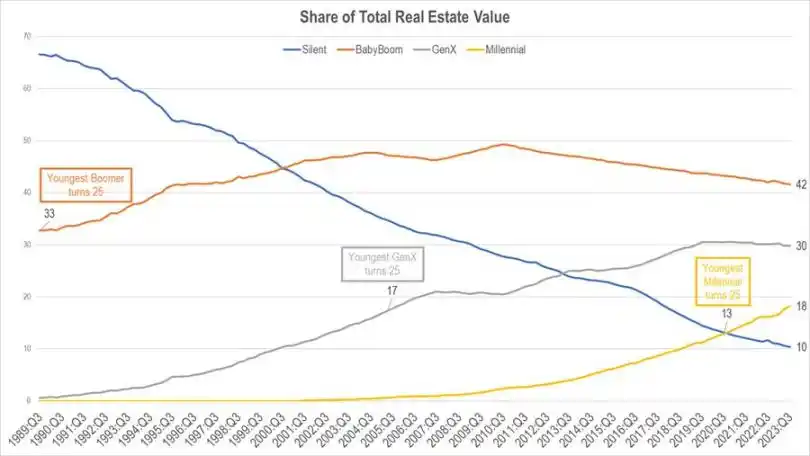
From 1989 to 2023, the total value of real estate held by U.S. households increased from 7 trillion The US dollar increased to US$45 trillion, an increase of nearly 7 times. In 2020, when the youngest Millennials turned 25, Millennials held 13% of the total value of real estate. In 2005, when the youngest Gen Xers turned 25, their share of housing wealth was 17%. In 1989, when the youngest baby boomers turned 25, they already owned 33 percent of the total real estate value.
So for today's young people, this is a bit unfair, right?
But let's go ahead and here's the distribution of household wealth by generation, a similar type of chart to the one above but looking at total net worth vs. real estate only Value:
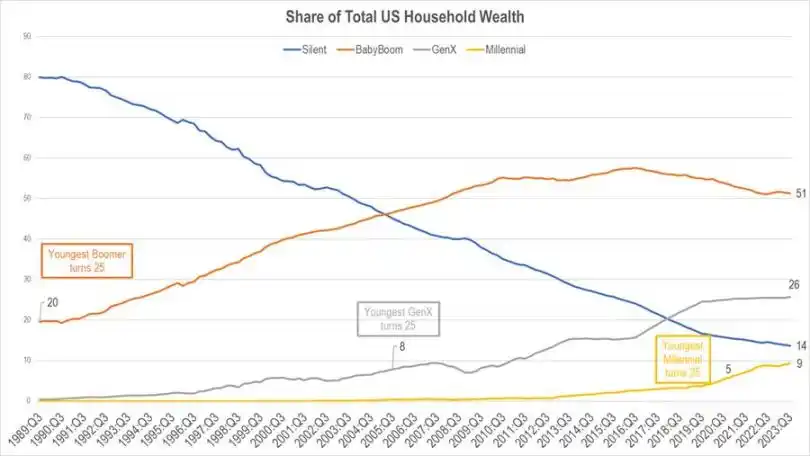
From 1989 By 2023, the total wealth of U.S. households will increase from US$20 trillion to US$143 trillion, an increase of 7 times, but in 2020, the youngest Millennials will be 25 years old, and Millennials only own 5% of total household wealth, so it’s no surprise that when you dig into the numbers, you’ll find that financial nihilism is on the rise among young people.
In contrast, when the youngest Generation X turned 25 in 2005, their generation had accumulated 8% of all household wealth; Compare this to the Baby Boomers - by the time the youngest Boomers turned 25 in 1989, they had amassed 20% of total household wealth!
Looking at these statistics in terms of wealth percentiles rather than generations is equally disheartening:
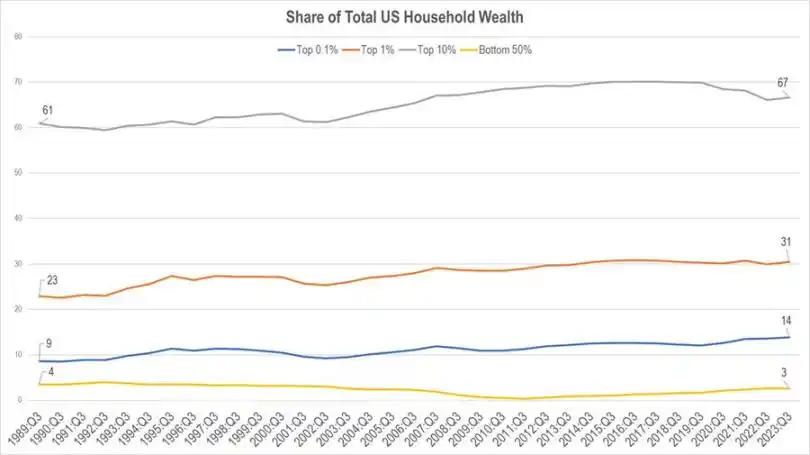
During this period, total wealth increased 7 times, It has increased from US$20 trillion to US$143 trillion, but there has been serious inequality in wealth distribution. The share of wealth held by the top 10%, 1% and 0.1% increased significantly, while the share of wealth held by the bottom 50% actually decreased. This means that the gap between rich and poor is widening, and the American dream of upward social mobility is becoming increasingly difficult for most people. This is a really frustrating situation.
Performing the same analysis on property values yields a slightly different graph, but the same result:
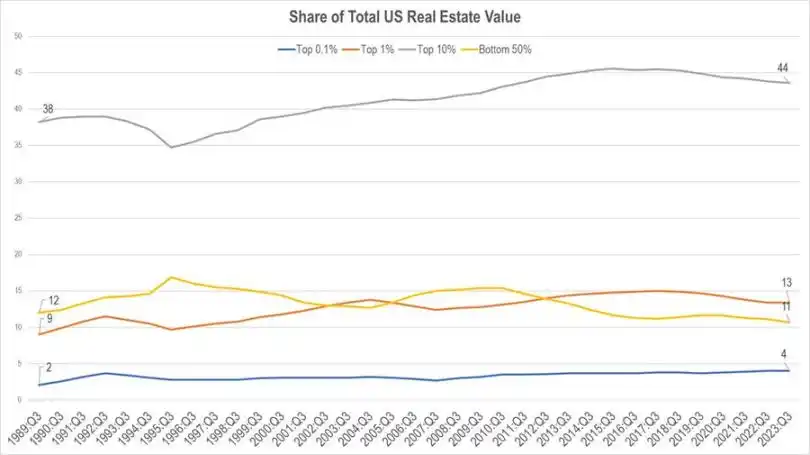
In the past period of time, although the overall wealth An increase of $38 trillion, but the rich are getting richer, while the bottom 50% have actually lost their share of wealth.
Let me prove my point with another chart. The chart below is the "ratio of median household income to the S&P 500 Index", which can be understood as "how many S&P 500 stocks can be bought with one year's median income."
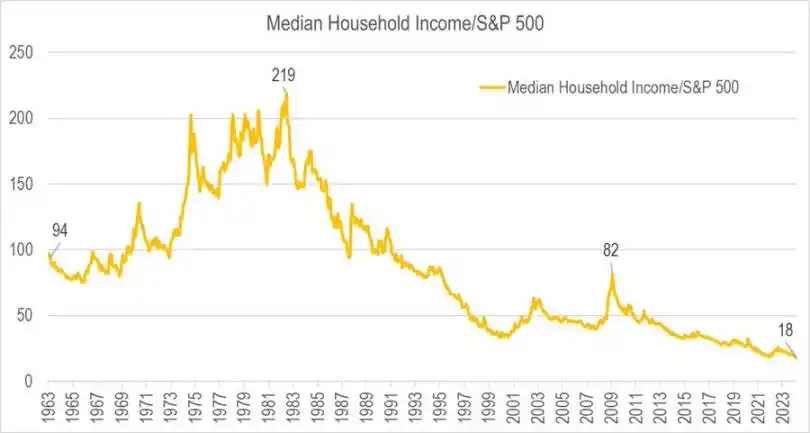
This once again depicts a It’s a grim picture: Back in the early 1960s, one could buy 94 shares of the S&P 500 with the median household income. The ratio peaked at 219 shares during the 1982 crash, and then there was a structural collapse, and for the average For Americans, the stock market is becoming more and more "expensive."
The background is this: the baby boomer generation controls most of the wealth, the rich are getting richer, the poor are getting poorer, and the American dream of upward social mobility is increasingly important to Out of reach for more people. Why do you think Oliver Anthony suddenly became famous? This is called financial nihilism.
So, if you, like most Americans, are in this disadvantageous situation, what should you do?
You tend to take greater risks. In order to try and get out of your current financial situation (most people are living paycheck to paycheck; buying a home seems out of reach; you are saddled with student loans; salary increases are not keeping up with rising prices), you feel pressured to take more risks. Take big risks in order to achieve a more stable and comfortable life.
Therefore, people may turn to high-risk behaviors and eagerly seek high-return opportunities, such as 5:1, 10:1, 50:1 returns, The hope is to improve one's financial situation, which may also explain why the gambling industry is booming:
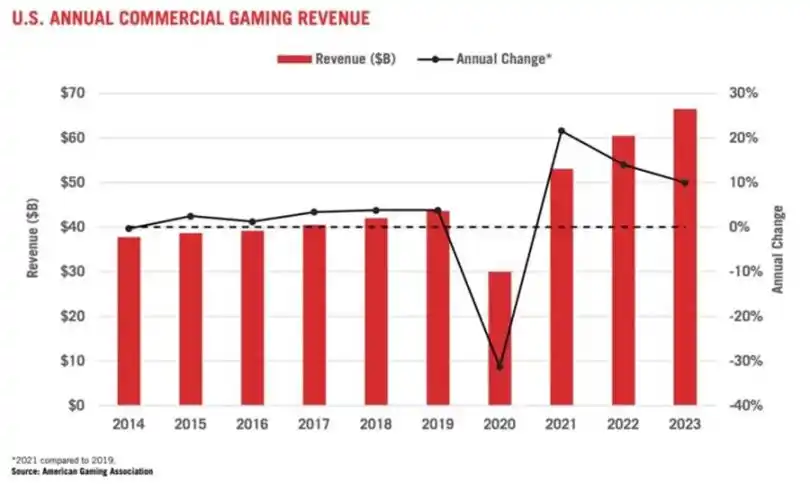
Across the broad spectrum of gambling, people are turning to more accessible forms of participation, such as sports betting where bets can be placed directly on mobile phones, which are growing at an incredible rate Confidence.
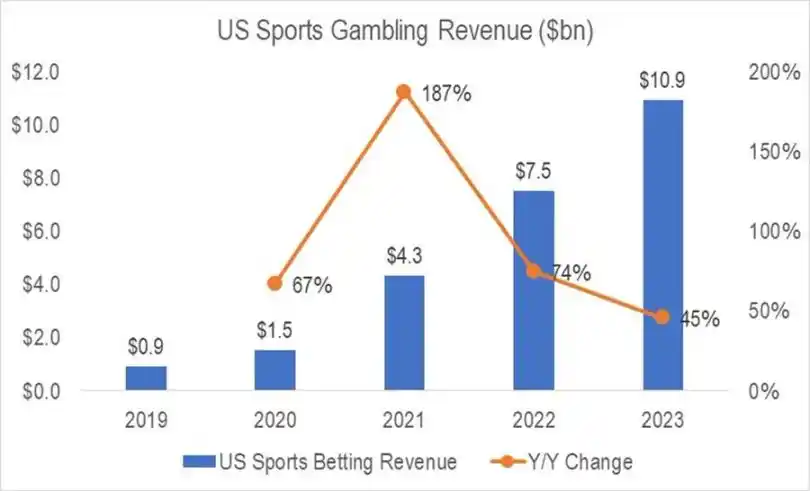
By the way, this year 's Super Bowl broke betting records.
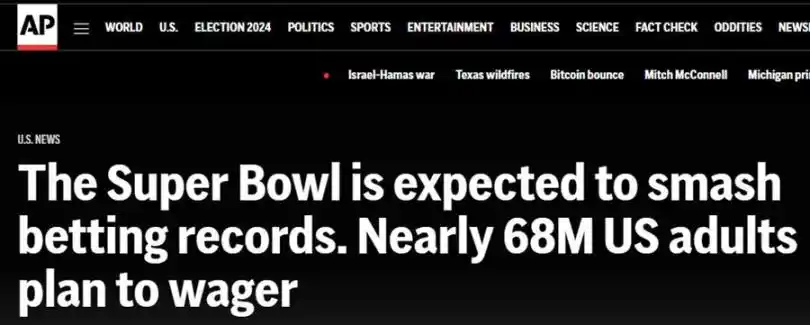
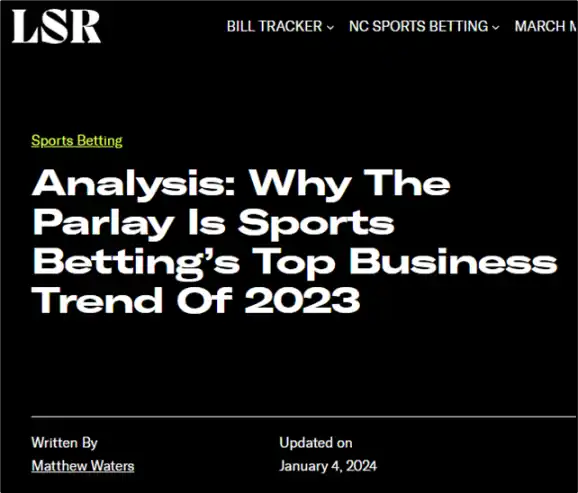
An example of further movement towards "financial nihilism" - There has been a surge in the popularity of parlay bets, a type of betting that requires bettors to hit all the hits in a series of bets to achieve high returns (win multiples of the original stake).
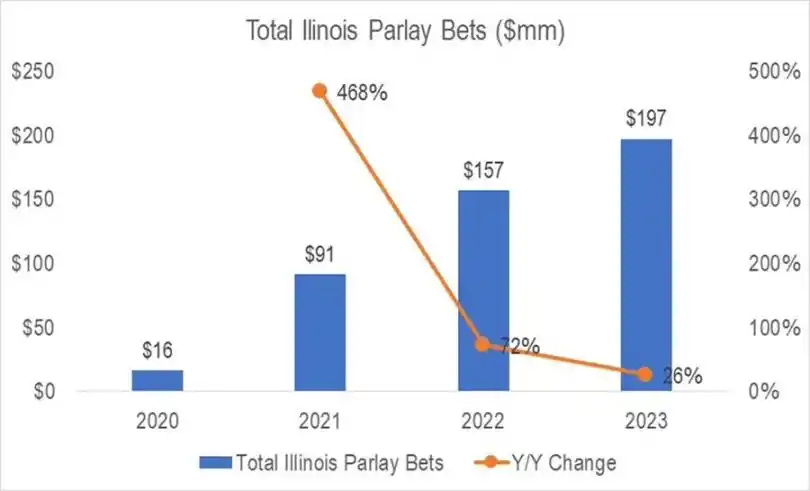
While I can't find a source that reflects multi-year cumulative betting data (other than Illinois), the crazy growth curve shown above is enough to illustrate the overall surge in popularity of cumulative betting. It’s worth noting that cumulative bets actually have higher house odds than regular bets, although the potential returns are also greater.
In other words, although the possibility of winning is slim, the high potential gains still make people take risks.
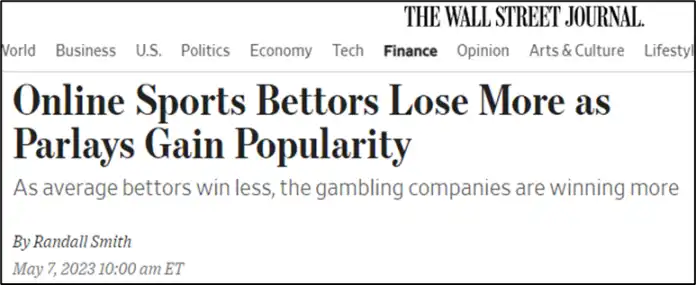
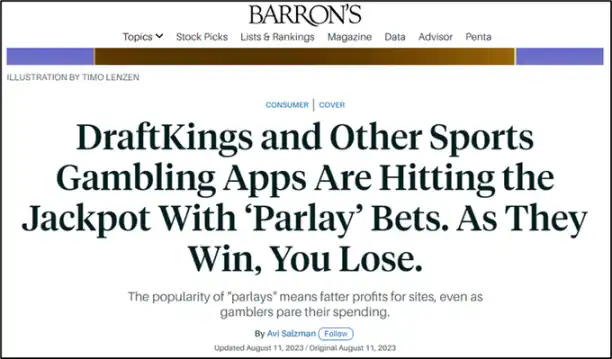
The cumulative bet is reminiscent of To a financial instrument - 0DTE option, which is an option contract that expires on the same day (Foresight News notes, that is, an option at the end of the day). Similar to cumulative betting, 0DTE options also have a higher probability of loss, but the potential gains are also multiplied. It’s worth noting that wins or losses are settled on the day you place your bet (or rather “invest”).
Do you know how popular 0DTE options have been recently?
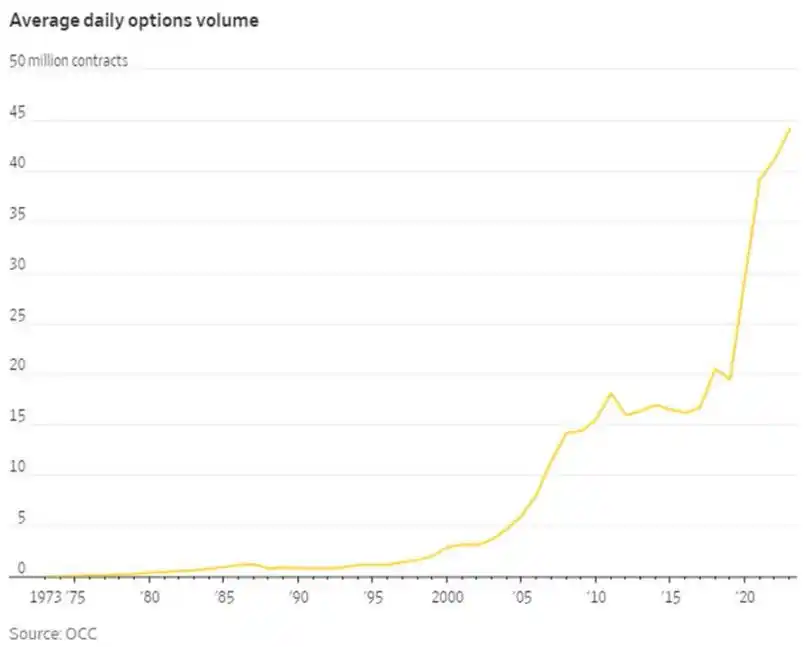
0DTE options trading since COVID-19 It has doubled since the epidemic. Does this growth rate look familiar? That’s right, between 2016 and 2023, 0DTE options trades increased from 5% to 43% of total SPX options volume.
Evidence of the rise of "financial nihilism" abounds. For example, the WallStreetBets community, a gathering place for retail investors on social media, DeepFukingValue, a well-known retail investor, and the trading boom in the stocks of GameStop, AMC, Bed, Bath & Beyond, Blockbuster and other companies that caused heated market discussions last year, and even related movies All of them were released quickly (such as the movie starring Seth Rogen about retail investors shorting out Wall Street), which is enough to prove that the concept of "financial nihilism" is becoming increasingly popular.
I will talk about cryptocurrencies later - people who choose to practice "financial nihilism" are essentially acting against the monetary and fiscal policies of the Federal Reserve and the U.S. government. Respond directly and emulate. Because these policies are one of the major contributors to wealth inequality between generations and wealth classes, the U.S. government in general is acting in an extremely irresponsible manner that puts professional poker players to shame.
I've been discussing this here for years, but I'm going to give you a few reminders:
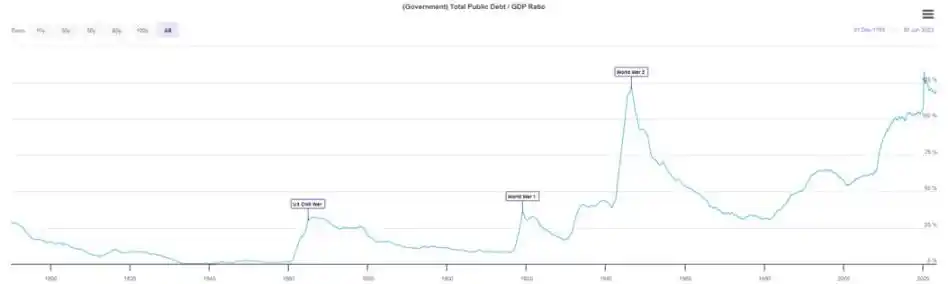
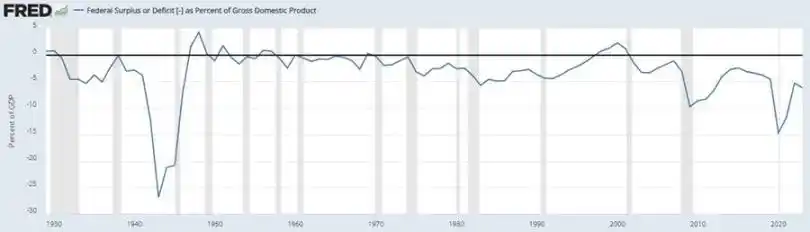
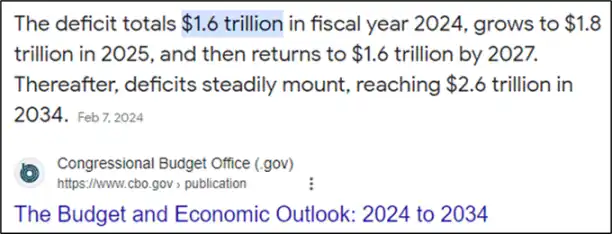
Recent actions by the U.S. government have devalued the U.S. dollar at a worrying rate. It can be said that Bitcoin enthusiasts were the first to realize that when government actions are confusing, people may be forced to resort to unconventional countermeasures - whether it is accumulated betting, special expiring on the day, etc. TSLA call options are still betting on virtual currencies because the money printing press has been and will continue to run like crazy, which will lead to distortions in various asset prices and distortions in risk appetite. It is unwise to deny this.
This brings us back to the cryptocurrency market, a Roman Colosseum of distorted asset prices and risk appetites, with fluctuations far more severe than those of stocks expiring on the same day. For high-risk investments such as SLA call options, the token gains here even eclipse the social media concept stocks that caused a lot of discussion last year.
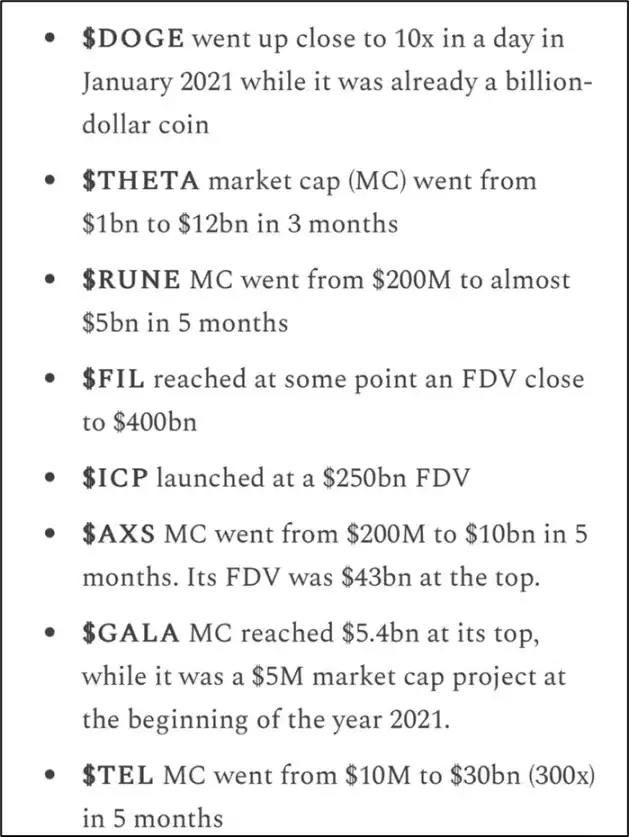
It should be noted that, Cryptocurrency has a populist flavor. It represents a countercultural trend and is a movement for young people. Boomers don't understand it, it's our own domain, and it's the one thing that beats our predecessors (at least so far). Whether baby boomers join the cryptocurrency wave now, in the next few years, or never, they will eventually leave this world.
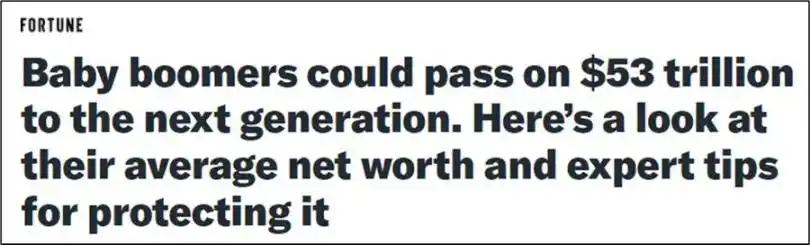
The huge assets accumulated by the baby boomers will be passed on to the next generation. Where will these assets be used? The answer may be more speculation, more high-risk investing, more cryptocurrency trading. Ask yourself, what would it look like if this entire trend continued for another 20 to 30 years? It's like Dave Portnoy combined with the novel "Ready Player One."
This article focuses on " "Financial Nihilism" concept, I chose this topic partly because I think it profoundly affects the price trend of cryptocurrencies, and partly because the concept has resonated with people in the last month. Hopefully, after this explanation, you will be able to understand this phenomenon more deeply than before.
Through writing this article, I myself have a deeper understanding of "financial nihilism". My sense is that this ethos is becoming more pervasive and ingrained in American society (and globally). "Financial nihilism" is one of the main factors affecting cryptocurrency price fluctuations, and it is likely to be further strengthened. It will continue to play an important role in the upcoming cycle.
You can expect the cryptocurrency market to become more rational and prudent, able to solve real problems, and have reasonable valuation methods to avoid bubbles. However, I think these expectations may be difficult to achieve, at least during this cycle.
There are some reasons that the cryptocurrency market may be more speculative this cycle than before, and there may even be tokens that “lack any practical use” and larger The bubble may be blown, followed by an even more violent crash. The factors and incentive mechanisms that promote "financial nihilism" are simply too powerful. Therefore, please take appropriate measures to avoid risks.
Original link
Recommended
The Wall Street Journal: How is AI Trading Stealing the Limelight from Cryptocurrency?
Aug 15, 14:00
Tencent Still Has a Dream
Aug 15, 11:27
To Catch North Korean Hackers, They Set Up a Fake Project
Aug 15, 10:00
From Litigation to Settlement: Positive Signal Released by HTX's Negotiation with FCA
Aug 14, 19:32
11,742 Shipping Addresses Exposed Alongside Trezor Orders
Aug 14, 19:01
Founder Interview: FOMO Creator Explains How They Added 30,000 Users in One Day and Became One of the Fastest-Growing Crypto Apps
Aug 14, 18:37