How do Bitcoin "Wanbihou" keep their Bitcoins?

Original title: HOW DO THE WEALTHIEST BITCOIN HOLDERS SECURE THEIR BITCOIN?
Original source: Unchained Capital
Original compilation: Luffy, Foresight News
If you want to safely hold large amounts of Bitcoin, it makes sense to understand how the richest Bitcoin holders approach the task. Although it is not guaranteed to be foolproof, these people have the greatest losses when they make mistakes, and they will be more proactive in thinking and researching the security of Bitcoin.
Finding the wealthiest Bitcoin holders can be difficult, and asking them to reveal the full details of their security is even less likely. However, the Bitcoin blockchain provides us with some valuable information. After all, the transaction history and balances of all Bitcoin addresses are publicly available.
If an entity (individual or group) owns a large amount of Bitcoin, they may spread the Bitcoin across multiple different addresses, causing each address to The balances are small, so they don’t necessarily attract people’s attention. In some cases it is not possible to associate different addresses with the same wallet or owner. In other cases, correlations between addresses require blockchain analysis, often relying on advanced techniques and assumptions that are not guaranteed to provide accurate information.
While it is difficult to determine the richest entities in Bitcoin and the number of Bitcoins they own, it is easy to determine the richest Bitcoin addresses. Several websites track these addresses in real time, and the characteristics of these addresses can provide many clues about the secure storage of Bitcoins.
For example, if you are familiar with address types, you will know that any address starting with "1" is a P2PKH address and therefore must be a single-signature address. Likewise, any address that starts with "bc1q" and is 42 characters long is a P2WPKH address and must also be a single-signature address. Bitcoins held by one of these address types are not protected using multi-signature. Using SSS or MPC will be the only way to achieve institutional grade security, as we discussed in relation to thresholds noreferrer" target="_blank">as discussed in the article.
Similarly, any address that starts with "3" is a P2SH address, and any address that starts with "bc1q" and is 62 characters long is a P2WSH address. It is possible for these address types to use multi-signatures. However, the signature structure is only revealed after Bitcoins have been spent in these addresses. Some P2SH addresses are actually single signatures, a structure that was temporarily popular during the initial adoption of SegWit. Therefore, if a transfer has never been made to one of these address types, the escrow structure is unknown.
Let’s take a look at the 81 data as of January 30, 2024 Addresses holding more than 10,000 Bitcoins, these addresses collectively hold more than 2.5 million Bitcoins.
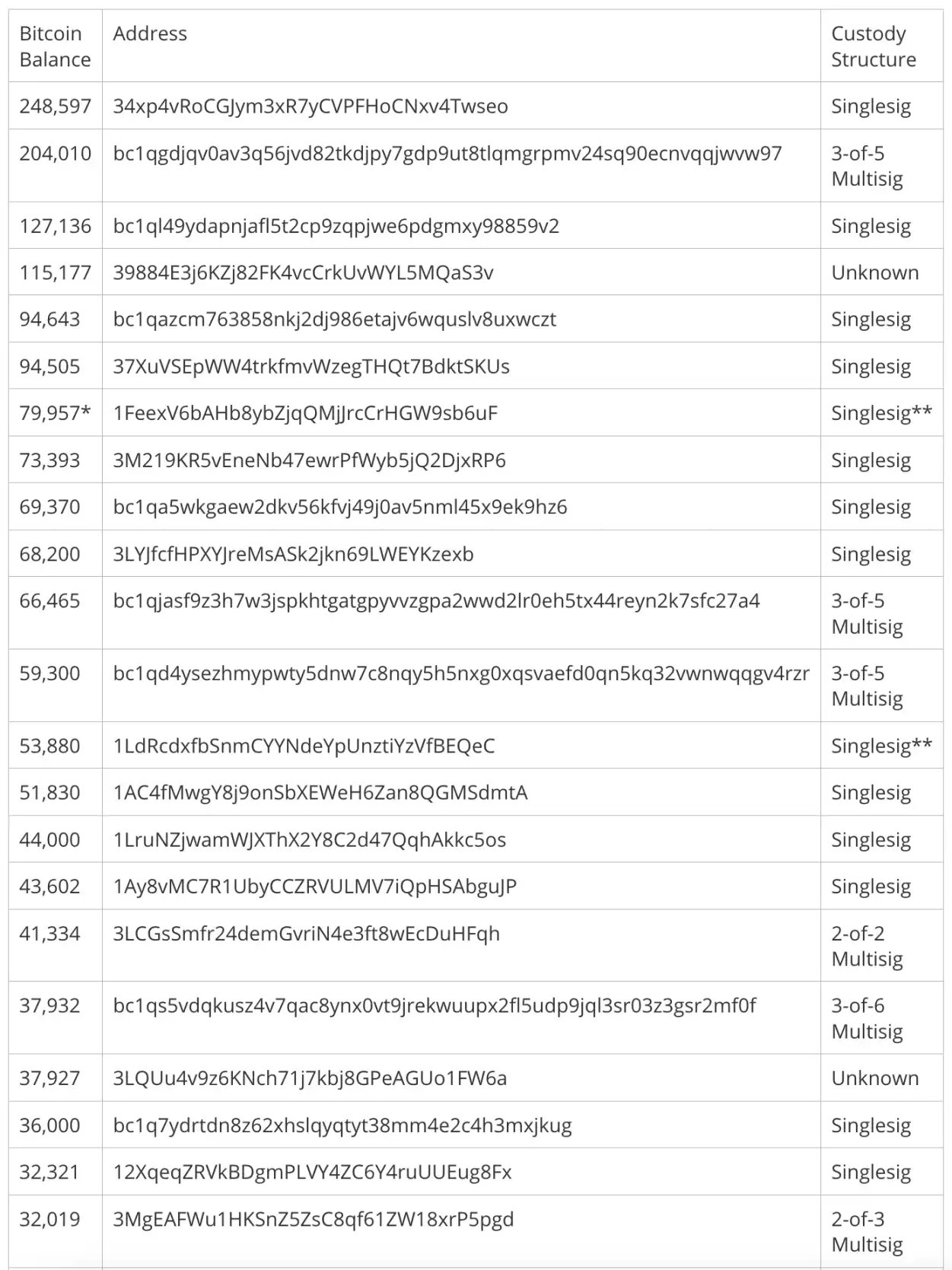
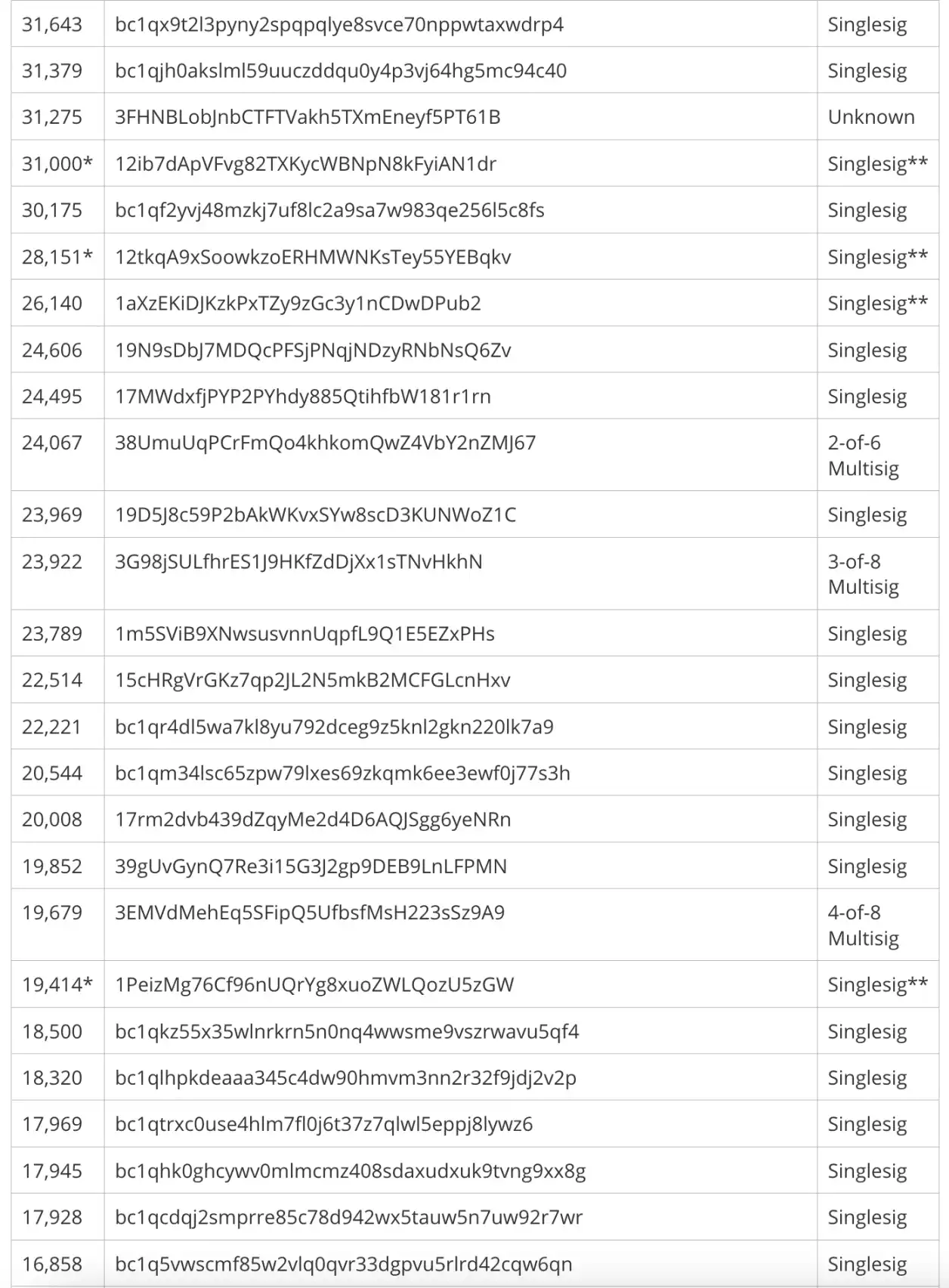
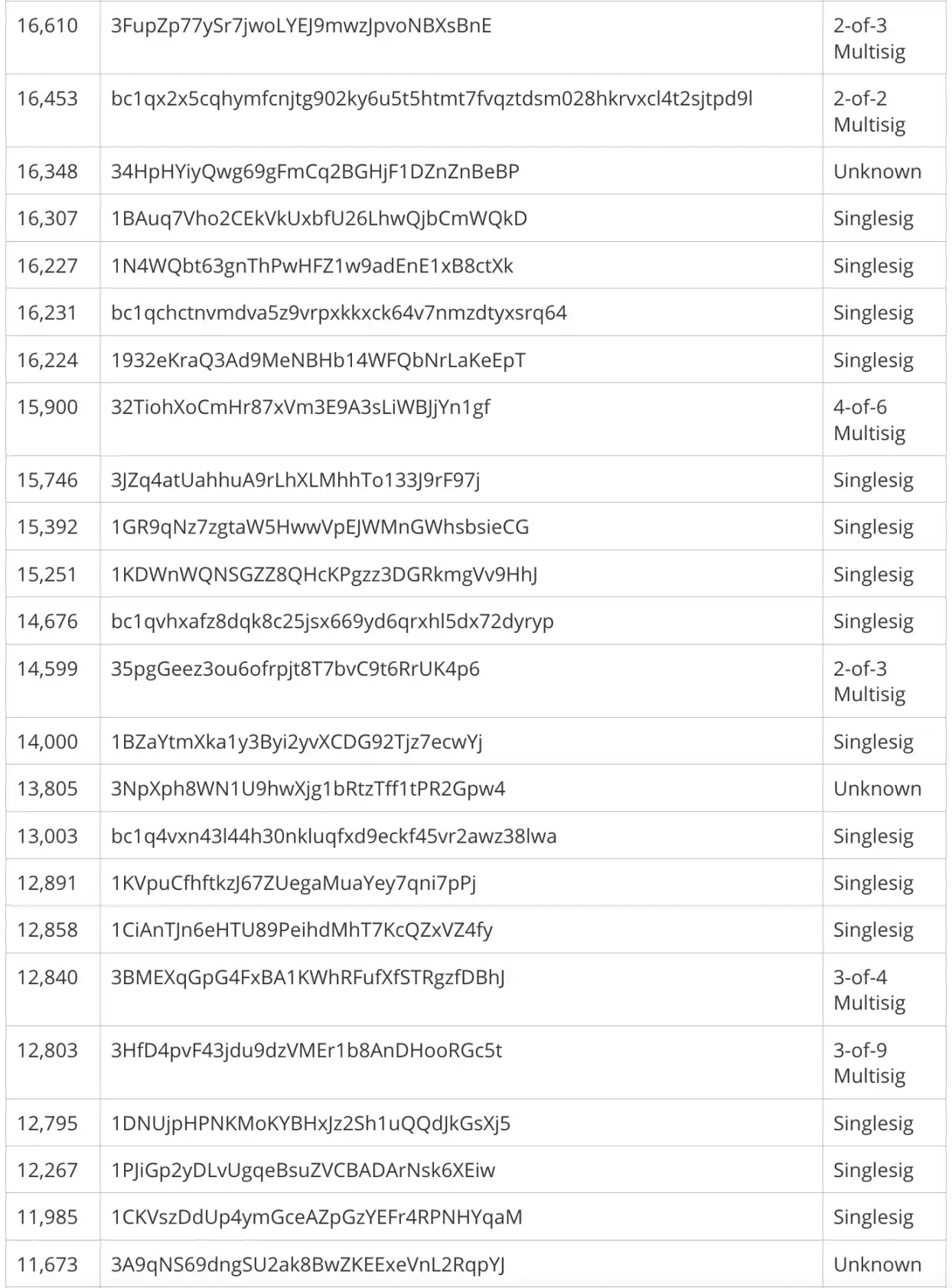
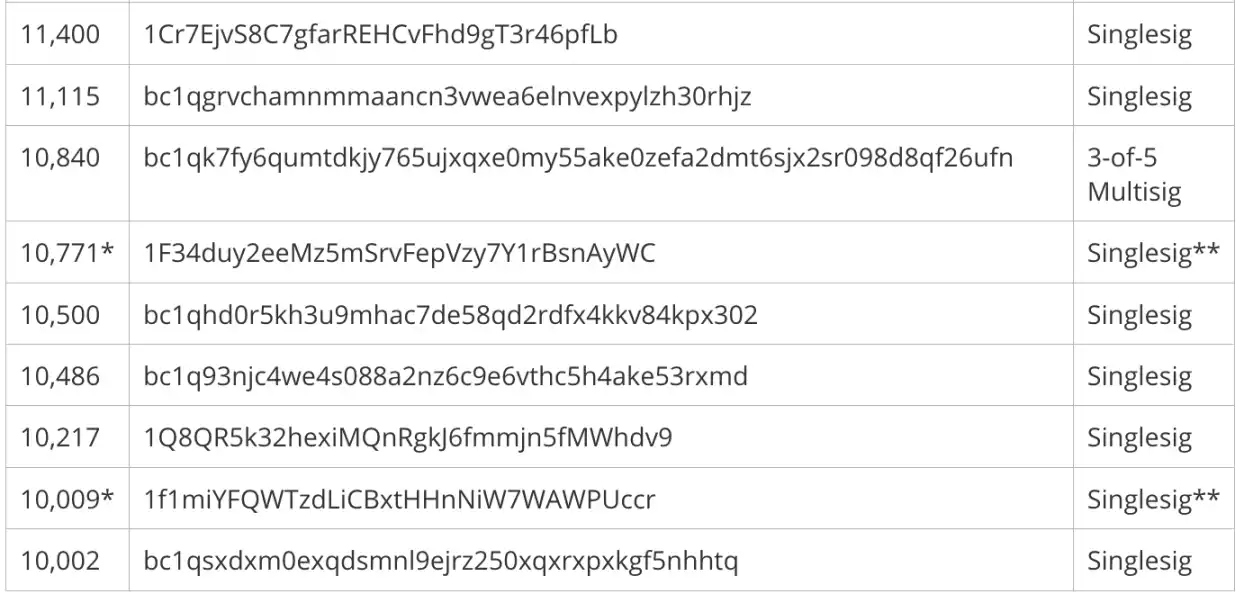
* May have been lost
** Do not use MPC
Among these 81 addresses, there are at least 6 addresses Holds potentially lost Bitcoin (179,302 BTC). These six addresses were created by their owners in 2010 or 2011, when Bitcoin was worth much less and not as valued as it is today. Five of them were never used and another had its last transfer in July 2010.
The remaining 75 addresses are in various hosting structures, let’s break them down:
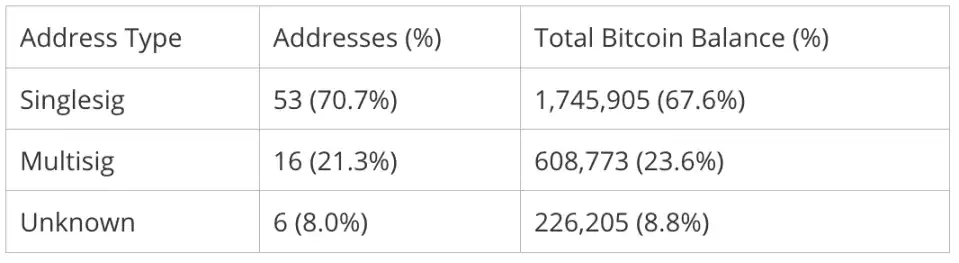
As explained in our article discussing institutional-grade threshold security, these 53 single-signature addresses Most likely use SSS or MPC. However, it is unlikely that two of the addresses used MPC as they were created before 2018, when the first MPC threshold protocol for ECDSA was invented. These addresses may be using SSS.
The 16 addresses we are aware of using multi-signature have all made transfers, and in doing so, they exposed their specific multi-signature quorum structure, where Contains a wide variety of types:
· 4 entities: 3/5
· 3 entities: 2/3
· 2 entities: 2/2
· 1 entity: 3/9
· 1 entity: 4/8
· 1 entity: 3/8
· 1 entity: 4/6
· 1 entity: 3/6
· 1 entity: 2/6
· 1 entity: 3/4
Multi-sig of 2/2 is the only quorum structure on the list that does not provide inherent protection from a single point of failure. While 2/2 multisig prevents theft, it requires other methods to prevent loss (such as using distributed SSS or MPC sharing for each key).
After looking at these data, at least one thing is clear. There is no consensus among the owners of the wealthiest Bitcoin addresses (which includes the largest cryptocurrency exchanges and even the U.S. Department of Justice) on the best way to protect Bitcoin.
Some of these entities use multi-signature addresses, with typical quorum multi-signature structures such as 2/3 and 3/5, but there are also several unusual ones Quorum. Many entities use single signature addresses, which may be using SSS or MPC. Details regarding the SSS or MPC threshold quorum have never been publicly recorded on the blockchain, which limits the scope of this investigation. Some of these single-signature addresses may not be using any threshold security at all, meaning that some Bitcoin reserves, currently worth over $400 million, are significantly lacking in security.
As we mentioned in a recent article, multi-signatures always have a higher security limit than single signatures. When using single-signature addresses (at least 70% of addresses holding more than 10,000 BTC), the opportunity for additional security is missed. While single signatures do offer some benefits in terms of spending convenience and transaction fees, for entities holding millions or even billions of dollars worth of Bitcoin, these benefits are less important than security.
It is unclear why single-signature addresses are so common among Bitcoin’s top rich. This may be due to the lack of popularity of multi-signature usage, or the historical lack of products and services that utilize SSS and MPC combined with multi-signature.
Original link
Recommended
The Wall Street Journal: How is AI Trading Stealing the Limelight from Cryptocurrency?
Aug 15, 14:00
Tencent Still Has a Dream
Aug 15, 11:27
To Catch North Korean Hackers, They Set Up a Fake Project
Aug 15, 10:00
From Litigation to Settlement: Positive Signal Released by HTX's Negotiation with FCA
Aug 14, 19:32
11,742 Shipping Addresses Exposed Alongside Trezor Orders
Aug 14, 19:01
Founder Interview: FOMO Creator Explains How They Added 30,000 Users in One Day and Became One of the Fastest-Growing Crypto Apps
Aug 14, 18:37