As an airdrop enthusiast, you need to master these contract deployment knowledge

Original source: Wyz Research
Original title: "What are the necessary development knowledge for airdrop enthusiasts?" 》
Understand development and deployment knowledge, allowing users to become BUIDL.
When you don't know how to deploy the contract, you may not be able to call it BUIDL.
Every airdrop enthusiast will enter the chain and application as a user, but from the perspective of the chain, users have certain hierarchical boundaries. , to the chain, application developers are the most valuable.
Application developers develop dApps that can attract users to use. Gas will be generated during use. Developers will deploy contracts on the chain and actively attract users to join the chain. Operation, the value of the chain itself will increase infinitely.
So, it can be said that having development capabilities or simple development knowledge increases the chances of obtaining airdrops, or to be more precise, becoming a real builder on the chain Better way.
In this article, we will describe in detail the simple development knowledge required by a user who likes to experience chain operations. Among them, it will not involve building a front-end, building a development environment or SDK corresponding operations. This article will lead ordinary users into the theoretical period of development experience for novices. If they want to enter the practical period, they can continue to learn other in-depth knowledge.
Our previous article "How to use technology Logically dismantle new and old projects around the world? "The definition of the attributes of blockchain is explained in "Blockchain is not just a general ledger. All public chains that exist today are designed for superficial application development.
So the understanding of chain development knowledge is consistent with the Internet development and application itself. In terms of architectural understanding, it is just that the backend has become a chain, and what was originally in the database The data state becomes the data state on the chain.
To develop Internet applications, you first need to purchase cloud services (earlier ones may be connected to the network through computing devices or deployed as servers). If we purchase two One server, one for front-end deployment and one for back-end deployment. Purchase a website, configure the website and front-end development parts, and then develop a back-end to manage data. The interactive data of the website will enter the back-end when used. When the front-end user needs to obtain feedback data before operating, it is executed after accessing the data status in the database.
Based on such a complex process, in traditional applications, users basically cannot feel the back-end, but in the blockchain, they can clearly feel the front-end and back-end. .
The backend of dApp turns the servers and databases used in Internet application development into the chain and the overall state on the chain.
During development, the back-end chain exposes a remote call interface rpc, and all developers and applications operate the chain through this interface.
This is why when using MetaMask to experience different dApps, you need to add different networks to the dApp. When adding a network, the url represents the rpc Access Point.
In other network designs, there is another way to upgrade dApp again. If a chain only uses one rpc, which requires a lot of interaction, when the task Before submitting to the chain, just the access process will be congested.
At this time, if it is possible to build a self-built rpc, the application side will have a greater advantage, but currently in the public chain field, with the current POS design, this operation There are not many dApps.
At this point, we can basically figure out that when we interact with the chain for development actions, we will need a wallet and an rpc port.
After getting the entrance, how to chain operations on.
Ethereum is known as the world computer. It can run various types of automatically executed smart contracts. This process is achieved by deploying contracts to the network and being processed by EVM. Carry out execution.
The term virtual machine VM is a word that must be mentioned in the cloud service industry. We can think of the computing equipment in the Ethereum network as a huge computing storage Zone, that is, a virtual machine. The virtual machine allows smart contracts to have the ability to run and complete the execution of task instructions.
Then smart contracts become the key, and the core link for developers to experience is smart contracts.
The deployment of smart contracts is divided into writing the code first, compiling it second, and deploying it third. After the deployment is completed, the contract function can be called directly.
Ethereum has fixed tools, and these tools have been extremely simplified. After understanding the entire process, you can try the entire process as long as you look carefully.
Remix, Hardhat, and OpenZeppelin are currently the simplest and most open tools. In addition to these open source tools, there are also tools such as Thirdweb that can assist development and simplify some aspects. Process tools.
Recently, we have experienced the test networks of public chains such as Berachain, Taiko, and Shardeum. You can learn about development knowledge from the experience process of these chains.
First of all, I am a regular user and I use MetaMask operations to interact with the network. The first step is to add the test network in MetaMask and obtain the tokens in the test network. The test network tokens are collected from the test network faucet. The quantity is limited. The collection is announced in the official documents of the three projects. In the process, the test tokens of these three chains are Bera, ETH, and SHM.
It can be found that Berachain and Shardeum are both L1 and use their own native tokens, while Taiko is L2 and the goal of existence is to expand Ethereum, so use ETH, and because Ethereum has a public test network, Taiko also used Ethereum's own test network to conduct some functional tests. If users want to experience it, they need to know which chain it will ultimately implement.
After getting the experience tokens from the faucets of the three chains, the next step is to try how to use development tools to deploy the contract to the chain.
So there are three steps in the next step: find the contract, modify the contract, and complete the contract deployment in the IDE.
The documentation pages of the three projects will clearly indicate which tools will be supported for corresponding contract deployment. After checking, these three projects all support the use of Remix for deployment, so we will use Remix for this process.
Remix is an online editable environment, which is very convenient. There is no need to use other more complex tools such as SDK or terminal, but the simple process in this article is only a one-time deployment. , contract modification and call testing still require other tools to be executed.
1. How to find the contract to be deployed
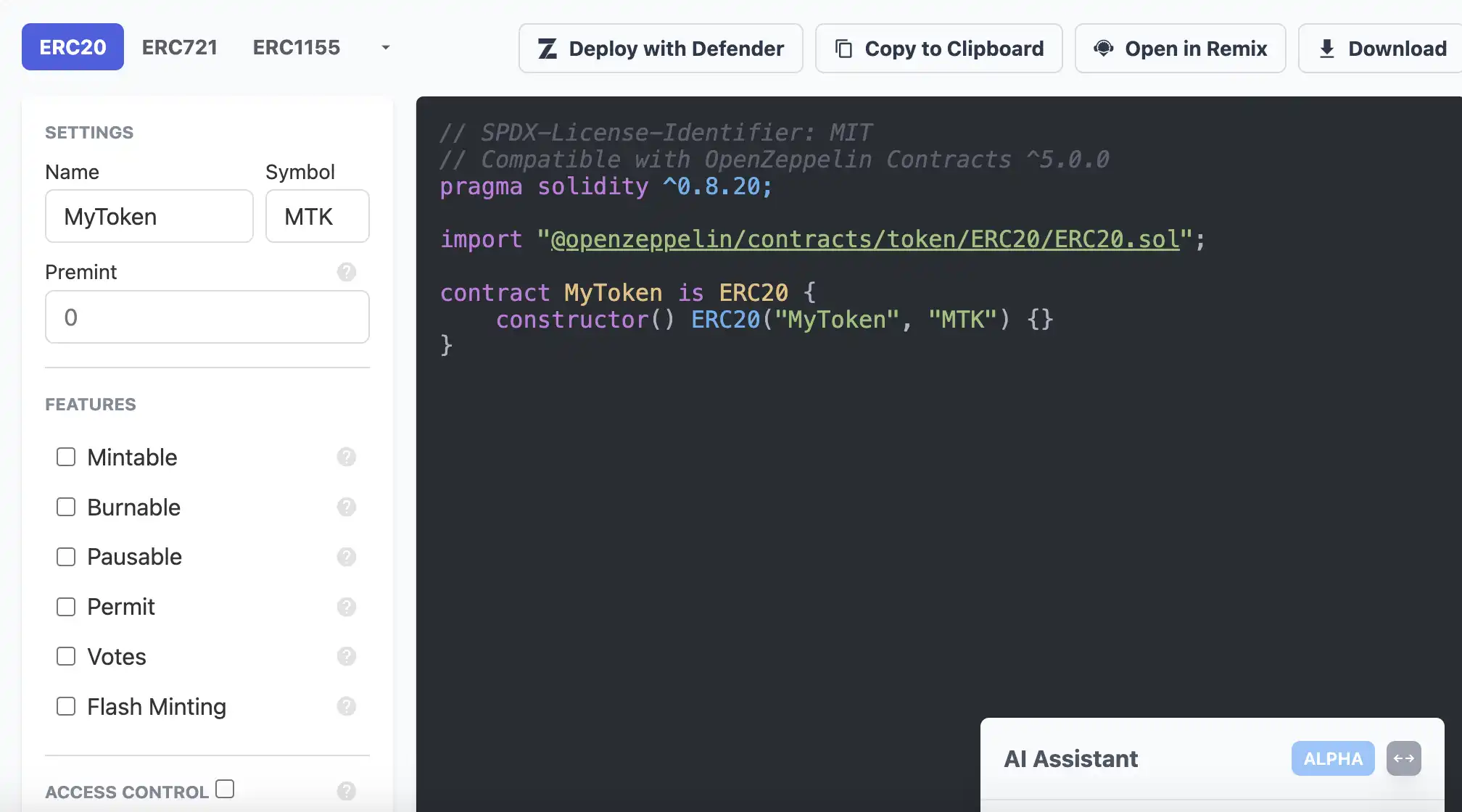
On OpenZeppelin, there are several common The token issuance contract has a modular display, where we can directly select the function and then jump directly to Remix.
This is the initial page:
2. Make simple modifications to the contract code
Then I set up the contract for issuing tokens, using the full name of Wyz Research , the abbreviation of Wyz, and selected the pre-release in the function, and specified the control ownership of the contract. Through these operations, the contract code on the right has the builder shown in the first red box, and the pre-release tokens also have addresses to point to.

3. How to deploy the contract
Next, click Open in Remix in the upper right corner, and we can start editing in the Remix interface.
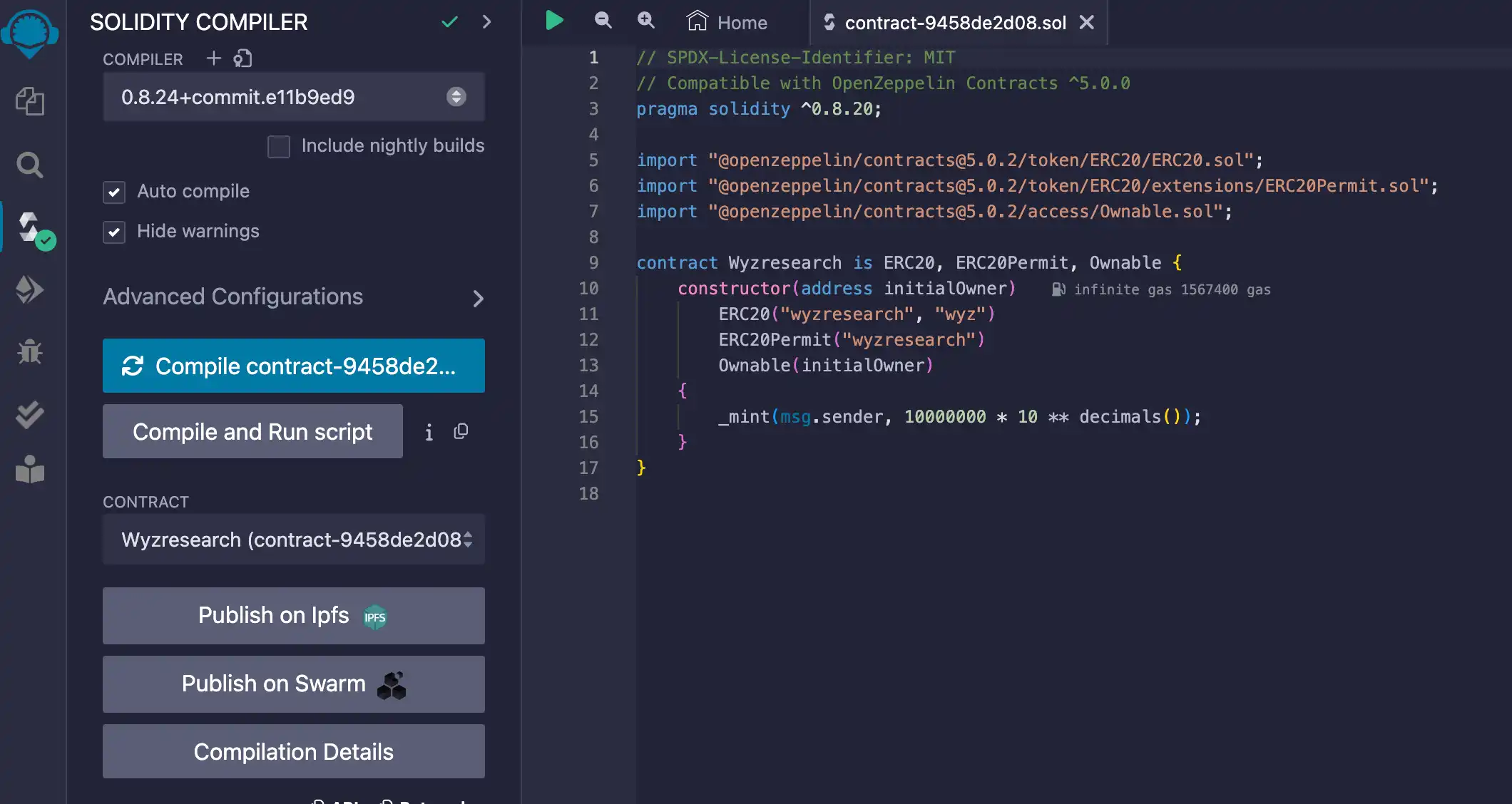
Before starting editing in the Remix interface, please first change the network and The wallet address is adjusted correctly.
After entering the page, we need to modify the two corresponding addresses above. I used the wallet address to replace them. The display is as follows:
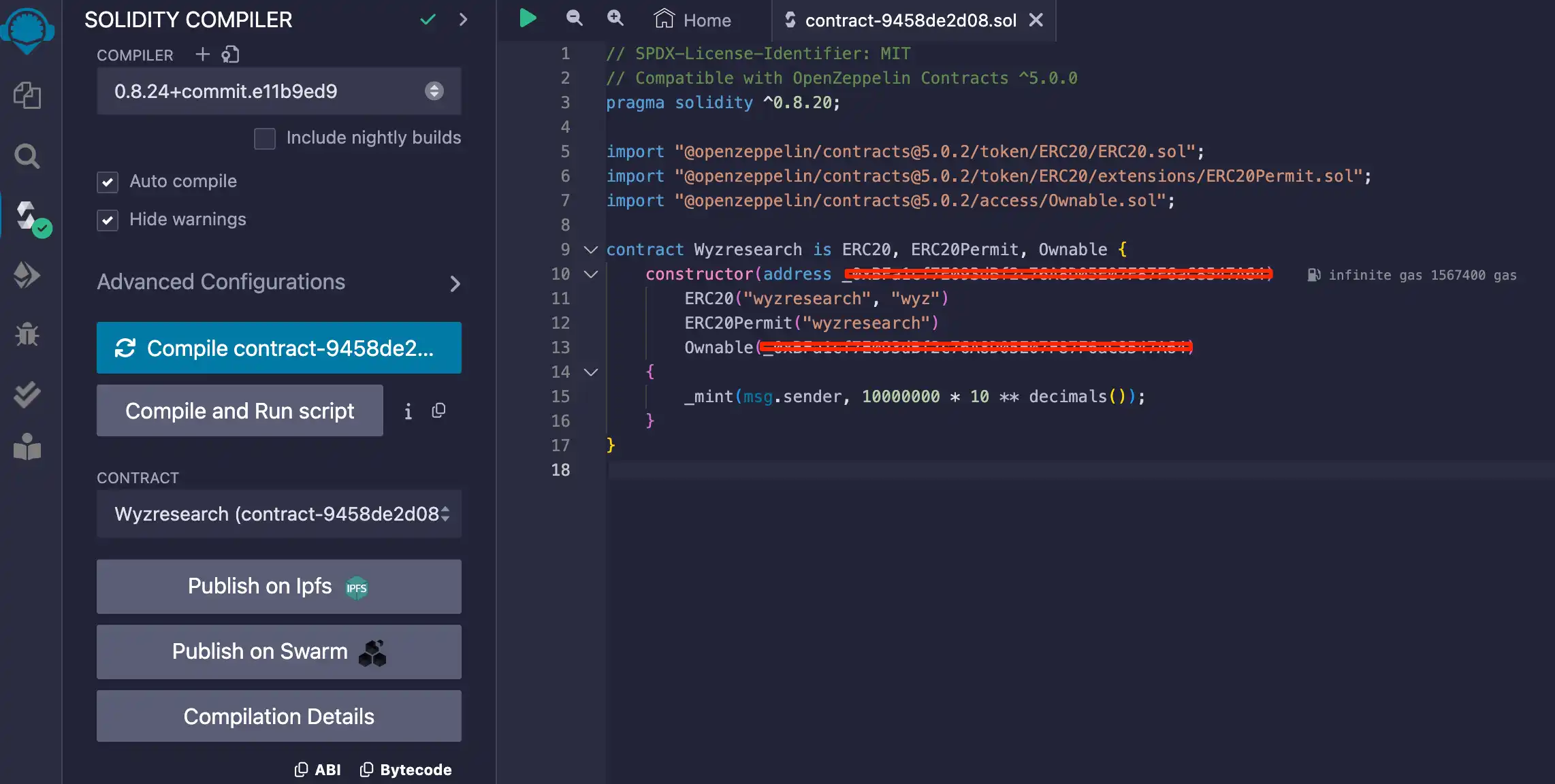
Then click Auto complie on the left to automatically compile. If there is no automatic compilation, you need to click the blue button on the left. When a green check mark appears on the far left. Then click the button under the green check on the left to enter the deployment page.

When the wallet has been modified correctly, click on the account section in the upper left corner , this position represents the account for paying gas, and the following position represents the deployment address. After selection, it will be displayed as follows:
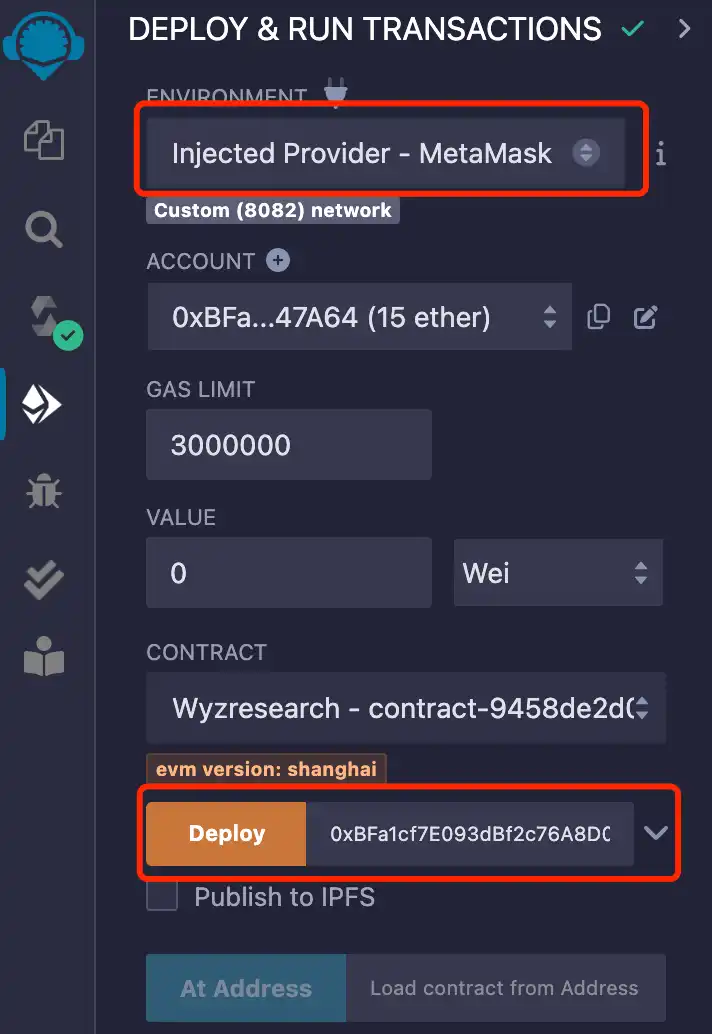
Click Deploy and MetaMask will pop up to pay the gas fee for this operation.
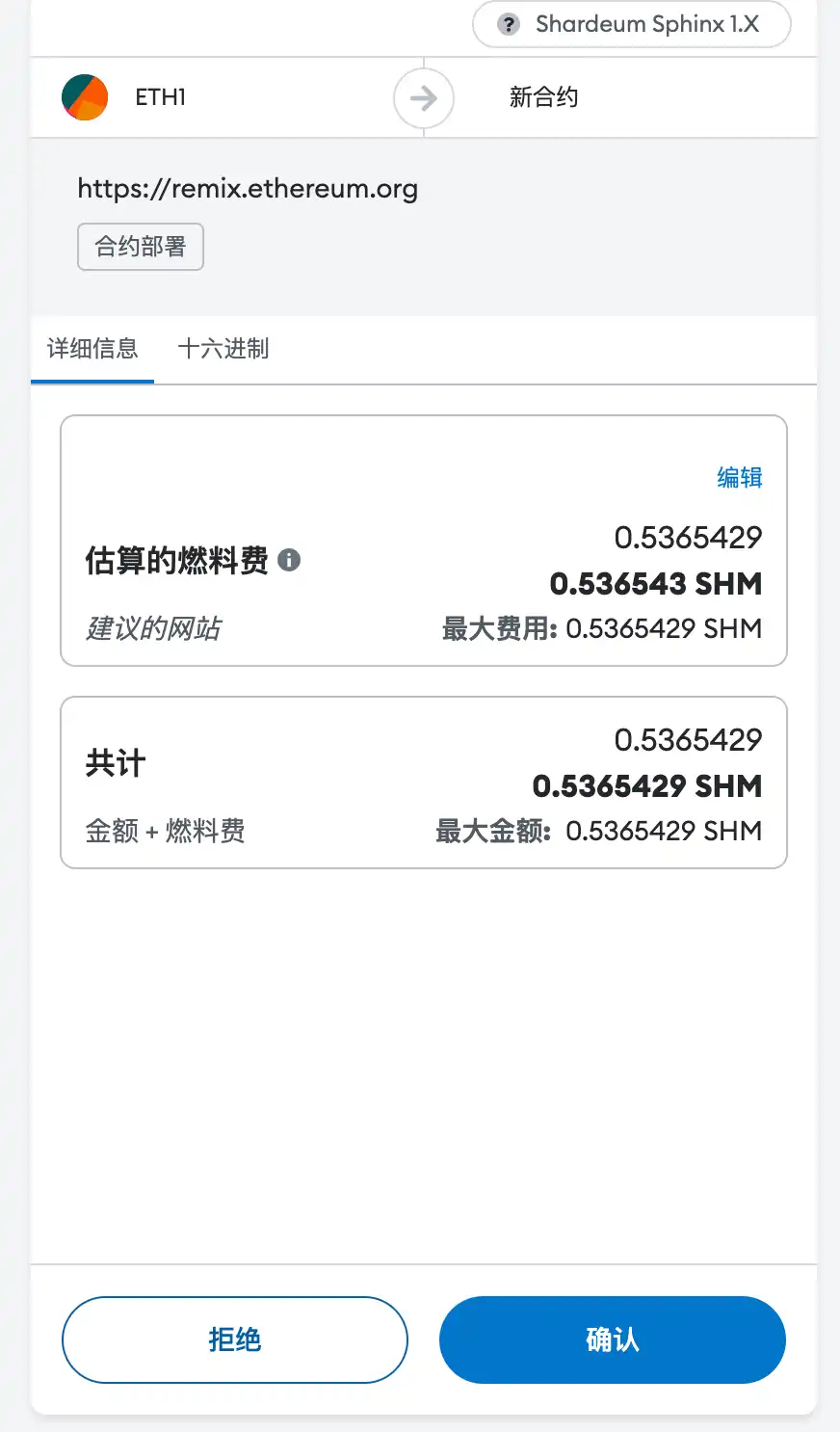
During the contract deployment process, the contract pending
will be displayed on the lower side of Remix p>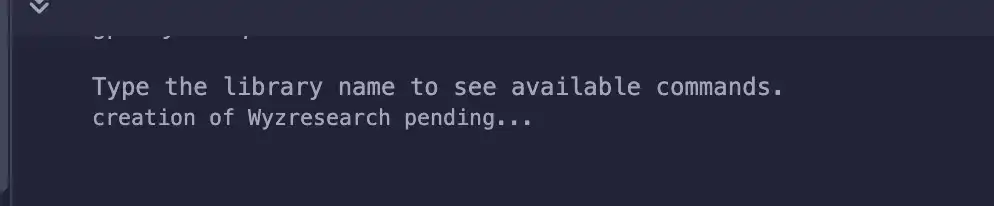
After the contract is deployed successfully, the transaction success will be displayed on the lower side.

4. Query transactions in the browser
After completing the deployment, when you click the button in the wallet to enter the browser to view the transaction, you can find that we have just completed the action of creating a contract, and during the execution of the contract, the A token sends a corresponding token.
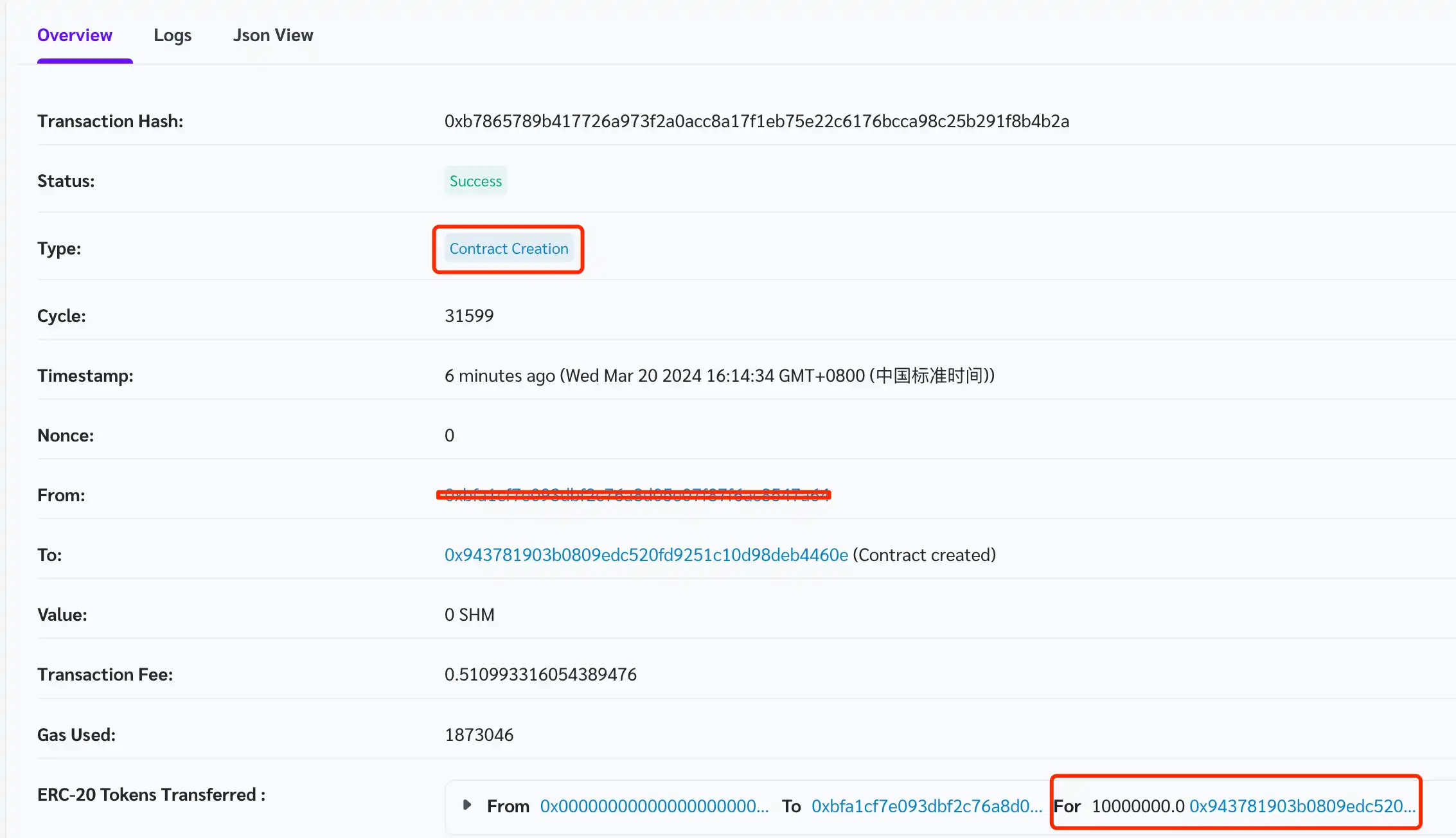
When you click on the address again to view it, you will find that I have Mint in the address. 1000W tokens. However, it seems that due to the testnet browser, the token name is not displayed, and this issue remains to be verified.
This deployment uses Shardeum. If deployed on Berachain and Taiko, the process is the same. It only requires adjusting the corresponding network in the wallet. Online IDEs such as Remix provide a simple entrance to network operations.
To carry out certain development operations on the chain, it is the simplest construction attempt for non-application users. You can try to use contracts to issue some assets, or fork other dApp codes. Each dApp's contract on the chain interacts through combination. For example, we see that Uniswap's swap is one contract, and the one that provides LP is another contract.
Compared with Dex, other Defi and Gamefi contracts are more complex. Although the development process is complex and lengthy, for enthusiasts, understanding its principles can help chains and applications build more.
Original link
Recommended
The Wall Street Journal: How is AI Trading Stealing the Limelight from Cryptocurrency?
Aug 15, 14:00
Tencent Still Has a Dream
Aug 15, 11:27
To Catch North Korean Hackers, They Set Up a Fake Project
Aug 15, 10:00
From Litigation to Settlement: Positive Signal Released by HTX's Negotiation with FCA
Aug 14, 19:32
11,742 Shipping Addresses Exposed Alongside Trezor Orders
Aug 14, 19:01
Founder Interview: FOMO Creator Explains How They Added 30,000 Users in One Day and Became One of the Fastest-Growing Crypto Apps
Aug 14, 18:37