CKB and Binance AMA Review|Bitcoin Ecosystem Super Protocol RGB++

On April 2, Baiyu, head of CKB Ecosystem and founder of SeeDAO, was invited to participate in the AMA of Binance's official Chinese group. Baiyu gave a detailed introduction to the Bitcoin layer asset issuance protocol RGB++ and CKB's plan for this year to more than 160,000 users in the group. The content is very rich. Friends who missed this AMA are welcome to read this text draft directly.
The following is the main content of the AMA:
1. Why did the team make the RGB++ protocol in the first place?
We believe that the key to Bitcoin's second-layer competition lies in the first layer, and the core of the first-layer competition lies in new protocols. We divide new protocols into two categories: one is assets that use UTXO features, and the other does not. On this basis, we chose protocols with UTXO features, such as Atomicals, RGB, and Taproot Assets.
We decided to choose the RGB protocol because Cipher personally has a strong interest in RGB and has conducted in-depth research with Professor Ajian. The RGB protocol is very elegant and has many advantages, especially it can provide Bitcoin with almost uncompromising scalability, but after so many years, it has not been widely adopted. The reason is that the RGB protocol has multiple technical and product problems in practical applications, such as interactive operation problems, data availability (DA) problems, interoperability problems, smart contract/script execution environment problems, etc.
Then we found that this is what we have done in CKB for the past four years. These difficulties or disadvantages of the RGB protocol can actually be solved directly on the blockchain, such as a P2P network that does not rely on anyone, shared data, a virtual machine that can verify transactions, and a non-interactive operation experience. This is also the earliest core idea of RGB++.
2. Can you briefly introduce what the RGB++ protocol is?
First of all, RGB++ is a Bitcoin layer-one asset issuance protocol, at the same level as Ordinals, Runes, and BRC20 asset protocols. Our advantage lies in protocol design and technical level, which is the accumulation of the CKB team over the years. The original RGB protocol needs to exchange transaction history and data through the P2P network, which includes the use of new virtual machines and the definition of interactive logic, making the off-chain logic complicated and slow to develop. RGB++ aims to move all the "smart" components in the original RGB protocol, such as P2P networks, virtual machines, smart contracts, etc., to the chain through isomorphic binding. In other words, RGB++ delegates the tasks to be done by the client verification outside the original RGB protocol chain to a Turing-complete CKB blockchain based on the UTXO model and PoW consensus mechanism.
Many people tend to confuse RGB++ and RGB protocols. In fact, they are two different concepts. RGB was originally proposed by Peter and is currently mainly managed by the LNP/BP Association and Dr. Maxim, who have expanded it using the concept of disposable seals. RGB++ introduces more about the possibility that other UTXO chains can serve as RGB++ clients. Its core contribution lies in the concept of isomorphic binding. From a CKB standpoint, we plan to be compatible with more protocols in the future.
3. What are the advantages and disadvantages of the RGB++ protocol?
RGB++ has many advantages, such as being able to achieve:
Non-interactivity of transactions: RGB++ takes advantage of the characteristics of CKB as a data hosting and computing platform, allowing transaction parties to complete transfers through asynchronous and non-interactive methods, making the user experience more friendly.
Transaction folding: RGB++ can correspond to multiple CKB transactions and one Bitcoin RGB++ transaction, so that low-speed The low-throughput Bitcoin chain uses the high-performance CKB chain for expansion.
BTC assets do not need to cross-chain to directly interact with assets on the CKB chain: RGB++ realizes the connection between Bitcoin UTXO and CKB Cell After the association mapping between them, interoperability without cross-chain assets can be directly realized.
Of course there are many things that can be improved. First of all, the entire UTXO ecosystem is just in its infancy. After all, the hot spots used to be EVM, so it will be more difficult for early developers to accept Bitcoin programming. However, as long as BTC script programming is accepted, CKB is many times simpler than Bitcoin. Secondly, RGB++ uses CKB as Client, and the privacy is currently not as good as RGB. Next, we will introduce ZK-like technology to add privacy to RGB++ transactions.
4. How friendly is RGB++ to developers?
In fact, whether it is RGB or RGB++, the main work of developers is outside the chain, not on the Bitcoin chain. For RGB, most of the work of developers is how to assemble RGB transactions, how to generate RGB certificates, how to write contracts on RGB, etc. What needs to be done on RGB++ is the same, but many things CKB blockchain It was solved directly.
Take making a DEX as an example. On CKB, it becomes how to make a DEX that can accept RGB++ assets. Its development difficulty is not much different from that of developing other contracts on CKB. At present, the development tools on CKB are relatively complete. A skilled developer can probably get started after a few days of study.
The Bitcoin mainnet is not Turing complete and cannot run complete smart contracts, but CKB is a UTXO-based smart contract platform, so it provides RGB++ assets It brings Turing-complete smart contracts, and can even create an AMM similar to Uniswap on CKB, open a pool, and everyone can also play Meme in the BTC ecosystem.
RGB++ assets do not require a cross-chain bridge, so developers do not need to consider additional cross-chain aspects, which is also an advantage. In addition, in response to the needs of many developers who want to build BTC L2, we are also preparing a UTXO Stack around RGB++, similar to the OP Stack, which can send a chain with one click, has its own RGB++ asset capabilities, and can directly interact with BTC L1.
5. When will the RGB++ protocol be launched and what are the future plans?
The RGB++ protocol has been deployed in the BTC testnet contract. The current test is very popular and the Inscription community is paying great attention. As far as I know, many friends from the studio are preparing for the competition. Everyone is welcome to experience the different BTC protocol. The mainnet will be online in the next few days. It’s a coincidence that I’m here to share it today. The team is working overtime on development.
In addition, there are necessary infrastructure such as L2 DEX, wallets, and browsers that support RGB++ assets. After the mainnet is launched, it is expected that many projects will use RGB++ to issue Bitcoin-level assets. There may be many good opportunities in it. Everyone is welcome to stay tuned.
Later, we will also release a series of SDKs, conduct code audits and open source, conduct scalability research, etc. We have released a roadmap for RGB++ , for specific milestones, you can view the road map below:
Finally, everyone is welcome to follow CELL Studio’s Twitter account (@ckbcell) to get it as soon as possible The latest news in RGB++.
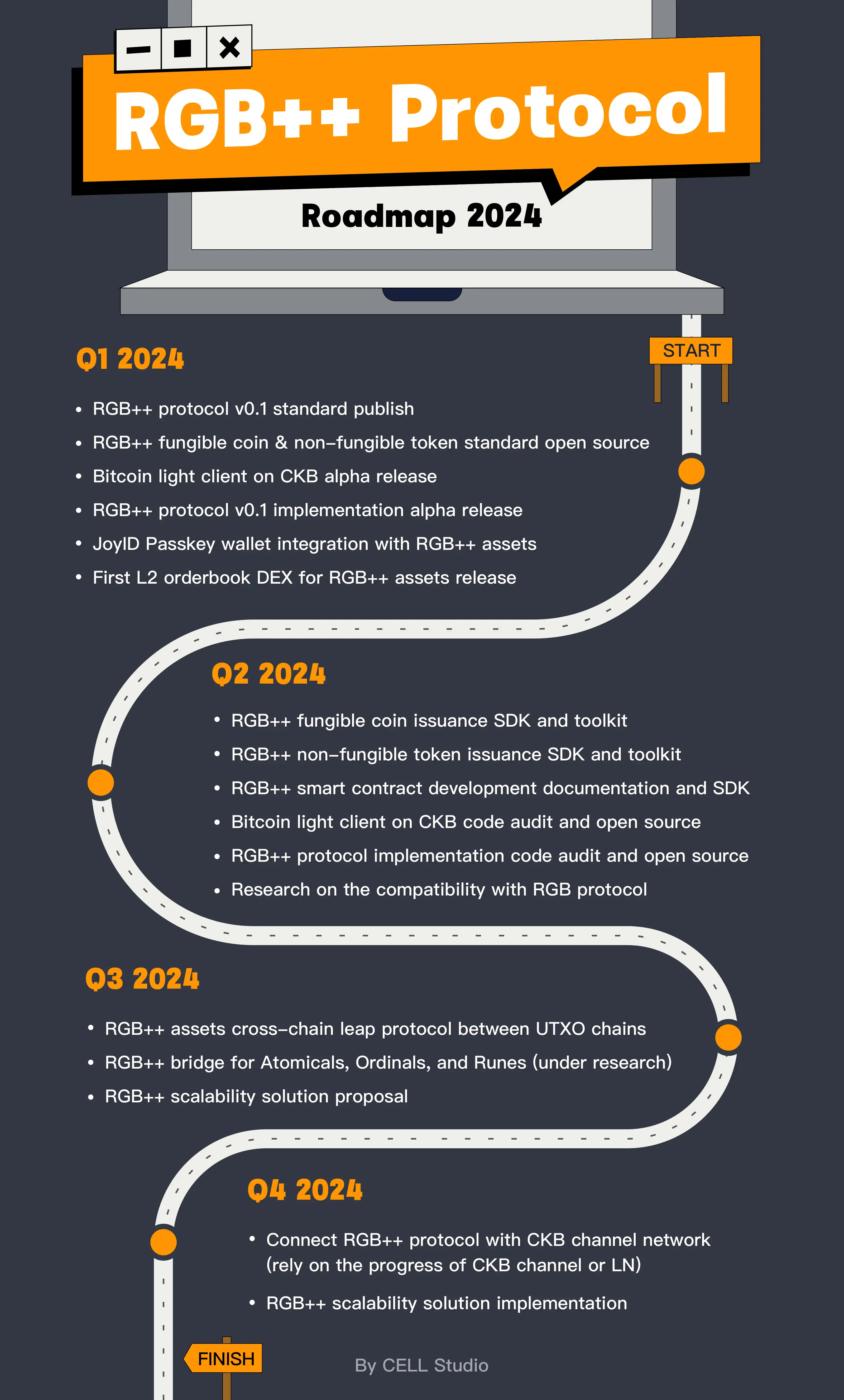
6. CKB link What exactly does Chuang's concept of isomorphic binding mean, and how do you plan to implement it?
This is a very good question, which is more technical. I am not a developer, but I can try to briefly introduce it.
Every Bitcoin transaction has an output, and every RGB transaction requires an OP_RETURN to be added to the Bitcoin output, which contains some hash data, called commitment. If this commitment happens to be the hash of a transaction on another public chain, and the input and output of this transaction are isomorphic to the input and output of that Bitcoin transaction, and the UTXO of the input and output on this chain, if its computing power and state storage capacity are Turing complete, then the transaction on the Bitcoin chain is completely bound to the transaction on this chain.
The CKB blockchain meets these conditions, so executing a Bitcoin transaction is equivalent to executing this transaction on the CKB chain, and the state change of this Bitcoin transaction is equivalent to the state change of this transaction on the CKB chain, and it complies with the contract constraints on CKB. This is the isomorphic binding technology. Of course, there are many technical details, such as how to ensure the consistency of the two transactions and how to prevent double spending. I will not introduce them here. Interested friends can read the RGB++ Light Paper, which contains detailed diagrams and cases: https://talk.nervos.org/t/rgb-protocol-light-paper/7733 7. Is RGB++ compatible with the Lightning Network? Why did CKB choose RGB++ for deployment? RGB++ is compatible with the Lightning Network. We are also considering working with the Lightning Network team, although they are mainly focused on payment and limited script functions. However, this depends on the progress of BTC's Lightning Network protocol. In theory, it is easy to integrate RGB++. We think it is the most appropriate way to bring these functions to CKB and empower it at the smart contract level.
In addition, CKB will also build its own lightning network, and the lightning network on CKB will be connected with the lightning network on Bitcoin in the future.
Why did CKB choose RGB++ for deployment? CKB is an open, permissionless public chain, and anyone can deploy any protocol on CKB. As mentioned in the previous answer, RGB++ was inspired by the RGB protocol, and the approach is to replace the client verification in the original RGB protocol with blockchain. So, which blockchain should be used to replace client verification? This blockchain must meet the following requirements: UTXO model, Turing complete support for smart contracts, and preferably a PoW mechanism so that security will not be compromised. After using these conditions to filter out, only CKB is left on the market, so RGB++ chose CKB.
It needs to be emphasized again that the RGB++ protocol originated from CKB, but it is an independent layer protocol. The future of RGB++ is unlimited, and it is committed to becoming the ERC20 standard of the BTC layer and expanding BTC.
8. What is CKB's plan for 2024?
I am the head of ecology and market, so I will briefly introduce CKB's plan for this year from the product and market levels.
The most important thing at present is the RGB++ protocol. The contract code has been deployed and is being tested intensively. Interested partners can also participate in the test network test. For specific information, please follow CELL Studio's Twitter. After completing RGB++, we may consider supporting other UTXO protocols, such as Atomicals, Taroot Assets, etc. In addition, we also plan to support BRC 20 or other assets through inscription bridges, and we are looking for partners to build these inscription cross-chain bridges.
In addition to RGB++, there is also Spore, a digital object creation protocol based on the full-chain concept. The first project based on the Spore protocol is Unicorn, launched by the SeeU community, and they are about to start drawing. There will be many ways to play in the future of the Spore protocol, so you can look forward to it. We look forward to bringing full-chain games to the Bitcoin world, Autonomous Worlds, from DOB-Game-AW.
In the future, we will also launch the UTXO Stack service, which supports one-click UTXO chain issuance, helping other project parties to quickly build a Bitcoin L2. The chain issued by UTXO Stack can use RGB++ to connect with the first layer of assets on BTC.
In addition, the team led by Jan is studying the lightning network. We plan to build a lightning network on CKB. The lightning network on CKB will be connected with the lightning network of Bitcoin. It is expected that there will be good news at the end of the year. This progress is currently beyond expectations. It is estimated that there will be an MVP Demo in the third quarter. Theoretical research has been completed, and the remaining are engineering issues.
In terms of the market, we held Bitcoin Singapore in March. At the Wanxiang Blockchain Summit held in Hong Kong in early April, we will co-host a Bitcoin-themed conference with Wanxiang and Bitcoin Magazine. During Token2049, we will also participate in some activities in Dubai, hoping to communicate with friends from Binance on site. We will also hold some activities in South Korea, Vietnam, Japan and other places. At the same time, we will also hold some activities in North America to connect overseas communities with Chinese communities.
9. Can and how can the RGB++ super protocol provide security for users' transactions?
The security of RGB++ can be discussed in two cases.
The first is L1 transactions, where the "holder" of the UTXO of the RGB++ transaction is Bitcoin's UTXO. That is, only by consuming Bitcoin UTXO can the RGB++ UTXO be operated or updated. In this case, although each RGB++ transaction simultaneously initiates a CKB transaction, its security has nothing to do with CKB, and CKB is only used as a DA and status announcement. In this case, the transaction security of RGB++ L1 completely inherits the security of Bitcoin, which is the longest-running and most secure PoW chain to date.
The second case is to leap assets issued through RGB++ from the Bitcoin chain to the CKB chain. Leap operations are performed through contracts, not through traditional multi-signature bridges across chains. The risk of Leap lies in block reorganization, which can be avoided by waiting for a few more blocks to be confirmed. On the Bitcoin chain, transactions are considered irreversible after 6 blocks are confirmed. The number of PoW confirmations and security are not linearly related. The difficulty of overturning PoW blocks increases exponentially with the advancement of blocks. Therefore, on the CKB blockchain, to achieve the same security as Bitcoin's 6 block confirmations, only about 24 block confirmations are required. The average block time of CKB is about 10 seconds, and the time for 24 block confirmations is actually much lower than the time for Bitcoin's 6 block confirmations.
After assets Leap to CKB, subsequent transactions are called L2 transactions, that is, transactions that occur 100% on CKB, and its security is the responsibility of CKB. From the beginning, CKB has adopted the same time-tested PoW consensus mechanism as Bitcoin to maximize security and decentralization. Currently, the mining machines used by CKB are produced by Bitmain, the world's largest AISC mining machine manufacturer. The current total network computing power of CKB exceeds 300 PH/s, which has set a record high. It is extremely difficult to forge or reconstruct a PoW chain because the computing power of each block needs to be recalculated, so we can trust the security of the CKB blockchain.
10. Does RGB++ actually only connect L1 and L2?
No. RGB++ can not only help users issue assets on the first layer of Bitcoin, but also the issued assets can leap to the CKB chain. CKB is Turing complete, so the assets issued through RGB++ can also participate in dApp and DeFi applications on CKB.
The isomorphic binding technology proposed by RGB++ can also bind or map assets issued by Bitcoin's first-level asset issuance protocols Runes, Atomics, Taproot Assets, etc. to CKB In Cell, Turing-complete contract extensions and performance extensions that do not require cross-chains or loss of security are brought to these assets.
Recommended
The Wall Street Journal: How is AI Trading Stealing the Limelight from Cryptocurrency?
Aug 15, 14:00
Tencent Still Has a Dream
Aug 15, 11:27
To Catch North Korean Hackers, They Set Up a Fake Project
Aug 15, 10:00
From Litigation to Settlement: Positive Signal Released by HTX's Negotiation with FCA
Aug 14, 19:32
11,742 Shipping Addresses Exposed Alongside Trezor Orders
Aug 14, 19:01
Founder Interview: FOMO Creator Explains How They Added 30,000 Users in One Day and Became One of the Fastest-Growing Crypto Apps
Aug 14, 18:37