Bull market phase review: The real bull market will come when a large number of new infrastructure and applications emerge

Original author: jolestar, co-founder of Rooch Network
Editor's note: Last weekend, the crypto market ushered in a wave of painful plunges, and the entire network was liquidated for more than $900 million. Bitcoin once reached $60,000. At the same time, altcoins followed the market and fell across the board, with ORDI, MEME and other coins falling by more than 20%. Rooch Network co-founder jolestar reviewed this round of bull market on X. He believes that the real bull market has not yet arrived. BlockBeats reprinted the full text as follows:
The waterfall washed my face, the group was wailing, and I was no longer excited on Twitter. I calmed down and reviewed this bull market in stages.
This bull market has not seen any replicable application models emerge. There is no grand occasion like ICO in 2017 and DeFi in 2020, where various projects were launched at the same time. So I always think that the real bull market has not yet arrived. However, there have been many attempts at new types of asset issuance models, such as new asset protocols on Bitcoin (Inscription, Atomicals, RGB/RGB++), inscription protocols on various chains, Meme Coin, Picture Coin, SFT, etc.
As a Builder, I look at the problem from the perspective of whether there is an opportunity to build applications. What are the revelations of these attempts? I have summarized two points.
First, Bitcoin's Inscription verifies that the model of defining asset data on the chain and verifying legality off the chain is feasible. It indicates a new way of issuing assets and expanding capacity, which I mentioned at https://twitter.com/jolestar/status/1732711942563959185. All protocols derived from Bitcoin, including RGB/RGB++ and Atomicals, belong to this paradigm and can be called client-side validation in a broad sense. This type of asset is between L1 and Offchain (L2). It can define a bridge within the protocol to realize the migration of assets from L1 to Offchain. This has been preliminarily verified by the RGB++ protocol, which is its transition mechanism. This capability indicates that one way of blockchain expansion is that assets overflow from Bitcoin to the infrastructure of Offchain (including other public chains), thus bringing prosperity to the entire blockchain ecosystem.
Attached is a picture I shared at the Bitcoin Layer2 Conference organized by @BTCSCYLab in Hong Kong:
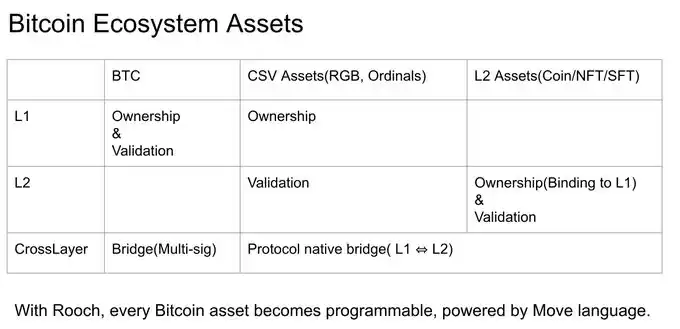
This model is different from the ecological paradigm of Ethereum. The application scenarios of assets are no longer limited to the smart contract environment provided by L1, but are provided through the smart contract environment of Offchain, so that the construction of applications has no technical bottlenecks.
If the technical bottleneck of building applications is broken, another problem is how to start the application. The traditional way is to build applications, attract users, and then issue assets. The way this wave of new asset issuance models wants to verify is to put assets first, build communities, and then build applications based on the community to provide usage scenarios for assets. This model has been initially verified to attract users and build communities, but the launch of applications still needs to be explored, and there are several problems to be solved:
1. Fair distribution can easily attract users and reduce fraud, but how to solve the initialization cost of building applications.
2. Building applications takes time, and assets with too high liquidity may not wait for the birth of applications. Therefore, it is more appropriate to initially issue low-liquidity assets, and then turn them into high-liquidity assets after growth, but how to switch seamlessly is a direction of exploration (ERC404, Movescriptions).
Although there are many problems, the advantages of this model are also obvious:
1. Assets come first, and applications are derivatives of assets, not vice versa, so that the life cycle of assets can exceed the life cycle of applications.
2. Only in this model can there be a combinable scenario where the same asset is used in multiple applications, and this combination capability is the most critical point that distinguishes blockchain applications from Web2 applications.
3. In this model, the application team does not need to issue assets, but can directly benefit by providing scenarios for assets, thereby solving the compliance issues faced by the Web2 application development team.
The combination of the above two exploration directions will promote the emergence of a large number of assets and applications. At that time, a hundred flowers will bloom, and it will be a real bull market.
Original link
Recommended
The Wall Street Journal: How is AI Trading Stealing the Limelight from Cryptocurrency?
Aug 15, 14:00
Tencent Still Has a Dream
Aug 15, 11:27
To Catch North Korean Hackers, They Set Up a Fake Project
Aug 15, 10:00
From Litigation to Settlement: Positive Signal Released by HTX's Negotiation with FCA
Aug 14, 19:32
11,742 Shipping Addresses Exposed Alongside Trezor Orders
Aug 14, 19:01
Founder Interview: FOMO Creator Explains How They Added 30,000 Users in One Day and Became One of the Fastest-Growing Crypto Apps
Aug 14, 18:37