Will Karak, a rising star in the rehypothecation space with $48 million in funding, launch a Vampire Attack against Eigenlayer?

Original Title: "Is Rookie Restaker Karak a Vampire Attack on Eigenlayer?"
Original Authors: Viee, Biteye
Rapidly emerging, Karak went from announcing a $1 billion valuation funding to launching an early access staking plan, and now supporting various assets, all in just about two months.
Seen as a rookie in restaking, what is Karak's background and how much of a splash can it make in the restaking race? How can one participate early in the Karak project to have a higher chance of receiving airdrops? In this research report, Biteye will take you deep into the Karak Network.
Karak Network is a restaking network, similar to Eigenlayer and other restaking projects, also using a point system to incentivize users to restake and earn multiple rewards.
In December 2023, Karak announced a $48 million Series A funding round led by Lightspeed Venture Partners, with participation from Mubadala Capital, Coinbase, and other institutions, where Mubadala Capital is Abu Dhabi's second-largest fund. In this funding round, Karak was valued at over $1 billion.

(Image: Karak Series A Funding Details)
In February 2024, Karak announced the launch of an early access plan, allowing users to restake on Karak to earn XP points. In addition to rewards from partner projects, users can also earn Karak XP. XP is distributed through the protocol and may eventually be airdropped by converting points into tokens.
Private access was opened on April 8, 2024. As of April 12, the total value locked (TVL) on different chains supported by Karak reached $140 million, with Karak Network accounting for the highest percentage at 48.5%, followed by Ethereum at 45.7%, and Arbitrum at 5.8%.
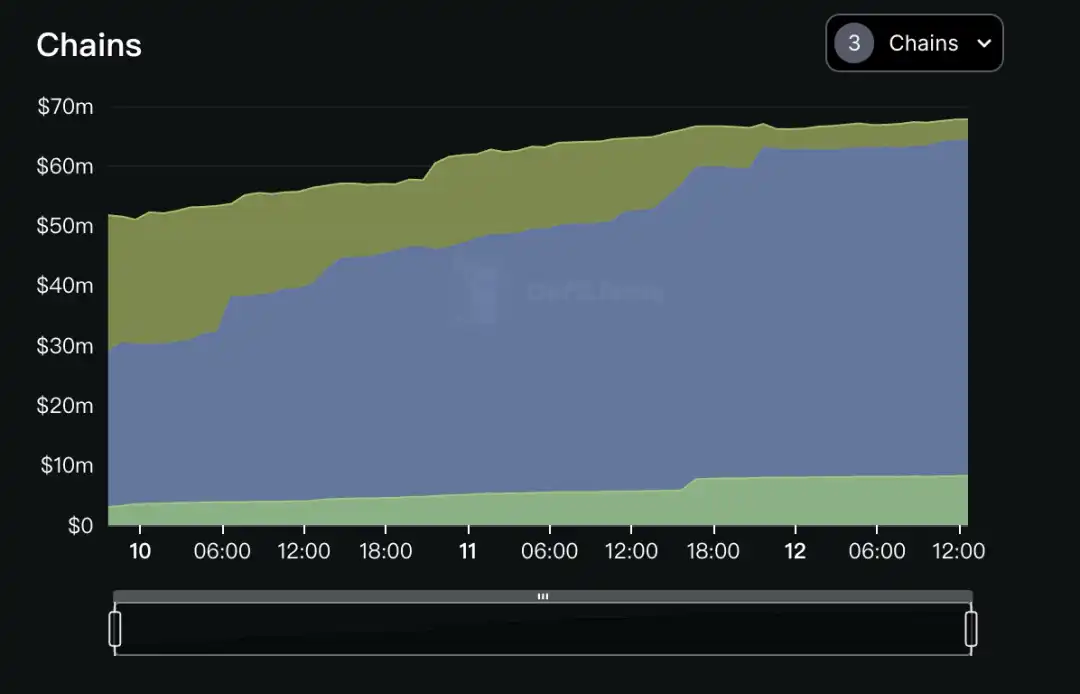
(Chart: Karak TVL on Different Chains, https://defillama.com/protocol/karak#tvl-charts)
The emergence of Karak has attracted significant market attention. Although the total value locked (TVL) is still far below EigenLayer, Karak has unique technical highlights that could challenge EigenLayer's dominant position in the staking field.
2.1 Karak Network: A Staking Layer with Multi-Chain Support
As a staking platform, Karak differs from EigenLayer, which focuses on Ethereum, by providing a platform that supports various assets, including ETH, Solana, and various Layer 2 tokens. This allows Karak to offer a secure solution across multiple blockchain ecosystems, leading to greater diversity and inclusivity. Currently, Karak supports networks such as Ethereum mainnet, Karak, and Arbitrum.
Here is a simplified breakdown of how Karak works:
· For validators, staked assets are allocated to Distributed Secure Service validators (DSS) on the Karak network, granting them additional execution rights over their staked assets.
· For developers, using Karak allows them to attract validators through simple, non-dilutive incentive measures. This significantly reduces costs compared to building a new trust network from scratch.
Karak serves as a bridge between developers and validators, where developers can incentivize validators with non-dilutive tokens.
The reason is that Karak eliminates the need for a new protocol to use highly dilutive reward mechanisms to attract and incentivize validators, avoiding large early token distributions to ensure network security. This setup reduces costs and complexity.

(Image Source: https://docs.karak.network/karak)
Karak has three technical highlights:
1. Multiasset Restaking: Karak introduces the multiasset restaking feature, which is a new security mechanism. Under this mechanism, users can restake various assets such as Ethereum, liquidity provider tokens, stablecoins, etc., to earn rewards. This multiasset restaking not only increases the user's potential earnings but also significantly enhances the security of various Dapps, protocols, and DSS.
2. Restake Anywhere: Karak internalizes a universal restaking concept, making secure restaking infrastructure accessible to anyone on any chain. This convenience allows developers to focus more on innovation and product development without having to spend a significant amount of time and resources on initial security measures.
3. Turnkey Development Environment: Karak enables new systems to tap into a powerful and secure trust network from the start, significantly lowering the barrier for new protocols to secure themselves and allowing these protocols to operate without complex security setups.
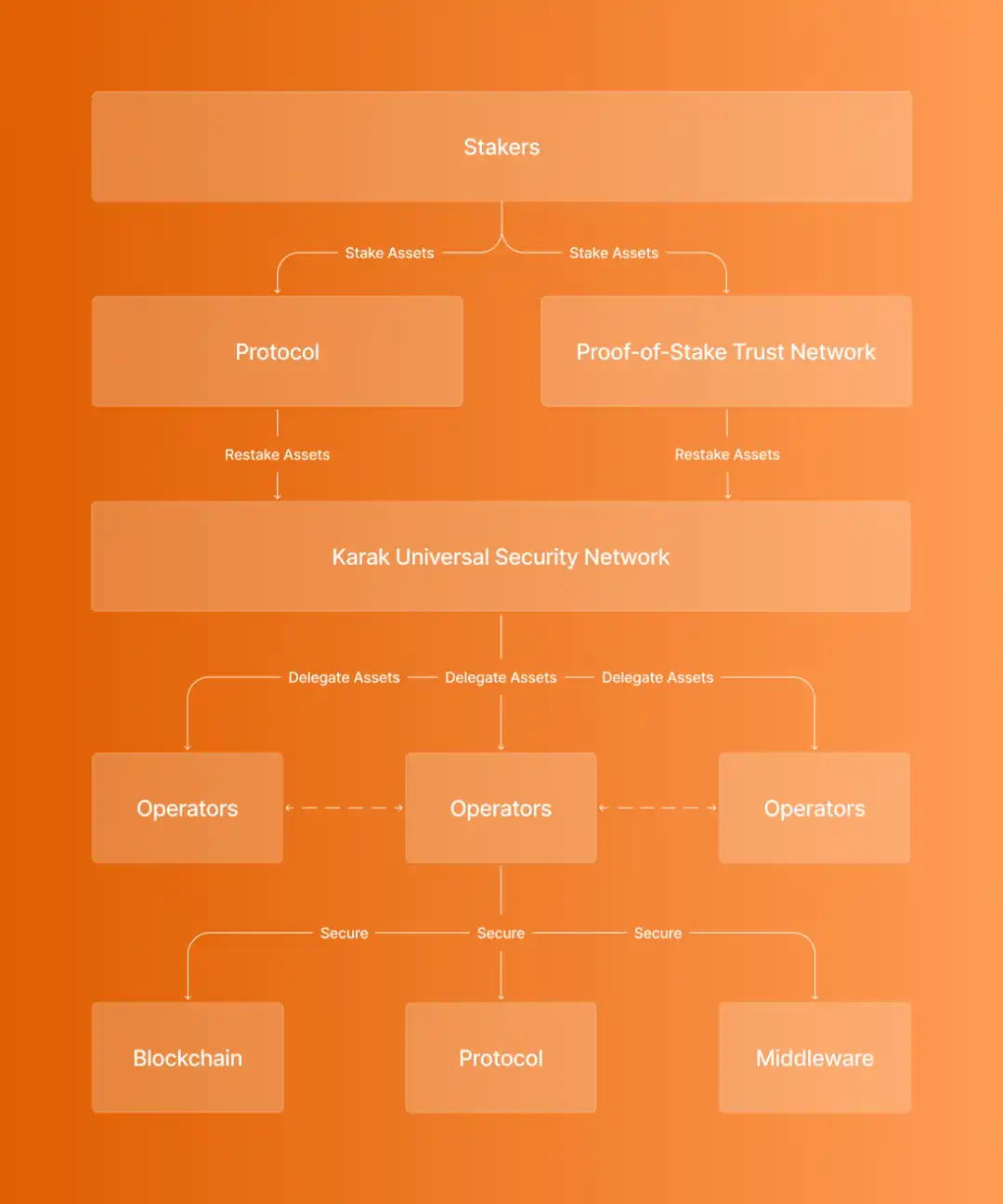
(Image Source: https://docs.karak.network/karak)
In summary, Karak's innovativeness not only provides users with the opportunity for multiasset restaking but also greatly simplifies the security assurance process for new protocols. These features collectively elevate Karak's competitiveness and attractiveness in the same domain.
2.2 Karak vs. EigenLayer Comparison
Like EigenLayer, Karak is a restaking protocol, meaning it allows staked assets like ETH to be restaked across multiple networks of validators, enabling validators to earn additional rewards. At first glance, Karak may seem like a copycat of EigenLayer, but comparing the technical paths of the two reveals some differences.
So why is it said that Karak is not an “Eigenlayer Fork” and what are the differences?
Reason 1: The dApp on Eigenlayer is called Actively Validated Service (AVS), while the dApp on Karak is called Distributed Security Service (DSS). This will be explained in detail in the next section.
Reason 2: The execution layer of Eigenlayer is on the Ethereum mainnet, but Karak has its own Layer2 (called K2) for sandbox testing, allowing DSS to be developed and tested on Layer1 before deployment on the mainnet.
Here we need to address the first issue: What are AVS and DSS? What are the differences?
AVS stands for Actively Validated Services, which is a concept in the EigenLayer protocol. AVS can be simplistically compared to “middleware,” providing services similar to data and validation capabilities to end products. For example, an oracle is not an end product but can provide data services to DeFi, wallets, etc., making it a type of AVS.
Understanding EigenLayer's AVS (Actively Validated Service) can be illustrated through a simple and vivid analogy:
Imagine Ethereum as a huge shopping mall, and various Rollup L2 (Layer 2 scaling solutions) are like stores in the mall. These stores need to pay rent to operate in the mall, which in the Ethereum world equates to paying GAS fees so that their transactions and state data can be validated, packaged, and stored on Ethereum's ledger in this “mall.”
In this analogy, Ethereum not only provides the physical space for the stores (block space) but also handles security (validating transaction legitimacy and consistency), ensuring that all store transactions are secure and valid.
EigenLayer's AVS is like providing an affordable service for small vendors (projects) that want to set up stalls outside the mall. These small vendors cannot or do not want to operate within the mall, such as mobile vendors (requiring liquidity), roadside vendors (prime location), but they also want to benefit from some mall services. AVS can provide services for them. Although the security may not be as comprehensive as that inside the mall, meaning there is a reduction in consensus security and lower costs. This can provide a solution for dapps that cannot be verified within the Ethereum EVM network, offering an Ethereum-external data or trust mechanism solution, allowing even small-scale projects to find a place in the vast Ethereum ecosystem.
This approach is especially suitable for applications with lower requirements for consensus security, such as some Dapp Rollups, cross-chain bridges, oracle services, and more. These projects may not need the highest level of security provided by the Ethereum mainnet, so by choosing AVS, they can obtain the necessary security verification services at a lower cost while still operating in a relatively secure environment. The emergence of AVS is actually expanding the boundaries of the Ethereum ecosystem, allowing a more diverse range of projects to join, especially those with limited resources but high innovation.
Similar to EigenLayer, Karak also has its own version of AVS called Distributed Secure Services (DSS). Unlike EigenLayer, which is limited to the Ethereum ecosystem, Karak introduces a new concept—providing re-collateralization services for multiple assets, allowing anyone to use any asset on any chain.
In an Ethereum-only environment, AVS needs to compete for every opportunity that provides Ethereum rewards, which is unsustainable without airdrop speculation. DSS, on the other hand, can onboard more assets from multiple chains, use re-collateralized assets to enhance security, and reduce operational costs. Compared to ETH, the opportunity cost for many assets is lower, meaning DSS has a simpler and more viable path to sustainable revenue.
Notably, the first AVS was launched on the EigenLayer mainnet on April 10 and 6 AVSs were subsequently released. Karak plans to launch the first DSS in the coming weeks.
Next, let's discuss the second question: What is Karak's Layer2 K2? How does it differ from Eigenlayer?
K2 is a Layer2 built on top of the Karak network.
Operating on Layer1 is relatively costly for developers and users, so K2 provides a new solution. Acting as a "sandbox" environment, it allows Distributed Secure Services (DSS) to be developed and tested on K2 before being formally deployed on L1 to ensure they are stable and secure before real-world application. Additionally, by adding custom precompiles that enable more validators to verify DSS, K2 not only improves efficiency and security but also enhances decentralization.
Compared to Eigenlayer, which uses the Ethereum mainnet as the execution layer, Karak has its own execution layer (K2) built on Layer2. This setup offers faster transaction speeds and lower transaction costs without sacrificing security.
Having understood the two questions above, we can see that Karak and EigenLayer have adopted differentiated technical paths, and this has also brought the most intuitive difference.
Karak supports a more diverse range of assets beyond ETH, planning to cover Solana, Tia, as well as Layer2 solutions such as Arbitrum and Optimism, aiming to create a cross-chain diverse staking layer. EigenLayer focuses on the Ethereum ecosystem, using ETH as the primary staked asset, unlike Karak's broader inclusivity.
We can use an analogy to aid understanding, imagine Karak as an international airport connecting multiple countries, welcoming travelers (assets) from around the world, whether they are large airplanes (Layer1 assets like Solana) or small private jets (Layer2 assets like Arbitrum). Karak's goal is to provide these travelers with a convenient, secure transit hub. In contrast, EigenLayer is more like a subway system designed specifically for a metropolis (the Ethereum ecosystem), focusing on serving the residents and visitors of this Ethereum city, providing professional, efficient transit services (transactions and operations).
In other words, Karak, while similar to EigenLayer, expands the range of staked assets, including Ether, various liquid staking Ether, and stablecoins, thereby increasing the range of choices available to users.
Indeed, this approach by Karak has proven to be effective. According to DefiLlama data, for stablecoins, for example, stablecoins account for approximately 19% of Karak's staked crypto assets, while in EigenLayer's staked crypto assets, stablecoins may be less than 0.27%, as shown in the following pie chart highlighting more differences.
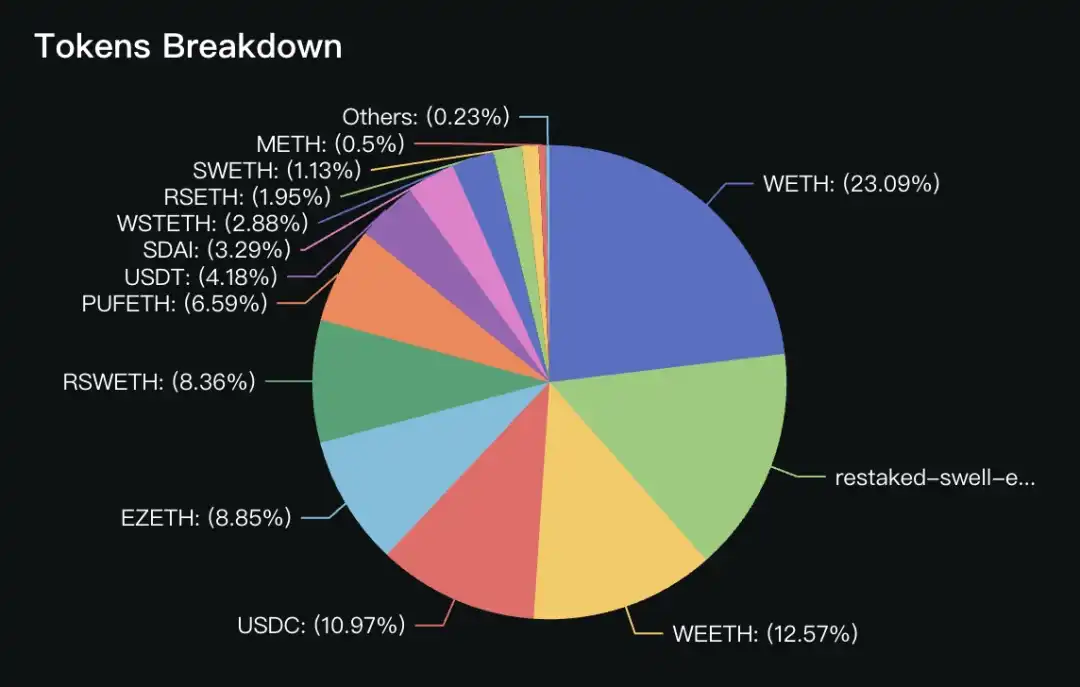
(Chart: Karak Staked Crypto Assets Breakdown https://defillama.com/protocol/karak#tvl-charts)

(Chart: EigenLayer Staked Crypto Assets Breakdown https://defillama.com/protocol/eigenlayer#tvl-charts)
Reflecting on SushiSwap's vampire attack on Uniswap, what if Karak launches its token before Eigenlayer?
First, we need to understand what a "Vampire Attack" is. A Vampire Attack in the crypto space is a strategy where a project (in this case, SushiSwap) attempts to siphon users and liquidity from another similar project (like Uniswap) by offering better incentives (e.g., higher liquidity provider LP rewards).
In simple terms, a "Vampire Attack" is a tactic used to drain liquidity from a target to increase its own liquidity and value, essentially performing a "vampiric" act.
In 2020, SushiSwap successfully attracted a significant amount of liquidity by forking Uniswap's code and introducing SUSHI as its native token. As Karak and Eigenlayer are protocols with similarities, a "Vampire Attack" scenario is not out of the question. If Karak launches its token first, we can speculate on the following potential outcomes:
1. Karak supports multiple assets, which may attract potential users seeking asset diversity for restaking. Executing a Vampire Attack could pose a challenge to EigenLayer.
2. Once Karak and Eigenlayer are running on the mainnet with multiple AVS/DSS, Karak could execute a Vampire Attack by moving staked Eigenlayer LRT assets from Eigenlayer to Karak. (Note: Karak allows re-staking LRT assets that have already been staked with ETH on Eigenlayer, essentially enabling the staked LRT to be restaked, creating a nesting doll effect.)
If Karak launches its token first, it will indeed attract LRT from the entire market. More importantly, Karak's own chain is already usable, with reasonable speed and fees. After all, one of Karak's prominent advantages is its execution layer, which distinguishes it as a competitor to Eigenlayer rather than a lesser entity.
Currently, the Karak project is still in its relatively early stages, and you can participate by staking on the official website to earn XP rewards. In the future, Karak's airdrop will likely convert these points into tokens. The amount of XP earned may depend on the timing and duration of staking and the number of new users brought in through referral codes.
Access the Karak Official Website Staking Interface
Official Staking Link: https://app.karak.network/
Currently Supported Staking Networks on Karak: Ethereum Mainnet, Arbitrum (L2), Karak (L2).
Staking Assets Supported by Karak: various LST assets such as mETH, various LRT assets such as pufETH, as well as USCT, USDC, sDAI stablecoins. Please note that the supported tokens may vary by network, so please confirm carefully.
Simply put, in the Staking rules, when Staking on Karak, you can simultaneously receive "Staking Rewards + Re-Staking Rewards + Eigenlayer Points + Staked LRT Points + Karak XP."
Currently, Karak is not a "one fish, multiple eats" like Eigenlayer. Instead, it allows you to earn higher returns by betting on other protocols when Eigenlayer is already "saturated," but with increased risk.

I recommend that you stake directly on Karak (the Karak L2 network mentioned above) to receive double Karak points. The specific steps are as follows.
First, add the Karak Network
Access Chainlist, select Karak Mainnet on the left
https://chainlist.org/?search=karak
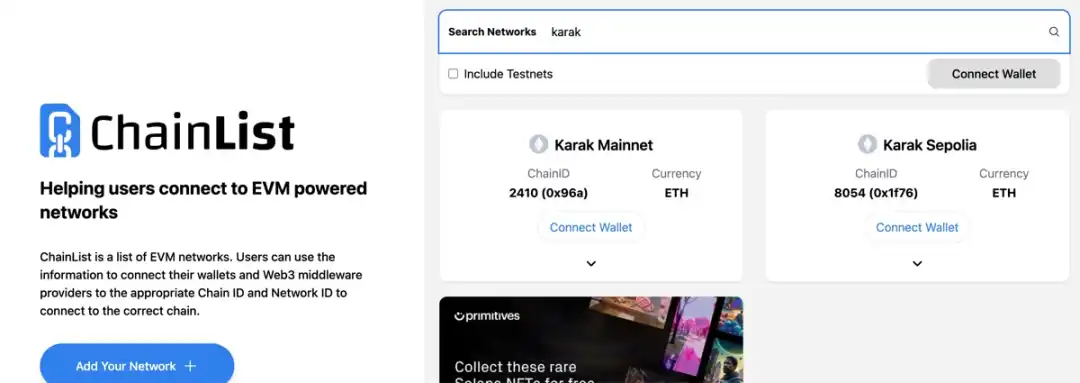
Next, bridge your assets to the Karak chain. If you choose to stake through the Karak chain, three tokens are currently supported: rswETH, USDC, wETH
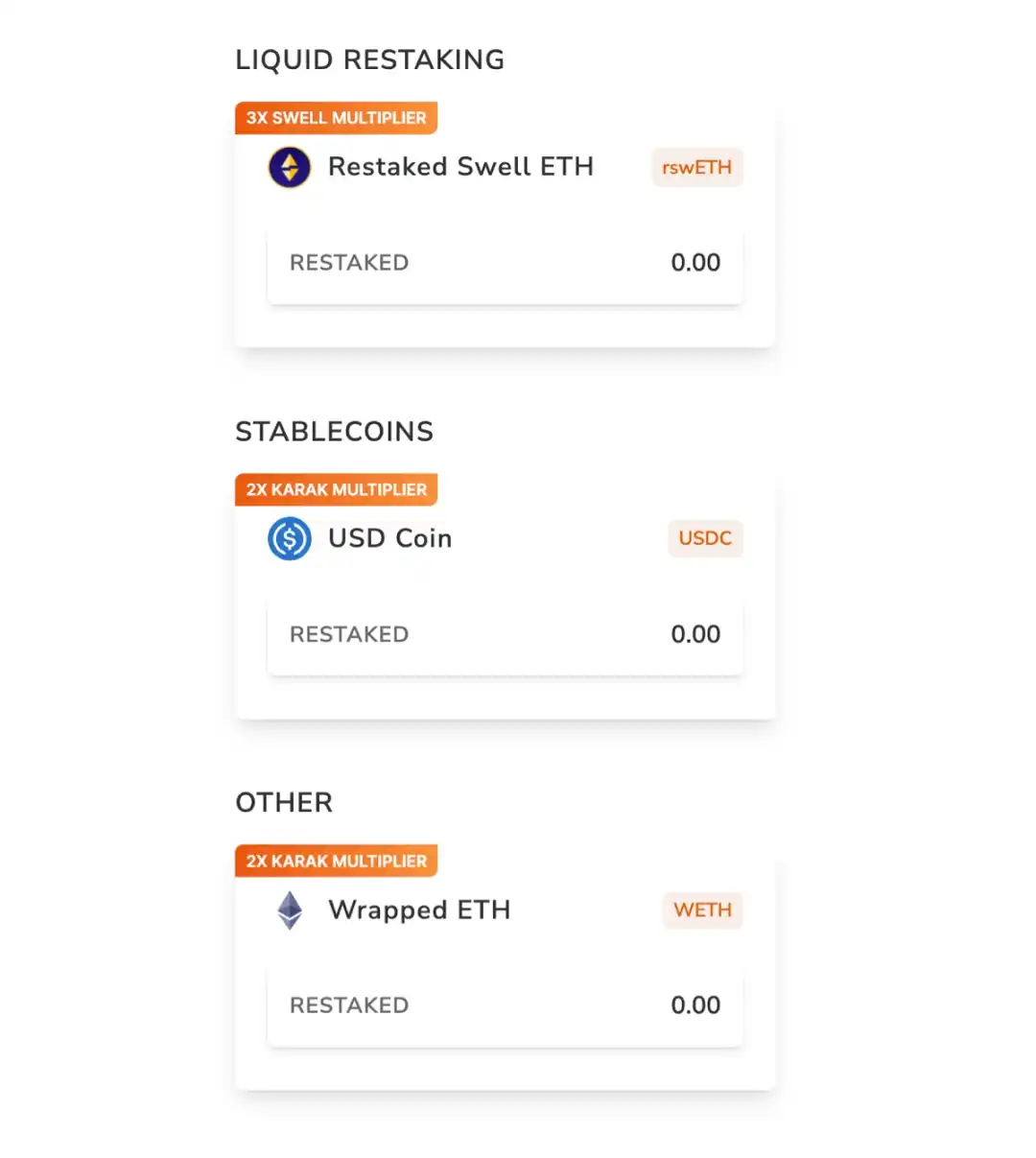
Staking rswETH has two scenarios:
1. If you have rswETH, you can bridge it to the Karak chain via the Karak official bridge.
2. If you do not have rswETH, you can stake ETH on Swell to receive rswETH (Swell only supports staking ETH on the mainnet and does not allow bridging ETH to the Karak chain before staking), then bridge to the Karak chain via the Karak official bridge.
Swell Staking Address: https://app.swellnetwork.io/restake%EF%BC%89
Staking wETH also has two scenarios:
1. If you already have wETH, you can bridge it from the Karak official bridge to the Karak chain.
2. If you don't have wETH, you can bridge ETH from the Karak official bridge or MiniBridge to Karak. When staking, simply activate Auto-Wrap ETH.
Karak Official Bridge and MiniBridge Addresses:
https://karak.network/bridge
https://minibridge.chaineye.tools/?src=arbitrum&dst=karak
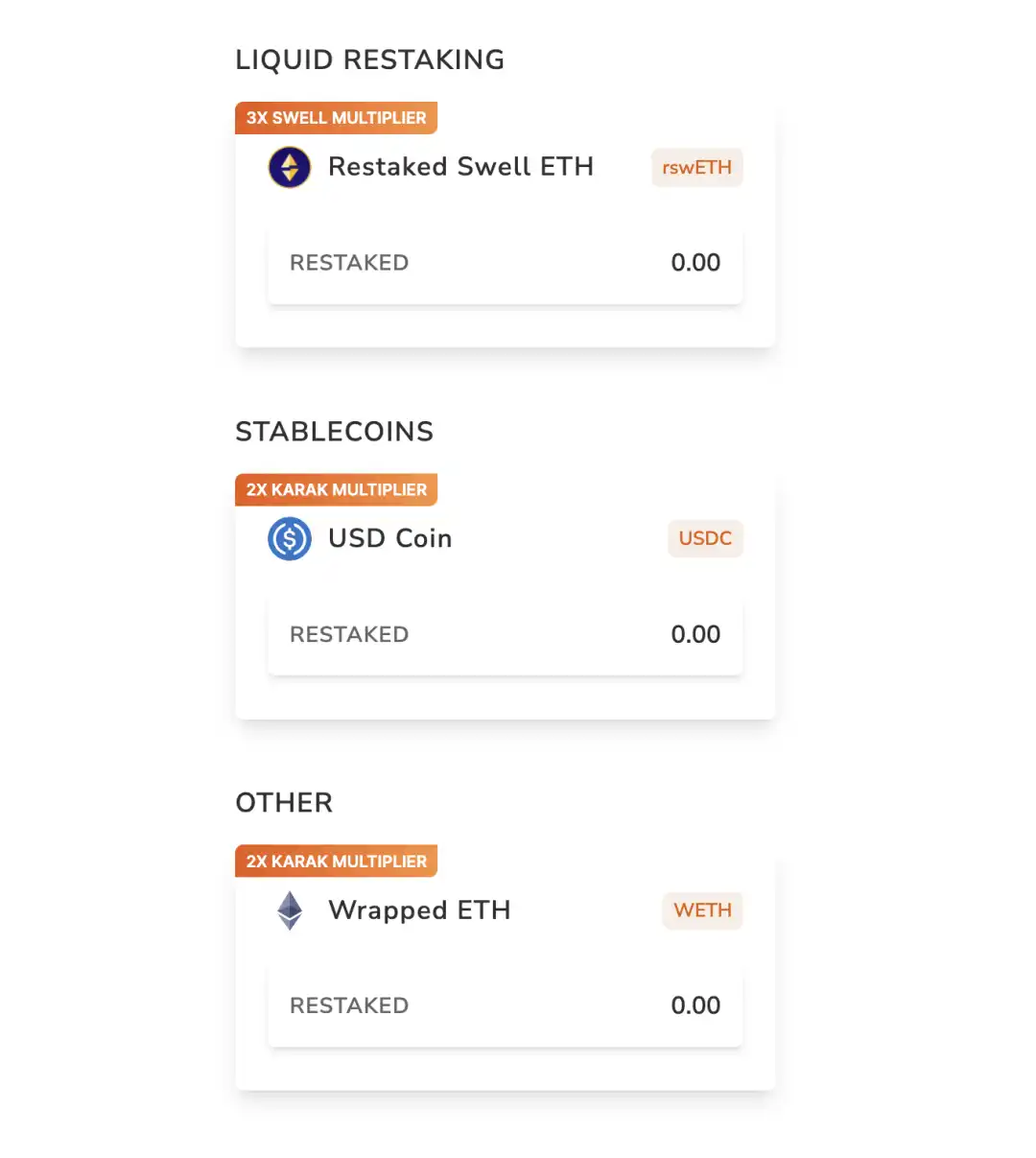
Finally, complete the staking in the Karak Pools.
Since the three supported tokens are not ETH, this means that when bridging, you still need ETH for gas fees. Specifically for WETH, if you bridge with ETH and choose max deposit, the first contract is a Deposit function, which essentially wraps the ETH. This can result in the ETH in your wallet disappearing, causing the second deposit to fail.
Recommended operations are as follows:
1. For staking rswETH and USDC, you can use the MiniBridge cross-chain tool to bridge a bit of ETH for gas fees.
2. For staking wETH, keep some ETH aside, and avoid clicking max. However, if you accidentally max out the staking, you can still use MiniBridge to bridge a bit more ETH.
MiniBridge supports bridging ETH from the mainnet to the Karak chain, supporting small-scale bridging with low fees.
Currently, the controversies surrounding Karak mainly focus on two aspects.
First, the team obtained funding at the end of 2023 and promptly launched the product in February of this year. As a staking project, there is currently less technical discussion, with more emphasis on marketing tactics such as "point activities" to seize market share.
Second, the Karak team's previous project's "self-insurance behavior" was criticized by the community, with some KOLs directly calling it a RUG. In response to this question, the team addressed it in the DC on April 9.
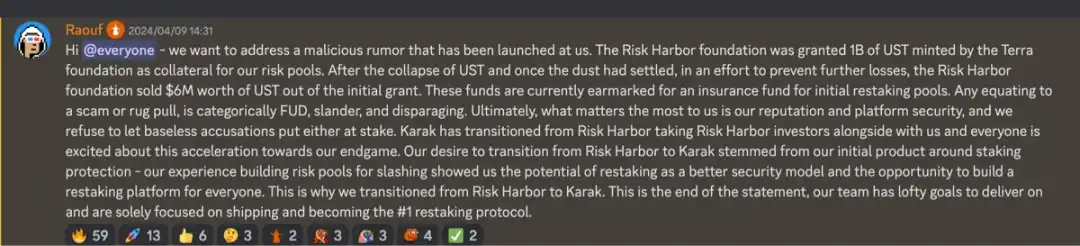
In any case, blockchain projects always come with smart contract risk and team risk, especially staking protocols that easily absorb billions of dollars. However, from the current market environment, new users tend to prefer projects with a strong investment institution and large funding background, while old users pay more attention to the project team's past.
How to balance risk and return has always been a concern for users.
As a newcomer in the staking track, Karak's $10 billion valuation and unique technical highlights have made it a possible challenger to EigenLayer's dominant position in the staking field. At the same time, Karak supports multiple LRT token staking, including but not limited to Swell, Puffer, Renzo, EtherFi, KelpDAO, etc., which also promotes the prosperity of the Ethereum staking ecosystem.
Perhaps sensing the "crisis," EigenLayer announced the removal of all deposit limits at 12:00 on April 17 Beijing time and reopened the deposit window.
Is it a conventional choice to choose EigenLayer or a bet on Karak for higher returns? This chess piece is currently in the hands of users.
Original Article Link
Recommended
The Wall Street Journal: How is AI Trading Stealing the Limelight from Cryptocurrency?
Aug 15, 14:00
Tencent Still Has a Dream
Aug 15, 11:27
To Catch North Korean Hackers, They Set Up a Fake Project
Aug 15, 10:00
From Litigation to Settlement: Positive Signal Released by HTX's Negotiation with FCA
Aug 14, 19:32
11,742 Shipping Addresses Exposed Alongside Trezor Orders
Aug 14, 19:01
Founder Interview: FOMO Creator Explains How They Added 30,000 Users in One Day and Became One of the Fastest-Growing Crypto Apps
Aug 14, 18:37