EigenLayer Staking: Potential Wealth Passcode or Hidden Risk?

Original Article Title: "EigenLayer Staking: Potential Wealth Key or Hidden Risk?"
Original Article Author: Fishery, Biteye Core Contributor
Recently, EigenLayer launched the first phase of the Eigen airdrop event, and the market excitement is high, seen as a leader in this bull market staking race.
Currently, Eigen has only enabled staking and cannot yet conduct transfer transactions. Therefore, whether to participate in Eigen staking is a highly discussed topic in the market.
To help everyone understand, this article will clarify the mechanism of EigenLayer staking, the rewards staking may bring, potential risks, and finally, the author will also discuss their views on whether one should stake EIGEN themselves.
First and foremost, it is important to clarify that EigenLayer's staking mechanism is significantly different from the ETH mainnet's PoS staking mechanism, and is more akin to the staking logic in the Cosmos community. From the staking interface structure to node airdrop marketing, it is full of shadows of Cosmos, so strategies from Cosmos can be referenced to some extent.
Re-staking is the act of reusing ETH already staked on the Ethereum mainnet to support the security of other projects. Through this method, users can not only receive rewards from their original stake but also increase potential rewards by supporting more projects.
Founded in 2021, EigenLayer is a pioneer of the re-staking concept. It is a middleware platform between the Ethereum mainnet and other applications. This platform, by deploying mainnet smart contracts, allows stakers to re-stake their ETH as well as ETH stake derivative tokens (LST) on EigenLayer.
Since its launch in June 2023, EigenLayer has experienced rapid growth, with a total staked value exceeding $10 billion, making it one of the largest blockchain protocols in the market, surpassing many major decentralized finance (DeFi) platforms such as Aave, Rocket Pool, and Uniswap.
Double Staking
Today, the $Eigen token has been introduced, and EigenLayer's accepted staking assets are no longer limited to ETH and ETH LSTs for restaking, but now also include $Eigen and the staking service for native tokens issued by various AVS in the future.
This is the innovative concept of Dual Staking introduced by EigenLayer: the "Restaking" service for ETH series tokens and the "Staking" service for Eigen native tokens collectively take responsibility for maintaining EigenLayer's security.
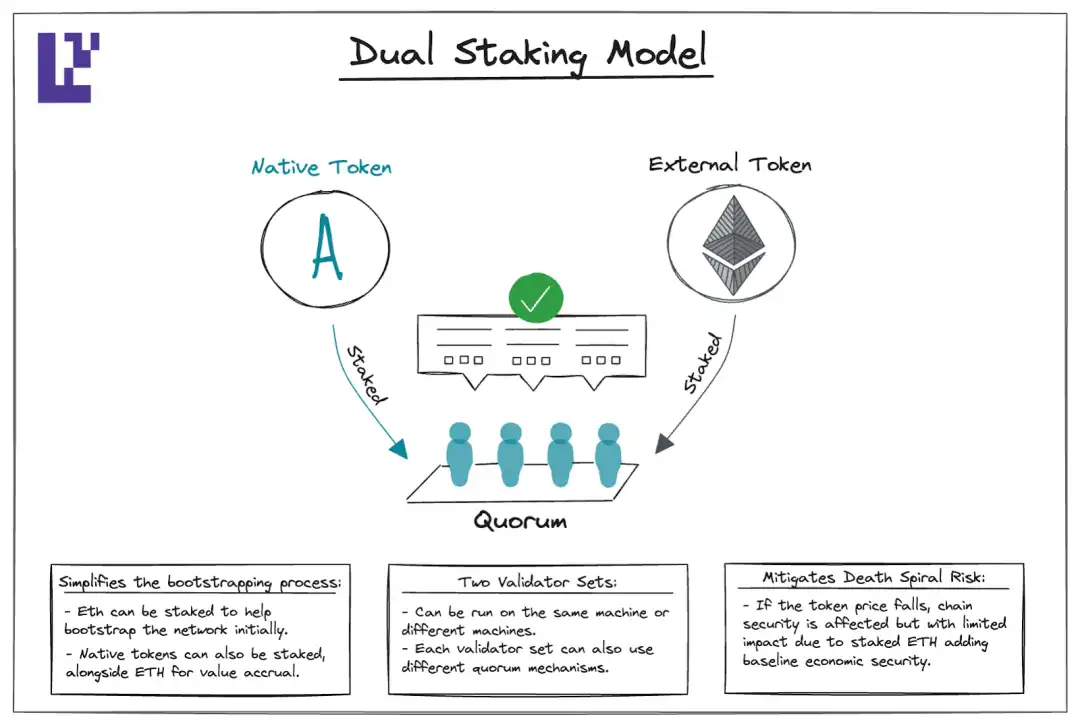
To understand Dual Staking, one must first understand Quorum.
In the context of EigenLayer, Quorum specifically refers to a set of assets (assets restaked/staked) used for Shared Security employed by AVS.
Node operators can choose to join one or more token Quorums based on the asset composition staked to their node and AVS design.
According to the official introduction, the AVS team can decide on the Quorum's numerical settings and asset composition, and the Quorum settings are not set in stone and can be changed after AVS launch to adapt to the market environment.
The innovation of Dual Staking mitigates security issues in traditional Proof of Stake (PoS) networks caused by massive native token emissions. By introducing more stable assets as security collateral, Dual Staking, through the introduction of externally quoted stable tokens like Ethereum, provides ongoing economic support to the network, thereby maintaining the overall security and stability of the PoS network.
Once the network operates smoothly, consideration can be given to adjusting the staking ratio of the two tokens, i.e., increasing the weight of the native token to enhance the network's autonomy and independence.
Although Dual Staking enhances the network's risk resistance and provides the project with a more diverse economic toolbox, it also brings new challenges and risks.
First, this mechanism to some extent undermines the sovereignty of the project token, weakening the value and utility of the network's original token, which may require more empowerment to offset the negative impact of sovereignty loss.
Additionally, this enhanced flexibility staking mechanism introduces a certain level of centralization risk, especially if the Quorum modification decision is not entirely transparent or widely participatory in the community, potentially involving centralized decision-making.
Furthermore, in the context of the EigenLayer project itself, under the same Dual Staking scenario, there is a differing treatment in unstaking time between the native token Eigen and the ETH series tokens.
The EigenLayer mainnet contract has set a 7-day withdrawal period for LST tokens and ETH restaking, while the withdrawal window for EIGEN tokens is 24 days.
The team's explanation for the withdrawal time differential is that in the future, EIGEN will be endowed with more unique features (requiring a longer unlocking time), but the specific feature that will make EIGEN's unlocking time three times that of ETH is still unknown.
This mechanism of setting an excessively long unlocking time in an opaque mechanism undoubtedly brings significant risk to EIGEN stakers.
In summary, while making a contribution to the project team from an economic perspective, providing a high degree of flexibility and scalability, retail participants need to exercise caution in practical operations, especially regarding critical protocol parameter settings and changes to the unlocking mechanism, to enhance vigilance against centralization risks.
EigenDA is a data availability storage solution developed by EigenLabs and built on the EigenLayer platform. The system has been live on the mainnet since the second quarter of 2024.
Due to the lack of specificity in EigenLayer's documentation regarding avs staking parameters, and as EigenDA is the first avs, we can catch a glimpse of EigenLayer avs staking parameter setting through EigenDA's parameters.
The active operator nodes of EigenDA on the mainnet and Holesky testnet are limited to 200. According to the documentation, this limitation is due to the cost of bridging EigenDA's availability proof to the Ethereum L1, and it is expected that with technological improvements, this cost will decrease, thereby potentially relaxing the operator limit.
The documentation specifies a minimum staking asset requirement for nodes:
An operator joining Ethereum (ETH) must stake at least 96 ETH; whereas an operator joining the EIGEN group must stake at least 1 EIGEN.
Compared to the currently newly launched PoS public chains, the number of nodes on EigenDA is not large, on the same order of magnitude as the Cosmos ecosystem, and with a set limit on the number of nodes.
In contrast, other well-known PoS public chains do not limit the number of nodes but choose to set a minimum staking asset requirement. For example, Solana and Avalanche have over 1700 nodes, while Ethereum has over a million validators.
From both an asset and quantity perspective, EigenDA has imposed restrictions on the node group, under such stringent conditions, it is not surprising that there is a shortage of nodes meeting the asset requirements under the avs-set 200 limit. For example, at present, there are only 147 active EigenDA nodes.
Of course, the number of nodes and network security are not directly correlated, just for reference and comparison.
When the number of operators reaches the limit (200 operators), a new operator must possess a group weight at least 1.1 times higher than the current lowest-weighted operator in order to replace that operator.
However, there is a major hidden challenge here, which is also one of the core issues that restaking aims to solve:
A regular PoS chain can easily audit the native asset status within nodes, autonomously update the valid set of nodes based on rules. EigenLayer, on the other hand, is different because restaked assets are on the Ethereum mainnet, and EL nodes cannot directly access the dynamics of the Ethereum mainnet.
Therefore, a secure, decentralized mechanism is needed to prove that the upper-level node meets the requirements.
If this step cannot achieve decentralization, then malicious actors may illegally replace legitimate nodes and thereby attack the EL consensus.
The challenge lies in the fact that considering the use of smart contracts to solve this problem is unrealistic because the on-chain sorting or maintaining a priority queue involves high computation costs and complexity.
To address this issue, EigenLayer takes a step back and introduces a combination of an off-chain Churn Approver and on-chain smart contract checks.
When the network reaches the operator limit, if a new operator wishes to join, the new operator can request a signature from the "Churn Approver," who will verify if the new operator meets the financial requirements, provide a signature, and finally, the signature and operator change information will be input into the EigenDA smart contract on the mainnet.
Although this mechanism relying on off-chain signatures provides operational convenience and flexibility, it also introduces a certain level of centralization risk.
The off-chain signature process may be impacted by improper actions of the approvers or system security vulnerabilities, thus affecting the decentralization and security guarantees of the entire network.
In addition, not mentioned in the documentation is the risk of the Churn Approver going offline. If off-chain validators do not respond to the new node's onboarding request, EigenDA's validators cannot perform replacements according to the rules, and excluded validators can still participate in validation, posing a significant risk.
Therefore, extra attention is required from users for any part of the process that involves off-chain mechanisms.
The Punishment and Reward (Slash & Reward) mechanism is the core mechanism of all PoS networks, but due to the rushed launch of EigenLayer, the slashing function has not been properly implemented yet.
Everyone should be very familiar with the reward part, which includes APR yield and expected airdrops. The punishment (slashing) part, on the other hand, is more complicated. If an operator fails to fulfill their duties, such as node downtime/offline for a period of time, or double signing, the funds of users delegating to this node will be subject to a percentage deduction, and the node's APR emissions may also be suspended.
It is important to note that EigenLayer has not yet disclosed details, and the above introduction of the punishment and reward mechanism is based on summaries from other PoS projects.
In the author's view, this operation is quite unreasonable because when users participate in restaking, these rules are not yet online, and most people are not aware of the existence of slashing. Therefore, one day in the future, if the delegated node behaves maliciously or fails, users will unknowingly lose their funds.
From a fund security perspective, if restaking users should try to diversify their stake among different operators. This way, risks can be spread, and if slashing occurs, only a portion of the funds will be lost.
According to EigenLayer's marketing reward direction in its ecosystem, choosing the most well-known nodes with a token airdrop plan for restaking obviously can achieve the highest expected return. However, this incentive measure contradicts the original intention of maintaining decentralization.
Restaking, as an emerging technology, is attracting widespread attention both inside and outside the industry. In particular, according to a report on March 15, the co-founder of the largest Ethereum mainnet staking protocol Lido and Paradigm are secretly funding a new project named Symbiotic to enter the restaking field, which confirms the industry trend.
However, despite the huge development potential of the restaking market, the technical challenges faced by EigenLayer discussed in this article should not be underestimated. Especially when the Ethereum mainnet has not included restaking in an EIP.
Currently, the proposal on how to get the mainnet to acquire EigenLayer exit validators has not been finalized, which has brought about some uncertainty. The imperfect technology increases the risk of participating in restaking, especially in a scenario where assets may be slashed.
Currently, EigenLayer's design is more inclined towards economic benefits rather than technology. If technical issues can be resolved, a project specializing in economic benefits will undoubtedly bring significant returns.
Overall, EigenLayer has demonstrated tremendous market potential and room for growth in the recent staking wave. While facing some technical and standardization challenges, these are all stepping stones on the path to growth.
As these issues are gradually resolved, we have reason to believe that EigenLayer will be able to accelerate innovation while achieving its long-term economic goals.
Original Article Link
Recommended
The Wall Street Journal: How is AI Trading Stealing the Limelight from Cryptocurrency?
Aug 15, 14:00
Tencent Still Has a Dream
Aug 15, 11:27
To Catch North Korean Hackers, They Set Up a Fake Project
Aug 15, 10:00
From Litigation to Settlement: Positive Signal Released by HTX's Negotiation with FCA
Aug 14, 19:32
11,742 Shipping Addresses Exposed Alongside Trezor Orders
Aug 14, 19:01
Founder Interview: FOMO Creator Explains How They Added 30,000 Users in One Day and Became One of the Fastest-Growing Crypto Apps
Aug 14, 18:37