io.net has gone viral, who is paying for AI narrative?

Three months ago, in the first phase of io.net's points incentive activity started on March 1, Ahmad Shadid, founder and CEO of io.net, said in a press release interview that the token is expected to be launched on April 28. Even though the number of GPU supplies of io.net surged in the following month, io.net CMO Garrison said in an interview in early April that "io.net" is still on schedule to release tokens, coinciding with the release of Nvidia's financial report, which will be an appropriate time."
But on April 25, the io.net team announced in the telegram group that the trading platform required the TGE of io.net tokens to be postponed until after April 28. Now a month has passed since the initial time, and the time for io.net to issue the token is still undetermined. But after the snapshot, the community no longer seems to care about io.net.
Since the start of the mining incentive plan, io.net has undergone earth-shaking changes in the past three months. First, it became popular and was regarded as the star project of this round of bull market. Then, the project data was repeatedly questioned for fraud, and the founder was exposed for his black history. A large number of users set up rights protection groups to "denounce io.net". Although the token has not yet been launched, many users believe that the high return expectations have been dashed, but "in general, io.net is a good project."
After all, everyone understands that outside of io.net, the market has turned. Ten days ago, amid the community's dissatisfaction with "high FDV" projects, Binance announced that it would modify its listing rules, saying that it would begin to support small and medium-sized crypto projects, aiming to provide opportunities for more small and medium-sized projects with good fundamentals, organic community foundations, sustainable business models and industry responsibility, so as to promote the development of the blockchain ecosystem. And just today, after a month of delaying the issuance of coins, io.net announced that the third mining activity will start on June 1.
Looking back, the explosion of io.net two months ago was inevitable. Since February, AI has become the recognized wealth code of the crypto community. Nvidia's stock continues to hit new highs, OpenAI launches revolutionary new products, WLD has increased several times in a few days, and a number of AI tokens have outperformed most track tokens.
Well-equipped retail investors queuing to enter the market
According to the development of previous stories, some new projects in the AI sector should be able to emerge in this round, and lucky early community users will benefit a hundredfold. Adhering to the concept of "buy new, not old", among all AI projects, io.net is the one that looks the most "reliable".
Generally speaking, the community generally divides the combination path of AI and Web3 into three sub-directions: computing power, algorithms, and data. Two months ago, many new AI projects emerged, among which GPU leasing was the most popular positioning among a number of projects. The reason is that, at the level of popular science, most retail investors find it difficult to understand the positioning and development space of similar projects in terms of the combination of AI models, applications and encryption technologies. The continuous rise of Nvidia has made everyone realize the necessity of "computing power", and the direction chosen by io.net has a natural advantage in user cognition compared to other projects.
In essence, the decentralized computing power projects that have emerged at present all belong to the category of Depin, and the Depin project on Solana has experienced a hot market last year. The three concepts of AI, Solana, and Depin are superimposed together, making io.net a "chosen project". In addition to the good track selection, io.net also had in-depth cooperation with Render Network in the early days. At that time, RNDR was in an upward cycle, rising from less than $4 to $13 in two months. In February and March, there were almost no KOLs promoting io.net on social media. But since io.net launched the two-month Ignitio.netn points reward plan on March 1 and directly announced the token launch time - April 28, a large number of users have flocked to io.net. An early user who participated in io.net told BlockBeats about his observation that "the number of discord community members has increased tenfold in a week."
On March 5, io.net announced that it had completed a $30 million Series A financing led by Hack VC, with other investors including Multicoin Capital, 6th Man Ventures, Solana Ventures, OKX Ventures, Aptos Labs, Delphi Digital, The Sandbox and other institutions. Among them, Multicoin Capital had a brilliant record in the Depin field and participated in the early financing of Helium Mobile (MOBILE). In addition, individual investors include Solana co-founder and CEO Anatoly Yakovenko, Sandbox co-founder and COO Sebastien Borget and Animoca co-founder and executive chairman Yat Siu.
With the support of powerful VC, in the io.net project, how to overcome the technical difficulties in the process of realizing decentralized computing power and whether there is a suitable and sufficient demand side to pay users and platforms are not within the scope of consideration of participants. "From the user's perspective, I am not afraid of whether you can land or not, I just look at how well you tell the story."
The technical participation threshold of io.net is not low. BlockBeats observed that at the beginning of the event, there were bug feedbacks everywhere in discord, and the project party specially opened a channel "support ticket" to receive and handle user-submitted questions. An early user who participated in io.net once told BlockBeats that "high participation threshold" was also one of the reasons why he was optimistic about io.net, which means "no roll", and you can get more chips. But what the community did not expect was that various io.net mining tutorials later became popular all over the Internet.
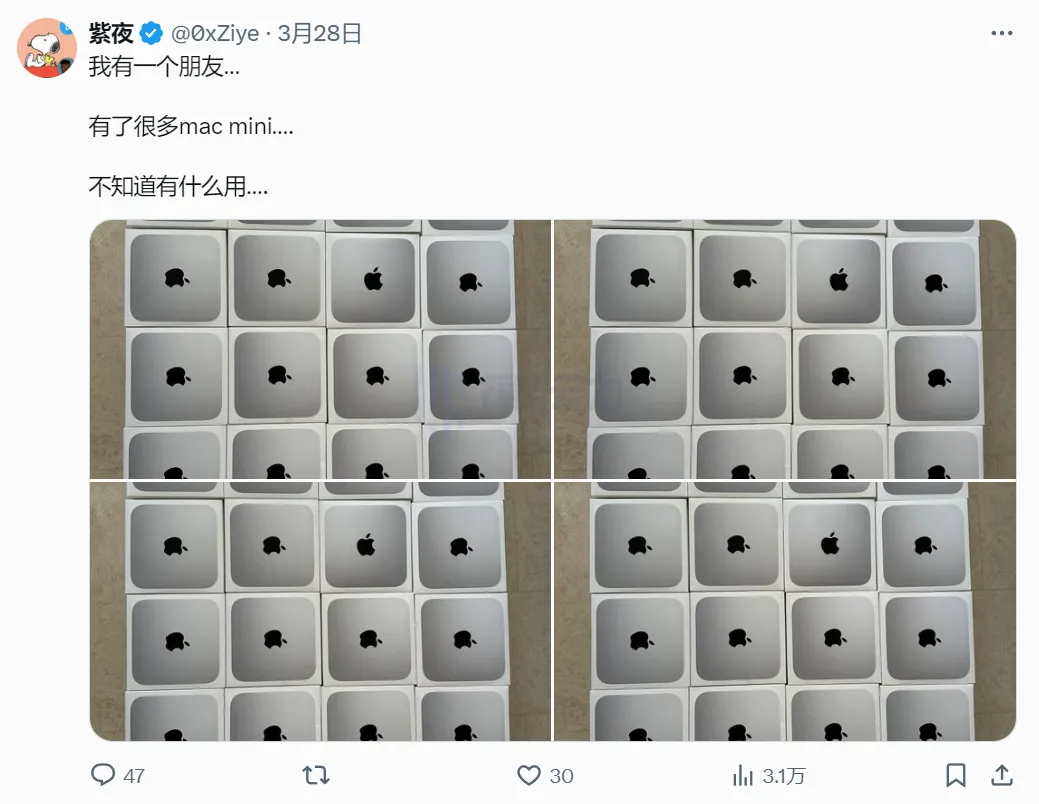
io.net user Zhu Rui (pseudonym) described his experience in detail to BlockBeats. During his first attempt, Zhu Rui gave up participating after discovering that his equipment did not meet the requirements listed on the official website. But then he found that more and more people around him were digging io.net, and many people posted multiple Mac minis, "I have a friend... He has a lot of Mac minis... I don't know what they are for..."
Perhaps out of precaution against "Lu Mao Studio", io.net did not announce the points details, only stating that the points will be related to multiple factors such as the machine's online time, bandwidth score, GPU performance and equipment rental time. In addition to contributing their own equipment, participation in Galaxy Missions and Discord activity will also bring varying points, but more users choose to buy more equipment on their own and enter the market fully armed.
Not wanting to miss out, Zhu Rui began to consider entering the market. He studied the configuration schemes circulating in the community in detail, and first considered buying a Mac mini directly. "This strategy is suitable for players with a small number of graphics cards, because it is troublesome to configure more than 100 graphics cards, and special people are needed to maintain them in special venues. Just like a mining plant, it is a heavy asset. But there are also advantages. After use, you can sell it second-hand at half the price, or switch to mining other projects." When researching, he speculated that there may be a trend in this direction. "Earlier, the price of buying a Mac mini on Pinduoduo was 2,100 (RMB), and two weeks later it was 2,800."
In addition to purchasing Mac mini, some users choose to rent cloud servers. "There are domestic and foreign ones. Domestic ones are generally in some computing centers, with low costs and channels. A single 3080ti card is about 150u-200u." The cost overseas is higher. "The price of a single card in Google Cloud is about 1400u per month, and an annual lease is required, requiring more than 50 cards; Tencent Cloud is often out of stock and has no inventory; the price of a single card in AWS is about 2400u per month, requiring more than 8 cards."
Zhu Rui finally chose the "premium account" route. He bought more than 200 T4 single cards from a small foreign cloud service provider, renting each card for 400U per month. In addition, he also equipped 15 a100 8 cards, renting each card for 1200U per month. In one month, Zhu Rui had to pay about $98,000 for equipment alone.
In addition to the cost of equipment, Zhu Rui also made sufficient preparations for anti-witch detection. He purchased hundreds of IPs, manually modified the passwords of 100 Google mailboxes he bought, and spent a week running through all the equipment.
Zhu Rui is one of the larger users of io.net. For small and medium-sized retail investors, after successfully "entering the market" with good equipment, they still have many tests to face.
An io.net user recalled to BlockBeats that after going through the complicated configuration process, users still need to deal with a series of problems. Devices connected to io.net often go offline, but it is difficult for users to tell whether their devices are online. "It is possible that your front-end shows that the device is online, but the back-end is actually offline. We have no choice but to write a script that automatically restarts the connection every day to deal with this problem."
In addition to spending a lot of money, io.net users also need to constantly check the operation of their devices. For those who are not able to write scripts, they can only reconfigure manually. In a configuration tutorial on Youtube with more than 10,000 views, the airdrop blogger was also at a loss for this problem. "If you can't see the device running status on the official page after completing these configurations, I suggest you do the whole process again."
The high maintenance cost is actually in the setting of io.net. The official explanation is that the continuous reconfiguration of users is to filter out witch accounts. In the later stages of the event, this frequency has been greatly reduced. This was also interpreted as a positive signal by some users at the time. After all, "the bigger the waves, the more expensive the fish." For "battle-hardened" Web3 players, as long as the rewards in the later stage are sufficient, the early physical and mental investment is worth it.
"Cloud service providers are all mining io.net"
The popularity of io.net has not diminished due to users' complaints about high maintenance costs. The title of a video published by Youtube blogger "Alex's Encrypted Diary" two months ago may be the most appropriate explanation of the situation at the time, "[io.net] The most reliable combination of computing power and encryption in the AI X Crypto track. Two weeks ago, we planned to mine io.net with 600 machines, and the dream of the computer room was shattered two weeks later! But this is undoubtedly the best project in the same field before the release of Gensyn."
In the video, blogger Alex explained the reason for the "broken dream of the computer room". It was originally planned to deploy 800 devices, and the estimated capacity could account for about 1%-2% of the entire network. After finding a computer room overseas, io.net began to become popular during the price negotiation. All overseas cloud service providers that had been contacted before asked them to confirm whether they were mining io.net. The computer rooms that had originally agreed on pricing also doubled their quotes.
io.net has become popular, and domestic and foreign cloud service providers who have raised prices may be the biggest winners in this wave of popularity.
At present, there is no channel to calculate the specific profit figures of cloud service providers in this wave of fortune brought by io.net. Alex once said in a tweet that Amazon Cloud, a leading foreign cloud service provider, has generated a total of US$40 million in revenue from providing services to mine io.net. Although there are more doubts about this number in the comments section, if we count it based on the hundreds of thousands of GPUs displayed on the io.net front end at the time, this number may not be exaggerated.
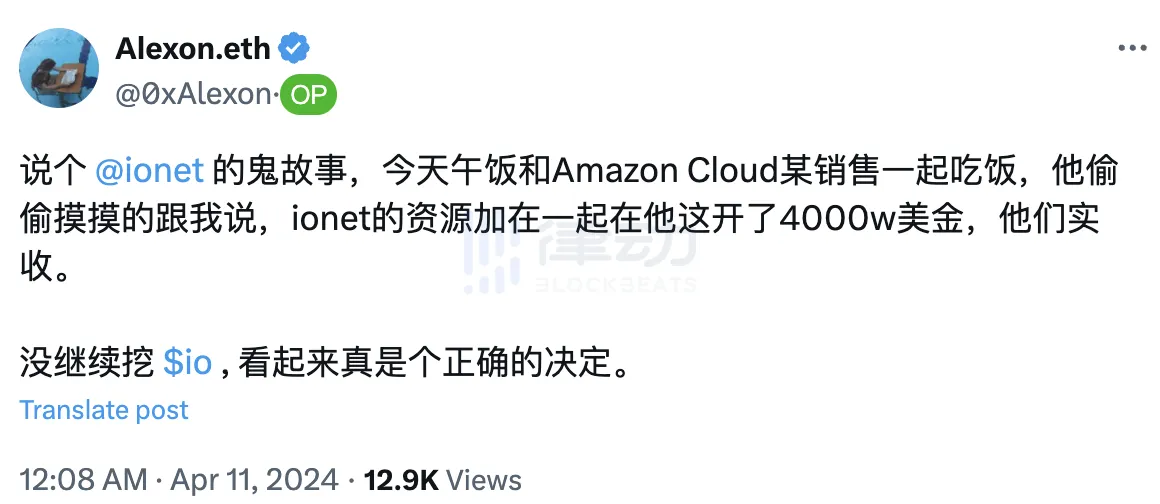
Not only overseas cloud service providers benefited,many users interviewed by BlockBeats expressed the same understanding: "All domestic cloud service providers are digging io.net."
Xiao Ju (pseudonym), a cloud server manufacturer with computer room resources and no retail investors, revealed to BlockBeats, "Looking back now, renting machines from io.net is the easiest business I have ever done." When asked about the specific rental scale, Xiaoju said, "As long as you have enough machine resources, it is easy to rent out machines worth millions a month, tens of millions is not difficult either, and machines worth hundreds of millions can be rented out with some effort. All kinds of domestic cloud and overseas cloud machines are all sold out, and almost all domestic computer rooms are rented out. At that time, all machine vendors in the market raised the price. It is up to you to rent or not. If you don't rent, someone else will rent it soon."
In addition, since the devices supported by io.net also include Apple’s Mac mini, “those who took advantage of the airdrops bought all the Mac minis worth tens of billions on Pinduoduo and raised the price by hundreds of yuan, and the Mac minis on Xianyu also increased in price by hundreds of yuan.”
Even in April, when the first phase of io.net’s incentive activities was more than halfway through, users continued to try to buy more devices. Xiaoju recalled, “I stopped renting machines after April, but many people still came to me to rent. I replied that it was not cost-effective to rent for a month, and that I would basically get it back if I rented it, so I didn’t do it anymore. It’s too tempting.”
According to the stories that happened in the crypto industry in the past, users who invested in io.net have all applied the right formula. If you face the risk of being reversed, you will inevitably have a lot of emotions. However, for a Web3 project, the io.net project itself has not done too much "evil", constantly improving the interactive experience, and can respond quickly when facing disputes. But all kinds of problems have indeed occurred, and io.net has often faced embarrassing situations in the past three months.
After the first round of points were announced, many users received very low points because their machines were not online during the snapshot period, and some rights protection actions directed at the io.net project began to appear in the community. Zhu Rui recalled that on May 3, someone on Twitter launched a space called "io.net Criticism Conference", with more than 1,000 users participating without preheating, and the WeChat group was full of rights protection information.
Unclear points
Unlike other projects with clear points, io.net did not seem to have planned to release a points panel from the beginning. BlockBeats asked a user close to the io.net project team about the problem of displaying statistical points on the front end in early March. He speculated that "it may be due to lack of manpower. If there is a chance, I will propose it to them."
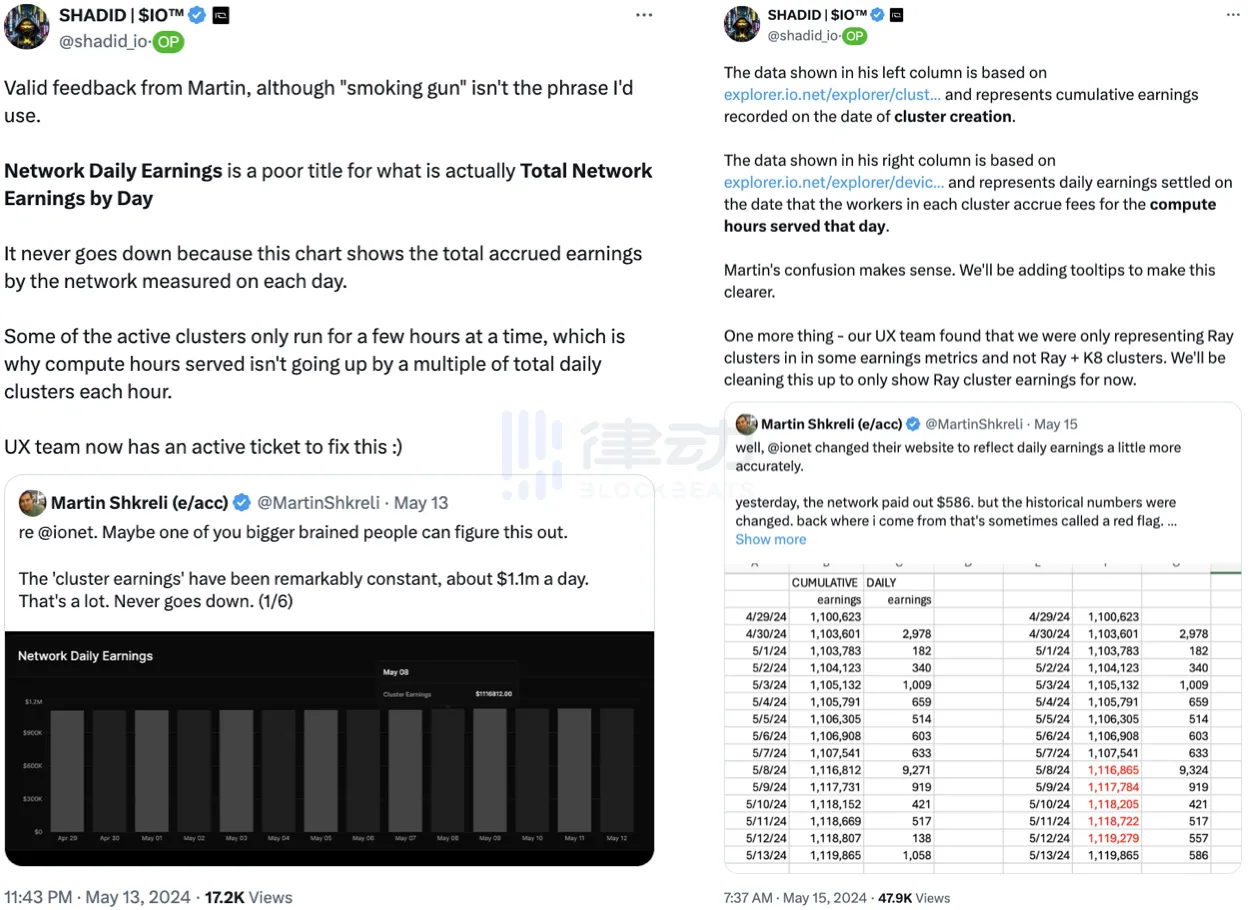
In the two months since the io.net points plan was launched, there have been constant voices questioning the number of GPUs displayed on the io.net platform. The most concerned was the question raised by community member Martin Shkreli on May 13, who posted several tweets on the accuracy of the data displayed on the io.net front end and received a personal response from io.net founder Shadid.
In the tweet, he believed that the income displayed on the platform did not match the actual situation. For example, it was found that the platform's daily revenue was $1.1 million, the number of online clusters was very small, and the total computing time on the platform was always displayed as 88 hours. After getting Shadid's explanation, Martin Shkreli released his calculation of specific daily revenue indicators. Shadid's response mainly revolved around the errors in data statistics indicators, such as the difference between daily average revenue and cumulative revenue, and the fact that the revenue did not calculate clusters of other specifications.
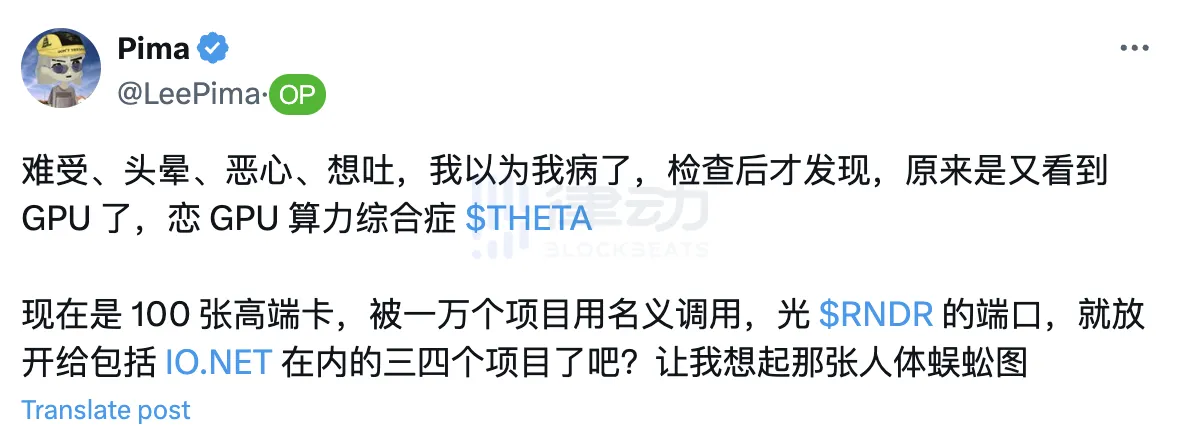
ContinueCapital founder Pima pointed out two months ago that several current decentralized AI projects have the situation of calling ports and "sharing computing power" with each other. An early anonymous user of io.net also explained to BlockBeats that the equipment provided by users on io.net may be rented on Render Network, and vice versa. At the beginning of April, the io.net front-end showed that the number of available GPUs online was 200,000, while the number of available GPUs in Render Network was around 3,700.
In this case, calculating the points clearly may be more of a test of technical ability. Investment institution Mint Ventures once mentioned in its analysis of io.net that the problems that need to be solved to achieve decentralized computing power include engineering verification problems, parallelization problems, and privacy protection problems. Among them, the parallelization problem involves many technical obstacles, including considering the decomposition of AI tasks, data transmission, and communication costs between devices.
Objectively speaking, some users have indeed been witched because they bought a "fake card" sharding machine. Xiaoju introduced to BlockBeats, "At that time, the rental market was in a mess. In theory, the market was in great need of machine resources, but there were many machine dealers who would give you as many as you wanted. This was actually selling virtual machines to you as real machines. For example, he could use a 4090 to virtualize unlimited cards, and the merchants could make money at zero cost. Such machines were easily identified and lost points by witches."
Faced with the "whole network crusade", the io.net team responded with a long article in discord. It stated that it would conduct the second phase of point calculation, eliminate witches, and retain real users. In addition to the points dispute, the team also stated that the community was experiencing "fake news and rumor attacks" and pointed out that it was driven by the fake card studio behind it.
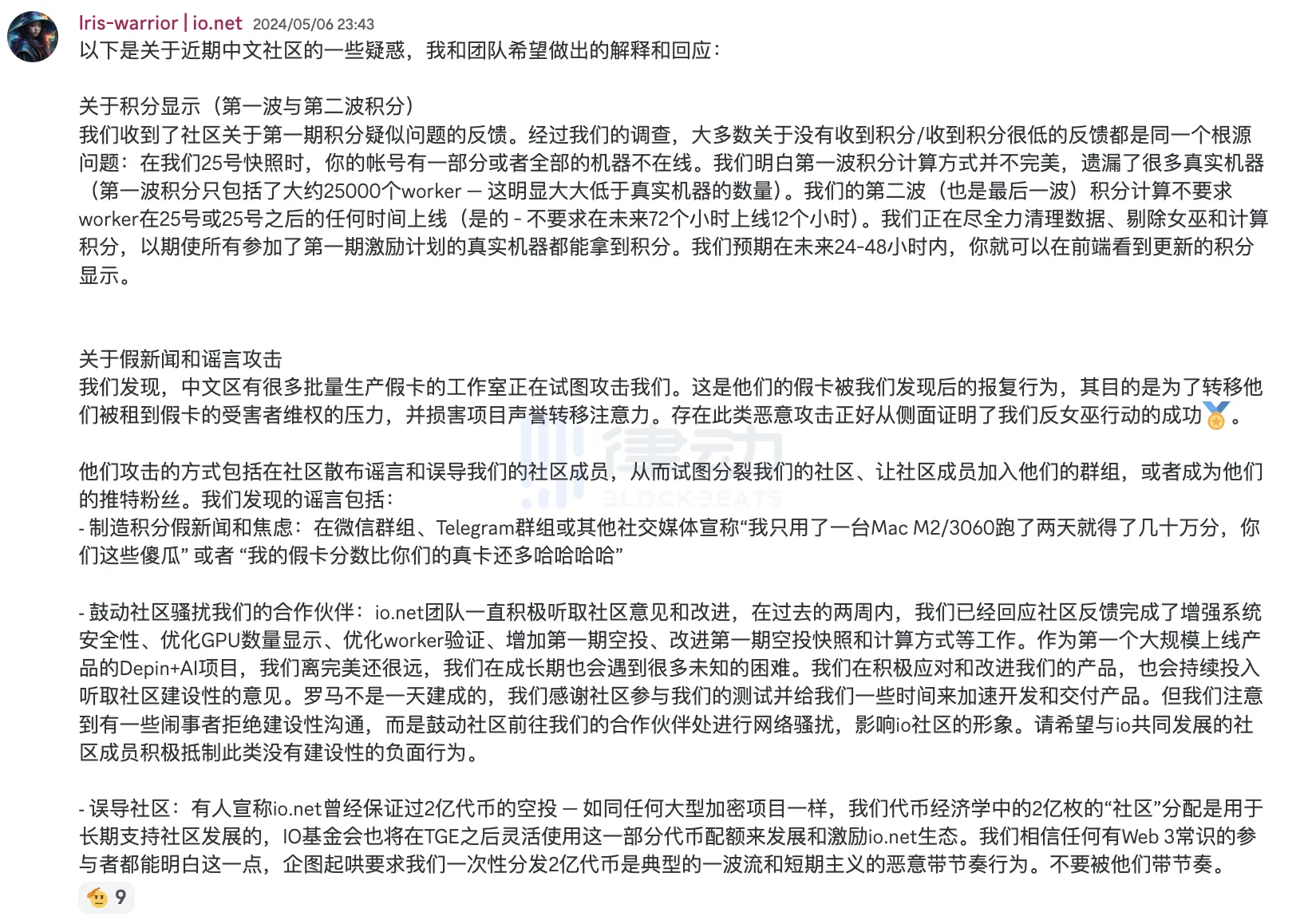
Regarding the issue of data pollution caused by fake cards, the responses from different io.net users to BlockBeats all mentioned that "it has existed for a long time." "Two months before io.net announced the points, I knew that a group of people were making a lot of fake cards. I went to DC to tell them, but no one paid attention to me. I often saw other people reporting this problem, but it didn't attract official attention. It was not until they started calculating the points that they said they would start identifying fake machines, but it was too late," Xiaoju told BlockBeats.
ImbaTrader also recalled that "in the early days, there were only a few thousand people in discord. At that time, there was a student who claimed to be a student from a certain university in the United States who questioned the number of GPU devices displayed on the front end of io.net, but no one responded to this matter."
However, on the other hand, the vague points did leave enough room for the io.net project to adjust the chip allocation according to the situation. When "too competitive" became a keyword in io.net-related topics, community members generally reported that "large accounts are being given a low security guarantee" in terms of the final points. "Small accounts (one or two machines) have more points than my large account with more than a dozen high-end graphics cards. From observation, small accounts of small accounts generally have higher points, while large accounts with more equipment have lower points. It seems like big accounts are being killed and retail accounts are being supported." After the second points update, some users found that their points had tripled.
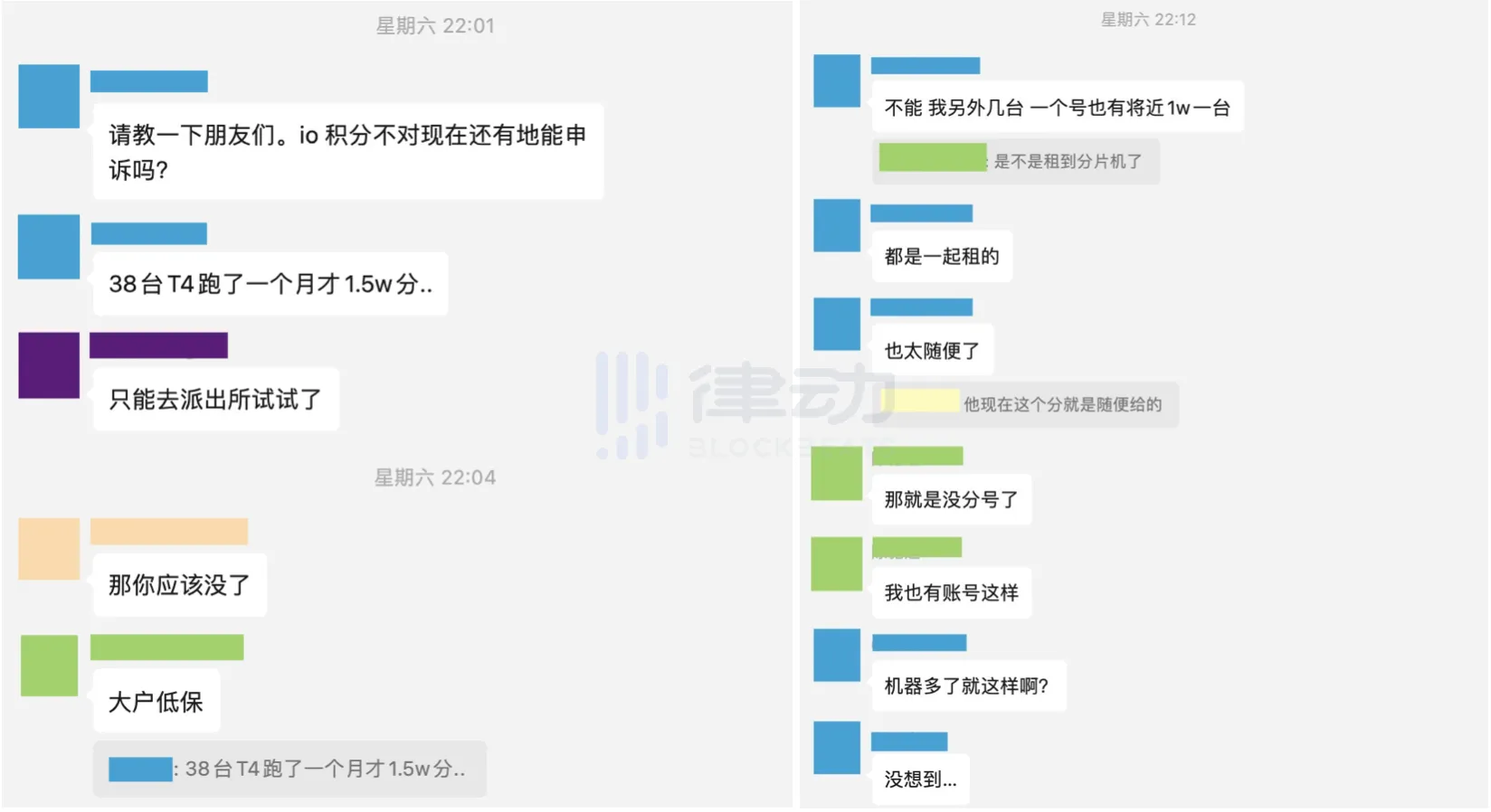
However, no matter how the points are distributed, the total amount of tokens distributed to miners remains unchanged at 32 million tokens. Among these miners' equipment, the io.net project seems to have "accounted" for a large part.
A user told BlockBeats in early March, "I think many of the A100s in there may be the project's machines." But considering that the equipment records are not on the chain, the community also questioned the possibility that io.net has falsified front-end data.
In a video released in April, YouTube blogger Alex Encrypted Diary said that the number of GPU devices on the io.net front end was originally observed to be between 60,000 and 80,000, but suddenly increased to 140,000 to 150,000 one night. He found that the number of GPU devices displayed on the front end would increase by thousands every half an hour, and the 4070, which had not been there before, suddenly increased by more than 20,000. Considering that the online status of devices from real users is not stable, it is hard not to suspect that the linear growth figures are from the project side.
A few days ago, Asa, the head of io.net in Asia, attended a space. In response to the "inconsistency of front-end and back-end data and the centralization of device data records" raised by community users, Asa responded that "decentralized technology stack is an improvement that will be realized later. The workload of our technical team in the past month is the same as that of the past three months."
The three characteristics of strict anti-witch measures, delayed launch of fake card identification, and opaque points have invisibly raised the participation cost of real users who want to interact well. In addition to economic costs such as traffic and electricity, "it PUAs you for a long time and does not tell you the actual points, so everyone has put in a lot of energy, and the rebound will be so big later." Faced with the rights protection action initiated by the community before the io.net coin was issued, user Liu analyzed to BlockBeats.
Difficult chips
User Xiaoju felt deeply, "For me personally, losing money on io.net is a small matter. io.net is the most torturous project I have ever worked on. At that time, it would go offline several times a day. After all the machines went offline, maintenance took several hours. After maintenance, it continued to go offline. In short, io.net is the most torturous project I have ever worked on, the shadow of blockchain."
From the perspective of the project party, the high maintenance threshold that was complained about is actually due to the management of low-quality nodes. Garrison Yang, COO of io.net, specifically introduced the management of low-quality nodes when mentioning the airdrop link in a podcast interview, "We introduced "time score" and "reputation score". Each node on io.net has a reputation score. Customers see the time a node remains available, the time it is online, and other performance indicators to help make decisions. We will constantly ping each node. If a node does not respond, it is considered unavailable. If it is unavailable, it will not receive a reward. 」
In the team's vision, "cryptoeconomic incentives are straightforward: if a node is available, it provides better service to the demand side, and is hired more frequently, earning more rewards. As long as the node maintains availability and performance when hired, the demand side will get the required computing power, a win-win situation." Although this setting later contributed to one of the controversies faced by io.net.
According to valuation, token shares, total points and OTC price estimates, except for early users, most users feel that they will not make much profit on io.net. "A month before the announcement of the airdrop points for this project, I roughly knew that I would reverse the points, because the airdrop is limited, and the machines are unlimited." "According to the ratio of the OTC price and my estimate, I will lose about half in the bad situation, and at most I will break even in the good situation."
However, despite this, Xiaoju believes that the problem of the project lies in the technical loopholes that have appeared, rather than intentional evil. "The machines are all rented, and io.net has never charged retail investors a penny." Not only Xiaoju, but also early users and major participants interviewed by BlockBeats have expressed their continued optimism about io.net to varying degrees. Alex said in the video, "Although I don't recommend participating anymore, I still think io.net is a good project worth paying attention to."
“Although we were also counter-invested, my money was not paid to io.net. First of all, everyone has to think about this problem clearly.” Alex explained in an interview with BlockBeats, “Generally speaking, when you interact with a project, the money you invest is taken away by the project party, and the project party then decides how to distribute the chips in their hands. But the problem with io.net is that in the process it set up, there are only retail investors and project parties, which are actually cloud service providers, retail investors and project parties. Retail investors paid the money to cloud service providers, and the cloud service providers did not pay the money to io.net, so io.net paid salary costs, operating costs and everyone’s constantly rising expectations from beginning to end.”
A VC member who participated in the io.net investment process told BlockBeats that they were looking for AI projects at the time, and the Partner Fund introduced the io.net project. It took about one and a half months from contacting io.net to deciding to invest. “It showed strong capabilities in the early days, including various technical documents and its partnership with Render. Among the targets we looked at at the time, io.net was a relatively good target. But at the time, io.net’s valuation was relatively high, with a price offer of US$300 million, so we didn’t decide on it immediately until the valuation in the secondary market rose. This valuation became a suitable valuation.”
The investor told BlockBeats that the psychological expectation of io.net's return ratio is far from the actual situation. It was originally expected that after listing, the overall environment would be relatively good, and FDV could reach 5 billion US dollars, and it is expected that there would be more than 10 times the profit space. In addition, people familiar with the matter told BlockBeats that some investors had already connected their own computing power equipment to io.net in the early stage to participate in mining at a lower cost.
For the various situations that occurred later, "there is actually no way to control this aspect, and we can only observe the development in the later stage." The investor said. Technical shortcomings and investor scandals will not constitute reasons for withdrawal.
The time for io.net to issue coins has not yet been determined. Although there is no expectation for a high rate of return, Zhu Rui and most users still believe that "io.net itself is a good project." "In the crypto industry, product logic is not very important. If we follow the idea of fud io.net to fud other crypto products, how many products can be studied in depth?" Zhu Rui told BlockBeats, "io.net also sorted out its product structure after being fud this time. I think it is a good thing. Now that the market is recovering, it is better to postpone the issuance of coins than to issue coins in the bear market a month ago."
The concept of decentralization and asset ownership, which has only been born for more than ten years, has encountered the evolving AI revolution. Under the cognition that "AI represents productivity and Web3 represents production relations", no one can deny the huge imagination space generated by the collision of the two. From VC to retail investors, they have placed great expectations on the development of the concept of AI.
But objectively speaking, as a hot narrative in this round of bull market, the source of the charm of Web3xAI comes from the blowout innovation of AI productivity outside the crypto community. Compared with previous DeFi, Gamefi and other project categories with strong crypto characteristics and traceable valuation models, the AI track is completely different. In the research and analysis of major investment research institutions, this direction seems to be still at the stage of "elaborating imagination space and classifying existing projects".
ImbaTrader, an early user of io, told BlockBeats, "I think the reason why io.net's narrative expectations are so high may not be because the io.net project itself is so good, but because the web3 market is too eager for this narrative."
Technical level and product logic are questioned, which is a situation that all Web3 projects will encounter. The real problem that io.net needs to solve is that in the community reputation, io seems to have changed from a "top narrative this year" project to a "VC-based high FDV" project.
However, the AI narrative still has unquestionable vitality. In an environment where computing power is becoming increasingly tight, as io.net continues to polish its products, it still has obvious scale and funding advantages in decentralized computing power. For AI projects, there is already a huge demand for funding scale, and it is somewhat one-sided to deny the development of projects simply because of "high FDV".
In the Web3 world, how to control the hot spot direction is a question that every project needs to think about. Whether it is "embracing the bubble" or "carving a boat to seek a sword", only time can give the answer.
Recommended
The Wall Street Journal: How is AI Trading Stealing the Limelight from Cryptocurrency?
Aug 15, 14:00
Tencent Still Has a Dream
Aug 15, 11:27
To Catch North Korean Hackers, They Set Up a Fake Project
Aug 15, 10:00
From Litigation to Settlement: Positive Signal Released by HTX's Negotiation with FCA
Aug 14, 19:32
11,742 Shipping Addresses Exposed Alongside Trezor Orders
Aug 14, 19:01
Founder Interview: FOMO Creator Explains How They Added 30,000 Users in One Day and Became One of the Fastest-Growing Crypto Apps
Aug 14, 18:37