On-chain liquidity game: a battle between developers, snipers and traders

Original author: post-goa
Original translation: TechFlow
Based on my research, here is a brief summary of the roles playing the on-chain liquidity game.
False Utility Slow Pull or "Exploited":
· These were very popular in the early AI craze because no one really understood AI at the time, but everyone wanted early exposure.
· They never complete more than 1% of the roadmap and are usually hyped by opinion leaders (KOLs).
· Teams usually allocate a large amount of supply to themselves when the contract is launched, and then distribute it before others. These tokens are then hidden in multiple wallets and then sold.
· Slow pull after initial pump or hit a hole after weeks of pump and quickly run away after accumulating a large market cap (20-100 million).
· Involves groups that repeatedly release fake projects that follow the current hot narrative. These projects are often derivatives of more successful large venture-backed projects.
Custom Bots:
· Custom bots that systematically sniped multiple ETH projects.
· Bots follow specific parameters based on smart contracts and transaction volume.
· The goal is to achieve 10-100x gains on a few projects from many failed or runaway sniping, almost like a form of income.
One of the most profitable on-chain traders:
· Search to discover new contract addresses, or obtain contract addresses through internal information.
· Simulate contracts to check their security and other indicators to determine potential, or to understand team background.
· Outbid other snipers when promising contracts are launched.
· Grab large amounts of supply when promising on-chain projects or stealth projects are launched without anti-sniping defenses or using pre-launch platforms such as Fjord.
· Sniping with multiple wallets to hold a large amount of supply, more than 1%.
· In many cases, projects are subject to snipers, who can smash the project to zero in the early stages.
· Many snipers enter the project and play against each other, hoping that "stupid money" will enter and sell when the market value reaches 500k-1 million, and then the project dies. This happens every day on the ETH mainnet.
· Snipers who combine some fundamental analysis and machine learning to determine which contracts may bring more than 5 million market value or more have significantly outperformed others in the past year.
· Most snipers hold tokens for less than a few hours.
Track the actions of snipers and insiders:
· Track the actions of profitable (highest PNL) wallets.
· Track volume and holder alerts.
· Usually buy strong projects after snipers sell off; or, even if they know that snipers hold a large amount of supply, they will buy if the launch is very promising.
· Usually do some fundamental analysis or narrative analysis on newly launched projects.
· Long-term holders.
· Diluted and increased in popularity as on-chain trading becomes a growing content segment in the space and more on-chain services become available for retail use.
· Is exit liquidity for the above players.
· These traders often play against each other on newly launched projects that will eventually go to zero. Just see who gets in first.
· Rely on dumb crypto twitter (CT), opinion leaders (KOLs) or other late on-chain traders as exit liquidity.
have not learned to use Etherscan or how to check the basic data indicators of the tokens:
· Get information from call groups, opinion leaders (KOLs) and crypto twitter (CT).
· Slower traders who tend to buy the hype.
· Believe that cryptocurrencies have utility beyond speculation.
· One step behind the narrative.
· Probably only been in the space for less than a year.
· These traders have most likely given up on buying new utility projects or meme coins. Or they slowly start learning about on-chain trading and gradually upgrade to the above categories.
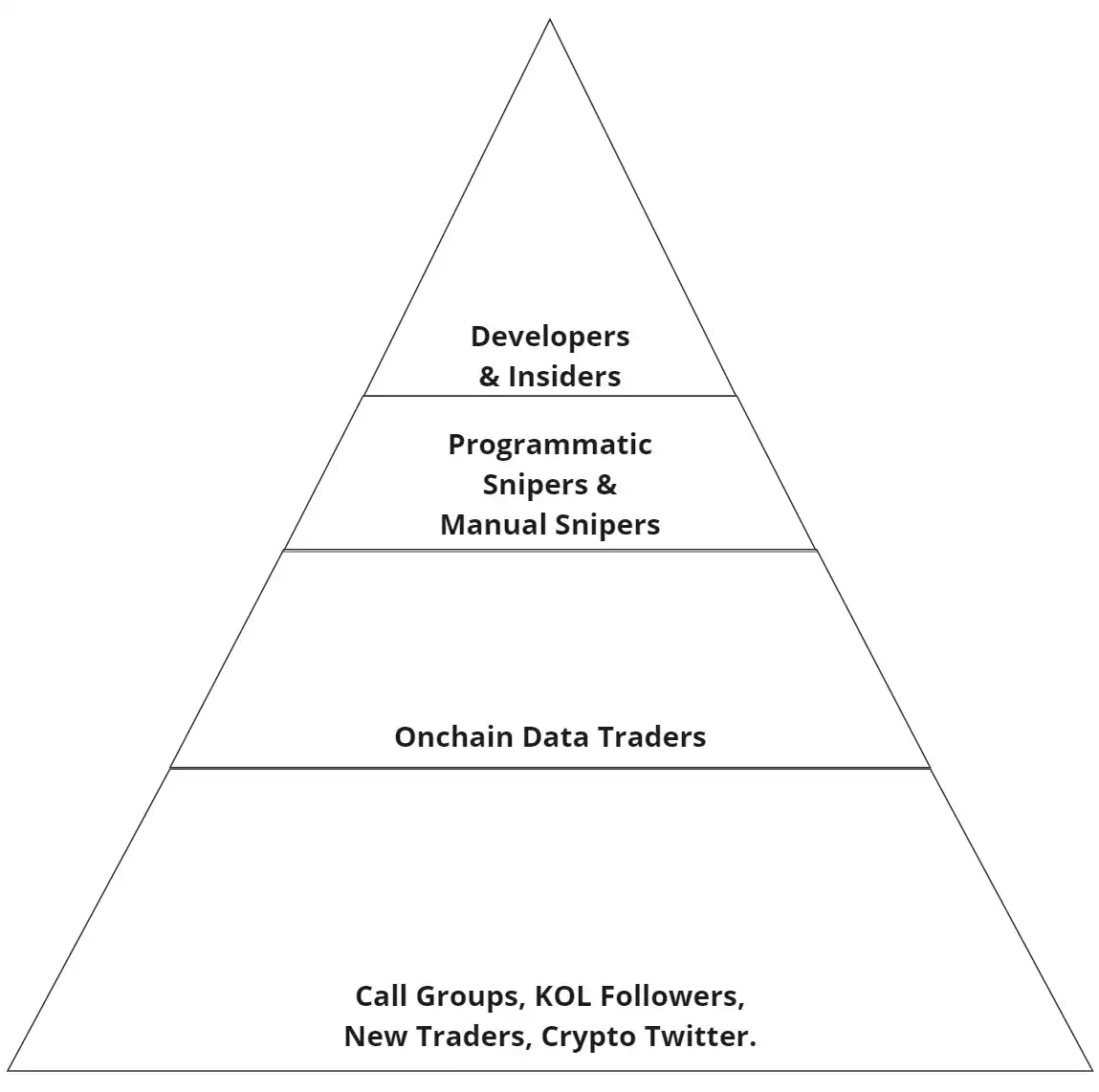
On-chain trading is a liquidity game for developers, snipers, on-chain data traders, and others. As liquidity entering the on-chain space decreases, competition between participants becomes more intense, and results in those at the top of the pyramid reaping most of the rewards.
Original link
Recommended
The Wall Street Journal: How is AI Trading Stealing the Limelight from Cryptocurrency?
Aug 15, 14:00
Tencent Still Has a Dream
Aug 15, 11:27
To Catch North Korean Hackers, They Set Up a Fake Project
Aug 15, 10:00
From Litigation to Settlement: Positive Signal Released by HTX's Negotiation with FCA
Aug 14, 19:32
11,742 Shipping Addresses Exposed Alongside Trezor Orders
Aug 14, 19:01
Founder Interview: FOMO Creator Explains How They Added 30,000 Users in One Day and Became One of the Fastest-Growing Crypto Apps
Aug 14, 18:37