Analysis of "Sun Ge's Arbitrage Method": Buy PT tokens with 33,000 ETH, what is the profit?

Original title: "Justin Sun spent 33,000 ETH to buy Pendle PT, what are the strategies and risks of a return rate of nearly 20%? "
Original author: DaFi Weaver, BlockTempo
On the 4th, Justin Sun, the founder of TRON, made a large purchase of Pendle PT tokens to enjoy a low-risk arbitrage operation with an annualized return rate of nearly 20%, becoming the focus of community attention. This article will explain where the benefits of this wave of operations come from, explore the related risks, and provide risk avoidance strategies for readers' reference.
First, according to on-chain analysts Yu Jin and Aunt Ai’s monitoring of on-chain addresses, Sun Ge’s operations in the past two days are as follows (the figure below is Sun Ge’s position in Pendle):
A total of 3,3000 ETH were invested in Ethereum re-staking projects that expired on June 27, namely:
· Ether.fi: 20,000 ETH bought 20,208.93 PT-weETH;
· Puffer: 10,000 ETH bought 10,114.11 PT-pufETH;
· Kelp: 3,000 ETH bought 3,025.91 PT-rsETH
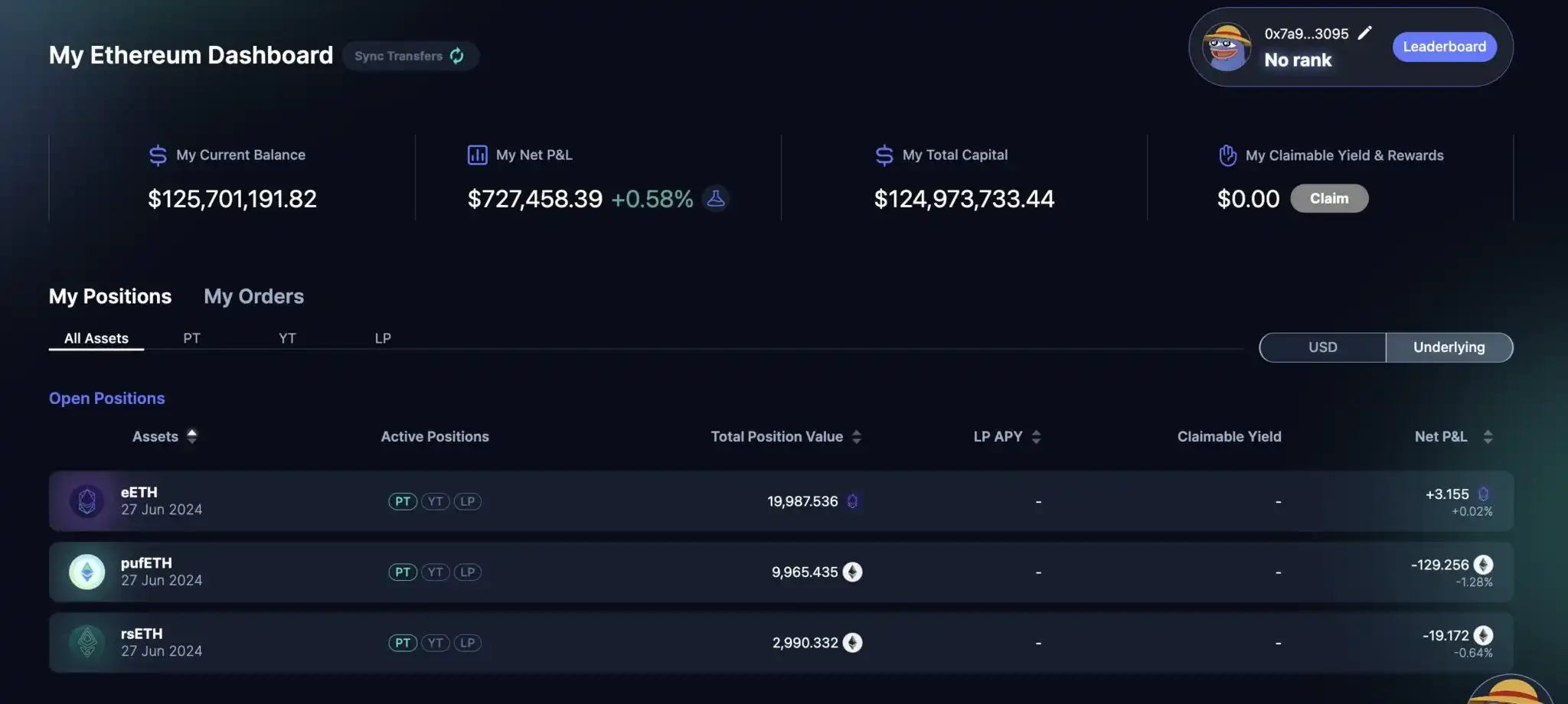
Sun Ge’s position in Pendle|Source: Aunt Ai
Take Ether.fi as an example, this means that if Sun Ge holds it until maturity, he can redeem weETH equivalent to 20,208.93 ETH (Note: this is not equivalent to 20,208.93 weETH, the exchange rate between weETH and ETH is not 1:1, as shown below), and how much ETH weETH can be exchanged for depends on market conditions. Here is a simple calculation, assuming that the exchange rate between weETH and ETH is 1:1, so if Sun Ge holds it until maturity, he can earn a 1% return rate in 22 days, which is 17.33% annualized.
By analogy, the annualized return rate of Puffer’s investment is 18.93%; Kelp’s is 14.33%. The annualized return rate of the total investment is as high as 17.54%.
Pendle Chinese Community Ambassador ViNc described that Pendle's PT is like a short-term debt on the chain, which has the characteristics of good liquidity, close to cash value when redeemed (if viewed in ETH), short duration, and good risk-reward ratio. So, where does the income of PT come from? This requires understanding the basic operation of the Pendle protocol.
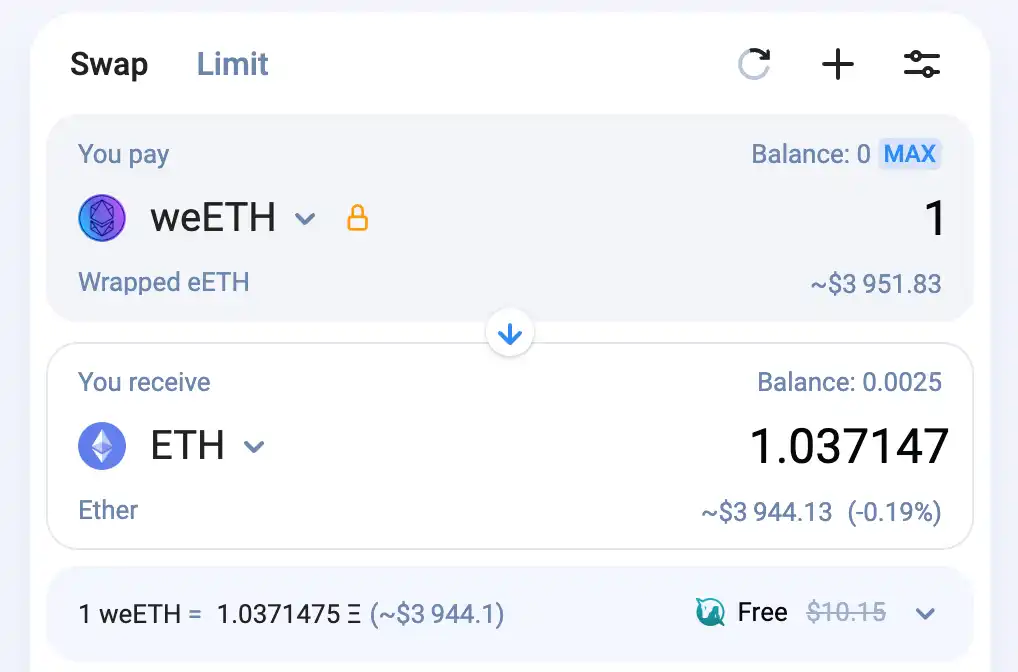
The exchange rate between weETH and ETH is not 1:1|Source : 1inch
Pendle is a permissionless yield trading protocol that packages yield-bearing tokens into standardized yield tokens (SY, for example, weETH → SY-weETH, this packaged version is to be compatible with Pendle AMM), and splits SY into PT (principal token) and YT (yield token).
PT represents the principal portion of the interest-bearing token before its expiration date, and the right to obtain income during this period is represented by YT and sold to other buyers. Since the monetary value of YT is separated, the principal part (i.e. PT) can be sold at a lower price.

Pendle has three main ways to participate:
· Buy PT: PT allows holders to redeem the underlying asset after maturity and can be sold at any time. For example, 1 PT-weETH purchased at 0.9 ETH at the beginning of the period can be redeemed for weETH equivalent to 1 ETH after the expiration date. The 11% appreciation between 0.9 ETH → 1.0 ETH is Pendle's fixed yield strategy. And this is the strategy adopted by Brother Sun.
· Buy YT: Allow holders to obtain all the income and airdrop points generated by the underlying asset before the expiration date, which can also be sold at any time. For example, holding 1 YT-weETH means having the right to receive all the income and points generated by 1 weETH until the expiration date.
· When a liquidity provider (LP): LP's income includes: PT income + SY income + ($PENDLE emission + pool transaction fee).
With an impressive rate of return, the risks of using Pendle are mainly smart contract risks, human risks in operation, and price risks (in terms of U-standard. If you look at it in terms of currency standard, the strategy of buying PT is a sure win).
To further avoid price risks, that is, losses caused by price "falling", you can try to open short contracts on the exchange as a response, but this requires considering the risk of liquidation and funding rates. If everything goes well, you can get fixed income. For example:
Buy 1 ETH at $3,800, and you can get 1.01 PT eETH on the Ether.fi market that expires on June 27, which means you can get a net profit of about 0.01 ETH after expiration.
However, in order to avoid the decline in ETH prices, a short order worth 1 ETH was opened on the exchange. After expiration, the short order and 1 ETH were closed and sold at the same time. In this way, in addition to recovering the cost of US$3,800, a stable income of 0.01 ETH was also obtained.
Another method is to borrow money to buy PT, citing Alvin's capital preservation strategy (this strategy was recently forwarded by Pendle officials). Take the same example as an example, the steps are as follows:
1. Borrow 1 ETH on CEX/DEX
2. Use the borrowed ETH to buy 1.01 PT eETH
3. Redeem eETH equivalent to 1.01 ETH after maturity and repay 1 ETH
4. The remaining ETH is the stable income, which is estimated to be about 0.01 ETH. As explained above, this depends on the market conditions of eETH and ETH.
This strategy needs to consider whether the stable income can exceed the borrowing cost, otherwise it may still lose money.
Original link
Recommended
The Wall Street Journal: How is AI Trading Stealing the Limelight from Cryptocurrency?
Aug 15, 14:00
Tencent Still Has a Dream
Aug 15, 11:27
To Catch North Korean Hackers, They Set Up a Fake Project
Aug 15, 10:00
From Litigation to Settlement: Positive Signal Released by HTX's Negotiation with FCA
Aug 14, 19:32
11,742 Shipping Addresses Exposed Alongside Trezor Orders
Aug 14, 19:01
Founder Interview: FOMO Creator Explains How They Added 30,000 Users in One Day and Became One of the Fastest-Growing Crypto Apps
Aug 14, 18:37