A conversation with Coinbase founder Brian Armstrong: Crypto’s iPhone moment has arrived

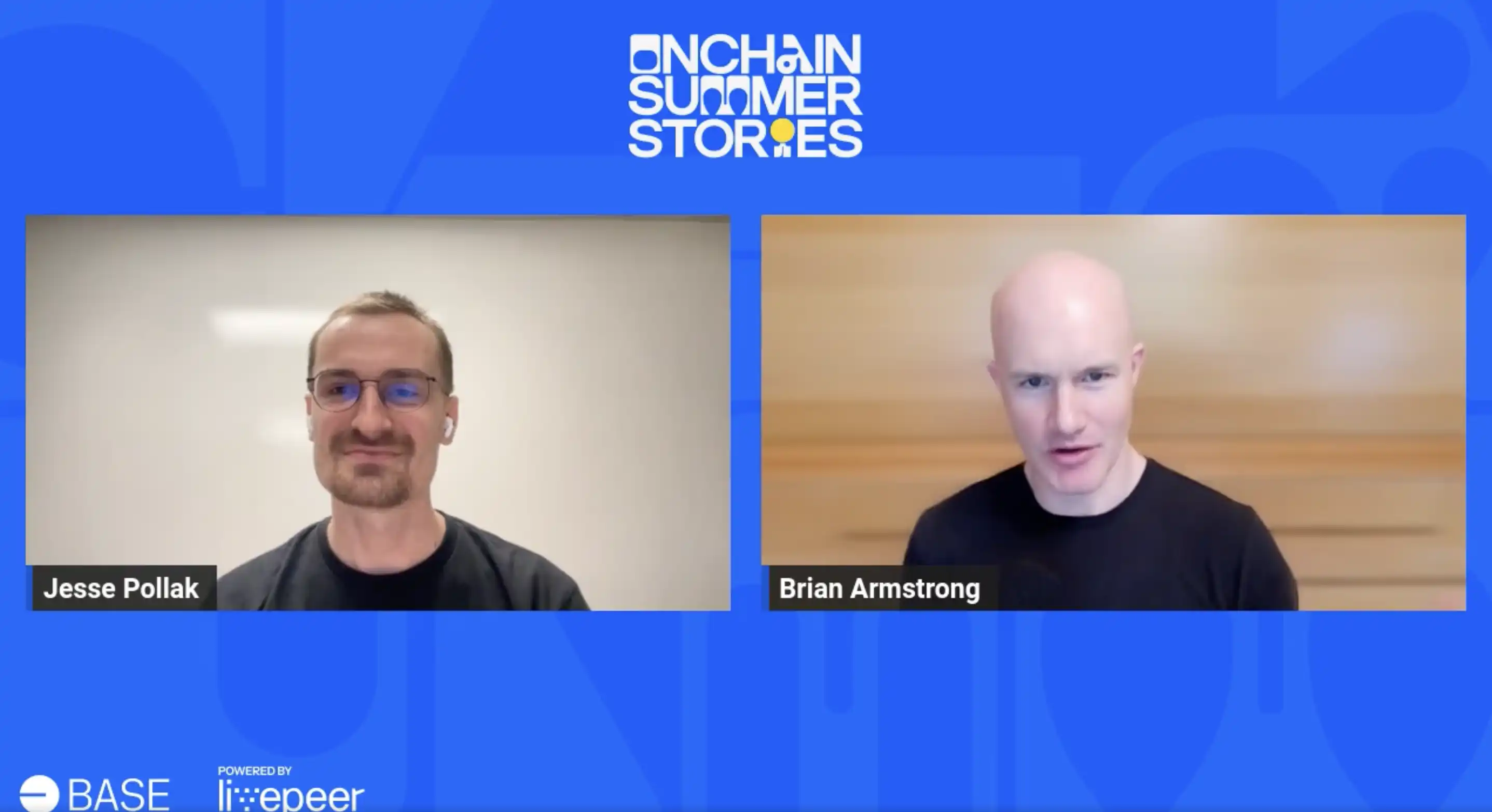
Editor's note: Base TVL has surpassed OP Mainnet to become the second largest Layer2 in the past two days, and it has also started the Onchain Summer series of activities as scheduled. In this conversation, Brian Armstrong, co-founder and CEO of Coinbase, and Jesse Pollack, head of the Base protocol, talked about how to promote innovation and development in the blockchain field. Brian shared his unique perspective as an engineer and CEO, discussed Coinbase's efforts to help developers, and his outlook on on-chain development in the next few years.
Jesse Pollack:Hello everyone! Welcome back to "Onchain Stories", this special episode hosted by me, Jesse Pollack, founder and head of Base. Today we are honored to invite Brian Armstrong, co-founder and CEO of Coinbase. Welcome, Brian.
Brian Armstrong:Hi, Jesse, it's great to see you.
Jesse Pollack:Thanks for joining us for this conversation and inspiring developers, let's start from the beginning. Ten years ago, you and Coinbase have been working to make cryptocurrency more accessible. Can you talk about your views? How far have we come now? What is the user experience on the chain today?
Brian Armstrong:Yeah, we have made a lot of progress, but I think we still have a long way to go. At the beginning, we were thinking about some simple problems, such as how to send Bitcoin to an email address. I remember in 2012, when we were developing early prototypes of Coinbase, we were inspired by PayPal - sending money through an email address, maybe we can apply this system to Bitcoin. At that time, we just wanted to solve some very basic problems, such as storing Bitcoin with a username and password without running a node on a laptop, which were very basic things at the time.
But over time, we did make some progress. For example, now we don't have to send those long addresses that look like passwords anymore, we can send ENS IDs, which are human-readable rather than machine-readable, which is great. Layer 2 is also a big step forward, Base is an important part of it, but there are many Layer 2 solutions like Lightning Network that are working to make this process easier.
We need faster confirmation times and lower fees, but I think we have a long way to go. One of the big issues is that it’s still hard to transfer assets across chains. It’s unclear how to transfer assets between L1 and L2, or between different L2s. There’s a lot of jokes on social media about this, like, is my USDC on Ethereum or on some L2? There are so many icons, and I feel like we need to find a way to make this seamless in the background so people don’t even need to know which chain they are on.
Perhaps there could be some kind of handshake between the sender and the recipient that says “Here’s what I have, what do you accept” and then the exchange is automatically done on the DEX. Something like that could help. My standard is something like Apple Pay, where you can tap your phone to pay on a point-of-sale device.
How can we get to that point? Like paying between two phones, or scanning a code to pay in an e-commerce environment. At Coinbase Commerce, we’ve been working hard to enable a world of “one-click magic checkout” where crypto is the easiest way to pay.
We're not quite there yet on L2, we need to debug some of the APIs built into the hardware and phones, and there may be a lot of details involved in NFC and so on. But I think we're getting there, and it's going to take a lot of hard work from a lot of smart people.
Jesse Pollack:Yeah, that's right. There were a lot of people building on-chain for the first time this summer, and some of them have been in this space for a long time. What are your expectations for this summer's on-chain build-a-thon and some of the projects currently being built on-chain?
Brian Armstrong:Yeah, I have a few ideas in mind. Of course, I'm not the judge of these good ideas, I'm often blown away by the creativity that the community comes up with. We often talk about these things starting to fit together like Lego blocks. For example, we have ENS, we have stablecoins, we have L2, we have identity, NFTs, and social.
Another piece that I think may be missing is a reputation system on the chain. You can imagine a version that uses the graph structure of the chain to represent trust relationships, such as I trust this node, and they send funds to another node, which implies a certain degree of trust, similar to the Google PageRank algorithm, and it would be cool to build this kind of thing on the chain.
Another thing I've been thinking about is that in Web2, the biggest business model is advertising. We don't want to repeat all the mistakes of Web2, but how distribution is achieved in Web3 is an interesting question. You can imagine an advertising network or the equivalent of Google Adwords, but instead of just pay-per-click (CPC), you can pay for an action.
You could imagine a world where smart contracts or dApps expose some metadata, like, if you refer a user to this function call, pass in your referral ID or address, you'll get a 1% reward. You could advertise different rates that people are willing to offer, and those rates could be displayed in various wallets or distribution areas.
Jesse Pollack:So I think we might see ad networks develop in this dimension. I'll bring up another one that I've been thinking about, which is on-chain P2P deposits and withdrawals. A lot of emerging markets need to transfer money in and out of platforms, and these centralized versions are often shut down or under pressure. If we can do all of this on-chain, like dispute resolution, mediation, rating and review systems, and build more of these on-chain systems, these markets will become more resilient and global. These are some ideas that I've been thinking about, but I'm excited to see what people come up with.
Brian Armstrong:What excites me is that the technology was always not ready before, we didn't have the right components, the fees on the chain were too high, we didn't have something like ENS, the wallets were too difficult to use. But now it feels like we finally have the components that will enable the next wave of use cases. For example, now you can really build reputation systems, ad networks, or deposit and withdrawal systems, and they have low enough fees and are easy enough for everyone to use.
I have two thoughts, the first is that the technology is finally ready to support reputation systems, ad networks, and deposit and withdrawal systems. This will make these use cases cheap and accessible for everyone to use.
The second is that it's really interesting to think about how these things actually fit together. To have a good ad network, you need to know if the people who are participating and seeing the ads are real people, and that's reputation. To have a good P2P network, you need to know if the people in the network are good actors, and that's also reputation.
So I think we're at a stage now where the on-chain infrastructure is built, but we're starting to see opportunities for this application-level identity infrastructure that will support P2P, advertising, and better commerce to help the world move on-chain.
Jesse Pollack:I know you're getting more and more personally involved at Coinbase, making it easier for people to get on-chain, not only from a user perspective, but also from a developer perspective. I know you're an engineer yourself, can you talk to us about what Coinbase is doing right now to help developers and what drives you to invest your time and energy?
Brian Armstrong: Well, if you guys haven't checked it out yet, you should check out CDP, the Coinbase Developer Platform. It's at cdp.coinbase.com. We're trying to make a lot of the tools that we've built internally at Coinbase available to third parties to use to build their applications. We've built a lot of things over the years, whether it's a simple way to store crypto, or staking, or trading, or even a way to index a lot of NFTs or handle ENS and different assets. Hopefully, we can reduce the workload for developers and provide these features through very easy to use APIs. Jesse, you posted a great video about a lot of the on-chain builder tools. We've included Base nodes and Paymaster functionality in there, where you can make fees completely invisible to your customers. Obviously, the Smart Wallet that launched yesterday was also a big deal. I think now we're seeing users onboarding without having to use a 12-word seed phrase, but instead can just tap on a biometric or a YubiKey, which makes it a lot easier to use and onboard.I'm very passionate about this and I think there's a huge opportunity for Coinbase to help thousands of developers build apps, which is one of the reasons I got so involved with the Coinbase Developer Platform product, to try to see how we can make it easier to use. As a developer, I always love those magical moments, like the first demo of Ruby on Rails, when I could create a blog in five minutes with features like real-time comments and RSS feeds, and it was amazing. These tools increase productivity. We want to be able to provide a range of tools like this to developers to make it easier for them to get started and lower the barrier to innovation.
Jesse Pollack: Absolutely agree, if you don't know, Brian was an engineer when he started Coinbase and he's still an engineer today. We had a three-day weekend recently for Memorial Day. I got a message from Brian on Sunday and he asked, “What’s the best way to learn how to write smart contracts?” I recommended some resources to him and we talked about it later in messages and he said, “Can we code together?” He then spent his vacation time writing smart contracts with Wilson Cusack.
I think it’s very inspiring for me as the CEO of a public company to be personally involved in writing smart contracts and improving developer tools. Over the past year, almost no one thought about what Coinbase was doing for developers, but now Base is the leading L2 for developers, and the Coinbase Developer Platform is a very powerful developer tool where you can find everything you need to start building on-chain applications. We are just getting started, and I think it all comes from having a leader like Brian who understands the technology and can personally write the code to make everything possible.
Brian Armstrong: Thank you for saying that, Jesse. I feel like my programming skills are getting worse every year, but hopefully my CEO skills are getting better every year. I'm trying to lead by example, and I have to learn the basics myself. Everyone is a little intimidated when they learn a new language or way to build an application. It's complex stuff, so you have to learn it with a beginner's mind, and experience some frustrations, and I also asked a lot of seemingly stupid questions. Thanks to Wilson Cusack for helping me with some pair programming, which was very cool. In Singapore, some officials, like the former Prime Minister, have also written some things on GitHub. This attempt to deeply understand the basics shows good leadership within the company, and I think we need every engineer at Coinbase to build on-chain, and if I don't lead by example, I can't ask others to do it. Jesse Pollack: Absolutely agree, your example is being seen and felt, and it's changing the company. About a year ago, we didn't have many developer products, and we didn't have many teams building on-chain internally. Today, we have many teams building on-chain internally at Coinbase, and we say we want to build the best smart contract on-chain engineering team in the world. If you had asked us a year ago if we could do this, we would have thought it was crazy, but now we are gradually getting there, pushing the boundaries of what is possible, and setting an example for ourselves, our internal teams, and the entire ecosystem of how large companies can improve their on-chain capabilities.I'm curious where you see the future of on-chain in the next few years? How quickly do you think this will all happen?
Brian Armstrong:I think these things always feel very incremental when they happen, but when you look back on them, they seem very sudden. People think the launch of the iPhone was a sudden turning point, and it was from a historical perspective, but it didn't feel that way to people who were in it at the time. After the iPhone was launched, there was no app store for even a year or two, and it only ran on AT&T's 3G network. So it felt very incremental at the time, and only in hindsight did we see how huge these changes were.
I think we are at such an inflection point, but it feels very incremental when you are in the middle of it. L2 is a huge step forward, it reduces the friction to build different applications. What I have been thinking about lately is how all these decentralized protocols can come together in on-chain super applications. We need a Netscape or iPhone moment, not just for payments.
We're seeing the rise of decentralized social media like Farcaster, and interesting messaging apps like XMTP coming online. How can these be embedded into people's daily lives, like their livelihoods, paying for basic necessities, daily operations, etc. Content creators, social media, journalism, and even the way organizations are created, voted on, and governed could be impacted. I think that's very exciting.
If we can achieve this, there could be an on-chain super app that brings these protocols together, which would be very interesting and I'm looking forward to seeing what you guys do. It really feels like all the infrastructure is in place, but the user experience hasn't really brought it all together yet, and there's a big opportunity here. I'm looking forward to continuing to build on the developer and builder side of things and seeing what Coinbase does on the consumer side.
Jesse Pollack:Last question, we're doing a hackathon and thousands of developers have signed up to build over the summer. You've been a very successful founder for a long time, and I'm wondering what advice you have for these developers building in a buildathon? Brian Armstrong: The early stages of innovation weren't glamorous, it was just a couple of people in their apartment tinkering, which is where Coinbase started, and some of the ideas I'd tried in the past that didn't work, that was the norm. I remember my friends would call me and say, hey, come out to this party. I would always say, I don't know, I was just at home alone tinkering with my laptop. But it didn't feel like I was changing the world, in fact, most of the time I was struggling with a bug, maybe a semicolon was in the wrong place. So a lot of innovation is like this: you need to persevere, allow yourself to be a beginner, allow yourself to slow down, not understand how it works. If you're on the cutting edge, there aren't a lot of manuals to refer to. You can learn to make an LLM in five minutes, but if you really want to build something new, that material doesn't exist. So you have to overcome those difficulties by persevering. Perseverance is probably the biggest determinant of success in starting a business and building something.
I think a lot of startups, they get a few people together to try something, and three months later, the first product launched doesn't work, or there may be some internal partner disputes, and they collapse at the starting line. In my opinion, this approach almost never succeeds, almost nothing succeeds the first time it is launched, it is very rare.
Coinbase’s first product certainly didn’t work out either, you have to launch a very embarrassing version 1, releasing something that wasn’t actually ready. If you’re not embarrassed about it, you’ve waited too long. A lot of people never release anything just because they can’t get over the hurdle of launching a slightly embarrassing product.
Once you’ve launched version 1, no one cares, launch it on Farcaster, get 10 people to come and see it. Then you have to keep looping: talk to customers, improve the product, talk to customers, improve the product again, keep doing this for two, three, four, ten years, and eventually you might have a breakthrough. That’s the game of entrepreneurship, you don’t know if it’s going to work. You have to be willing to go into the unknown and keep trying enough ideas that eventually something will work. And 99% of people give up, or they never start. That’s the way.
Jesse Pollack:I love this summary, it’s a great way to end. If you’re building, don’t give up, you’re only on day one. The most important thing is to stay determined, stay focused, keep your eyes on the goal, Stay Based.
Recommended
The Wall Street Journal: How is AI Trading Stealing the Limelight from Cryptocurrency?
Aug 15, 14:00
Tencent Still Has a Dream
Aug 15, 11:27
To Catch North Korean Hackers, They Set Up a Fake Project
Aug 15, 10:00
From Litigation to Settlement: Positive Signal Released by HTX's Negotiation with FCA
Aug 14, 19:32
11,742 Shipping Addresses Exposed Alongside Trezor Orders
Aug 14, 19:01
Founder Interview: FOMO Creator Explains How They Added 30,000 Users in One Day and Became One of the Fastest-Growing Crypto Apps
Aug 14, 18:37