Exclusive interview with Nubit founder: How to build the first DA layer of Bitcoin ecosystem

At the Bitcoin Asia Conference that just ended some time ago, BlockBeats had the honor of interviewing Yu Feng, one of the founders of Nubit and a professor in the Department of Computer Science at the University of California, Santa Barbara. He introduced us to his personal experience and how he led the team to develop the first DA layer project in the Bitcoin ecosystem - Nubit. As a computer security expert, his exploration and innovation of the Bitcoin ecosystem are eye-catching. In the interview, Professor Yu Feng shared the development history, technical features and future prospects of Nubit's Bitcoin ecosystem.
Professor Yu Feng said that the development of Nubit began with an analysis of the needs of the Bitcoin ecosystem infrastructure. Due to the limited throughput of the Bitcoin mainnet, a native DA solution is urgently needed. Therefore, the birth of Nubit aims to solve the infrastructure problems in the Bitcoin ecosystem and lay a solid foundation for the long-term development of the ecosystem. In addition, he also introduced Nubit's technical features and security measures, and shared the team's progress in market expansion and ecological cooperation.
For the future of the Bitcoin ecosystem, Professor Yu Feng said that the next round of outbreaks may be the development of applications that can arouse the interest and demand of a wide range of users, such as games or other innovative technologies. He believes that these applications will drive the development of the entire ecosystem and promote the continued growth of the Bitcoin ecosystem.
The following is the original content of the interview:
BlockBeats: Please introduce yourself first. When did you enter the encryption industry? Why are you attracted to the narrative of cryptocurrency?
Yu Feng:I am Yu Feng, the founder of Nubit, and a professor in the Department of Computer Science at the University of California, Santa Barbara. I mainly engage in research on software security and programming languages. I started to get involved in cryptocurrency in 2014, when I was still a doctoral student. I originally wanted to conduct research on Bitcoin, but my supervisor disagreed. It was not until I became a professor in 2018 that I began to conduct research on blockchain, especially security.
I think cryptocurrency represents a kind of freedom, and decentralization is advocated by many people who advocate freedom. For me, the freedom of cryptocurrency and its value are one and the same. As for why I chose Bitcoin, there was no Ethereum before 2014. At that time, cryptocurrency was mainly Bitcoin, which was the earliest currency popular among a minority of civilian groups. Later, with the rapid development of the Ethereum community, I also began to study Ethereum and became a developer and researcher of the Ethereum ecosystem.
BlockBeats: How does your academic background and personal pursuits affect your understanding of Bitcoin, including your persistence in this track when many people are not optimistic about cryptocurrency?
Yu Feng:Since 2017, we have been conducting research on Ethereum security in colleges and universities for some time. Last year, we decided to turn to the construction of the Bitcoin ecosystem. In 2022, I founded my first company, which focuses on providing security audit services for projects in the Ethereum community, including smart contracts and zk.
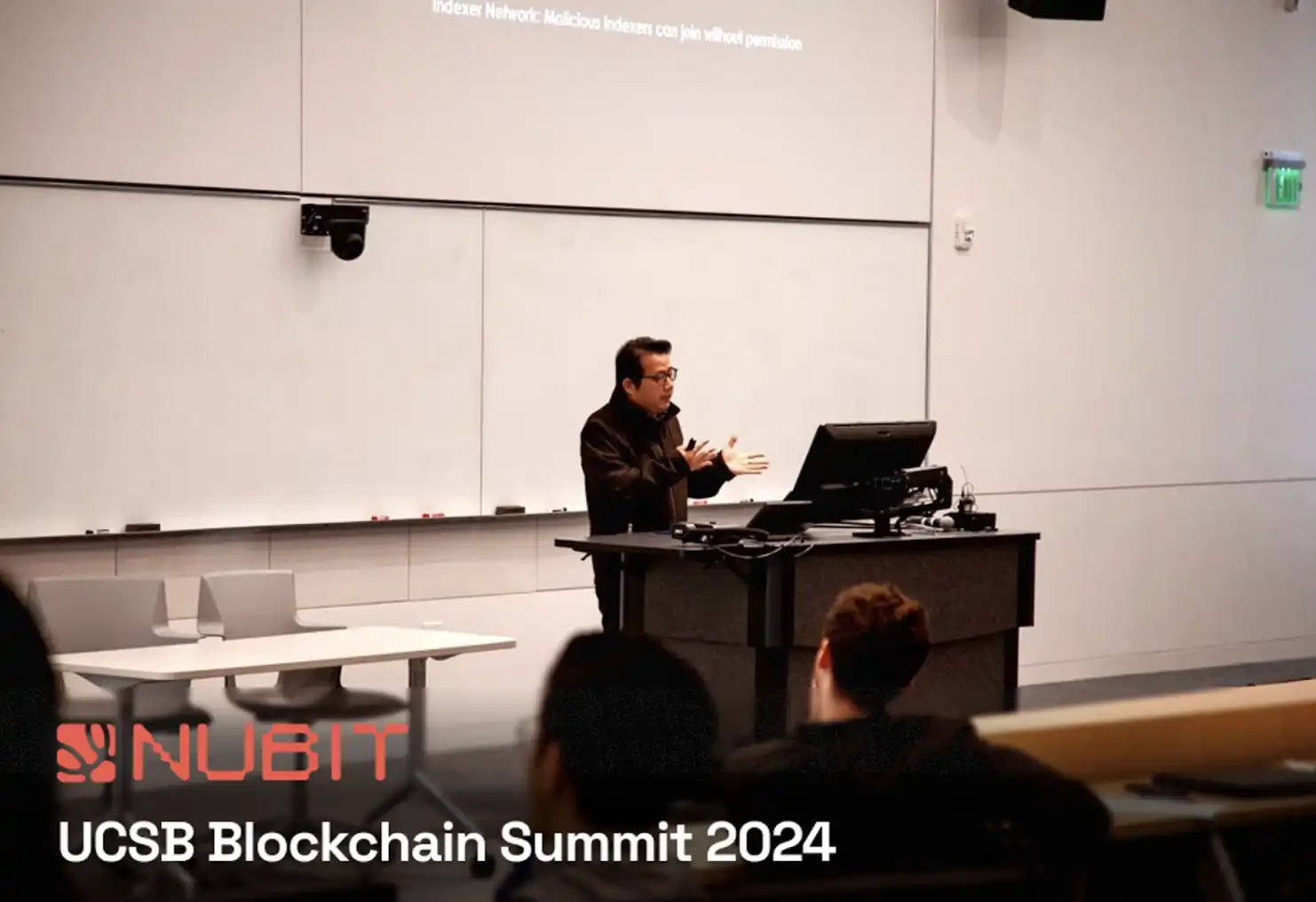
By the end of last year, I discussed with several of my students the limitations of our work on the impact on users. We realized that although our services are important to the B-side, the direct impact on the C-side is limited. We decided to expand to consumer-oriented projects.
Noting that the Ethereum community is already very mature, communities that lack infrastructure may provide more development opportunities. One of my students, now another founder of Nubit, suggested that we turn to the Bitcoin field because the infrastructure in this field is particularly lacking.
Especially at the beginning of last year, my students had begun to pay attention to the new technological development of the Bitcoin ecosystem, which was still in a very early stage. We decided to start with Bitcoin, and we did not expect the explosive growth of this community at that time.
We initially entered the Bitcoin ecosystem to continue our security work because we have rich experience in this area. However, after further understanding, we found that the entire ecosystem is in a very early stage and even the basic ecological needs have not been solved. For example, a project has just been hacked for four or five million US dollars, which shows that security is still crucial, but the lack of infrastructure is a more urgent problem. For example, Bitcoin's data throughput is far inferior to Ethereum.
Therefore, we decided to start with infrastructure construction to help the community grow and develop, and then consider security issues. We analyzed the market demand and found that, for example, printing a simple picture may cost hundreds of dollars on Bitcoin, which shows a serious lack of data processing capabilities. We decided to start in this direction to solve these basic problems and lay a solid foundation for the long-term development of the community, so Nubit was born.
BlockBeats: As the first DA layer project in the Bitcoin ecosystem, Nubit has achieved rapid development in just half a year. Can you briefly introduce Nubit and its current achievements?
Yu Feng: Nubit is the first Bitcoin DA project developed by our team and the first of its kind in the Bitcoin ecosystem. Nubit is mainly dedicated to solving the problem of insufficient throughput of the Bitcoin mainnet and provides a native DA solution. Our project has been established for less than a year, but has already achieved significant popularity and progress.
From a product perspective, we have completed pre-alpha testing and are about to start final alpha testing. In addition, we have developed an execution layer based on the Nubit DA framework, which is stateless and efficient, allowing users to reliably verify calculation results, which will be widely used by Bitcoin wallets and users.
In terms of market and ecology, Nubit has gained a certain degree of popularity in Asia, with the number of fans growing from dozens to hundreds of thousands. We have established in-depth cooperative relationships with many leading projects in the East and the West, such as Babylon, Merlin Chain, Polyhedra, etc. These collaborations are not just superficial handshakes, but are truly using our solutions.
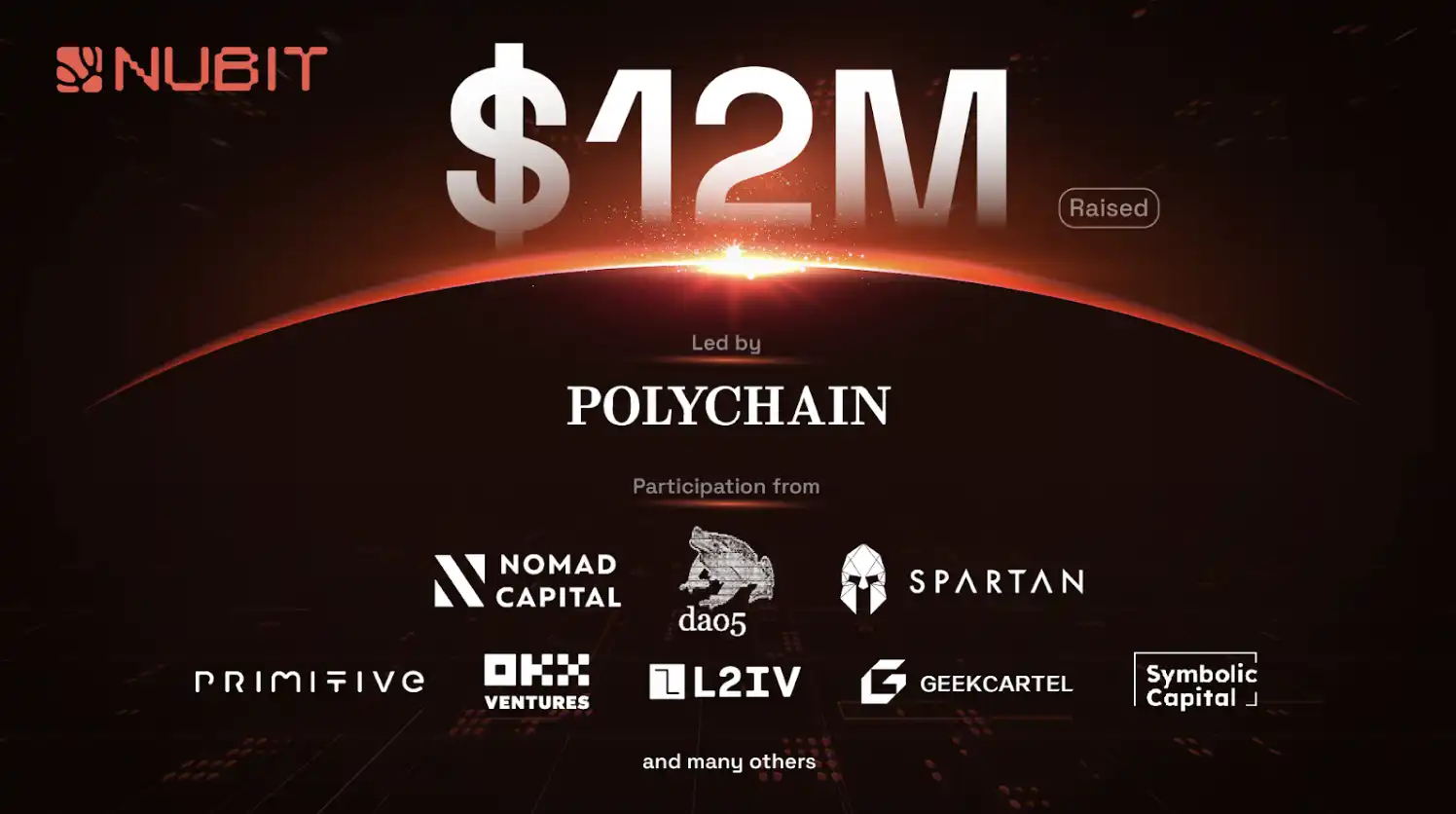
From a financing perspective, since our establishment last Christmas, we have completed three rounds of financing, with a total of more than 12 million US dollars, and major investors include industry-leading institutions such as Polychain and dao5.
In terms of the team, from the initial three founders, including me and my two doctoral students, it has grown to a medium-sized team of more than 30 people, covering marketing, product and R&D.
BlockBeats: How is Nubit different from other DA solutions?
Yu Feng:Compared with other Bitcoin DA projects on the market, Nubit has several unique advantages. First, we provide a truly decentralized solution, which is different from some of the more centralized DA solutions on the market, which usually rely on a smaller server cluster to maintain data availability.
Second, our economic security is guaranteed by Bitcoin stakers. Compared with other DA solutions that rely on a single project or a small user base, our model involves thousands of stakers, which improves the security of the entire system.
Finally, our consensus layer is fundamentally different from existing Bitcoin or Ethereum DAs, supporting hundreds of thousands of stakers, ensuring the highest degree of decentralization and security.
BlockBeats: Why did Nubit try to use its own chain's DA to replace BTC L1's DA?
Yu Feng: Just like Beijing's vehicle restrictions, the Bitcoin mainnet's throughput is extremely limited now, similar to all vehicles being crowded on the Second Ring Road during peak hours. In contrast, the traditional banking system, Visa or UnionPay can process about 20,000 to 30,000 transactions per second, Ethereum about 30 transactions per second, and the Bitcoin mainnet can only process about four transactions per second. Therefore, Nubit is positioned as a Bitcoin DA strategy to help reduce the storage burden of Bitcoin Layer1.
BlockBeats: How does Nubit handle network fee settlement?
Yu Feng: There are two ways to settle Nubit network fees: one is to pay directly with Nubit's native tokens, and the other is to pay through Bitcoin, which requires a cross-chain bridge based on the Lightning Network.
These two settlement methods are designed to ensure the economic security of Nubit and avoid relying on a single staking system, thereby reducing the risk of the entire network being affected by a single economic event. For example, if a settlement method based on Nubit staking is adopted, economic security will rely on Nubit's pledgers. If any problems arise, such as threats to the economic security of pledgers, the entire ecosystem may be affected.
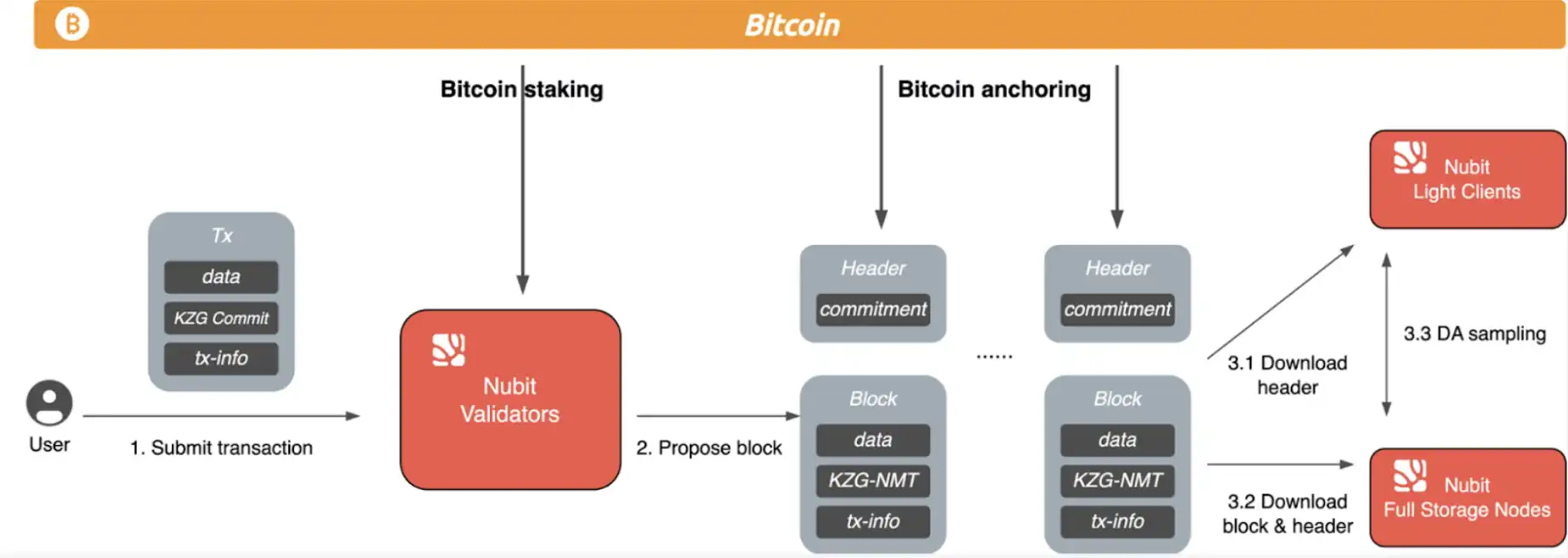
Nubit Architecture
Ultimately, the Bitcoin-based staking solution was chosen because this approach is more in line with the Bitcoin-native spirit and technical architecture, while providing users with more choices and security. Users can choose to use Nubit for investment, or rely solely on Bitcoin staking to maintain the stability and security of the network. This approach is designed to ensure that the Nubit network can effectively support the development of the Bitcoin ecosystem, rather than just providing a simple payment solution.
BlockBeats: How does Nubit ensure security?
Yu Feng:In the field of Web3 security, we ensure the security of Nubit from three main aspects. The first is economic security, which is a layer we attach great importance to. Nubit integrates Babylon's POS staking solution to ensure that the economic security of the entire DA ecosystem is determined by Bitcoin-native stakers.
The second layer is the security of the consensus layer. This involves the verification process of transactions, that is, how to decide whether a transaction is legal. Our consensus mechanism is designed based on a high-performance support scheme, which is different from other DA schemes on the market. For example, some projects can only support more than 200 pledgers at most, while our scheme can support hundreds of thousands of pledgers once it goes online. This scale of pledger support can greatly improve the degree of decentralization, almost approaching the native decentralization level of Bitcoin.
The third point is security at the code level. No matter how good the design is, if the code is not well implemented, problems may eventually occur. Therefore, we also pay great attention to security in code implementation. Our code is in the final round of testnet stage and has been audited by three top security audit companies. In addition, our internal team is also doing formal verification of some core codes to ensure that everything runs smoothly.
BlockBeats: Is the development of Ethereum DA layer of reference significance for the development of Bitcoin DA?
Yu Feng: When we develop DA projects for the Bitcoin ecosystem, we do pay attention to the DA of the Ethereum ecosystem, because the development of Ethereum's DA is more mature and rich than that of Bitcoin. This reference is necessary in the early stage because it can help us quickly establish our own technical foundation and ecological applications. However, simply imitating Ethereum's solution is not enough to support the healthy development of the Bitcoin ecosystem in the long run.
There are significant differences between Bitcoin and Ethereum in terms of ecological maturity, technical genes, and main network characteristics. For example, for Ethereum, the DA layer is an enhancement of its already rich mainnet functions, while for Bitcoin, due to the extremely limited transaction processing capacity of its mainnet (only about 4 transactions per second), the development of the DA layer is more like solving urgent needs.
Therefore, although we can borrow some technical solutions from Ethereum in the early stages, for the continued development of Bitcoin, we need to explore a path that is more suitable for its characteristics. This means not just patching existing problems, but developing unique technologies and strategies to truly meet the needs and characteristics of the Bitcoin ecosystem. Such exploration and innovation are necessary to ensure the long-term and healthy development of Bitcoin DA.
BlockBeats: What is the current progress of Nubit? What are the next plans?
Yu Feng: Nubit has made significant progress so far. First, we completed the pre-alpha test in mid-October last year. The test lasted less than two weeks and attracted more than 160,000 participants and generated nearly 600,000 transactions. Currently, we are preparing to launch the first phase of the final round of testnet, which is expected to start this week.
In terms of technology and security, our relevant codes have been submitted to the three top auditing companies in the industry for audit. In addition, Nubit has supported mainstream Layer 2 SDKs, including Polygon CDK, OP, etc., which further ensures that our technology platform is compatible with and effectively supports existing mainstream technologies.
Regarding cooperation, we have recently completed deep integration with several important industry partners. These cooperations are not just superficial partnerships, but substantial technical integration. They have fully supported and used Nubit's services in the test network.
Our next plan is to complete the last round of test networks and then officially launch the main network in the second half of this year. At the same time, we are also actively promoting Nubit's popularity in the European and American communities and expanding our market influence. These steps are to ensure that Nubit can provide stable and secure services when it is launched on the main network and is widely used and recognized around the world.
BlockBeats: Where do you think the next round of explosion point of the Bitcoin ecosystem will be? What role will Nubit play in the next outlet?
Yu Feng: The start of the Bitcoin ecosystem in the West is indeed later than that in the East. Despite this, the West has shown a more stable pace in developing Bitcoin-related projects. For example, although Western projects may not respond as fast as Eastern ones, they pay more attention to differentiation and in-depth research when carrying out their work, which is different from the rapid iteration and TVL competition of many Eastern projects.
In the Bitcoin ecosystem, many projects in the early stage were copied based on Ethereum's solutions, whether it was Layer2 or other DeFi projects. However, although this model is helpful for a quick start in the early stage, it is not enough to support the long-term and healthy development of the ecosystem. Because Bitcoin and Ethereum have essential differences in technical foundation and ecological maturity.
At present, although the Bitcoin ecosystem is slowing down, this slowdown is actually a healthier and more normal state. This shows that the ecosystem needs to shift from relying on simple copying or borrowing to developing innovative solutions that are more in line with the characteristics of Bitcoin. This includes developing head applications that can truly attract users to use, not just investment-type applications such as Restaking.
The next round of Bitcoin ecosystem outbreak may be the development of applications that can arouse the interest and demand of a wide range of users, such as games or other innovative technologies. These applications will not only increase transaction volume, but will also drive the development of the entire chain, from DA to Layer2 to specific applications, forming a mutually reinforcing ecosystem.
For example, even infrastructure such as Nubit will find it difficult to develop independently without the actual ecosystem and user participation. The success of the entire ecosystem depends on the participation of real users and the actual use of applications, which will be key factors in promoting the further development of the Bitcoin ecosystem.
Recommended
The Wall Street Journal: How is AI Trading Stealing the Limelight from Cryptocurrency?
Aug 15, 14:00
Tencent Still Has a Dream
Aug 15, 11:27
To Catch North Korean Hackers, They Set Up a Fake Project
Aug 15, 10:00
From Litigation to Settlement: Positive Signal Released by HTX's Negotiation with FCA
Aug 14, 19:32
11,742 Shipping Addresses Exposed Alongside Trezor Orders
Aug 14, 19:01
Founder Interview: FOMO Creator Explains How They Added 30,000 Users in One Day and Became One of the Fastest-Growing Crypto Apps
Aug 14, 18:37