WSJ: We Talked to the "Degenerate Retail Traders" Behind the Latest Meme Stock Craze

Original Title: "A Chat About the 'Degenerate Retail Trader' Behind the Latest Meme Stock Craze"
Original Authors: Hannah Miao, Gunjan Banerji, THE WALL STREET JOURNAL
The U.S. stock market is rife with "degenerates."
A high-risk trading style is making a comeback, driven by self-proclaimed "degen" amateur traders. These traders are drawn to high-risk trades known for having no connection to traditional investment evaluation methods. Some are willing to pour large sums of cash into specific stocks or cryptocurrencies just to participate in a trend. Others do it for the memes and jokes.
In their language, "Degen" can be a noun, adjective, or verb, popular mainly among the youth. It's a self-deprecating identity, with some tracing it back to the term "degenerate gambler." It embodies a spirit that celebrates bold market bets and questions investment norms: You only live once, so why fret over conventional financial advice?
These self-proclaimed "degenerates" use online aliases to boast in chat rooms about buying obscure digital tokens, meme stocks, and speculative options contracts. They typically value the excitement these trades bring rather than the fundamentals of the assets. Such trades can result in almost immediate profits, but if the bet fails, they can also lead to huge losses.
"Degenerates" are one of the driving forces behind the "meme stock frenzy," such as the recent paradoxical moves in GameStop's stock. When these internet-fueled traders band together, they can trigger significant asset price swings. All it takes is igniting a meme.
In May of this year, amidst a surge in everything from major indices to meme stocks, there was a significant uptick in mentions of "degenerates" and "degenerate trading" on social media. According to Hootsuite's social media performance engine, references to "degenerates" and its variants surpassed 370,000 on various social media platforms like Reddit and X, up from fewer than 1,000 mentions in April.
"It's fast money," said 39-year-old former professional poker player Daniel Moravec, who identifies as a "degenerate trader." "Buying some options or high-risk stocks is better than buying lottery tickets."
During the COVID-19 pandemic, with people stuck at home and receiving extra cash from stimulus programs, day trading saw explosive growth. Apps like Robinhood made trading easy and fun, while across the industry, brokers eliminated commissions and offered fractional trading, reducing investment costs to all-time lows.
Today, investors are betting on everything from clearly valueless digital tokens to highly risky options that could become worthless within minutes or hours. Robinhood introduced 24-hour trading last year and has expanded the number of stocks available for overnight trading this year, allowing degenerate traders to easily invest in stocks around the clock and attempt to capture certain stock movements.
A trader known as Keith Gill has become the ultimate hero of many degenerate traders, although he claims to be a value investor. His online aliases are "Roaring Kitty" and "DeepF——Value". In 2021, he heavily bet on GameStop and shared his investment information online, leading a meme stock revolution. Rookie investors flocked to join him, driving up the stock price of the struggling video game retailer. They caused significant losses to hedge funds that were shorting the stock, attracting the attention of the U.S. Congress, regulatory agencies, and Wall Street. Gill's final Reddit post in 2021 showed that his GameStop stock holdings were valued at around $30 million.
Since then, brokerages' trading volume has fallen from the highs of the COVID-19 era. Many day traders have returned to their regular jobs.
Some Wall Street insiders doubt whether the meme stock frenzy is just a passing fad. But the die-hards remain steadfast. Along the way, parts of the market have become akin to a casino.
Last month, "Roaring Kitty" reappeared on X platform, once again igniting a trading frenzy in GameStop and other meme stocks. On Sunday, an account linked to Gill shared a screenshot on Reddit showing a position in GameStop exceeding $180 million, sparking a new round of roller-coaster trading. Over the past month, the stock has more than doubled.
Although the odds are slim, bets associated with GameStop and other favored stocks of degenerate traders have seen a significant surge, driving the year-to-date average daily options volume to nearly 47 million contracts, reaching a historic high according to data from the Options Clearing Corporation since 1973. These activities are mostly centered around day trading, where investors could make a huge profit or lose everything.
For example, data from Cboe Global Markets shows that if a trader bought options tied to GameStop's surge to $20 just before the recent stock market rally, the return could be over 2,000%.
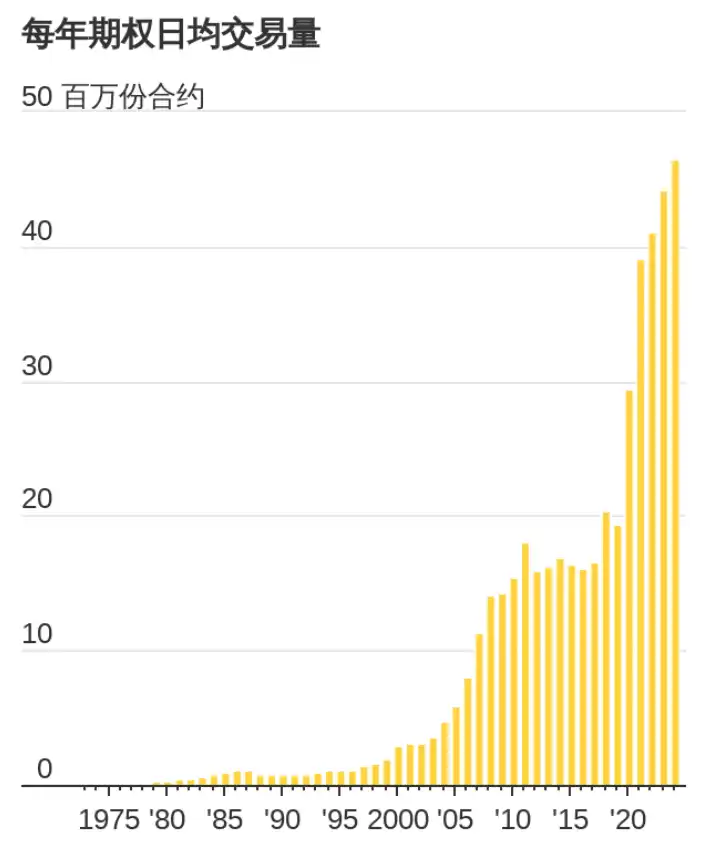
Data Source: Options Clearing Corporation
The US stock market has been soaring, with the S&P 500 index delivering a nearly 11% annualized return over the past 10 years. Meanwhile, the near-risk-free return of many money market funds is around 5%, reaching some of the highest levels in over a decade.
Nevertheless, some dissenters argue that the rather dull returns from such comparisons are far from enough. They crave for juicier profits, hoping for a big win to make a substantial difference in their lives.
Despite data showing a robust US economy, inflation has driven up grocery prices and rental costs. The Federal Reserve's practice of raising interest rates to curb inflationary pressures has also pushed up mortgage rates.
Youth, in particular, are feeling the pinch of record-high home prices and towering student debt burdens, with some worrying they may never earn enough money to reach the milestones achieved by previous generations. Longitudinal studies of American youth reveal that the post-pandemic disillusionment among the Z generation surpasses that of any previous living generation.
32-year-old Matt Kielczewski said he started investing in cryptocurrency in 2017 because he was drawn to the "promise of financial freedom." He had opened an account on Coinbase to buy a ticket to a solar eclipse event, needing bitcoin to make the purchase. The $10 remaining in his account turned into $100 six months later.
“That was an epiphany for me,” he said. “This magical internet money is changing people's lives.”
While making a living as an underground DJ in Colorado, the outbreak of the pandemic wiped out Kielczewski's income. Now, he works in marketing in the cryptocurrency industry and lives in Lisbon.
Initially, degenerate trading made him feel like part of an organization where the mission was greater than the individual: a community of like-minded individuals. Since then, he has become wary of scammers and now sees the "vast toxicity that exists in this space." He still trades weekly but now takes more of a buy-and-hold approach to cryptocurrency.
According to cryptocurrency data provider CCData, cryptocurrency trading volume on centralized exchanges surged in March to an all-time high. This includes bitcoin trades and degenerate investments in so-called meme coins; these meme coins are created for fun and often reference popular online inside jokes. Earlier this year, a cryptocurrency called Dogwifhat, associated with a virtual image of a Shiba Inu wearing a pink hat, was worth only a few cents, but its recent trading price is around $3.36, marking an increase of over 2,000%. There is even a Degen coin that has seen significant price swings.
So far this year, the proportion of low-priced stocks in U.S. stock trading has also increased, reaching 14% as of the end of May, setting a new high based on data from Cboe Global Markets since 2016.
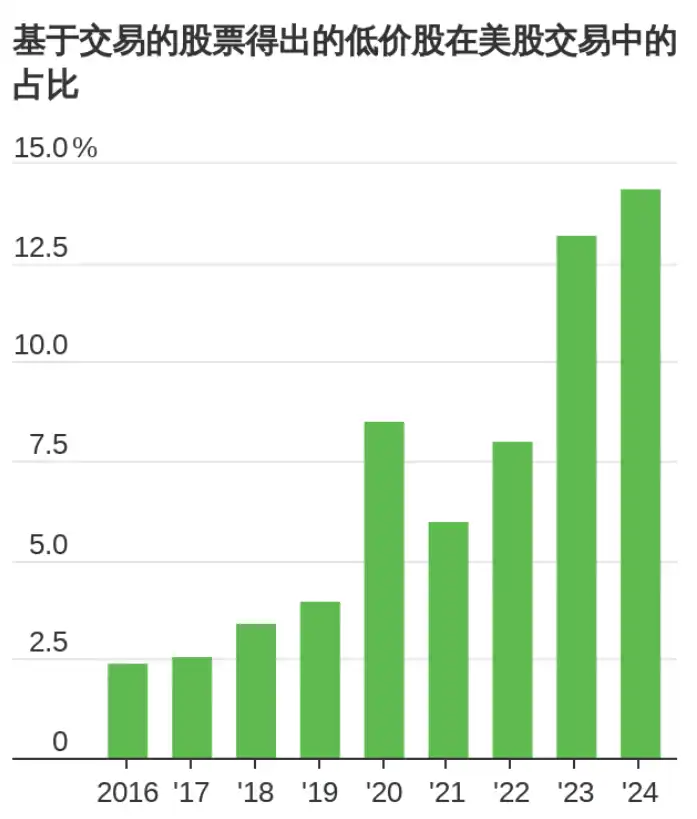
Note: Data for 2024 is as of May
Source: Cboe Global Markets
The degens and their ilk are also flocking to online sports betting. The National Collegiate Athletic Association (NCAA) surveyed 3,527 individuals aged between 18 and 22 last year and found that 67% of students living on university campuses had engaged in sports betting.
It's difficult to determine the exact origin of the term "degen" and how many traders actually classify themselves as such. Many have stated that it was first adopted by the cryptocurrency community and then expanded to other markets. Some started seeing the term during the 2020 "DeFi Summer" when significant funds flowed into the decentralized finance part of the cryptocurrency world.
Clearly, this term is gaining popularity as a trading style. With the surge in online mentions of "degen" and "degen trading" in May, data from J.P. Morgan Global Quantitative and Derivatives Strategy showed that the share of options activity driven by retail investors in that month soared to over 18%, marking at least the highest level since August 2020.
Traders might say they are "degening" (placing bets like gamblers) on meme coins and the like. This is akin to some traders self-identifying as "apes" or saying they are heavily accumulating, or "aping" (mindlessly following the crowd to bet) on a certain asset. Uniting and coordinating trades on platforms like Reddit or Discord is seen as a bold move. Those willing to take on such high risks are celebrated by their peers.
"In internet slang, 'degen' might actually be a nickname," said Dustin Burnham, a 41-year-old anesthesia assistant from Melbourne, Florida. "It may imply a willingness to take risks that others wouldn't to achieve a goal."
Burnham said he didn't consider himself a degenerate investor, but he was active in some communities filled with ape emojis.
Few retail investors made even a small part of the wealth that Gil seems to have obtained. An academic study in 2023 found that many retail investors lost money on options trading, especially around events like earnings reports. Many investors also failed to capitalize on opportunities in cryptocurrency. For example, new users flocked to cryptocurrency around the peak of prices in 2021, and some suffered significant losses in the subsequent crash.
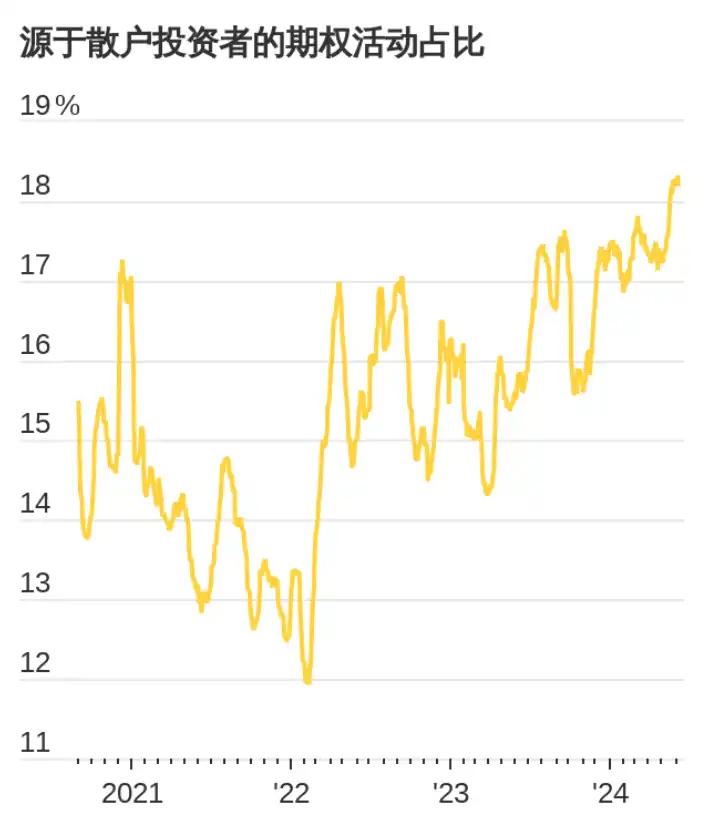
Data Source: J.P. Morgan Global Quantitative and Derivatives Strategy
Following the GameStop saga in 2021, the U.S. Securities and Exchange Commission (SEC) proposed setting up guardrails related to trading apps to curb what regulators see as gamification of trading. So far, such moves have faced strong opposition from the brokerage industry and Congress.
Based in Berlin, 38-year-old Maria Paula Fernandez has been trading cryptocurrency since 2017 and is now a cryptocurrency professional. Her home country, Argentina, imposes restrictions on foreign currency, making the promise of freedom and transparency in cryptocurrency very appealing to her.
While she has engaged in a fair amount of meme coin trading, enjoying the fun of navigating the market, she is skeptical of the "degen" spirit.
"It eventually affects the way you look at things. You no longer see certain things as financial instruments," she said. "You've just been sucked into this microculture."
Original Article Link
Recommended
The Wall Street Journal: How is AI Trading Stealing the Limelight from Cryptocurrency?
Aug 15, 14:00
Tencent Still Has a Dream
Aug 15, 11:27
To Catch North Korean Hackers, They Set Up a Fake Project
Aug 15, 10:00
From Litigation to Settlement: Positive Signal Released by HTX's Negotiation with FCA
Aug 14, 19:32
11,742 Shipping Addresses Exposed Alongside Trezor Orders
Aug 14, 19:01
Founder Interview: FOMO Creator Explains How They Added 30,000 Users in One Day and Became One of the Fastest-Growing Crypto Apps
Aug 14, 18:37