Industry transformation pains, KuCoin may settle with CFTC in the short term

11 years after the Winklevoss twins first applied for a Bitcoin spot ETF, the Bitcoin spot ETF was approved for listing and trading by the U.S. Securities and Exchange Commission (SEC) in the early morning of January 11, 2024. The Ethereum spot ETF is also just one step away from going online.
However, with the development of the cryptocurrency market, regulators are also paying more attention to the compliance and transparency of the market.
In March 2023, the U.S. Commodity Futures Trading Commission (CFTC) filed charges against Binance and its founder CZ, accusing them of violating the Commodity Exchange Act (CEA) and CFTC regulations. In November 2023, Binance reached a settlement with the CFTC, which lasted for 8 months. Binance agreed to pay a total of US$2.85 billion in fines and promised to comply with relevant regulations. Of this, $1.35 billion is the transaction fees that Binance received for bad assets, $1.35 billion is a fine, and the remaining $150 million is a civil penalty borne by CZ.
After Binance reached a settlement with the CFTC, KuCoin became the next target of the CFTC.
On March 26, 2024, the CFTC charged KuCoin with violating the Commodity Exchange Act (CEA) and various provisions of the CFTC. This is another important case after Binance, and it happens that the difference between the two cases is exactly one year.
Both Binance and KuCoin were accused of violating the US Commodity Exchange Act and CFTC regulations, but the specific allegations were different.
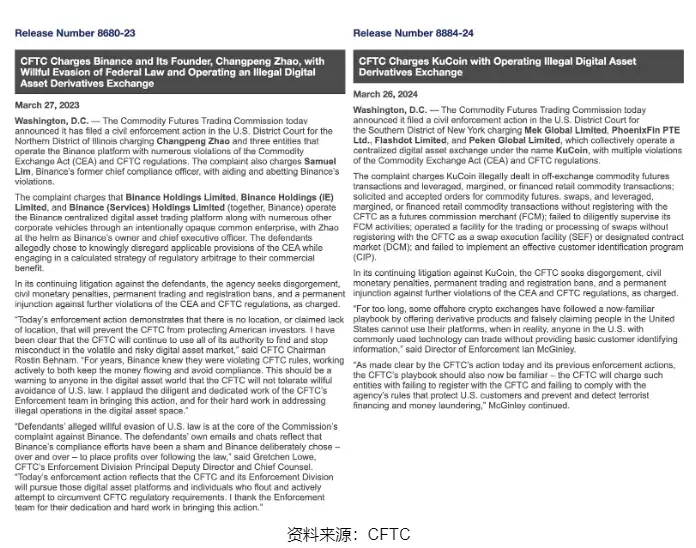
The CFTC has filed multiple charges against Binance and CZ. Specifically, the CFTC has charged Binance and its operating companies with violating the Commodity Exchange Act and CFTC regulations. In addition, Samuel Lim, former chief compliance officer of Binance, has also been charged with aiding and abetting these violations.
KuCoin faces charges mainly involving illegal over-the-counter commodity futures trading, failure to effectively supervise its business, and failure to implement customer identification procedures (KYC). Compared with Binance's charges, the CFTC's charges against KuCoin focus more on operations and compliance, without mentioning acts such as deliberate evasion of regulation.
Information disclosed by the CFTC shows that Binance's charges are more comprehensive, involving deliberate circumvention of the law and systematic guidance of customers to circumvent regulation. In contrast, KuCoin's case is relatively minor, and may be a violation caused by negligence or mismanagement rather than premeditated violations of the law. Neither party's charges involve user funds.
In May 2024, the U.S. Commodity Futures Trading Commission (CFTC) issued a statement saying that Falcon Labs, Ltd., an institutional digital asset broker based in Seychelles, reached a settlement with the CFTC for failing to register as a futures commission merchant (FCM) in accordance with regulations. Falcon Labs will pay approximately $1.2 million in illegal gains and a civil penalty of $600,000.
If cases such as Binance and Falcon Labs are used as precedents, despite facing charges, KuCoin's case is relatively minor, mainly operational and management issues, and it does not have deliberate evasion of regulation. KuCoin may pay a fine and reach a settlement with the CFTC in the short term.
Founded in 2017, KuCoin is one of the world's largest crypto trading platforms. According to CoinMarketCap data, KuCoin ranks seventh in the world in both crypto asset spot and derivatives trading.
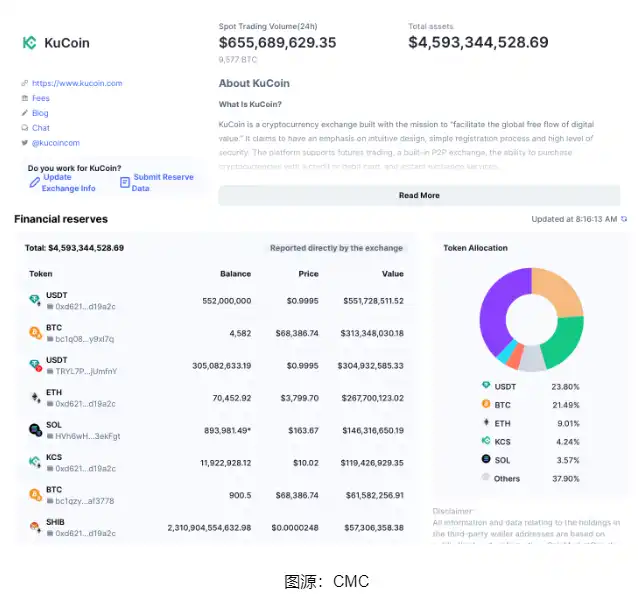
After being sued by the CFTC, the total assets of the KuCoin platform experienced a net outflow in the short term, but then gradually stabilized. According to CMC data, the total assets of the KuCoin platform are currently about US$4.6 billion. KuCoin's latest proof of reserves (PoR) shows that the value of BTC, ETH and stablecoin assets on the platform exceeds US$2.5 billion, and the reserve ratios of BTC and ETH reach 115%, and the reserve ratios of USDT and USDC are 109% and 120% respectively, all exceeding user assets and can be fully redeemed.
A similar situation also occurred on Binance. Although the platform was also sued by the CFTC and experienced a brief outflow of funds, it can be seen that after reaching a settlement with the CFTC, Binance's total platform assets reached 120.2 billion US dollars, a record high.
Faced with regulatory challenges, KuCoin chose to actively respond rather than shut down operations such as withdrawals. The platform immediately airdropped a total of 28.95 million US dollars in KCS and BTC to users who supported its development. Although KCS experienced a brief plunge after the news fermented, it subsequently rebounded by nearly 45%, and its holders exceeded 2 million, an increase of 4.06% from the previous quarter. Judging from past cases, US regulators have no intention of stifling the crypto industry and its enterprises, but more to ensure the long-term health and sustainability of the industry while protecting participants from unnecessary risks.
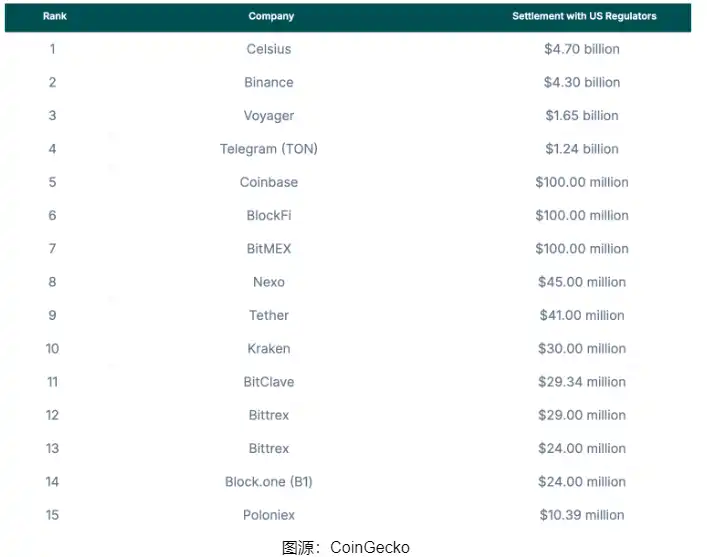
According to CoinGecko statistics, more than half of the crypto companies sued by US regulators and settled for more than 10 million US dollars are still operating normally, including Telegram (Ton), which ranks in the top ten of all crypto assets in terms of market value, Coinbase, the largest compliant crypto trading platform in the United States, and Tether, the world's largest stablecoin issuer.
According to public data statistics, as of March 2024, the total number of registered users of KuCoin was close to 32 million, an increase of 4.32% from the previous quarter. Among them, the growth of users in Latin America was particularly significant, reaching 16.26%, the Middle East and Africa region increased by 11.29%, and Europe increased by 6.98%. In the first quarter of 2024, KuCoin's spot trading volume increased by 121.85% year-on-year, of which the Middle East and North Africa (MENA) region increased by 263.91%. These data show that KuCoin's services are gaining wide recognition and popularity around the world.
Although KuCoin is currently facing a CFTC prosecution, which may have a certain impact in the short term, judging from its latest corporate data and business strategy, this incident will not have a significant negative impact on its existing business in the long run. On the contrary, this may be an important step for the crypto industry to move towards compliance, paving the way for attracting more traditional funds to enter the market. Compliance will bring more opportunities to the crypto industry and promote its healthier and more sustainable development.
In the early stages of the development of any industry, the era of wildness is often inevitable, and the cryptocurrency industry is no exception. Along with rapid development, there are high market volatility and frequent regulatory disputes.
This phenomenon is not unique to the crypto industry. In the traditional financial industry, Bank of America has been sued 156 times and paid more than $41 billion in fines, while Goldman Sachs has been sued 58 times and paid $13.1 billion in fines. History shows that even the most mature financial institutions will face challenges from regulation.
KuCoin's prosecution by the CFTC may mark an important turning point for the crypto industry. The era of wild growth is coming to an end, and a new era of compliance is coming. The approval of the Bitcoin spot ETF has accelerated this process. This transformation is an inevitable trend in the development of the industry. Only through compliant operations and market norms can more traditional funds be attracted to participate.
The crypto industry is undergoing a transition from wild growth to compliant operations. For companies such as Binance and KuCoin that have encountered challenges in the compliance process, this is more like a pain. However, these challenges are not only obstacles to the development of the industry, but also a sign of its maturity. After experiencing these pains, the crypto industry can become more robust, attract more attention and participation from mainstream investors, and ultimately achieve healthy and sustainable development of the industry.
Recommended
The Wall Street Journal: How is AI Trading Stealing the Limelight from Cryptocurrency?
Aug 15, 14:00
Tencent Still Has a Dream
Aug 15, 11:27
To Catch North Korean Hackers, They Set Up a Fake Project
Aug 15, 10:00
From Litigation to Settlement: Positive Signal Released by HTX's Negotiation with FCA
Aug 14, 19:32
11,742 Shipping Addresses Exposed Alongside Trezor Orders
Aug 14, 19:01
Founder Interview: FOMO Creator Explains How They Added 30,000 Users in One Day and Became One of the Fastest-Growing Crypto Apps
Aug 14, 18:37