2024 Q2 Review: Which projects show signs of growth?

Original title: Reflections on the State of Crypto: Q2 2024
Original author: Alana Levin, Variant Fund
Original translation: TechFlow
Every six months or so, I write an internal reflection on the current state of cryptocurrencies and future trends. This time I decided to publish the most recent one publicly, hoping that it will arouse your interest.
The article is divided into three parts: Existing successful projects, other things that have happened (or are happening), and new things I am looking forward to.While I will try my best to support the analysis with data, it is inevitable that some personal opinions will be mixed in. I hope this article will interest you, and if the response is positive or the feedback is constructive, I will consider sharing more such thinking articles in the future.
The good news is that there are many projects that are currently operating smoothly and have achieved remarkable results. Many of these projects can be called "big ideas" because they have the potential to significantly change the status quo. Their success will lead to new opportunities.
For clarity, I use the term "existing successful projects" to refer to projects or trends that show sustainable product-market fit, are expanding the size of the crypto market, or both.
So, which projects or trends are currently showing signs of success or growth? I’ve selected a (non-exhaustive) list of 10 projects that show clear signs of “success”:
1. Stablecoins
2. Bitcoin as an alternative asset
3. Farcaster, an early but growing social network
4. Asset creation
5. Community-created and trained AI models
6. Solana
7. Ethereum
8. Zora
9. Coinbase
10. On-chain exchanges
Stablecoins
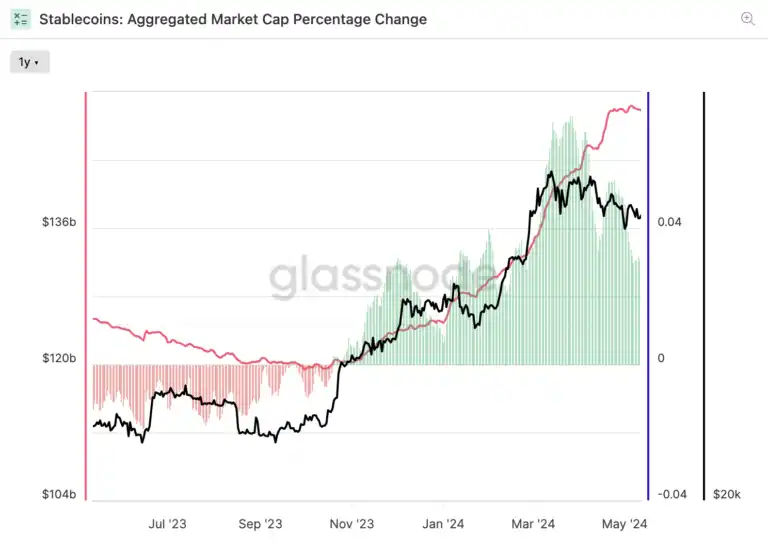
On-chain stablecoin supply has seen net inflows of around $25 billion so far this year. Overall inflows have been positive since November 2023. Permissionless, global access to the dollar continues to enjoy strong product-market fit.
Bitcoin as an alternative asset
In January, nearly ten Bitcoin spot ETFs were approved. As of early June, more than $80 billion in value has been deposited in Bitcoin spot ETFs. (Data from Blockwork & The Block)
Gold seems to be a good analogy for understanding institutional allocations to Bitcoin: whether or not you think the asset represents an inflation hedge, it is an alternative to traditional stocks and enjoys a certain degree of social consensus. One could argue that Bitcoin is better than gold because it is easier to transfer, the supply cap is known, and the asset is gaining adoption on the balance sheets of some companies and countries, and therefore could exceed the market value of gold.
In the private markets, the first quarter was characterized by a large number of projects trying to extend the utility of Bitcoin. This includes (many) Bitcoin smart contract layers, on-chain lending protocols, and exploring how to use Bitcoin's economic security budget to help protect other chains. I guess the fruits of these developments may become apparent in the second half of this year.
Farcaster
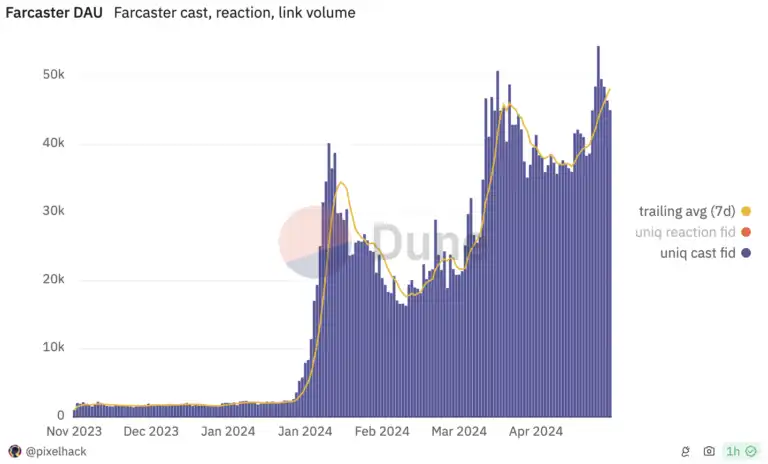
Farcaster, a social network built on an open protocol, is starting to enjoy significant growth.
The turning point came in late January with the launch of frames, small application widgets that people can share and interact with directly in the social feed of the Farcaster client.
Asset Creation
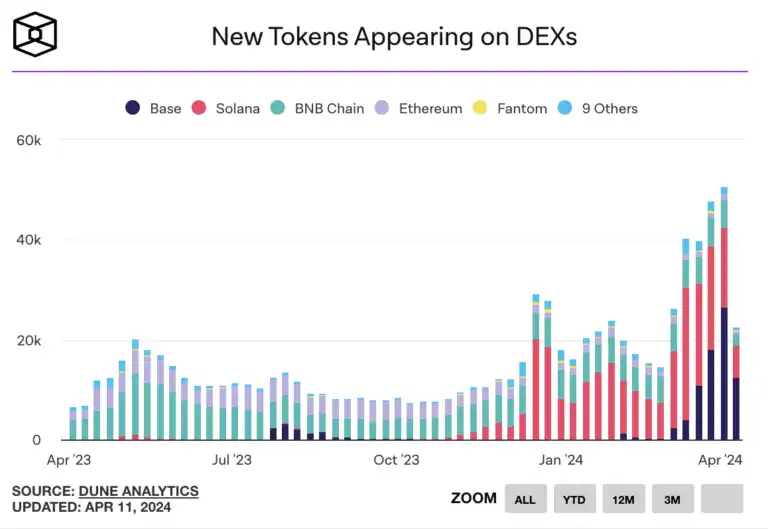
The number of new token creations continues to rise. One way to track this trend is to look at the number of new tokens appearing on decentralized exchanges (DEXs). Activity is driven primarily by asset creation on Base and Solana.
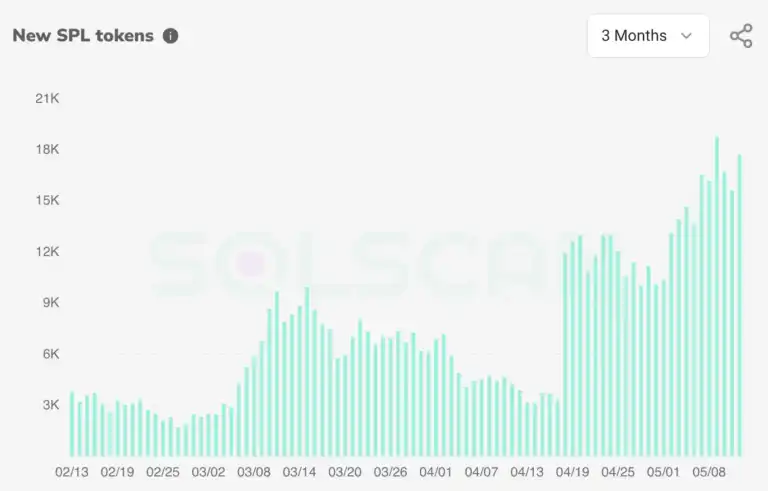
On Solana specifically, over 10,000 new tokens have been created every day over the past few weeks.
Many of these new assets are in the form of memecoins. I wouldn’t describe myself as an active participant in the memecoin space, but I do recognize a very real and active group of users who demonstrate enthusiasm for participation.
It’s worth noting that the emergence of these new assets has led to some unexpected but productive byproducts in the broader ecosystem. For example, we’re seeing more experimentation with new tools like Solana’s token extensions. One token called $BERN innovates on token economics using Solana’s new token extension: if someone sells their tokens, 5% of that transaction is destroyed (as a redistribution mechanism to remaining holders). The popularity of $BERN has become a driving force for wallets to adopt token extension standards — standards that help enable complex payment allocations, confidential transfers, and more. Without $BERN, who knows how long token extension adoption would have taken.
Overall, my main takeaway is that asset creation seems to be a trend with a tailwind. Regardless of how you feel about these assets, owning issuance and trading are always two excellent positions in the flow of value.
Community Created and Trained AI Models
It is clear that we are heading towards a world where LLMs (Large Language Models) are abundant, creation is cheap, and choice is plentiful. In such a world, where does value accrue?
I believe that value accrues in scarce resources. So in a world where computing power, content, and tools are abundant, the question becomes: what is scarce? One answer is taste and attention. The problem is that taste and attention are fairly intangible resources. Even if we can measure them (e.g., "screen time" as a measure of attention), it is difficult to put a price on this metric.
We are starting to see the crypto track help in terms of tightly integrating the financial track with taste and attention-based activities. Specifically, community-created and trained AI models that have some kind of productive output — such as a good or service that can be sold or licensed (like art, movies, intellectual property, etc.) — offer the ability to reward participants. For models with subjective outputs, community participants act as tastemakers by training the model to their cultural preferences. There is a strong incentive to choose good taste: the more tasteful the output, the higher the selling price.
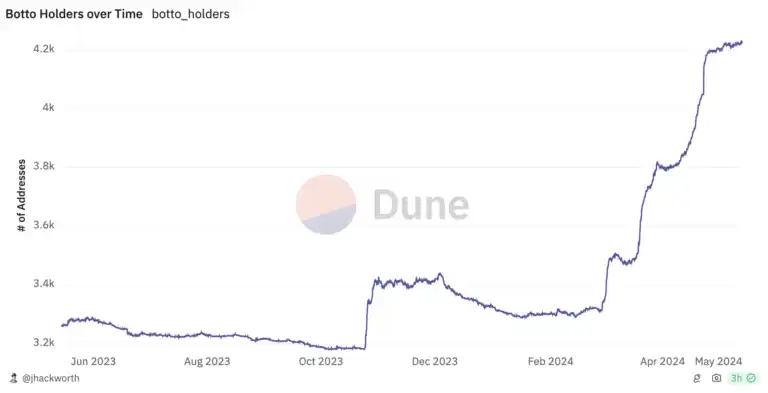
We are starting to see some of these projects emerge in real and working ways. Botto is my favorite example. It is an autonomous artist, and $BOTTO token holders have the ability to help train the model every week.
Botto’s art keeps getting better, and the prices of its weekly auctioned Botto pieces keep rising. At the same time, the network of owner-participants keeps growing:
I think we will start to see more community-created and trained AI models, especially as the number of known and working examples like Botto continues to grow.
Some companies are addressing the attribution problem from the top down, either through litigation, data licensing agreements, or a combination of both. If we assume that the status quo represents less than 1% of the model output that will exist in the next five years, there is clearly room for other attempts to address attribution and assign value to contributors. Crypto rails offer a uniquely valuable solution. Crypto strengthens the economic and creative attribution equation. Importantly, it also allows anyone, anywhere to participate.
In an old blog post, Chris Dixon mused:
“There’s a famous quote: ‘The future is already here, it’s just not evenly distributed.’ An obvious follow-up question is: if the future is already here, where can I find it?”
Community-created and trained models are an area where we have some small but growing projects that very much point to a larger future.
Solana
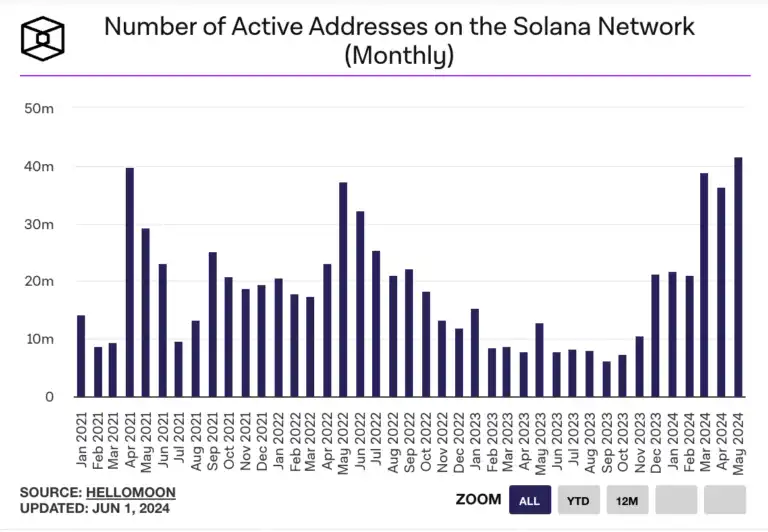
Daily active addresses interacting with Solana are 2-3x higher than this time last year, and roughly in line with the highest activity period in the 2021 cycle. Monthly active addresses have increased 3-4x over the same time frame, with a new high set in May 2024:
The network has also begun to generate significant fee income, beginning to prove the hypothesis that Solana’s low fees will be compensated by higher user activity/transaction volume.
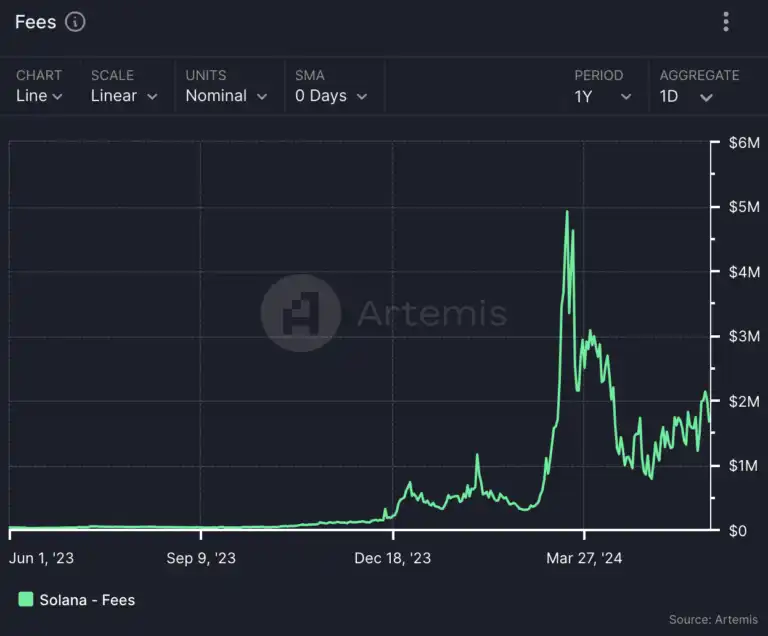
Conclusion: Solana’s trajectory suggests it is operating in a meaningful way and is here to stay.
Ethereum
The Ethereum ecosystem has also made significant progress. There are two ways to frame this growth: focusing on Ethereum itself, or looking at the Ethereum chain system as a whole (i.e. including the Ethereum roadmap).
Ethereum itself has seen significant growth in monthly active addresses. The past 30-day average YTD is up ~30% and is only ~10% below the 2021 peak.
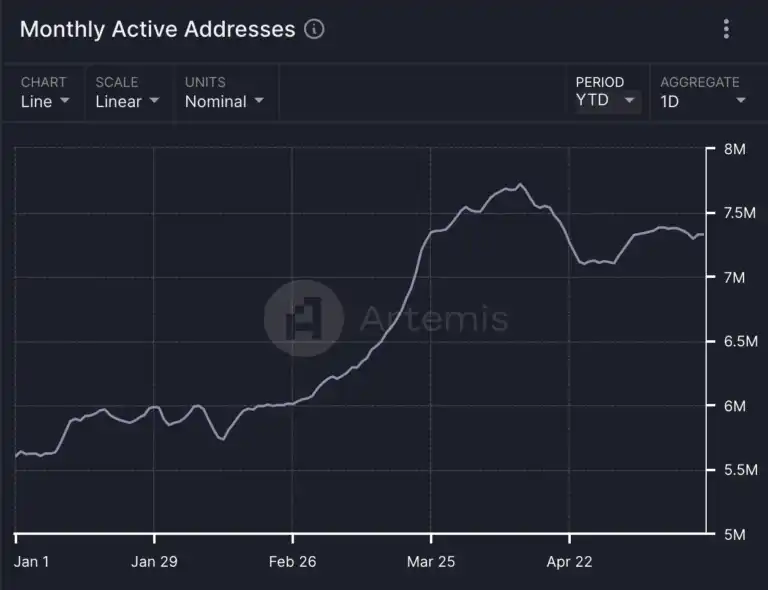
Looking at the Ethereum ecosystem as a whole also shows significant signs of growth. I aggregated the daily active addresses for the five top Ethereum chains — Ethereum, Arbitrum, Base, Optimism, and Polygon. These five were chosen because they have rich application and developer ecosystems.
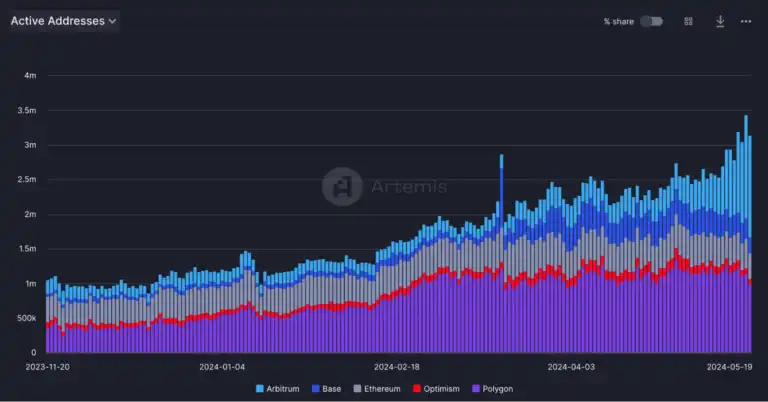
Conclusion: Ethereum has been and continues to be one of the most important ecosystems in the crypto space.
Zora
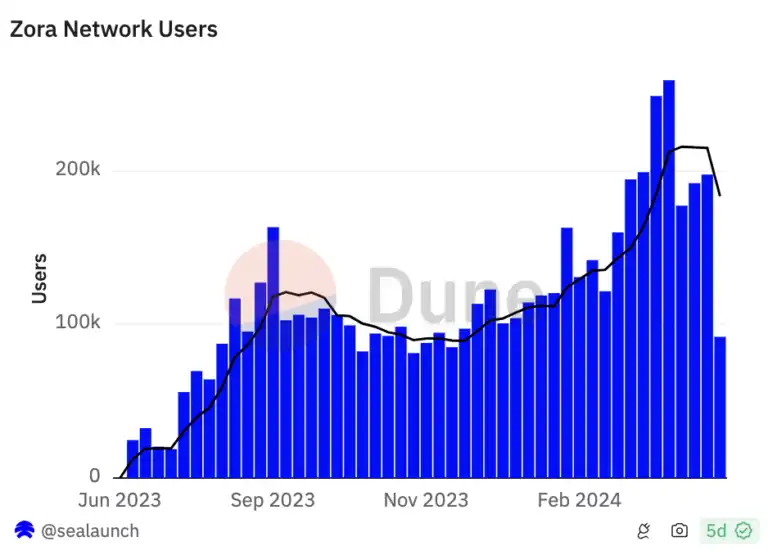
Zora Chain (also known as Zora Network) has been online for about a year. During this time, the network continues to find its niche. Weekly active users have increased by about 60% year-on-year and recently exceeded a new high of 250,000. The chain also enjoys a profit margin of about 34%, meaning that Zora retains one-third of the ETH that users spend on transaction fees.
Zora ChainZora Chain is a proof of concept that applications with enough distribution can begin to vertically integrate with other parts of the stack, such as block space, unlocking more attractive economics.
Coinbase
Coinbase also had a strong start to the year. It is listed as the custodian of 8 of the 11 Bitcoin spot ETFs. The trading business also continued to make progress - trading volume reached $157 billion, the highest since November 2021.
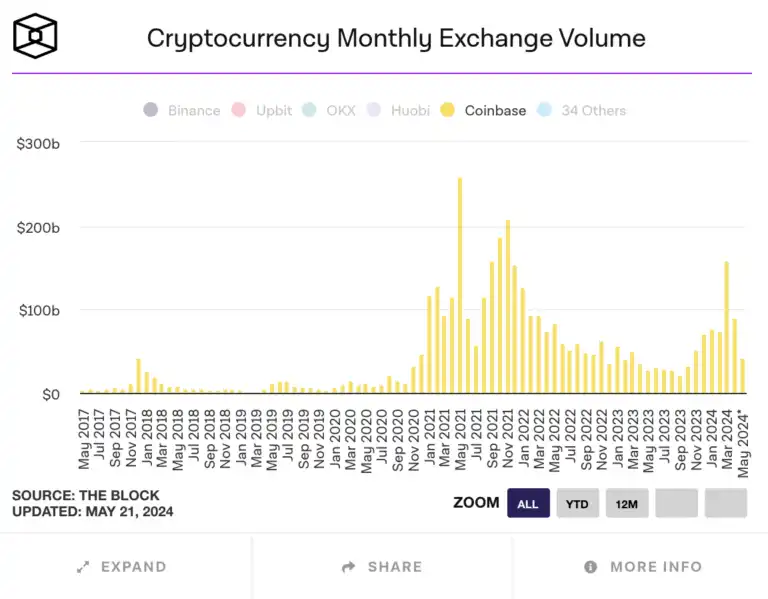
Trading fees still account for the majority of Coinbase's revenue. In the first quarter, the platform generated more than $1 billion in revenue from trading fees (about two-thirds of its quarterly revenue).
But it’s also worth noting that Coinbase continues to diversify its revenue streams beyond transaction-based fees. Blockchain rewards revenue and custody fee revenue both doubled from the year before. Stablecoin revenue is approaching $200 million, with USDC’s circulating supply growth offsetting (slightly lower) interest rates. Coinbase One, Coinbase’s membership suite, has over 400,000 subscribers. Base, Coinbase’s layer-2 protocol, generates millions in on-chain fees each month.
Coinbase’s success demonstrates what (until recently) many people had only assumed: that many meaningful new business models can be built around crypto primitives.
On-Chain Exchanges
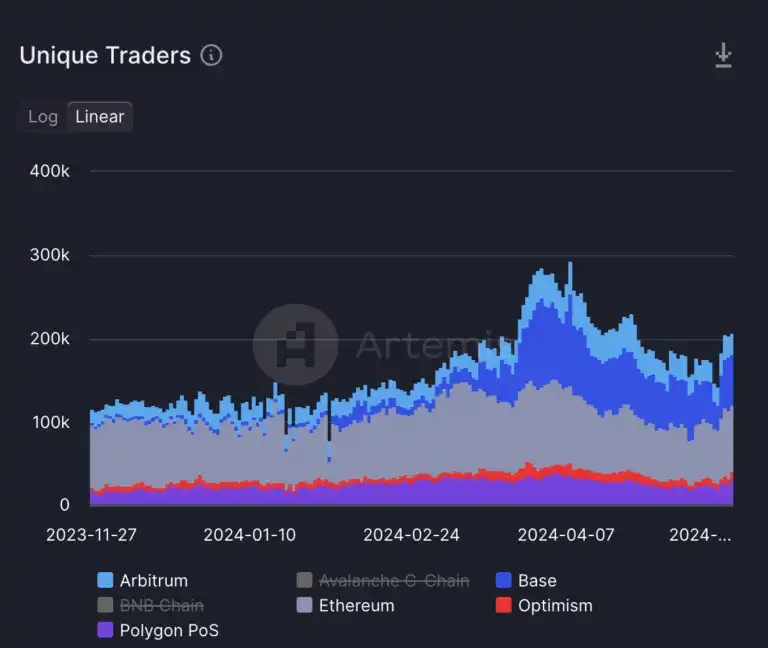
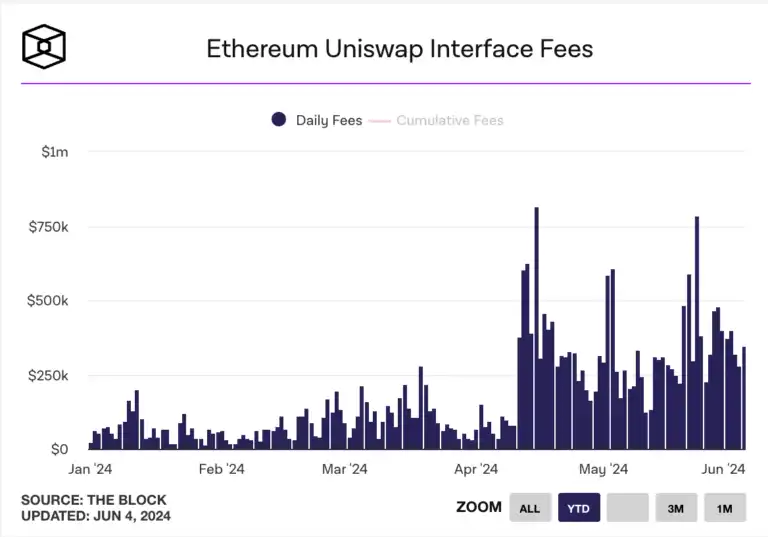
On the Ethereum mainchain, Uniswap’s number of unique users (traders) has roughly doubled in the last six months.
One of the definitions of a successful protocol is that successful businesses can be built on top of it. We see this happening with on-chain exchanges, exemplified by the growth in revenue Uniswap Labs is generating through its interface:
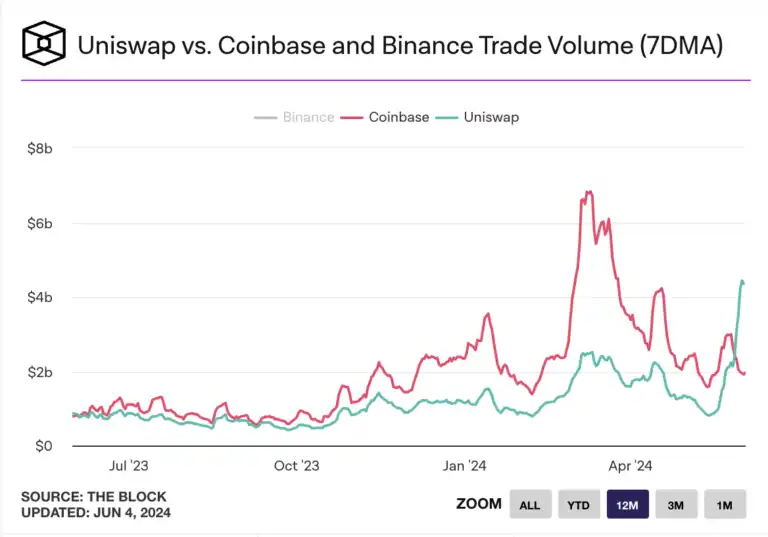
The 7-day moving average volume facilitated by Uniswap (the protocol) also recently surpassed that of Coinbase:
Importantly, it’s not just on Ethereum that we’re seeing growth in on-chain exchanges, either, as well, on Solana. Orca and Raydium, two leading DEXs, are also showing significant growth:
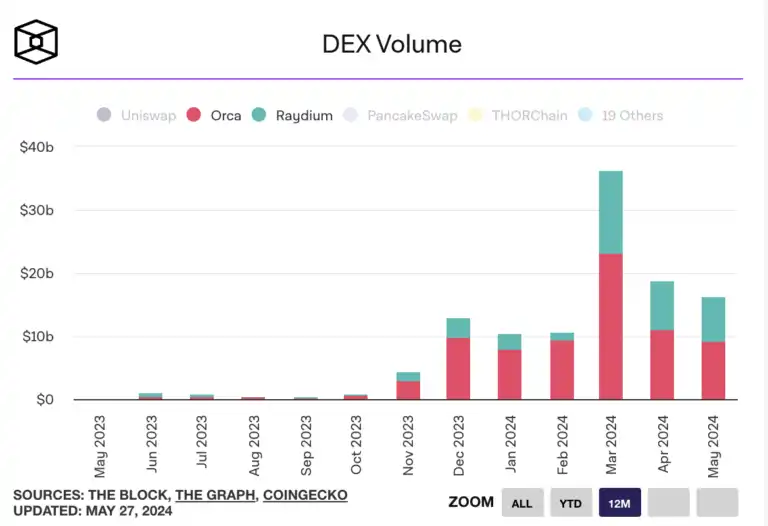
It is no small matter that on-chain protocols facilitate billions (or even tens of billions) of dollars of value exchanged each month. These protocols and interfaces represent very real, revenue-generating projects. In the presence of centralized institutions (such as interface businesses), I would like to see a portion of these profits reinvested into improving security, robustness, and user experience.
Bonus Project: Blackbird
Blackbird is a loyalty and rewards program designed for the restaurant industry, using crypto technology underneath. When a user checks in at a Blackbird-connected restaurant, the app mints them an NFT - a digital memento of their visit and a data point for the restaurant in the network to understand its customers' dining habits. Today, Blackbird is primarily present in New York City.
Blackbird continues to grow in user check-ins.
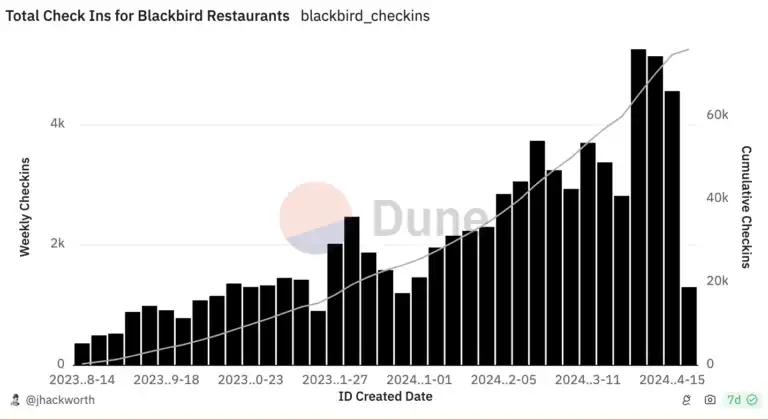
Personally, Blackbird has changed my dining habits: where before I would let my friends choose where we would eat, now I become more active in suggesting places, and primarily use the Blackbird app to guide us to restaurants that might interest us.
Other notable trends over the past two quarters include the rise of Social Finance (SocialFi) and the proliferation of new chains (primarily L2 and L3 in the Ethereum ecosystem). While I feel it is too early to say whether these trends are indeed "successful," it is worth noting that these trends are significantly affecting users' on-chain activity and how developers are evolving their business models.
Growth of Social Finance Apps
A number of financialized social ("social finance") apps have emerged. Several apps have generated millions in fees. The two most popular apps I know of are Friendtech and FantasyTop. Clearly, there are users who find these apps interesting and are willing to participate. It’s great to see new on-chain activity from users.
I’m skeptical about the sustainability of some of these business models. Speculation alone doesn’t seem enough to drive long-term success. But that’s okay. These applications may just need some tweaks to achieve a more sustainable business model. Even the attention driven by speculation provides the opportunity to monetize that interest in other ways. Of course, this critical second step is the hardest.
A surge in new chains
We’ve also seen a number of new chains — particularly L2 and L3 — launched. For these chains in the Ethereum ecosystem, the underlying technology doesn’t seem to be a significant point of differentiation. Instead, brand and community trump everything. Base, the L2 launched by Coinbase, is perhaps the poster child for a strong brand. The chain enjoys a (supposedly) growing developer ecosystem even without the direct token incentives that other chains use to attract talent.
So far, we’ve seen roughly three ways that chains attempt to differentiate:
1. The underlying technology. For example, integrated chains vs. modular chains, or optimistic vs. zero-knowledge convolutions.
2. Chain economics. Canto is the first chain (that I’m aware of) in recent years to attempt to redistribute transaction fees to developers in the ecosystem. Blast and Berachain are now experimenting with various other types of yield generation and economic distribution. It’s unclear to what extent these are sustainable — both in terms of general economic considerations, and in terms of providing a long-term competitive advantage.
3. Brand and community. A chain’s culture and/or reputation can provide an attractive halo for developers: it may enhance the perception that developers have more help (from the community or other developers) when building in the ecosystem, it may provide reputational cover for certain consumers (“no one is to blame for choosing a MacBook” or something like that), and/or the values espoused by the chain’s community may simply align with the developer’s own philosophies.
Mature chains have all three elements. Take the two “successful” chains I highlighted above: Ethereum and Solana. Ethereum pioneered the EVM, implemented EIP-1559 (which burns a portion of transaction fees to ETH holders as a redistribution mechanism), and has fostered a strong developer community and ethos around its technology. Solana popularized integrated blockchains, was the first chain to make low-fee commercially viable, and had its community really tested during the 2022-2023 trough.
My hypothesis is that the next wave of chain differentiation will come from external integrations. Examples might include seamless access to additional funding sources (e.g. a Coinbase account), KYC screening for wallets, or verifying that someone is human. This is a very broad design space, and one that I’m very much looking forward to exploring in depth.
Looking back over the past six months, my main conclusion is that we’re still mostly talking about the same things we were discussing 6-12 months ago, but with more maturity in terms of “existing successful projects”. As these projects mature, many should and will become platforms, and a byproduct of their success will create opportunities. With growth comes growing pains, and those pains create room for third parties to come up with solutions.
Forecasting the growth of these major platforms can also provide a basis for thinking about the future. What I’m most focused on are new forms of distribution and new building blocks.
New Distribution and Better Building Blocks
On the distribution side, I’m excited about a few growth vectors, including: Farcaster at a larger scale, the Telegram app with more robust wallet capabilities, and interfaces like the World App continuing to attract more people (it already has 10 million users).
There are also many new and exciting building blocks. Coinbase launched a Smart Wallet that allows users to pay directly from their Coinbase accounts. Reservoir’s Relay protocol helps eliminate the user experience of bridging funds between chains, making an on-chain “one-click” checkout experience finally possible. World ID continues to grow, hoping to provide a way to authenticate between people and agents. And there’s more.
This may sound a bit vague. I occasionally get frustrated reading something that seems more like abstract hope than reality, so I’ll try to circumvent that with a concrete example of what these building blocks and new distribution channels do.
Take modern advertising, a multi-billion dollar market that touches nearly every business. My guess is that despite decades of improvements in attribution and targeting, it’s still riddled with inefficiencies. Now imagine what an “ad” on Farcaster might look like:
· A company can send a coupon directly to a targeted customer’s wallet (since every account has an associated wallet).
· The coupon might be based on similar products mentioned in a post created by the consumer, or a post that the user liked.
· The business can operate with the confidence that the data will always remain open and accessible (i.e. no worries about the API being shut down or the price being jacked up), enabling it to invest in optimizing the effectiveness of this distribution channel.
· The budget allocated by a business or merchant for marketing campaigns will only be spent when consumers actually make a purchase and use the coupon.
· Overall, open social graphs, embedded payment rails, and verifiable digital identities will bring win-wins to businesses and consumers.
Another notable conclusion that can be drawn from the "Effective Projects" section is that there are now several credible and growing ecosystems (Ethereum, Solana, Bitcoin). These three ecosystems compete on unique points of difference, and their respective advantages create positive pressure on other ecosystems to continuously improve. For example, Solana's success in low fees and high throughput has driven Ethereum's continuous innovation at the base layer and L2 layer. Similarly, Ethereum has multiple clients, which may set Solana's goal of client diversification (such as its upcoming Firedancer client). Bitcoin was the first to achieve true institutional adoption, but has also begun experimenting with implementing new elements of programmability (like Ordinals, Runes, and potential OP_CAT upgrades). Overall, I would summarize each ecosystem as continually striving to achieve rough feature parity with the others. Looking at the current state of each ecosystem and the positive relative features exhibited by its competitors can serve as a guide for how each ecosystem can attempt to improve.
This feels very positive. I’m a tennis fan, I’m a tennis fan, so I’ll use a broad tennis analogy. If Federer, Nadal, and Djokovic weren’t competing against each other, they probably wouldn’t be at the level they are now in the sport. Each pushed the others to elevate their game, resulting in truly great tennis. I think the same is true of what we’re seeing on different chains in crypto today. Each chain is making greater progress at a faster pace because there’s pressure to be more productive. As a result, the industry as a whole is expected to see net growth.
There’s a lot of infrastructure and applications worth building as well. Some underexplored areas that I’m interested in that have potential:
· Different forms of credentials.Credentials (certifications, attestations, etc.) are valuable resources on-chain: both timestamping issuance and the ability to verify the issuer can benefit from a public ledger. An example of such a credential might be workplace verification – a receipt from an employer that someone has worked at a certain company for a certain amount of time. Within the crypto industry, I’ve seen many examples of attempts at authentication. I think the key is to identify credentials that have real economic value — like employment verification — and focus on those markets.
· Price Differentiated Assets (PDAs). These are commodities that have real economic value but for which market participants’ willingness to pay varies widely. Restaurant reservations are a great example. Recently an article about an underground reservation market in NYC went viral: popular reservations were hacked by bots and resold for thousands of dollars on exclusive secondary markets. In my opinion, if one assumes that this financialization is inevitable, then making these “assets” as transparent and accessible as possible seems like a net positive for both restaurants and diners. Restaurants can more easily check the transfer history of a reservation, and more potential consumers can participate. Tokenizing reservations could even enable some kind of programmatic price cap, or revenue sharing with restaurants. This is just one example. There are many other markets where real assets have fundamental economic value but are mispriced or inefficiently priced because market access is opaque or limited.
· New forms of token distribution. There are many opportunities to fine-tune activities that people are already doing through token rewards. Blackbird is the first and most well-known example: dining out was already a widespread activity, but the presence of Blackbird rewards may have changed some users' choices about where and how often they eat. This can be applied more broadly in areas where people are already spending time and money but lack consistency or loyalty in their spending activities. In particular, I would look for categories where merchants could benefit from some kind of alliance or cooperative effect (in terms of access to greater data/insights), and where there is a large opportunity to increase customer loyalty (via nudge-style incentives) through nudge-style incentives.
Whether any of these ideas have a unique “why now” opportunity is up for debate. They mostly strike me as good ideas that have been around for a while, but have not been fully explored (and therefore deserve more attempts).
This reflection represents a lot of what I think has been happening in the crypto space recently, but importantly, not all of it. Some areas it doesn’t touch on — but perhaps could (or should) — include the growth of permanent storage solutions like Arweave, the maturation of Defi protocols into true financial platforms like Morpho, and Telegram’s impressive push for TON.
Original link
Recommended
The Wall Street Journal: How is AI Trading Stealing the Limelight from Cryptocurrency?
Aug 15, 14:00
Tencent Still Has a Dream
Aug 15, 11:27
To Catch North Korean Hackers, They Set Up a Fake Project
Aug 15, 10:00
From Litigation to Settlement: Positive Signal Released by HTX's Negotiation with FCA
Aug 14, 19:32
11,742 Shipping Addresses Exposed Alongside Trezor Orders
Aug 14, 19:01
Founder Interview: FOMO Creator Explains How They Added 30,000 Users in One Day and Became One of the Fastest-Growing Crypto Apps
Aug 14, 18:37