This is a bull market for ETFs

On June 27, Matthew Sigel, head of digital asset research at VanEck, said he had applied to the SEC for the Solana ETF.
The new fund, called VanEck Solana Trust, is the first Solana ETF to be applied for in the United States. He said: "The native token SOL functions similarly to other digital commodities such as Bitcoin and Ethereum. It is used to pay for transaction fees and computing services on the blockchain. Like ETH on the Ethereum network, SOL can be traded on digital asset platforms or used for peer-to-peer transactions."
Related reading: "VanEck: Why do we apply for SOL ETF?"
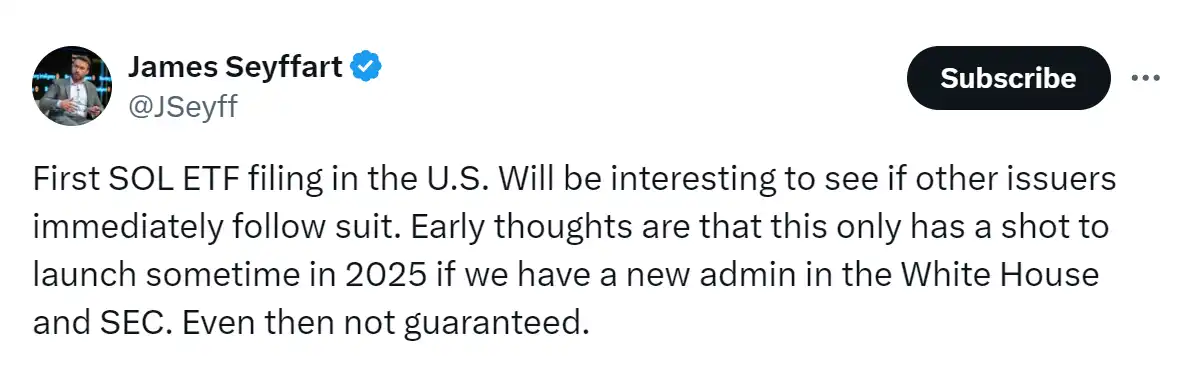
Bloomberg ETF analyst James Seyffart posted on social media that the Solana ETF "came earlier" than expected, but the approval rate is still unknown. Whether it is passed or not, it is enough to excite the dormant crypto community. After all, this round of the market can be described as an ETF bull market.
After the spot ETF was passed, BTC, as a representative of digital assets, became the first "logically run-through" target in the currency circle.
The Bitcoin spot ETF has given Wall Street a formal channel to configure crypto assets, bringing a large amount of off-market funds to the crypto market. It can also be seen from the key nodes of Bitcoin's rise that the rise from $25,000 to $69,000 was almost entirely driven by ETFs. Whether it is a victory in the lawsuit or fake news, the stimulation of the news has always been a concern for the market.
On August 30, 2023, Grayscale won the lawsuit against the SEC and overturned the SEC's decision to block the Grayscale ETF. As fake news about the approval of Bitcoin spot ETFs in October fermented, Bitcoin stabilized at $34,000. On January 11, the SEC approved 11 spot Bitcoin ETFs at the same time, and the price of Bitcoin soared to $48,590 that day.
After the Spring Festival, Bitcoin started a violent rise. After crossing the $69,000 mark, the market value of Bitcoin reached $1.35 trillion, surpassing Meta Platforms and jumping to the 9th place in the world's mainstream asset market value.
Data shows that from January 21 to 26, the total assets under management of Bitcoin ETFs fell from $29.16 billion to $26.062 billion in 5 days, losing more than $3 billion. Since February, the total assets under management of Bitcoin ETFs have steadily increased from $28.3 billion, and exceeded $40 billion in less than a month.
With the influx of funds, the price of Bitcoin has risen by a large step. Throughout February, the price of Bitcoin has experienced the largest fluctuation in history, with the price of each Bitcoin rising by $18,615, which is higher than the value of Bitcoin 15 months ago.
Related reading: "Bitcoin hits record high in 15 years, returns to $69,000 per coin, what happened in 800 days"
In comparison, the copycats seem to be struggling to catch up with the rise of BTC. The major positive of the Ethereum ecosystem, the Cancun upgrade, was diluted, and solana made a brilliant debut with meme coins, but the pre-sale and celebrity coins born from it continued to disrupt the market trend, and the rise of pumpfun made meme further divide the market attention, and the crypto VC was constantly squeezed to the opposite side of retail investors by highly profitable meme and airdrop chaos.
At the same time, the Bitcoin ecosystem, led by Rune, has been developing strongly. Due to the lack of a clear business model and asset logic, many people believe that this cycle is the "only bull" of Bitcoin.
If you have to find a reason to start this round of bull market, it must be BlackRock. In the context of the market being in a deep bear state and the industry facing high-pressure supervision, BlackRock's ETF single-handedly reversed the situation in the crypto market.
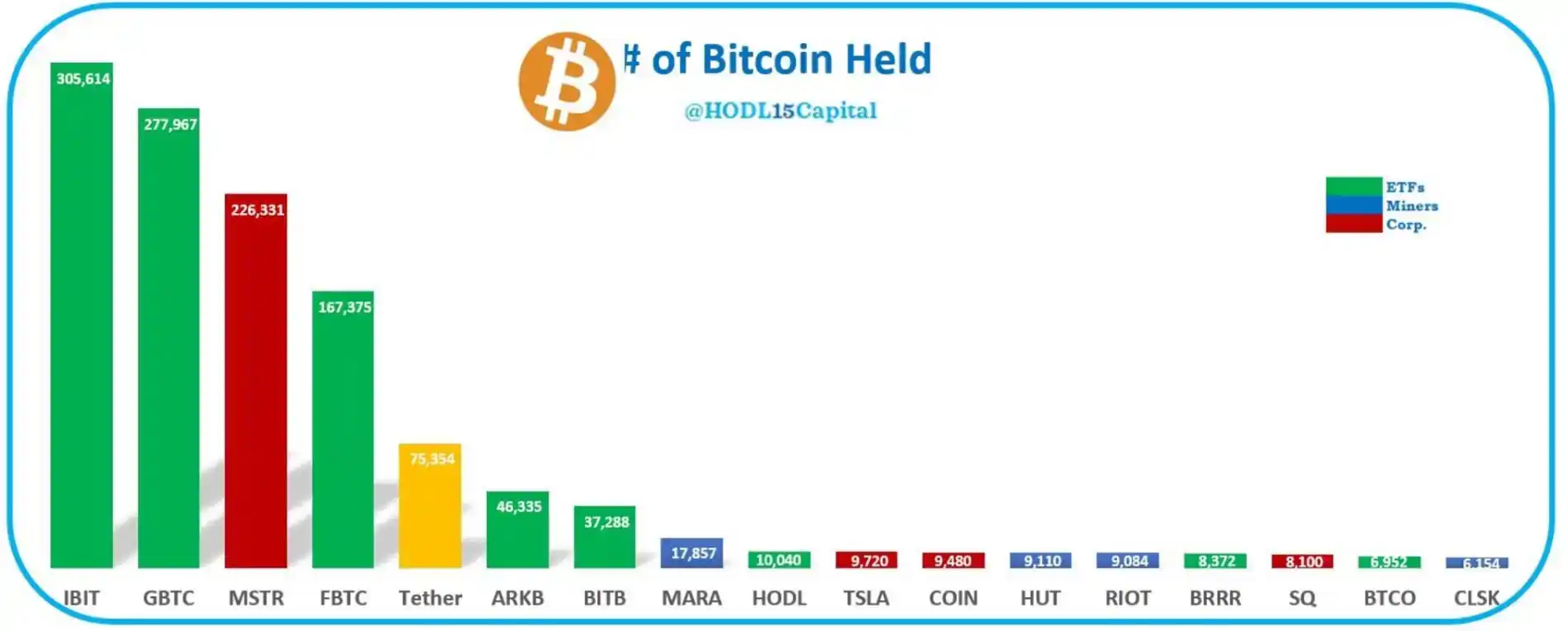
After the Bitcoin spot ETF went online, IBIT was also the one with the strongest performance and the best liquidity. Last week, HODL15Capital listed the top ten companies holding Bitcoin in the world so far, and BlackRock's IBIT ranked first with 305,614 BTC.
There is a saying on Wall Street: "BlackRock Wants, BlackRock Gets". As a financial giant that manages $10 trillion in assets, the SEC seems to have to give way to BlackRock.
What many people don’t see clearly is that the launch of a Bitcoin spot ETF may just be an appetizer for financial giants to lay out in the tokenized world.
At the end of 2022, BlackRock CEO Larry Fink said: "The next generation of markets, the next generation of securities, will be the tokenization of securities." BlackRock’s entry into Bitcoin is much bigger than we thought. Then we saw that the BUIDL fund, a US dollar institutional digital liquidity fund launched by BlackRock, was launched on Ethereum.
On April 30, BUIDL, the first digital asset fund launched by BlackRock in cooperation with Securitize, successfully topped the list in just six weeks, accounting for nearly 30% of the total digital treasury market of US$1.3 billion.
The market value of tokenized US Treasury bonds has increased significantly this year, and tokenized RWA (including Treasury bonds, bonds and cash equivalents) has increased by 35% in these two months. Leading the gains was BlackRock’s BUIDL, which has grown 65% since the start of the quarter, pushing the total market value of tokenized treasuries to over $1.5 billion. Over the same period, Ondo Finance, one of the leading RWA-focused DeFi protocols, saw its total locked value increase from $221 million in April to $507 million.
Less than a month after BUIDL was launched, the Ethereum spot ETF, which had regulatory issues with staking, staged a dramatic reversal, with one application approved.
On May 24, the Ethereum spot ETF went from no one favoring it and a 7% approval rate to a 75% approval rate overnight, and the price of ETH repeatedly broke through the $3,800 mark.
After Ethereum shifted to a new governance model called "Proof of Stake (POS)" in September 2022, the U.S. Securities and Exchange Commission (SEC) opened an investigation into the Ethereum Foundation, which is headquartered in Switzerland. "Proof of Stake" in fact provides the SEC with a new excuse to try to define Ethereum as a security.
As a compromise, companies such as BlackRock that applied for ETFs deleted the pledge part in their ETF proposals, indicating that they would not pledge part of the trust's assets. On May 30, BlackRock stated in a filing with the SEC that it would purchase $10 million in ETH to fund its Ethereum ETF.
After BlackRock's three moves, the many difficulties that the SEC brought to the industry in the past year began to be resolved. The big brother took the lead in the charge, and a series of younger brothers followed to eat meat. A BlackRock brought out countless institutions to enter the layout, and a new situation emerged in the mainstream process of "crypto logic/crypto terminology".
Whether there is still a bull market for altcoins is a question that has been discussed in the currency circle for the past six months.
On the one hand, VC funds are large in size, and the entry of new retail investors is less than expected. It is difficult for funds to take over new coins and old coins that are still alive in the market, resulting in the increase in project valuations in the primary market, and high FDV and low circulation after the tokens are launched. Secondly, due to the saturation of applications in the last round of bull market, the block space is "overloaded". VC's capital deployment during the bear market is mainly concentrated in the infrastructure field, which makes the application layer, which is most perceived by users, lag behind in development, and present the problem of "narrative poverty" when the market suddenly ushered in the market.
But in the final analysis, what everyone is most worried about is that the money coming in from the Bitcoin ETF cannot flow into the altcoins.
In the last cycle, crypto institutions promoted the growth of the overall crypto market value by pledging BTC and leveraging, and then these leveraged funds flowed into the altcoin market, thus bringing about the so-called altcoin bull market. But the logic has obviously changed in this cycle. Spot ETFs are managed by custodians and cannot be leveraged, which directly kills an important source of funds for the altcoin market.
However, the new trends of ETH and SOL spot ETFs this month have brought newer and clearer logic to attract and create liquidity for the crypto industry. ETF funds will not only be exclusive to Bitcoin, but also to altcoins.
But the next question is, will consumers in the capital market pay for crypto assets other than Bitcoin?
In the short term, it may be difficult. The world's general perception of cryptocurrency is still Bitcoin. It will take some time to digest the concepts of smart contracts, the difference between Ethereum and Solana, etc., but this is exactly the business opportunity for institutions such as BlackRock (packaged crypto index).
On the contrary, the entry of traditional institutions may lead to the gradual squeeze of the market of many crypto-native institutions, especially roles such as market makers and OTC. The regular army can bring funds, but they can also take your job.
In short, regardless of whether the SOL ETF is passed or how the ETH ETF performs in the future, the logic and trend of the ETF bull market seem to be unstoppable.
Recommended
The Wall Street Journal: How is AI Trading Stealing the Limelight from Cryptocurrency?
Aug 15, 14:00
Tencent Still Has a Dream
Aug 15, 11:27
To Catch North Korean Hackers, They Set Up a Fake Project
Aug 15, 10:00
From Litigation to Settlement: Positive Signal Released by HTX's Negotiation with FCA
Aug 14, 19:32
11,742 Shipping Addresses Exposed Alongside Trezor Orders
Aug 14, 19:01
Founder Interview: FOMO Creator Explains How They Added 30,000 Users in One Day and Became One of the Fastest-Growing Crypto Apps
Aug 14, 18:37