Can the $1 Billion Valuation Social Media Leader Farcaster Become the Bull Market's New Catalyst?

Original Title: "Can Farcaster, the $10 Billion Valuation Social Media Leader, Become the New Hot Spot in the Bull Market?"
Original Author: Wilson Lee, Biteye
Farcaster is a decentralized social networking protocol that leverages smart contracts and hybrid storage technology to facilitate social connections, content sharing, and data ownership among users, while supporting diverse and flexible client and application development.
In March of this year, the memecoin project Degen within the Farcaster ecosystem drew widespread attention with a more than 20x surge and a market capitalization exceeding $10 billion, making the Farcaster ecosystem the focus of attention.
In May, Farcaster's developer, Merkle Manufactory, announced the completion of a new funding round led by Paradigm with a total of $1.5 billion, raising the company's valuation to $10 billion.
According to Dune data, Farcaster's total user count has reached 540,000, with daily active users surging from 2,000 at the beginning of the year to the current 56,000, achieving a growth of over 28x.
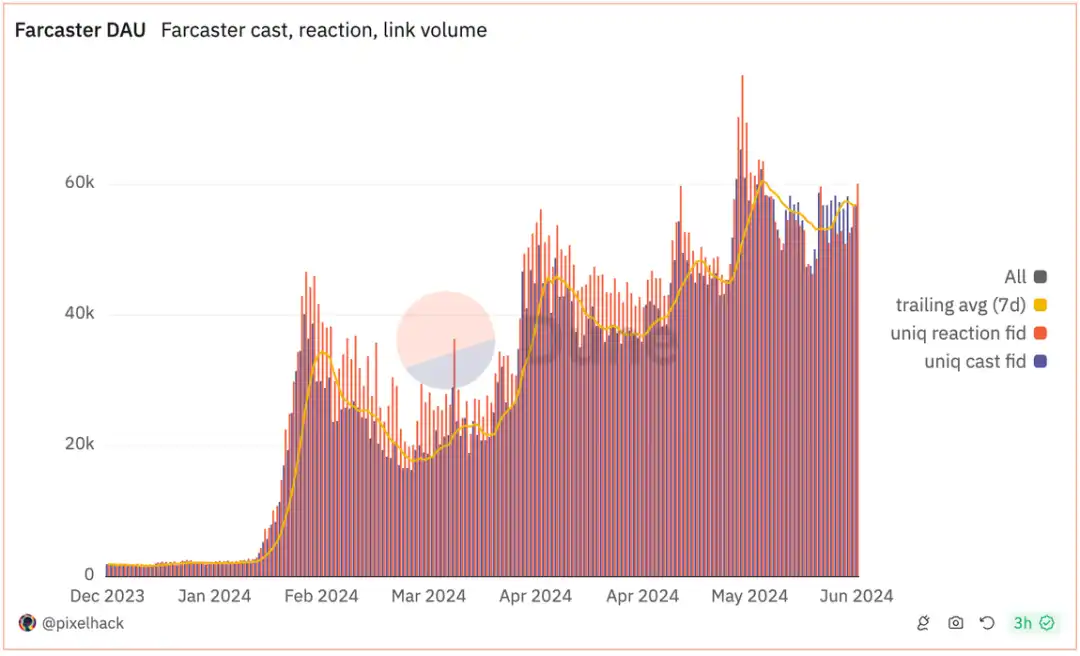
https://dune.com/pixelhack/farcaster
Farcaster is not a new social project. In the early testing phase, founder Dan utilized personal influence and relationships to invite many well-known OGs, including V God, to join. Through the method of obtaining invitation codes via Twitter DMs, early users were screened, resulting in a user base for Farcaster with a high "elite" concentration.
This approach of setting entry barriers was aimed at attracting a highly similar user base in the early stages, making Farcaster to some extent a more refined version similar to Twitter. Early users can enjoy a higher-quality posting and interaction experience.
Furthermore, users with early access are usually influential KOLs who have high social impact themselves. Having early access to experience Farcaster may create a sense of social superiority. They may also have a stronger motivation to discuss and spread Farcaster on other platforms.
Last October, Farcaster opened registration but still set a $5 entry threshold, effectively blocking a large number of bot accounts from registering, maintaining a good overall atmosphere for Farcaster, in stark contrast to Nostr, which suffered decline due to bot spam.
As of now, through registration fees and data storage costs, Farcaster has accumulated nearly $1.9 million in revenue.
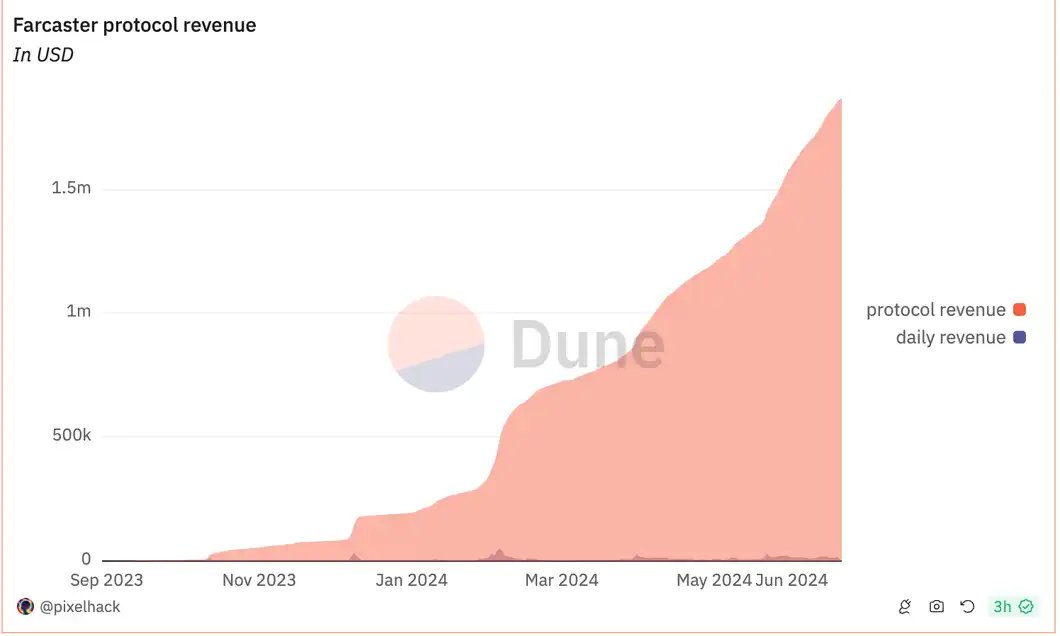
https://dune.com/pixelhack/farcaster
Farcaster's two founders, Dan and Varun, both held important positions at Coinbase, which has to some extent tightly linked Farcaster to the Base ecosystem, where Base chain's core contributor Jesse is also very active in Farcaster.
Looking from another angle, among the top 500 users with the most followers on Farcaster, over 70% of on-chain interactions occurred on the Base chain.
Therefore, for those bullish on the Base ecosystem, Farcaster is also seen as a potential Alpha treasure trove.
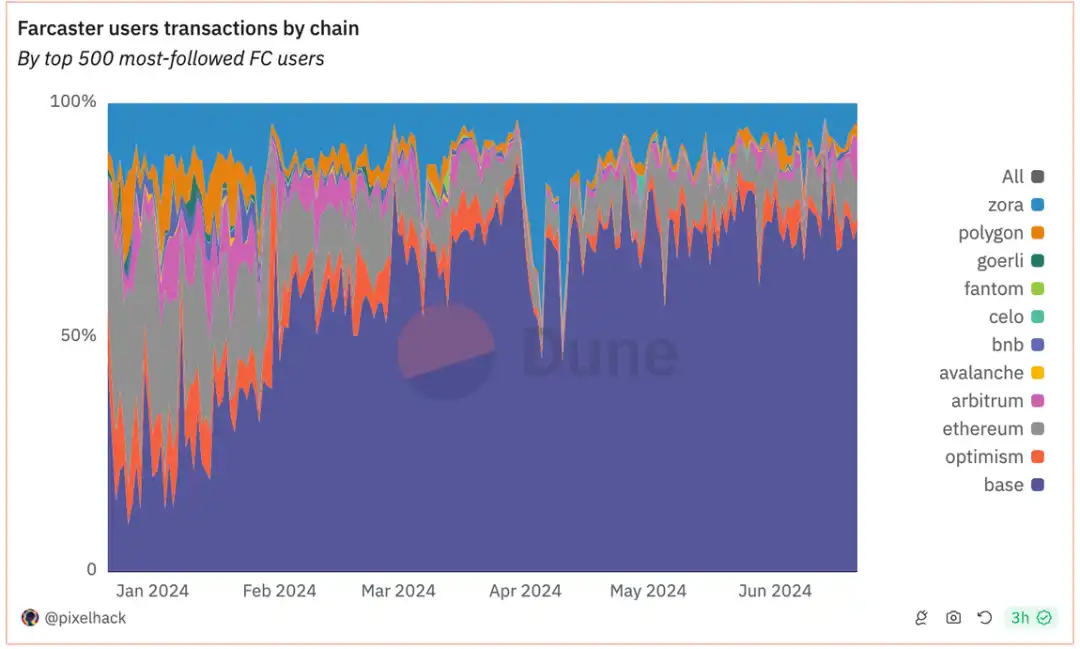
https://dune.com/pixelhack/farcaster
Farcaster protocol data is stored in on-chain and off-chain hubs, where developers can choose to run hub nodes themselves or rely on third-party service providers like Neynar to access the data.
All this data is permissionless, and based on this available data, developers can build various clients and applications, greatly enhancing the richness and innovation space of the Farcaster ecosystem.
Users can track the progress of the ecosystem through the Decaster website, and below are introductions to some highlight projects.
WrapCast is the primary application under the Farcaster protocol and the first Farcaster client, developed by a top engineering team assembled by Dan over a year.
Its overall architecture is similar to traditional Web2 social software, with a smooth user experience, currently occupying 90% of Farcaster protocol traffic.
The registration process for Warpcast is simple; the system will automatically generate a linked wallet for the user. All Warpcast accounts are associated with a Farcaster ID and the generated content is stored in the Farcaster hub.
This design allows even non-cryptocurrency users to easily enter the on-chain world, greatly reducing the cognitive barriers for new users.
For users familiar with on-chain interactions, they can also link their commonly used cryptocurrency wallets. These adjustments allow Warpcast to provide user-friendliness while also playing a significant role in promoting the growth of the Farcaster ecosystem and user adoption.
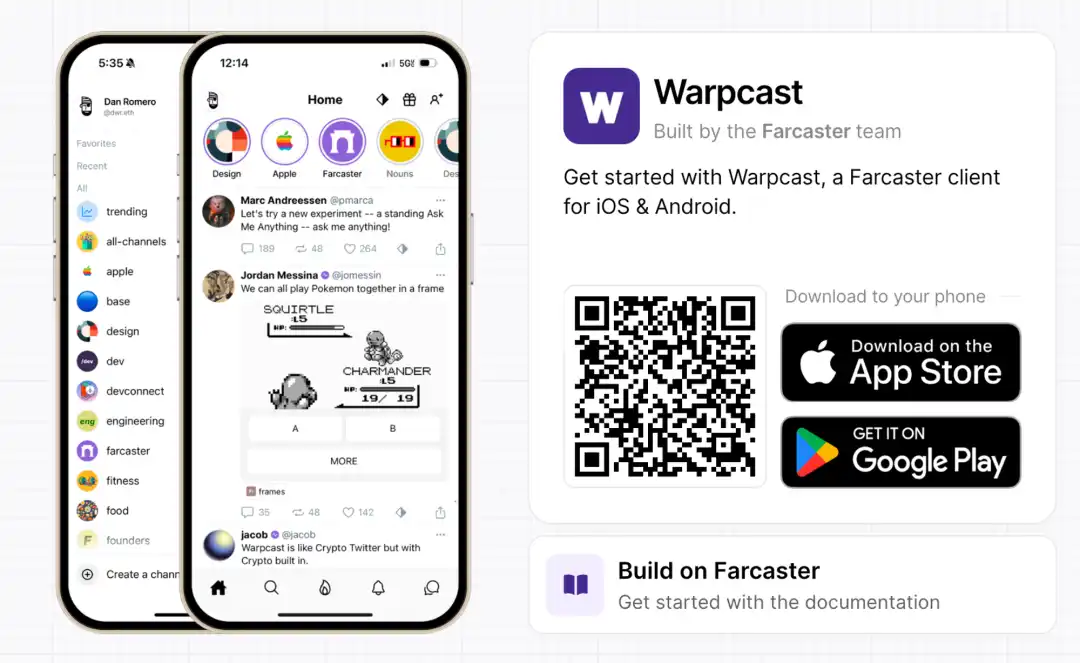
Warpcast is designed as a social platform similar to Twitter, where users can post tweets (casts), comment, retweet, and follow other users.
In addition to Twitter-like social media features, Warpcast also introduces functions such as channels and actions, leading to more interactive ways.
For example, DEGEN utilizes user engagement in the Farcaster ecosystem to distribute tokens. Users can participate in DEGEN's airdrop by following channels and interacting, and the airdropped tokens can be tipped to other users.
Farcaster's significant growth this year is closely related to the Frames feature launched in February. Frames are mini-applications embedded in Warpcast, allowing users to engage in a greater variety of interactions without leaving Warpcast, such as minting NFTs, subscribing to content, playing mini-games, and receiving tokens.
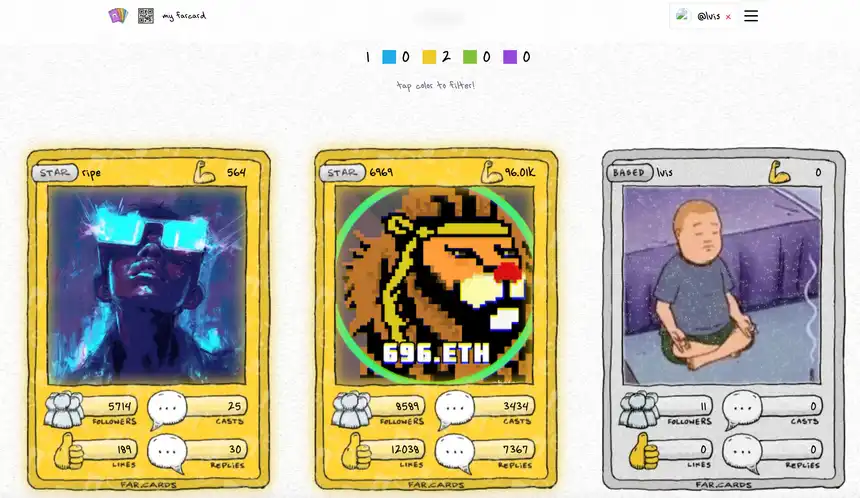
For example, far.cards is a collectible card project developed based on mint.club, exclusive to Farcaster users. Each user's card attributes are determined by their activity on Farcaster, such as the number of followers, likes received, and replies.
The card's price is determined by a bonding curve, and the acquired cards can be collected or traded.
As shown in the image below, the far.cards application can be embedded in a tweet as a Frame, allowing users who see the tweet to directly purchase its card within the Frame without leaving the Warpcast client.
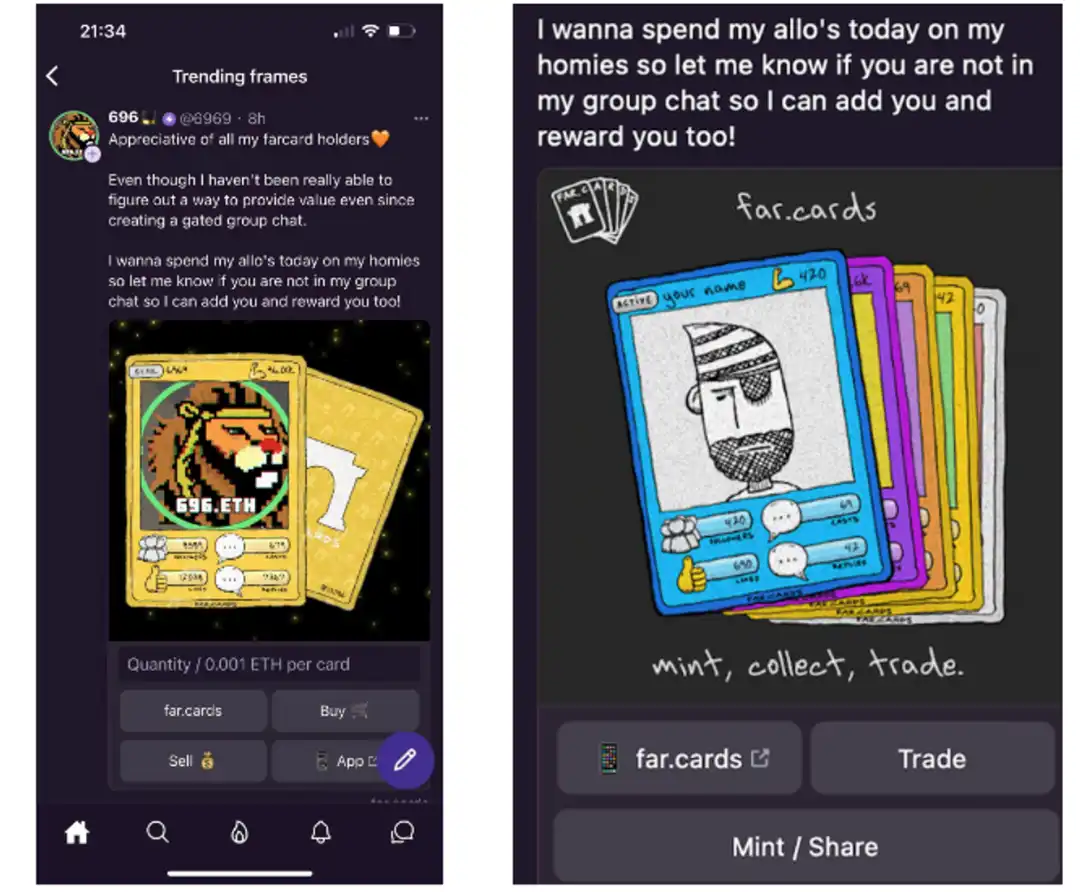
The introduction of Frames has greatly enriched the playability of Warpcast, enabling Farcaster developers to move beyond just building a decentralized Twitter.
Currently, nearly 40,000 users are using the Frames feature, resulting in over 150,000 on-chain transactions, with the number of interactive contracts reaching 1624.

https://dune.com/jhackworth/frames
In terms of user experience, the Frame is similar to the MiniApp in the Ton ecosystem. Although Farcaster currently struggles to have a large user base like Ton, it is also necessary to pay attention to simple and highly shareable Frames, such as the Not a coin Frame on Ton.
Drawing on the success of the DEGEN project in terms of market value and viral capability, it is entirely possible for projects on Farcaster to distribute high-yield tokens through Frame mini-programs.
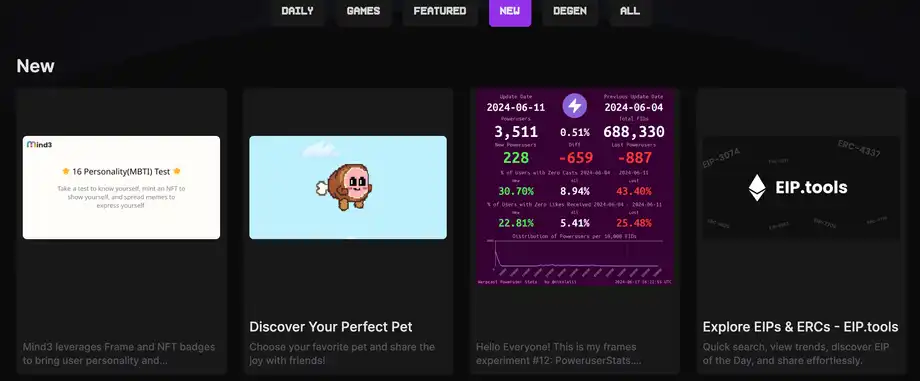
Degen.Game is a website that curates Frame mini-apps, allowing users to log in with their Farcaster identity, view the latest Frames daily, and interact with them.
https://www.degen.game/frames/new
Jam is a creator economy platform based on Farcaster that transforms every tweet a user makes on Warpcast into an NFT asset similar to Friend.tech Key. Users can buy and sell each tweet, with the price determined by the Bonding Curve as shown in the image below.
Within 72 hours of its launch, Jam's trading volume exceeded $10 million.
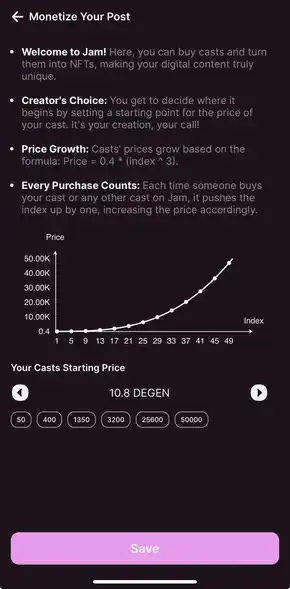
The first time you use Jam, you need to spend 10 warp points, which are given as a gift of 100 warp points when registering for Farcaster.
After binding your Farcaster account, you can view the feed on the homepage to find tweets worth minting. The Top list includes tweets with the highest recent transaction counts and the newest tweets, while the Trades section displays real-time records of tweet transactions.
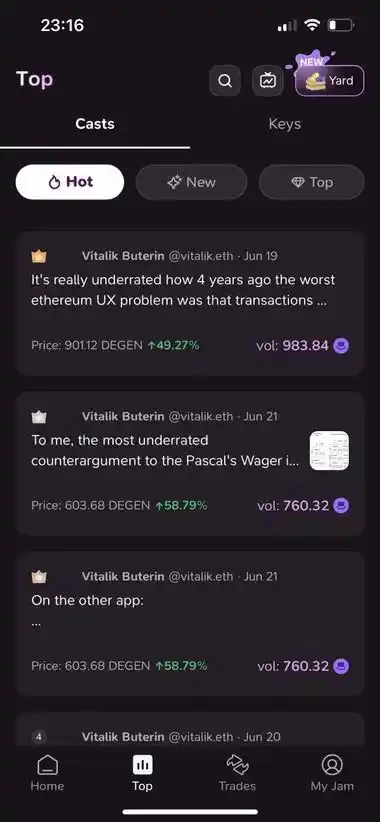
Unlike Friend.tech, each tweet can only have one holder at a time, so there is no front-running and dumping scenario. However, the profit strategy is similar, requiring early identification and purchase of tweets with potential virality, focusing on targets such as the Farcaster core developers, V God, KOLs, etc., to ensure there are other buyers willing to take over later.
If you are a KOL yourself or have a strong online presence and are good at tweeting, you can also continuously write tweets to create memes for propagation and earn a 5% transaction fee.
Currently, Jam does not have a token but has internal points. Considering the overall gameplay, it is very similar to Friend.tech, and there may be a significant potential airdrop.
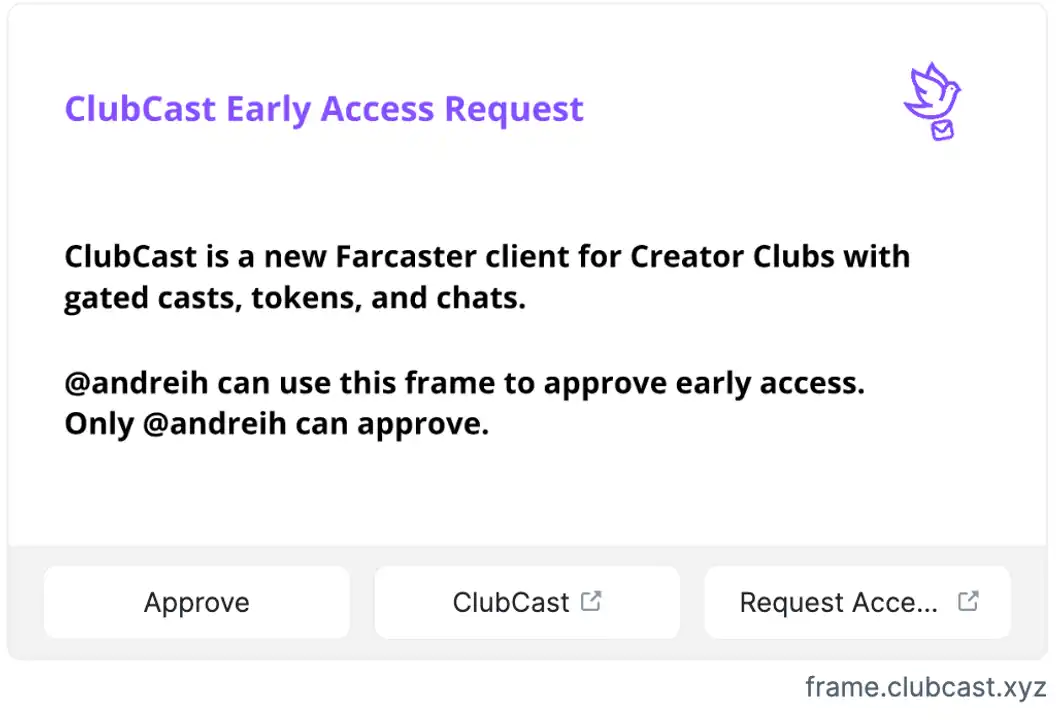
ClubCast is an application on Farcaster similar to Knowledge Planet, which has enabled token-gated casts. Users need to pay to purchase other users' club tokens to unlock and view hidden content on clubcast.xyz or Frame. Currently, developer permission is still required to use it.
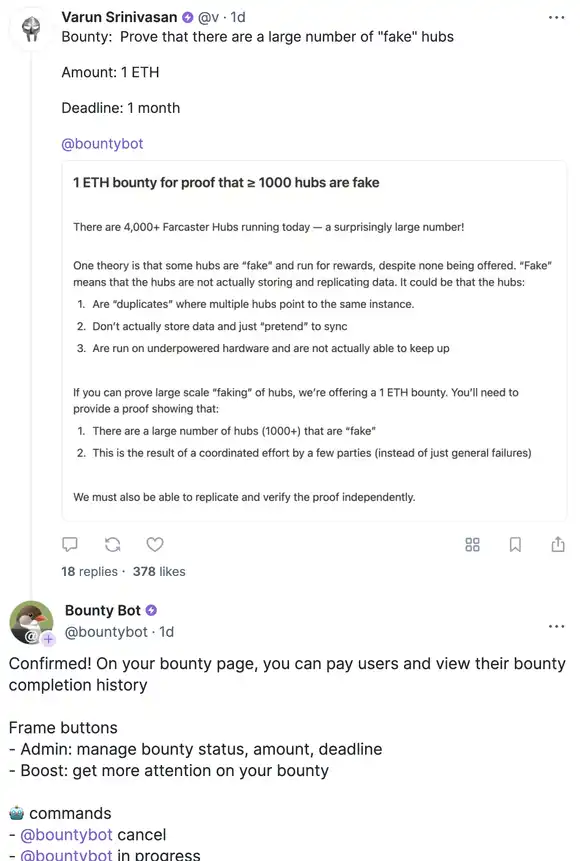
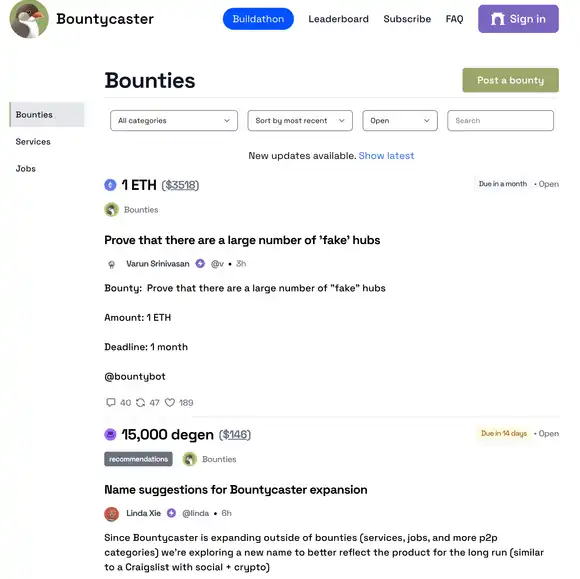
BountyCaster is a task platform built on the Farcaster protocol, founded by Linda Xie (former Co-Founder of Scalar Capital, Coinbase Product Manager).
As shown in the figure below, users can add the @Bountybot tag when sending content in clients like Warpcast to post tasks. Other users can then claim the corresponding tasks and receive the rewards.
Similarly, it is also possible to publish the services and prices that can be provided. Users may need to log in through their Farcaster account to the BountyCaster website to view published Bounties, available services, and even job opportunities.
AlfaFrens is a creator economy application built on the Base ecosystem and Farcaster protocol, developed by Superfluid to support on-chain asset flows.
Similar to Friend.tech, users can subscribe to KOL channels, access exclusive chat rooms, and further receive tokens generated by the channel.
There are two currencies on the platform, $Degen and $ALFA. $Degen is an ERC20 token on the Base chain, while $ALFA is the proprietary token of the AlfaFrens platform, currently only obtainable within the platform and non-transferable.
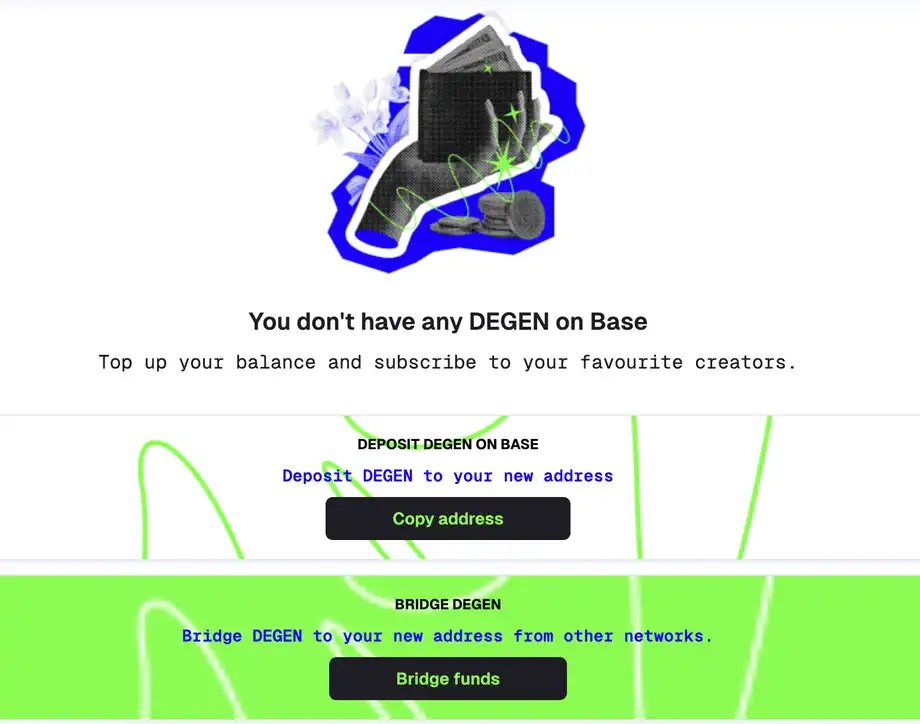
$Degen is the platform's utility token. When starting to use AlfaFrens, users need to have some $Degen ready to deposit into the wallet generated by the platform.
Users can use $Degen to subscribe to KOL channels, with three levels of subscription: 500, 1000, and 1500 $Degen per month.
The subscription fee is consumed linearly, and users can cancel the subscription at any time. 70% of the subscription fee is distributed based on the staking ratio to users staking $ALFA in the channel.
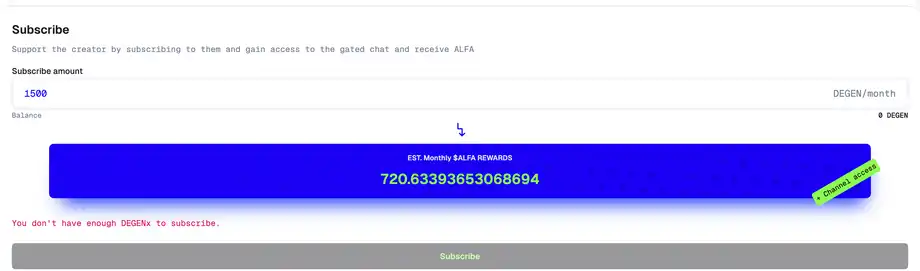
Every day, the platform mints $ALFA tokens, and each channel distributes the allocated $ALFA equally among subscribing users based on the $Degen received from subscriptions.
Therefore, the gameplay involves subscribing to channels of popular KOLs, earning $ALFA tokens, then staking them back into the channel to earn more $Degen.
$ALFA is currently not a circulating token and has no fixed price. In the early stages, it was acquired by exchanging $Degen. Hence, different participation strategies can be devised based on profit preferences (whether to acquire more $DEGEN with existing value or more $ALFA with undefined value).
As people become increasingly accustomed to "living" online, the social graph has become a significant personal asset, and the demand for data sovereignty is growing.
The Web3 solution inherently addresses the pain points of current Web2 social platforms, but the decentralized social sector has not been particularly successful.
Many projects have been overly focused on decentralization, overlooking the importance of user experience. Dan pointed out in his Bankless interview that the goal of Web3 social is not to replace Web2 social but to enhance it, allowing users to have ownership of their data while engaging in more on-chain activities, achieving things that are not possible in Web2.
By storing value data on-chain and high-frequency data off-chain, Farcaster has significantly improved user interaction fluency.
The team has been focused on mobile development from the start, recognizing that mobile devices are the primary usage scenario for social software.
As a result, the Warpcast client provides a great user experience, is feature-rich, has a fast iteration speed, and continually introduces new features such as long-form content and interactive actions, providing developers with increasing capabilities to build new applications.
Although Farcaster is far from perfect and there is still much room for improvement, it is already an application that can attract users and sustain growth. In the future, more excellent products based on Farcaster will definitely emerge. Let us look forward to and pay attention to the development of Farcaster and get involved as soon as possible.
Original Article Link
Recommended
The Wall Street Journal: How is AI Trading Stealing the Limelight from Cryptocurrency?
Aug 15, 14:00
Tencent Still Has a Dream
Aug 15, 11:27
To Catch North Korean Hackers, They Set Up a Fake Project
Aug 15, 10:00
From Litigation to Settlement: Positive Signal Released by HTX's Negotiation with FCA
Aug 14, 19:32
11,742 Shipping Addresses Exposed Alongside Trezor Orders
Aug 14, 19:01
Founder Interview: FOMO Creator Explains How They Added 30,000 Users in One Day and Became One of the Fastest-Growing Crypto Apps
Aug 14, 18:37