Encryption is still a faith

Original Title: "The Optimistic Crypto Pitch"
Original Author: Matti, Zee Prime Capital
Original Translation: 0x26
Editor's Note:
The development of cryptocurrency has entered deep waters, where the importance of cultural and social attributes has been further elevated, technology has almost become a true moat, and the criticism faced by new terms and narratives far outweighs the support.
Faced with these sudden changes, many seasoned players feel uneasy, even shouting that cryptocurrency is "doomed." But as community members say, "Belief is the only way out, which is why few succeed." Matti's article, The Optimistic Crypto Pitch, explains why we can still believe in cryptocurrency. The full article is as follows, with a rhythmic translation below:
Cryptocurrency has different definitions in the eyes of many: some see it as a geek's luxury item, some view it as currency anarchism, and some even call it a ridiculous scam. Today's crypto industry has moved far from its original libertarian dream, is no longer just the small circle of Satoshi Nakamoto and a few cypherpunk computer scientists. Cryptocurrency has undergone a process of commercialization, becoming more ideologically diverse.
In fact, cryptocurrency's greatest enemy is not those who are skeptical, but those who dare to tamper with the "holy scripture." Bitcoin supporters dislike Ethereum's believers, while Ethereum's believers do not favor Solana's proponents. My exaggeration here is intentional. Those who are often the least tolerant tend to be the loudest. But the conflict is evident—not a struggle between insiders and outsiders, but between different coins.
Discussing conflict may not sound optimistic, but it merely shows how this subculture mirrors past (and present) religious conflicts. If cryptocurrency were a religion, it would be a religion centered on currency, financial, and commercial revolution. The god here is fungible, the narrative is flexible, and the financial expectations are scalable. Cryptocurrency replaces "In God We Trust" with "In Coin We Trust."
Optimism
The optimism I refer to is the understanding that one possesses the potential to change the world and accepting it, drawing strength from one's innate nature.
Optimists tend to experiment and take risks. They love freedom and detest tyranny. But when optimists detest something, they pay the price. They make bets because they know, as Seneca wrote, "It is in times of security that the spirit should be preparing itself to deal with difficult times; while Fortune is bestowing favors on it is then is the time for it to be fortified against her rebuffs."
Optimists do not feel the need to rule on behalf of others; they understand they are often wrong, but still try. They seize the opportunity to explore, create, and rebuild the world in their image. Optimists understand that the expanding knowledge is the lifeline of life, enabling their offspring to abandon old ideas and embrace new thoughts.
Optimists understand that resources are not limitations but opportunities, as ideas empower resources, utilizing the surrounding environment in their service. Optimists embrace change and see it as a necessary condition for progress.
How does this kind of optimism relate to the promotion of cryptocurrency? Initially, one who could envision a world where governments no longer controlled monetary transactions, his deep-seated optimism became the origin of cryptocurrency.
Not because governments are evil, but because they are prone to corruption. And not because people are evil. The longer institutions govern a community, the easier it is for them to grasp power. Over time, they begin to turn inward, primarily serving themselves. Why?
Because over time, they become less relevant, dogma stagnates, while the world moves forward. But they want to survive. They cling tightly to relevance. Suddenly, the world serves them, and they no longer serve the world. To survive, they need to exert more power at the expense of the community they govern.
The initial idea of cryptocurrency—Bitcoin, was about reducing power reliance, not on violent monopolies but on immutable code in the network. "A foolish dream." However, it succeeded. This optimistic experiment is now worth trillions of dollars. Today, it's not just Bitcoin, but more.
Crypto
The volatility of cryptocurrency is very apparent. The higher the rise, the more painful the fall. Some natural laws also apply to the financial market and the human psyche. Cryptocurrency never sleeps; there is always something happening.
Supporters and critics cannot agree on whether meme coins are good or bad, while some succumb to price volatility. They also cannot reconcile whether VC coins appearing in the market at crazy valuations happened before the release of the minimum viable product or after.
Investors jump from one narrative to another, funding things that either won't work, can't work, or even if they work, no one will use. Most things will go to zero, absolutely zero. That's okay. "Wait, I came here for optimistic cryptocurrency shilling."
Media is information. A meme coin is a medium, cryptocurrency is a medium, human action unfolds in new ways under the impetus of new technology. Going to zero is part of the game.
But going to zero is okay because cryptocurrency is still the most optimistic technology movement in the world. Every technological and cultural revolution triggers exploitation precisely because it is revolutionary. This opens up opportunities for information asymmetry, and people quickly (mis)take advantage of these opportunities for their gain.
But eventually, in cryptocurrency, people start to address problems, attempting to solve governance issues (albeit failing), trying to build a new internet, a trusted neutral payment channel, new physical infrastructure for various interesting use cases, funding research projects inaccessible elsewhere, busying themselves with cultural monetization, achieving financial freedom before releasing a product used by thousands, establishing a casino as an alternative financial product, attempting to build new cities and challenge death. Most of this is likely misleading. But it showcases the great spirit that cryptocurrency offers.
Cryptocurrency is the Wild West meets Las Vegas; it's a frontier where you can get rich overnight, but more likely lose all your wealth, be scammed by sex workers. It's a place where dreams come true, where one storms the castle, or loses it all to gambling, with conflicts happening every day.
Pessimists and Optimists
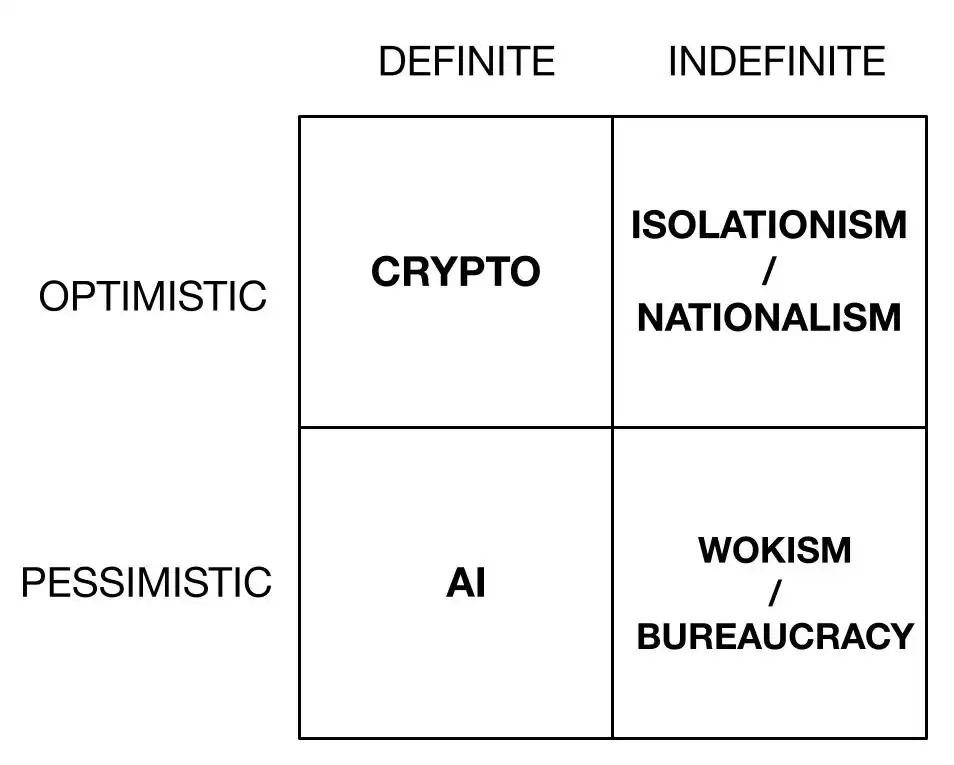
Over the years, I've long held in my mind Peter Thiel's simplified 2x2 framework on optimism and pessimism. Thiel distinguishes between definite and indefinite pessimism and optimism when you have a hammer (everything looks like a nail).
He says, "If you view the future as definite, you will work to shape it in advance and understand. If you expect an indefinite future that is ruled by randomness, you will give up trying to master it."
Indefinite Pessimists "only react to events, hoping things will not get worse. Indefinite pessimists cannot know if the inevitable decline will be quick or slow, catastrophic or gradual. He can only wait for it to happen."
Definite Pessimists "are obsessed with the way things can get worse. They think the future can be foreseen, but because it will be bleak, he must prepare for it."
Unclear Optimist sees a better future but doesn't know how to achieve it. In contrast, the Clear Optimist envisions an improved future, so he plans and works to make it happen. This is a simplified version of the narrative on my Twitter:
I frame politics and technology as the vertical boundary between the clear and the unclear. This is because politics is not about wealth creation but about governance and distribution. At best, good politics is an enabler of technology and entrepreneurship. But it doesn't create the future itself. Technology does. It is the substrate of social unfolding, the network of information exchange among humans.
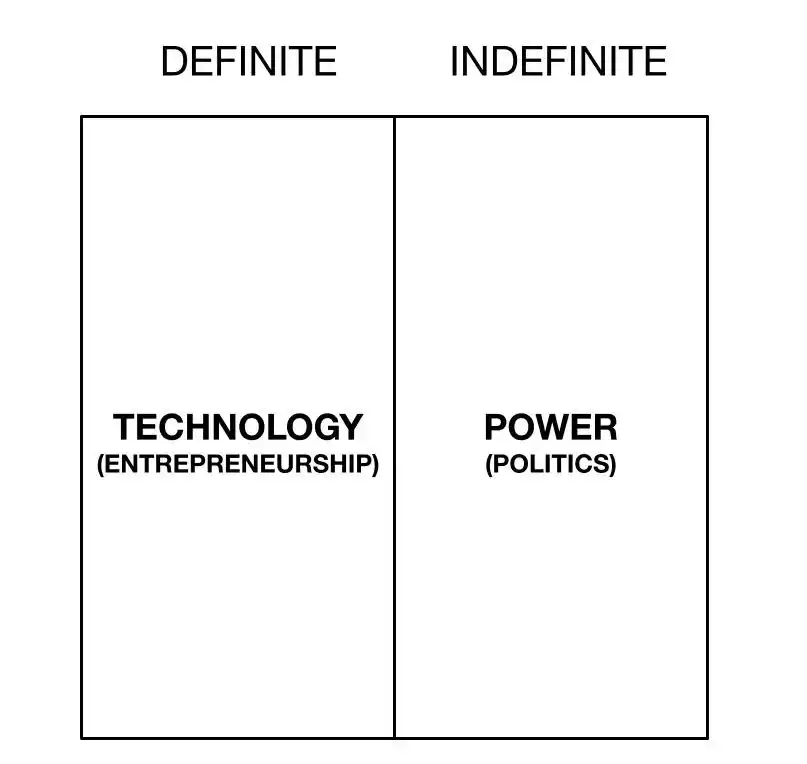
The horizontal boundary is about the individual's role versus the collective's role. Optimists emphasize the former mentioned above. It is more about bottom-up change and resilience through decentralization. Pessimists, on the other hand, see the world as fragile, wanting to rely on top-down control to maintain it. Only through their power can they address issues to prevent things from getting worse.
Let's start with the Clear Pessimism of the AI narrative. It is clear because it relies on a technological paradigm. Why pessimism? At the heart of this narrative is the machine as a greater being than humanity itself. It is a new interpretation of God, engaging with mortals through chatbots. Centralized algorithms rule everything. We are at the mercy of this technology.
Either it is the inevitable death brought by this omnipotent existence, or perhaps we can study the alignment scriptures (principles of alignment). AI serves as "Abraham's explanation (supreme being)" rather than artificial intelligence. Humanity has become just an object. We are powerless, unable to stop it, only able to surrender and hope not to be obliterated by this fierce force.
As for the Unclear Pessimist, they are the awakened ones. Believing everything has been invented, and now we can only redistribute. At the core of this interpretation is power. Leveraging power to redistribute from the strong to the weak. There is no other way; capitalism has failed, and we can only freeze humanity, relying on the bureaucratic cold hand to manage, plunging us into a strawpocalypse (emphasizing formal correctness over practicality and user experience).
Humans are the culprits. Nature is the victim. The poor are victims. The winners are perpetrators. The only way is for all of us to lose equally. All that remains is the promotion of superficial diversity and ideological homogeneity by those rules not entirely suitable, as they have come to save us from original sin. The world has ended, stop using energy for progress, as the only progress is the sorrow of equality.
Now, let's talk about those vague optimists who say, "Things didn't turn out that way, so we should go back and fix it." But how? Going back is not the solution. The path to the future is unknown. Embrace nationalism? Sure, it works for cultural cohesion, but the transitive property of patriotic individualism may turn into a destructive machine.
Vague Optimists reject the homogeneity of globalism and the senseless bureaucratic burden but are confused by the reality of new technological shifts. They feel threatened and may tend to be narrow-minded. They don't know how to embrace technology as a social functional substrate.
Should we ban social media? Is that similar to banning the printing press? Reform is already underway, and suppressing it will ultimately backfire. How do you take control of your affairs and strive towards a tangible future?
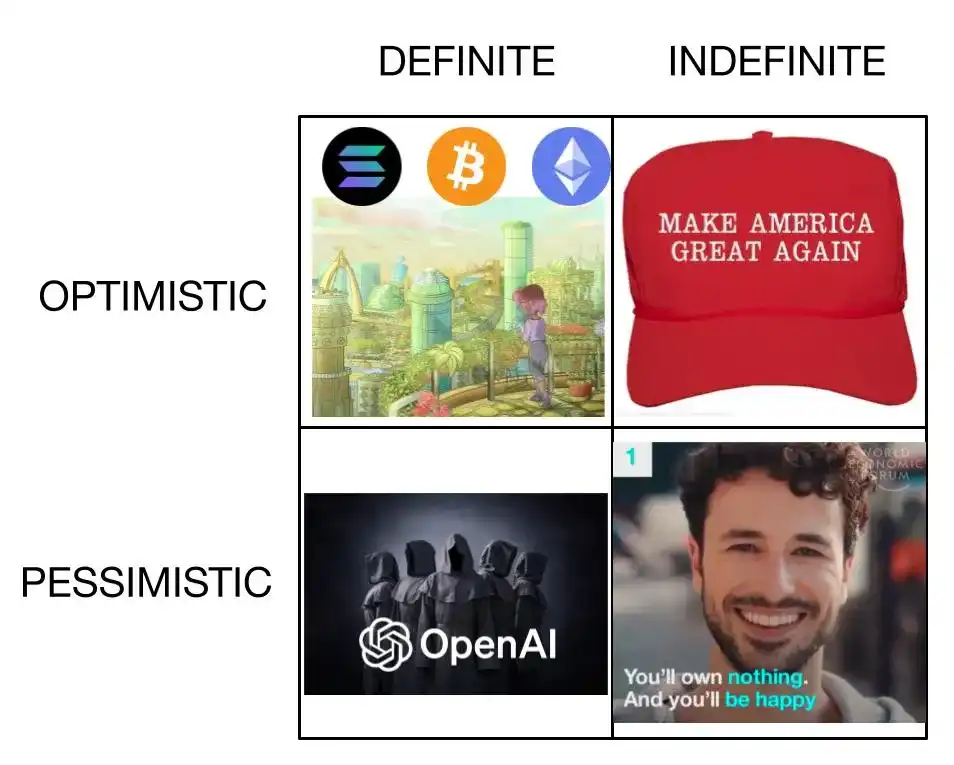
Clear Optimism of Cryptocurrency
If you've been in the cryptocurrency space for a while, you know it's a mess. Absolute chaos. But this chaos, noise, and the energy of a misleading technological revolution are driven by a strong desire, a hope to take control of oneself.
It started with finance because the market is a machine that controls resources. If we change the structure, we can direct the flow of value towards things the baby boomer generation dared not try. They like the status quo, but cryptocurrency does not. It seeks change, not just through protests. It's in the building phase. It takes risks. It doesn't want to occupy Wall Street. It wants to liberate itself.
Cryptocurrency is solarpunk. Cryptocurrency is about financial freedom, decentralized urbanism, and funding scientific experimentation. Cryptocurrency is a disobedient child. It may seem naive on the surface, but a decentralized, politically unbiased and corruption-free, trust-neutral currency is a significant technological revolution. It frees up capital. It ignores panic politics. Has the AML and KYC tyranny made the world safer or the opposite?
Cryptocurrency has created a new asset class that allows wealth to transfer from one generation to another. As housing becomes increasingly unaffordable, cryptocurrency has created a new game to bypass the bureaucratic machine that prevents young people from owning anything and progressing. It rejects the "own nothing, be happy" mantra. It wants to own everything, even if it means being miserable. But on its own terms.
Yes, we are minting NFTs with no inherent value. Yes, we are pumping overvalued tokens to clueless retail investors. Yes, we are bamboozling our lives with tech jargon. Yes, we are funding entirely useless things. In the end, this is innovation. No one promised it would be pleasant.
We have occupied the digital world, set new rules, and started a new game. It's not perfect, but we are on a mission. Embrace the individual, find new ways to conduct finance and business. These may be quirky experiments, but there's a vision, understanding that money has the power to transform.
We move forward slowly, one success at a time. Bitcoin. Ethereum. ICO. Uniswap. Solana. What's next? Bio.xyz? HairDAO? Most will fail in the heroic attempts. But the few that survive will have a global impact. We embrace the asymmetry of outcomes.
Yes, cryptocurrency is truly the frontier. You don't need a string of qualifications to make a difference in this world. A few lines of code can go a long way. Bad ideas get sent to the moon (and back). But so do good ideas. And we need more of those.
So, if you're not in cryptocurrency, you should join us clowns, scammers, and pilgrims. There's a lot of money to be made, a lot of wealth to be lost.
We always need new talent to help us weather the storm. We can't rely on divine intervention to move forward, or else we'll become vague optimists. We need new ideas and bold execution, maintaining the clearest movement of optimism on this planet.
It's not the Baby Boomers buying Bitcoin and Ethereum ETFs, but those coinless civilians daring to venture into the frontier, finding inspiration, overcoming obstacles, and building the spirit that drives cryptocurrency forward.
This is a spiritual sequel to "Why I'm Less Than Infinitely Hostile to Cryptocurrency" and "The Martian Casino". If I haven't convinced you yet that cryptocurrency is a rewarding endeavor, you should also read these two articles.
Original Article Link
Recommended
The Wall Street Journal: How is AI Trading Stealing the Limelight from Cryptocurrency?
Aug 15, 14:00
Tencent Still Has a Dream
Aug 15, 11:27
To Catch North Korean Hackers, They Set Up a Fake Project
Aug 15, 10:00
From Litigation to Settlement: Positive Signal Released by HTX's Negotiation with FCA
Aug 14, 19:32
11,742 Shipping Addresses Exposed Alongside Trezor Orders
Aug 14, 19:01
Founder Interview: FOMO Creator Explains How They Added 30,000 Users in One Day and Became One of the Fastest-Growing Crypto Apps
Aug 14, 18:37