Binance Labs announces the first batch of projects to be incubated in the seventh season. How to participate in the interaction?

Original title: "A Quick Look at the First Batch of Projects Incubated in the Seventh Season of Binance Labs (with Early Interaction Guide)"
Original author: Nan Zhi, Odaily Planet Daily
Yesterday, Binance Labs announced the first batch of projects selected for the seventh season of incubation, including Astherus, CYCLE NETWORK, DILL and EigenExplorer. Their concepts and businesses are relatively cutting-edge, and the former two have launched early interactive activities, which are linked to future airdrops. Odaily will analyze the business, characteristics and interactive activities of each protocol in this article.
Protocol Business
The re-staking market space for BTC and ETH is as high as 20 billion US dollars and is still growing rapidly. Restaking allows blockchain validators to deposit ETH or Liquid Staking Tokens (LST) into the platform, receive APR rewards and protect the network. But Astherus believes that most restaking protocols on the market have not seriously considered: What is the use of restaking assets?
According to the official introduction, Astherus is building a comprehensive DApp ecosystem for restaking assets such as LST and LRT. Users' assets can not only obtain staking APR, but can also be used to trade spot and derivatives, stablecoin Yield, and other profit strategies. Astherus supports multi-chain restaking assets, including Arbitrum, BNB Chain, and Ethereum.
The Astherus protocol consists of 3 module layers:
· DApp layer: includes various DApps for practical use cases of re-pledged assets, such as cryptocurrency spot and derivatives exchanges AstherEx and DeFi, CeFi profit strategy protocol AstherEarn, etc..
· Defi infrastructure layer: Aggregates liquidity from multiple LST and LRT pools, and can build stablecoins and spot yield aggregation protocols based on this infrastructure and establish innovative derivatives clearing houses. It also allows developers to easily build LST-based DApps.
· L1 chain: AstherLayer is a Layer 1 blockchain built using the Cosmos SDK, which will be linked to multiple other chains. The specific details are to be disclosed later.
Interactive Activities
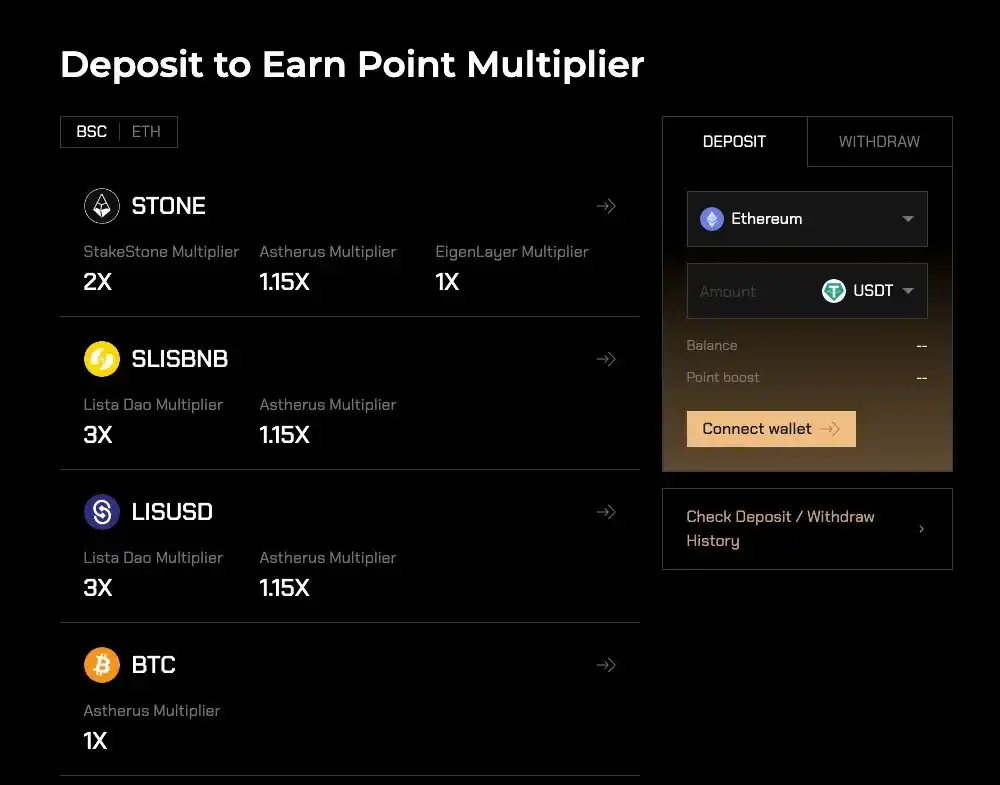
A month ago, Astherus launched the Stage 0 interactive activities, which aims to increase the TVL of the protocol, and clearly stated that the points of the activities are related to future airdrops.
The activity method is very simple and direct. You only need to deposit specific assets into the protocol. The supported chains include BNB Chain and Ethereum mainnet.
Supported assets include BNB, USDT, BTC, ETH, lisUSD, slisBNB, WBETH, STONE, CAKE, LISTA on BNB Chain. USDT, BTC, ETH, USDC, rsETH on Ethereum.
Among them, slisBNB, lisUSD, LISTA, STONE, rsETH will receive an additional 15% score bonus.
(Odaily Note: Binance announced today that the slisBNB deposited in its Web3 wallet will also be counted in Launchpool, achieving three goals with one stone.)
According to Binance Labs, CYCLE NETWORK is a universal, secure and verifiable chain abstraction that provides a bridgeless aggregated liquidity network for all blockchains, whether L1, L2, EVM or non-EVM.
Project Vision, Functions and Features
With the rapid development of Web3 and blockchain technology, many different blockchain platforms have emerged, each with its own protocols and assets, resulting in liquidity being dispersed across different chains, affecting user experience and the efficiency of market operations.
In a multi-chain environment, users need to manage their assets through complex bridges and solutions, while developers need to repeatedly deploy their applications in different ecosystems to meet the needs of different users. In addition, cross-chains have security risks and the complexity of multi-chain operations.
Cycle Network is an innovative solution designed to achieve interoperability, security, and efficiency between blockchains. It uses Verifiable State Aggregation (VSA) technology to build a universal, secure, and verifiable on-chain abstract architecture. In this way, Cycle Network enables seamless interaction between different blockchain platforms without relying on traditional cross-chain bridging technology.
The core features of Cycle Network include:
· Decentralized Application Center Infrastructure (DACI): Facilitates the development of decentralized applications and the popularization of Web3.
· Omni State Channel Indexer (OSCI): A decentralized multi-chain indexer that enables trustless verification and determination of the state of the Cycle ledger.
· Zero-knowledge hardware acceleration: Improves efficiency and scalability by accelerating the generation and verification of zero-knowledge proofs (ZKP) through dedicated hardware.
· Fully Homomorphic Encryption (FHE): Allows calculations to be performed on encrypted data without decryption, enhancing data privacy and security.
Points System
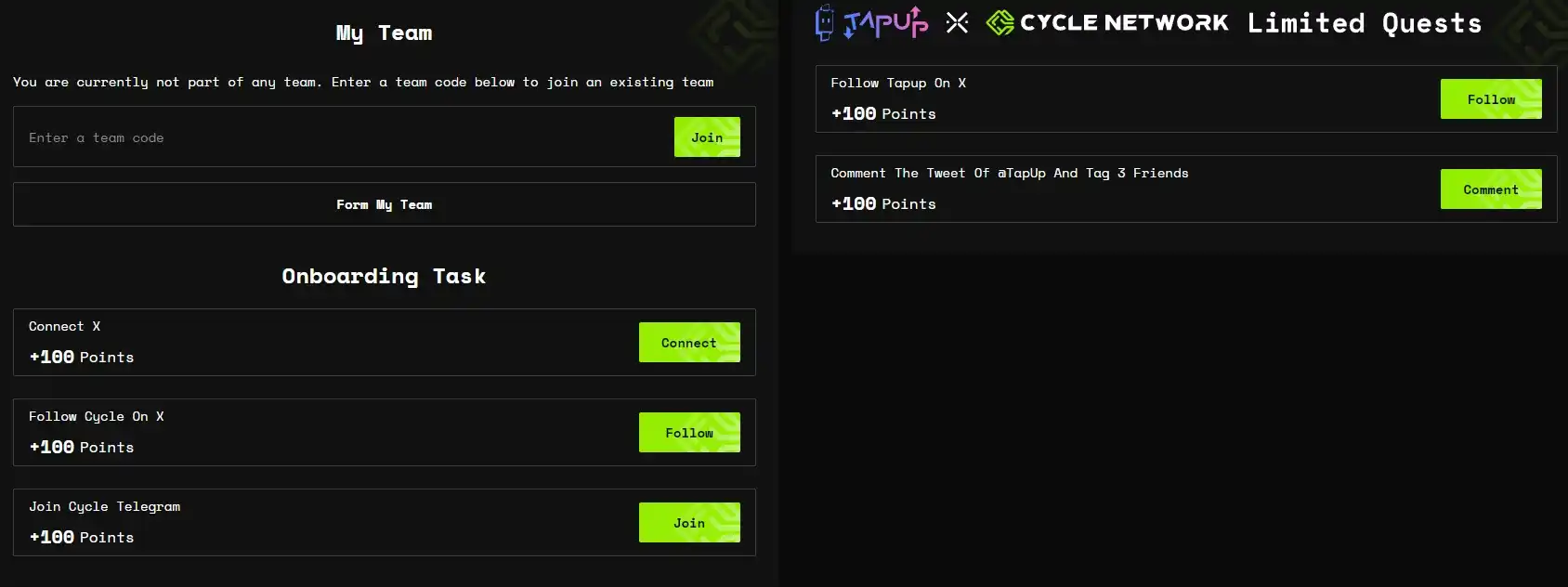
Cycle Network's current interactions are all external joint activities. Previously, it cooperated with BEVM, Macaron, IoTex and other projects to launch activities. The latest activity is a joint activity with TapUp. Completing tasks can activate Cycle points and TapUp's U prize pool.
The activity method is also very simple. You only need to link and follow social media, so this section will not go into details.
Dill is a highly scalable and secure next-generation data availability (DA) network. It is consistent with the full sharding technology solution in Ethereum's future roadmap, and adopts core technologies such as subnet sharding, 2D erasure coding, KZG (Kate-Zaverucha-Goldberg) and DAS (Data Availability Sampling). Dill provides scalability 10 to 100 times greater than other current DA networks.
Dill is a permissionless, decentralized proof-of-stake (PoS) network that supports millions of validators. It allows the staking and re-staking of Bitcoin (BTC) to participate in the PoS network consensus, thereby further improving the security of the network.
Funding
On July 16, modular network DILL announced the completion of its Pre-Seed round of financing, led by FSL Ecosystem, with participation from LayerZero Labs, Modular Capital, Pendle co-founder TN Lee, Manta's victorji.eth, etc. The specific amount has not been disclosed yet.
Dill is a data availability layer and proposes a paradigm-shifting scalability solution, leveraging the same technology stack as the Ethereum Go client to ensure high performance, and its validity proof guarantees fast finality by aggregating KZG polynomial commitments. Since applications accumulate a large number of user behavior data points, data sovereignty is very important for these applications. In extreme cases, when a licensed DA (such as a DA with only 100 nodes) stops functioning for some reason, most chains will not be able to do anything, and Dill will allow consumers of any application chain to allow permissionless network participation through a light client, thereby protecting the data sovereignty of the product.
EigenExplorer is a platform dedicated to serving core entities in the EigenLayer ecosystem, including re-stakeholders, AVS, and Operators. EigenExplorer's innovative asset class Liquid AVS Token (LAT) is designed specifically for the EigenLayer ecosystem.
LAT was launched to solve the problem that users are currently unable to directly support AVS. Users must allocate their staked assets through operators or use the LRT platform to control AVS participation and reward distribution. LAT allows users to bypass the operator selection step and directly support any AVS of their choice.
The features of LAT include:
· Directly re-stake to an AVS;
· Automatic selection of operators;
· While maintaining the staking status, it is a liquid token that can be used for other DeFi activities;
· Improved utility, efficiency, and user experience. Users can build their own liquid re-staking portfolio to match different risk preferences. Choose the protocol to support based on your preferences, rather than packaging the staking contribution for general verification.
According to the official tweet, the test network will be launched in mid-August 2024.
Original link
Recommended
The Wall Street Journal: How is AI Trading Stealing the Limelight from Cryptocurrency?
Aug 15, 14:00
Tencent Still Has a Dream
Aug 15, 11:27
To Catch North Korean Hackers, They Set Up a Fake Project
Aug 15, 10:00
From Litigation to Settlement: Positive Signal Released by HTX's Negotiation with FCA
Aug 14, 19:32
11,742 Shipping Addresses Exposed Alongside Trezor Orders
Aug 14, 19:01
Founder Interview: FOMO Creator Explains How They Added 30,000 Users in One Day and Became One of the Fastest-Growing Crypto Apps
Aug 14, 18:37