The bull market is halfway through, does the Bitcoin ecosystem still have a chance?

Original Title: "Is the Bull Market Half Over? Does the Bitcoin Ecosystem Still Have a Chance?"
Original Author: Louis Wang, Biteye
The Bitcoin network, with its outstanding stability and security, has not only endowed BTC with enduring value but also accumulated remarkable capital.
With the approval of a BTC spot ETF, the influx of traditional funds has driven its market cap to exceed 1.3 trillion USD.
However, people often overlook the difference between Bitcoin as a network and BTC as a digital asset. To unleash the full potential of Bitcoin, the key is to utilize the network's functionality, transforming Bitcoin from a mere store of value into the core infrastructure of the Bitcoin economy.
In December 2022, the emergence of the Ordinals protocol brought an unexpected innovation to the Bitcoin ecosystem.
The skyrocketing popularity of "Inscription" not only focused the attention of the public and developers on the Bitcoin ecosystem but also revealed the potential to unleash Bitcoin's huge capabilities.
In just 12 months, the total market value of Bitcoin Inscription tokens based on Ordinals exceeded 3.5 billion USD, demonstrating astonishing growth. Even today, the daily NFT transaction volume on the Bitcoin network exceeds that of Solana.
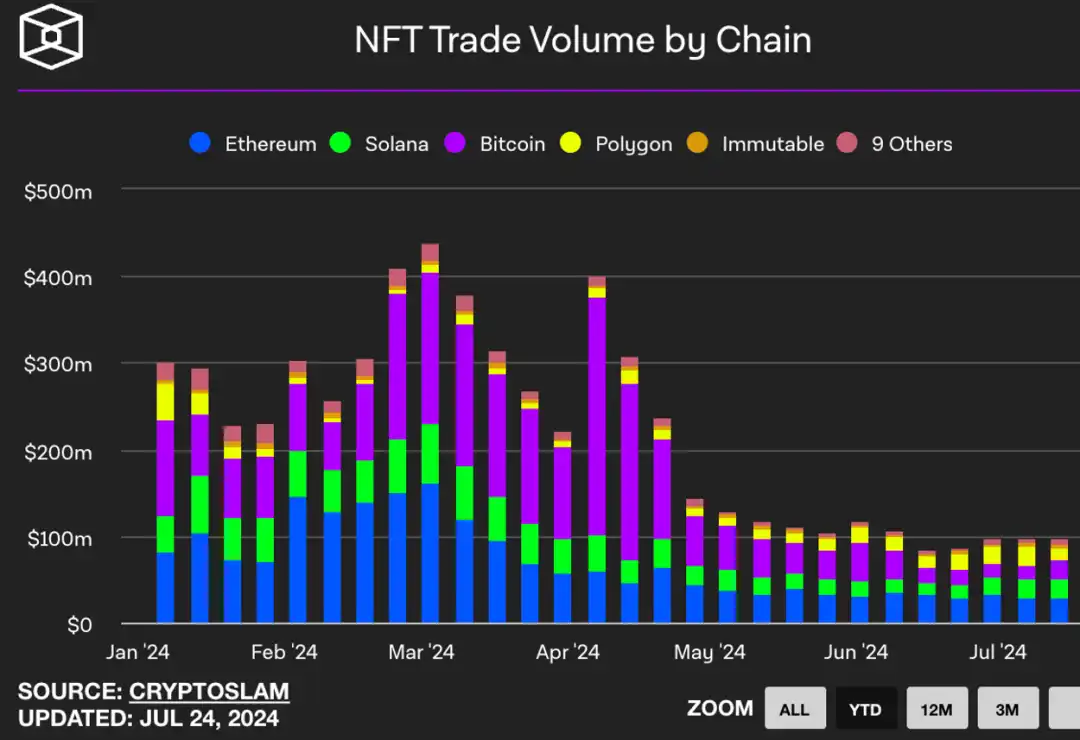
However, the market's excessive expectations for the Bitcoin ecosystem have also led to subsequent setbacks.
The rapid cooling of the Inscription craze, the underperformance of the highly anticipated "Runes" upon launch, and the dramatic turnaround of the Merlin project from TVL peak to a sharp post-launch price drop have left the market perplexed about the future of the Bitcoin ecosystem.
With the rise of Memecoins, market attention has been significantly diverted.
This cycle of ups and downs in the Bitcoin ecosystem is akin to the "annealing" process in semiconductor fabrication. This process aims to release internal material stresses, increasing its ductility and toughness.
We believe that this principle similarly applies to the development of the Bitcoin ecosystem. After the dissipation of FOMO sentiment, which projects continue to actively build? What is the development direction and trend of the Bitcoin ecosystem?
This article will classify by track, delve into the development trends of the Bitcoin ecosystem and representative projects, analyze how they are addressing challenges, and the roles they play in the Bitcoin ecosystem.
Bitcoin, as the first successful cryptocurrency, was designed with a primary focus on security and decentralization, which also brought inherent limitations in programmability and transaction speed.
Although upgrades such as SegWit and Taproot have partially addressed these issues, the Ordinals asset issuance frenzy clearly exposed the network's limitations: severe network congestion, skyrocketing gas fees, and a pressing need for more powerful smart contract capabilities.
As user demand for scalability and additional functionality beyond Bitcoin's original features continues to grow, the Bitcoin ecosystem has begun exploring various scaling solutions. Drawing inspiration mainly from Ethereum's scaling experience, these solutions adopt a modular layered architecture, giving rise to the concept of the "Bitcoin Layer."
This architecture includes the L2 layer (such as the Lightning Network, sidechains, and Rollup solutions), aimed at increasing transaction throughput by moving transactions off-chain for processing while maintaining a secure connection to the main chain;
the settlement layer, further optimizing performance and functionality for specific use cases; the data layer, providing data availability and storage solutions; and the application layer, developing various decentralized applications based on the underlying infrastructure.
This multi-layered architecture enhances programmability, enabling more complex smart contracts; significantly improves transaction processing speeds; enhances data availability; and expands ecosystem possibilities.
In the fiercely competitive Bitcoin Layer2 arena, the vast majority have adopted the EVM technology stack and utilized cross-chain bridges to address Bitcoin's scalability issues. While this approach allows for rapid ecosystem development in the short term, these solutions lack a strong bond with the Bitcoin main chain and heavily rely on cross-chain bridges, increasing potential security risks;
Furthermore, extending Bitcoin's UTXO-based model using Ethereum's account model and EVM is somewhat contradictory to the "Bitcoin Native" concept. From a technical roadmap perspective, L2 solutions can be broadly categorized into three types:
Rollup-based: These solutions highly prioritize Layer1's verifiability and aim to extend Layer1's security to Layer2.
Sidechain-based: The advantage of these solutions lies in their relatively mature technology and ecosystem.
Client-side validation: These solutions emphasize leveraging Layer1's native data availability (DA).
The Rollup solution, while pursuing Layer1 scalability, controls user trust costs through a modular design. This approach ensures security and reduces user trust burden to some extent.
In contrast, despite having advantages in technical maturity, the sidechain approach may face more challenges in inheriting Layer1 security.
Although a client-side validation solution can significantly ensure that all ledger records are on Layer1, it requires users to maintain a high level of trust in the client, and this trust cost is inherent and challenging to eliminate completely.
The emergence of Ordinals has turned the Bitcoin network into a highly secure database capable of storing various data, including Rollup proof data.
However, merely uploading Rollup proof data to the BTC network is not sufficient to ensure the validity and correctness of Rollup internal transactions. The core issue facing BTC Rollup lies in verification.
Currently, most BTC Rollups may choose a sovereign rollup (client validation) approach, where validators off-chain sync all Rollup data and validate it themselves.
The limitation of this approach is the inability to fully leverage Bitcoin's most robust feature—the POW consensus of hundreds of thousands of nodes to secure the rollup.
The ideal scenario is to enable the BTC network to actively verify Rollup proofs, similar to Ethereum, with the capability to reject invalid block data.
Simultaneously, it is necessary to ensure that assets in the Rollup can be securely withdrawn to the BTC network through a trustless emergency exit in extreme situations such as prolonged downtime or transaction rejection by Rollup nodes or sequencers.
Bitlayer
· Bitlayer is the first Bitcoin Layer 2 network based on the BitVM solution, aiming to provide security equivalent to Bitcoin while supporting Turing-complete computational capabilities.
· The core technological innovation of the project lies in adopting the latest BitVM computation paradigm and OP-DLC bridge, addressing the three main challenges faced by Layer 2:
Trustless Two-Way Peg: Combining OP-DLC with BitVM Bridge to achieve trustless two-way asset transfer between the Bitcoin main chain and Bitlayer
Layer One Security: Building on Bitcoin's security through BitVM
Turing Completeness: Supporting multiple virtual machines to create an environment that is 100% compatible with the Ethereum Virtual Machine (EVM)
· Bitlayer launched a $50 million ecosystem incentive plan on March 29th this year to attract early builders and contributors. Several native projects have already joined the ecosystem, including DEXes, permissionless lending protocols, and MEME, among others.
· Recently, Bitlayer announced the completion of an $11 million Series A funding round, led by institutions such as Franklin Templeton, becoming the first Bitcoin infrastructure project to receive investment from an ETF issuer.
· The project has currently launched a user center, consisting of beginner tasks, intermediate tasks, and daily tasks modules. Users can earn Bitlayer points by completing tasks and obtain an exclusive racing car driver identity. In the future, Bitlayer plans to distribute $BTR airdrops based on user points and racing car driver level.
· With its innovative technical solutions and proactive ecosystem development strategy, Bitlayer has become one of the notable Bitcoin Layer 2 projects to watch.
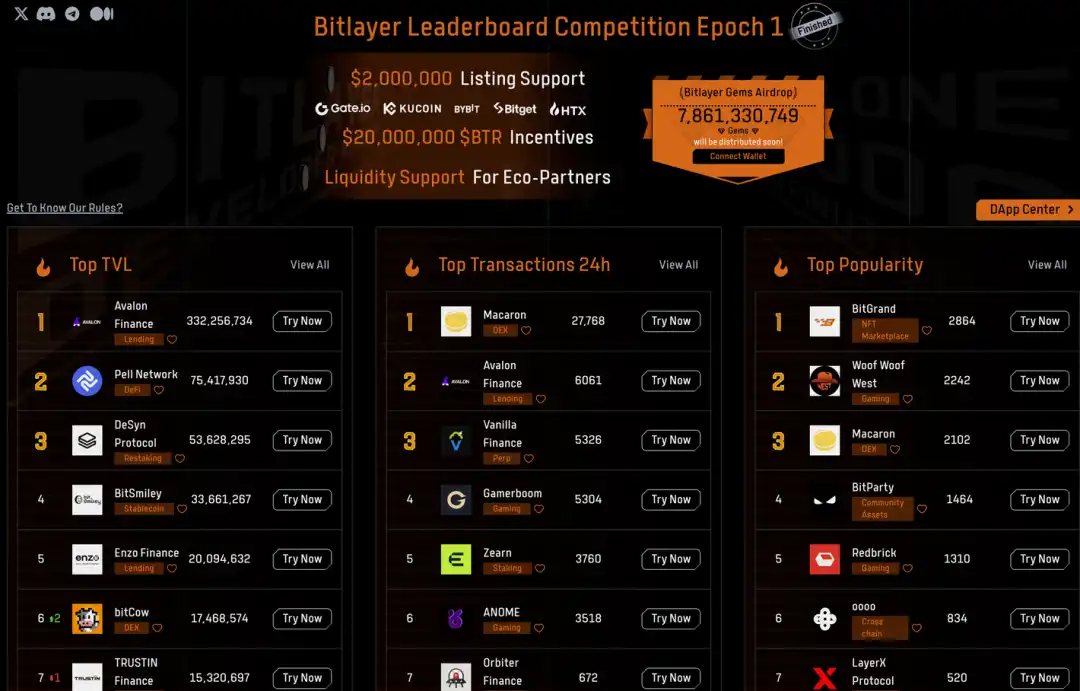
https://www.bitlayer.org/ready-player-one/dapps-center
B² Network
· The B² Network is an EVM-compatible Layer 2 on BTC, providing an off-chain transaction platform that supports Turing-complete smart contracts to enhance transaction efficiency and reduce costs.
· By integrating zero-knowledge proofs (ZKPs) with Bitcoin's Taproot, the B² Network ensures enhanced transaction privacy and security. The network aims to develop Bitcoin into a dynamic platform that serves as a stage for innovative applications like DeFi, NFTs, applicable to both traditional Bitcoin assets and emerging Bitcoin-derived assets.
· The B² Network's technical architecture consists of a two-layer structure:
1. Rollup Layer: Utilizing ZK-Rollup and zkEVM solutions, responsible for executing user transactions and generating related proofs.
2. Data Availability (DA) Layer: Includes distributed storage, B² nodes, and the Bitcoin network, responsible for permanently storing Rollup data, validating zero-knowledge proofs, and executing final settlement on Bitcoin.
· Distributed storage serves as a key component of the B² Network, acting as a repository for ZK-Rollup user transactions and proofs, enhancing network security, reducing single points of failure, and ensuring data immutability.
· Currently, B² Buzz is entering its third phase, introducing Buzz Farming, partnering with notable BTCFi projects such as Babylon, Unirouter, Lombard, and Bedrock, offering diversified yield strategies.
· Buzz Farming rewards include:
Earning 14,580 B² tokens daily from the B² Network.
Rewards from BTCFi partner chains and key collaborators, including Babylon, Aptos, Bedrock, Lombard, and other projects.
· As a native yield aggregator of the B² Network, Buzz Farming will continuously bring more rewards and pathways to users, showcasing the project's innovation in the DeFi space.
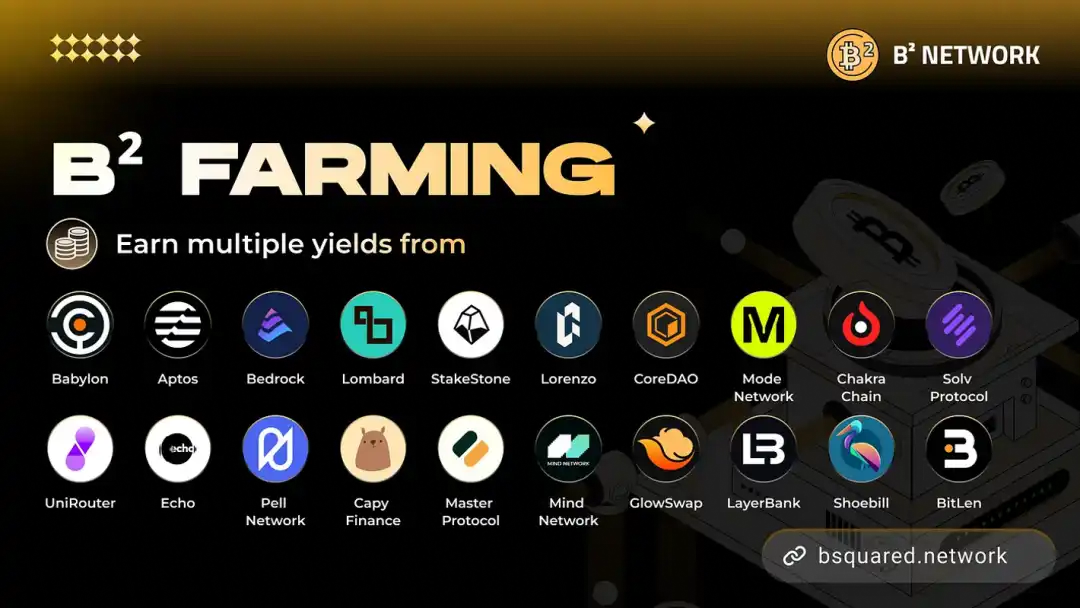
https://buzz.bsquared.network/farming
QED
· The QED Protocol is a ZK rollup on BTC, operating based on zkevm. Unlike other zk rollups, QED chooses not to generate zk proofs for all transactions on the Rollup but only creates ZK proofs for withdrawal transactions from the rollup to BTC L1 and verifies these proofs on BTC L1 by composing scripts into logical circuits.
· Each user's public key acts as a custom ZK circuit, featuring "smart signature" capabilities akin to smart contracts.
· Similar to the BitVM concept, the QED Protocol constructs scripts into a logic circuit to verify ZK proofs of withdrawal transactions on the BTC L1, these logic circuits will contain 1000 UTXOs, achieving direct verification but incurring high costs.
· Decentralized applications built on QED can locally prove transactions, providing users with unlimited computation at a fixed Gas cost.
· Founder Carter Feldman stated that QED can process over 150,000 transactions per second, plans to launch a testnet in the next 3-4 months, the mainnet will go live after community consensus is reached, and introduce native token incentives for high-performance infrastructure operation.
· QED completed a $6 million seed round of funding, with Blockchain Capital as the sole investor, reaching a valuation of at least $1 billion. Previously, it also received $3.25 million in pre-seed funding and $1.35 million in angel funding.
· QED's ZK technology is STARK technology, a pioneering project of Starkware<>BTC, receiving early investment and support from Starkware.
GOAT Network
· The GOAT Network is a BTC Rollup Layer2 project launched by ZKM incubated by MetisDAO, the first decentralized Bitcoin L2 with shared network ownership.
· It technically introduces the Optimistic Challenge Protocol (GOAT-OCP), provides a BTC script lock-in native security mechanism to ensure security, adopts ZKM Entangled Rollup as a universal settlement layer, enhancing transaction inclusivity and finality.
· The GOAT Network can support direct asset deposits without introducing additional cross-chain bridges, and secures assets in a decentralized Sequencer network.
· The development team comes from MetisDAO, Metis is currently the only Ethereum Layer2 project with a decentralized sequencer, and they have brought this technological advantage to BTC Layer2, the decentralized Sequencer network allows any Bitcoin holder to lock assets to become a node or delegate to existing nodes
· Currently, GOAT has secured commitments of 5,000 BTC from five institutional node operators, with plans to launch with seven node operators and expand to dozens in the future
· Potential benefits of participating in the GOAT Network include:
1. gas fees in BTC
2. Mining rewards in GOAT tokens
3. Returns generated by yBTC (receipt token for BTC locked on the GOAT Network)
4. Additional revenue opportunities unlocked within the GOAT Network ecosystem through yBTC
· The first phase of decentralized sorter activity has already begun, where users can bind their wallets (holding 0.001 BTC), social information, and complete social tasks
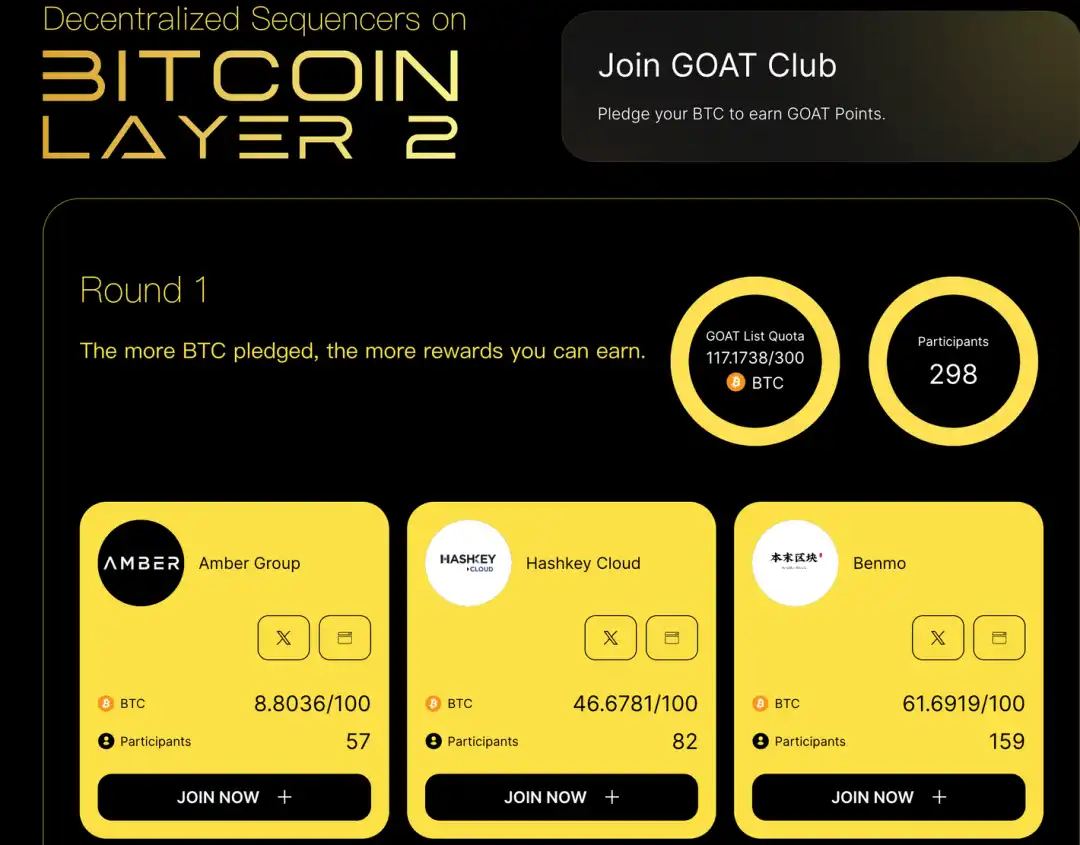
https://club.goat.network/goatlist
Mezo
· Mezo is a Bitcoin Layer2 Network designed to shift Bitcoin from a "savings technology" to a circular economy.
· The project employs a unique Proof of HODL mechanism, where users secure the network by locking BTC and MEZO tokens, and validating transactions.
· Mezo uses the CometBFT consensus mechanism, incorporating the innovative concept of Proof of HODL. Users can lock BTC on Mezo, with a higher HODL score achieved through longer lock-up periods, enabling them to contribute to network security and earn rewards upon mainnet launch.
· The project is launched by the venture studio Thesis, a team with extensive experience in BTC ecosystem development and the previous tBTC project.
· According to Mezo's official website, the current user count is close to 12,000, with a total of 2,333 BTC staked.
· Mezo recently announced the completion of a $7.5 million new funding round, bringing the total funding to $30 million. The new funds will be used to expand network adoption, including integrating more products like the Bitcoin staking platform Acre.
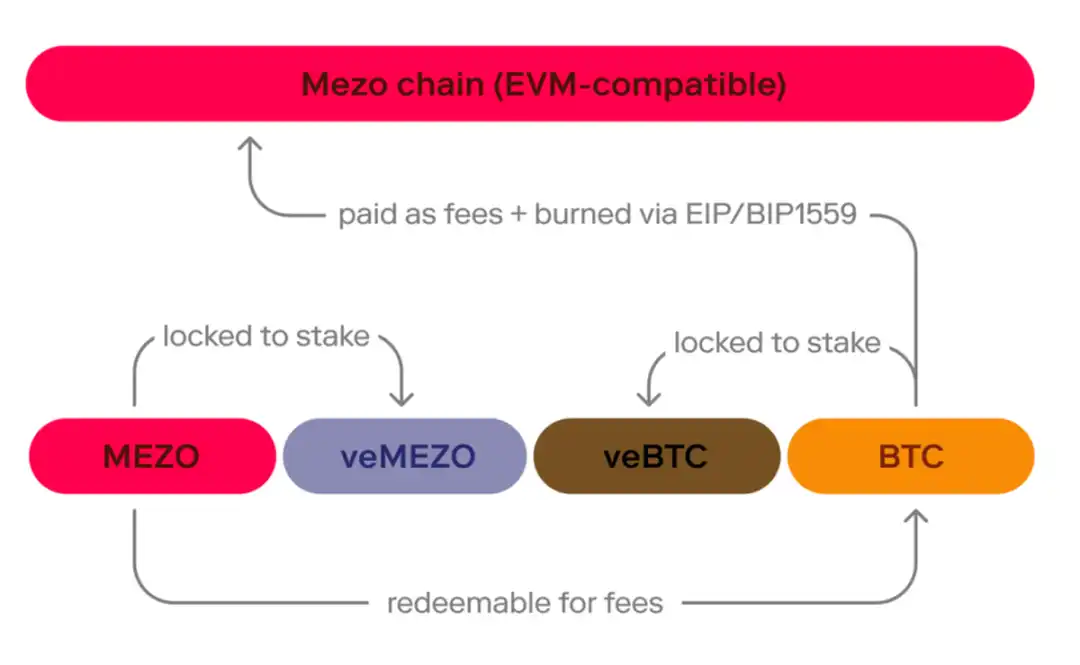
https://mezo.org/hodl
Bitfinity Network
· The Bitfinity Network EVM is an Ethereum-compatible blockchain created on the Internet Computer (IC), developed using the Solidity language. Developers can deploy Bitcoin, Ordinals, and BRC-20 smart contracts written in Solidity on Bitfinity, potentially enhancing Bitcoin's utility.
· Leveraging the IC's unique architecture and Chain Key technology, the Bitfinity Network EVM achieves higher efficiency compared to traditional EVMs, with on-chain storage capacity and processing speed comparable to traditional web services, without the need for gas fees.
· Bitfinity plans to integrate Ethereum and other EVM-compatible chains by running a light client on the IC, requiring adjustments to the network protocol to interface with full nodes of other chains and synchronize the entire blockchain.
· The project supports connecting ICRC-1 tokens and ERC777/ERC20 tokens, as well as Bitcoin as an ICRC-1 token.
· Earlier this year, it completed a $7 million funding round at a $130 million valuation.
· Tokenomics: BITFINITY is the official project governance token approved by the Bitfinity DAO and is the native token of Bitfinity EVM, with a total supply of 1 billion tokens, following the ERC-20 standard.
Arch Network
· The Arch Network is an innovative Bitcoin-native programmability solution that, unlike traditional L2 solutions, aims to directly introduce programmable features to the Bitcoin network.
· Arch is a parallelized PoS network that uses ZK proofs to enhance Bitcoin's native programmability. The network consists of a Rust-based zkVM (ArchVM) and a decentralized validator network.
· Drawing inspiration from Solana and the Solana Virtual Machine (SVM), the project does not rely on any bridges or L2 solutions. Arch features programmability, parallel execution speed, and trustless interoperability and composability.
· In the Arch Network, asset transfers and state changes on the Bitcoin chain occur on the Bitcoin L1. Arch utilizes a state chain through ordinals, submitting state changes in a single transaction to reduce costs and ensure atomic execution.
· Arch's fee model includes Infrastructure Processing Fee and a dynamic pricing mechanism. The Infrastructure Processing Fee is for each BTC transaction, including deploying smart contracts, transactions, Minting NFTs, and other operations. The dynamic pricing mechanism is similar to a fast lane fee, adjusting based on network congestion and transaction complexity.
· Arch Network has completed a $7 million seed round, led by Multicoin Capital, with participation from OKX Ventures, CMS Holdings, among others.
· Currently, Arch's product and roadmap are still in development, and a specific launch schedule has not been announced yet.
The concept of sidechains originated from the 2014 paper "Enabling Blockchain Innovations with Pegged Sidechains" by Adam Back and others. The concept aims to enhance Bitcoin's service capabilities by allowing assets to move across multiple blockchains.
A sidechain is essentially an independent blockchain network that runs in parallel to the main chain and has the following characteristics:
1. Customizability: Can design specific rules and functions to improve scalability and flexibility.
2. Independent Security Mechanism: Maintains its security mechanism and consensus protocol, with security depending on the sidechain's design.
3. High Autonomy: Has greater design freedom compared to the main chain.
4. Interoperability: Interoperability with the main chain may be limited but supports cross-chain asset transfers.
The key function of sidechains is to enable asset transfer and utilization from the main chain to the sidechain, often involving cross-chain transfers and asset locking. This design brings new possibilities to the Bitcoin ecosystem, allowing for the rapid implementation of Ethereum-like features linked to Bitcoin. However, it also presents security and interoperability challenges.
Merlin
· Merlin Chain is a Bitcoin sidechain released by Brc420. As one of the earliest Bitcoin Layer2 implementations, Merlin has maintained a significant TVL. Even in a scenario where the token price did not meet expectations post-launch, according to BTCEden data, Merlin still leads other BTC L2 projects by a large margin with a TVL of $1.28 billion.
· Merlin Chain is based on Bitcoin Layer 1 native assets, protocols, and products, with the goal of empowering Layer 1 assets, protocols, and user ecosystems on Layer 2, such as building a user-friendly metaverse based on Bitmap and utilizing BRC-420 to build DeFi protocols.
· Merlin uses the MPC solution from the Cobo Wallet to achieve BTC cross-chain functionality. In terms of security, there is still some gap compared to Taproot-upgraded BTC multisig, but MPC has been extensively validated. By adopting ParticleNtwrk's account abstraction technology, users can continue to interact with sidechains using Bitcoin wallets and addresses, maintaining user familiarity. This design is more user-friendly compared to requiring Bitcoin users to interact with Metamask.
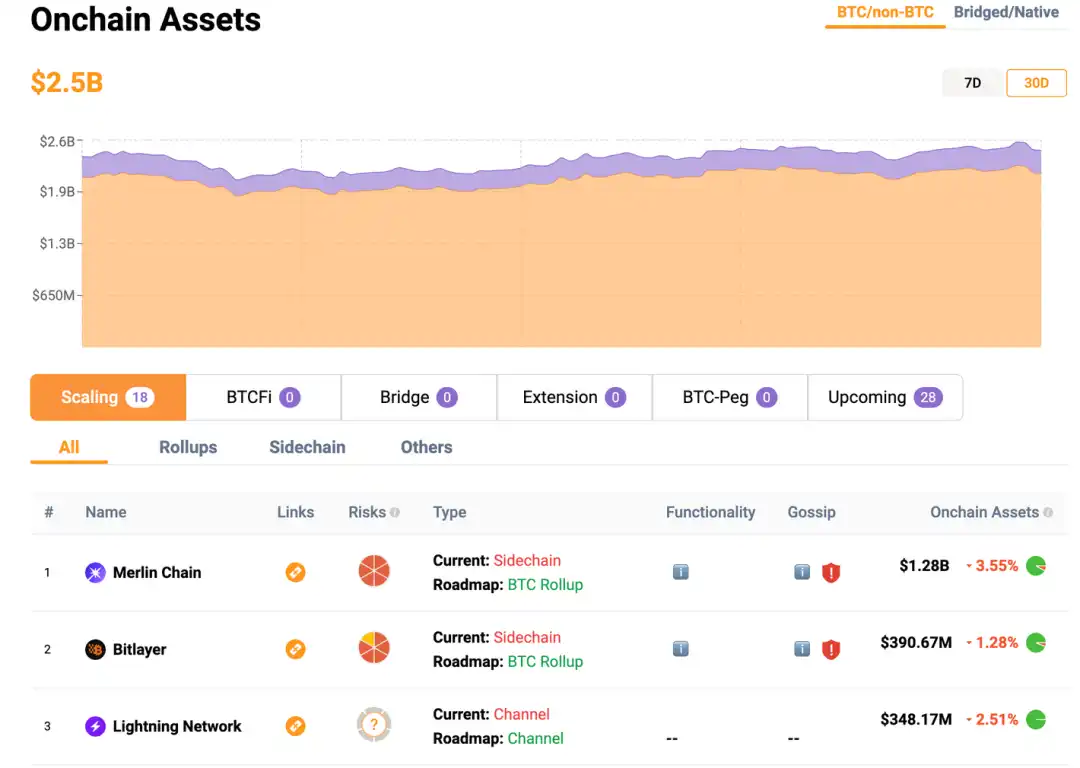
https://www.btceden.org/?type=all
Stacks
· Stacks is a Bitcoin-integrated sidechain with a unique consensus mechanism and smart contract capabilities. The project has adopted an innovative mechanism called Proof of Transfer (PoX), where miners participating in the consensus no longer burn Bitcoin but allocate it to a set of network security maintainers.
· Stacks plans to launch the Nakamoto upgrade this year, which will transform it into a true Layer 2 solution. The upgrade code has been fully completed and is ready to be deployed to the mainnet. This upgrade aims to significantly increase transaction throughput, achieve 100% Bitcoin transaction finality, and reduce transaction confirmation time from 10 minutes to about 10 seconds.
· The Nakamoto upgrade will also enhance Stacks' security, aligning it with the Bitcoin network. Even in the event of a reorganization in the Bitcoin network, most Stacks transactions will remain valid, thereby improving overall network reliability.
· In addition to the Nakamoto upgrade, Stacks will also introduce sBTC, a decentralized, programmable 1:1 Bitcoin-backed asset that can be deployed and transferred between Bitcoin and Stacks (L2).
· sBTC enables smart contracts to write transactions to the Bitcoin blockchain, with the transfer security guaranteed by the entire Bitcoin hash power.
· Stacks currently has a rich ecosystem of projects, with an on-chain TVL of 200 million USD.
· For example, Alex is Stacks' ecosystem DEX, which also includes Launchpad functionality, currently with a TVL of 30 million USD; the liquidity staking project StackingDAO has locked 100 million USD in liquidity.
· The STX token also currently holds the highest market cap in the Bitcoin sidechain ecosystem, being the only token in the Coinmarketcap top 100 by market cap.
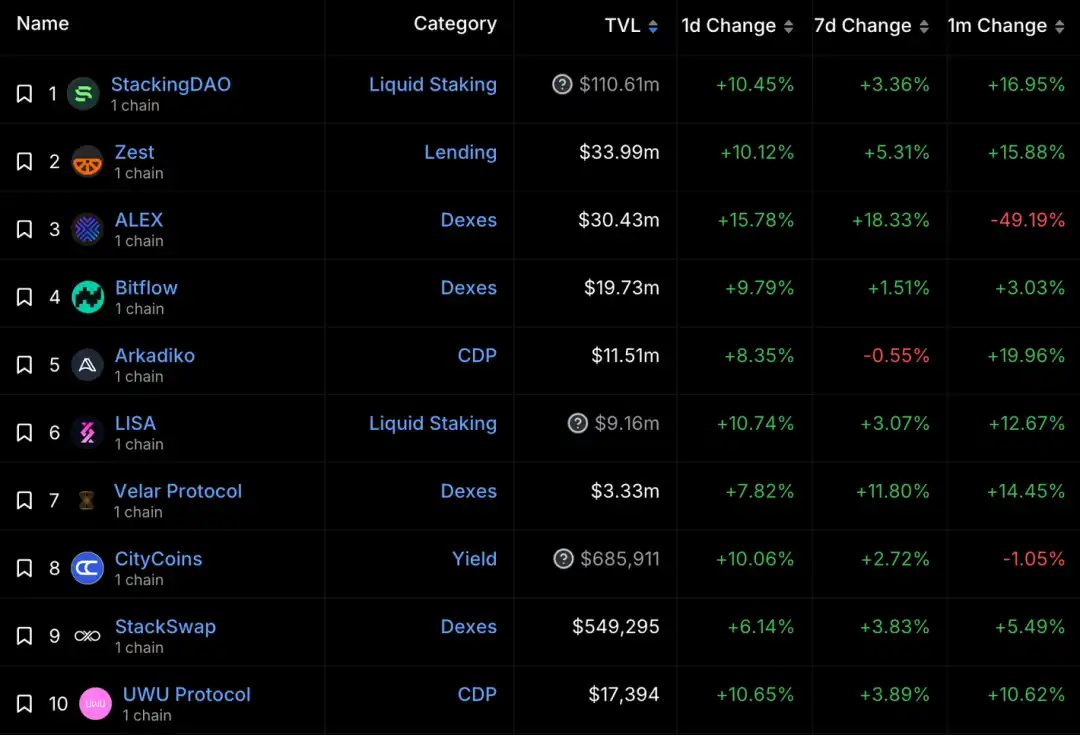
https://defillama.com/chain/Stacks?pool2=false&staking=false
Citrea
Citrea is an innovative Bitcoin scaling solution that achieves scalability within the Bitcoin network through zero-knowledge proof technology, ensuring on-chain verifiability and data availability. The project's key advantage is its ability to support more complex applications without compromising Bitcoin's security or altering its consensus rules.
The technical features of Citrea include:
· Batch processing a large number of transactions and generating succinct validity proofs in zkVM
· First implementation of validity proof engravings and local verifications on the Bitcoin blockchain
· Native ZK proof verifier smart contract on BitVM on the Bitcoin L1
Unlike traditional sidechains, Citrea creates a modular ecosystem for Bitcoin by introducing sharding, maintaining settlement and data availability on the Bitcoin mainchain.
In February of this year, the project announced the completion of a $2.7 million seed round led by Galaxy.
Currently, Citrea's public developer network is live, with three separate one-week testing phases from July to August, where users can participate in testing and earn NFT rewards on the Galaxy.

Fractal Bitcoin
Fractal BTC is a Bitcoin Layer 2 solution developed by the Unisats team, the only solution that recursively extends infinite layers on the Bitcoin blockchain using Bitcoin Core code, using the BRC20 token Sats as Gas fees.
Fractal forked the Bitcoin core code and made some key adjustments. Key features include shortening the block confirmation time to 30 seconds, planning to implement controversial opcodes such as OP_CAT and ZK native verification opcodes faster than the Bitcoin mainnet, which can enable smart contracts via scripts in the future.
The consensus mechanism adopts a proof-of-work (PoW) similar to Bitcoin, allowing miners to mine using existing ASICs, GPUs, and other hardware devices.
Fractal has introduced an innovative Cadence Mining method, where two out of every three blocks are mined in a permissionless manner and one is mined through merged mining, balancing decentralization and security.
As a native scaling solution, Fractal supports cross-chain secure asset transfers starting from the Bitcoin main chain, including decentralized bridges for BRC-20 tokens and Ordinals.
Key applications include Fractal Swap (a flexible BRC-20 exchange mechanism), Asset Bridge (an asset bridge between the mainnet and the Fractal network), and UniWorlds (an application introducing real-world transactions).
Unisats completed a pre-Series A funding round in May this year, led by Binance, with the specific amount undisclosed.
Unisats is one of the most reliable infrastructures in this wave of Ordinals, with wallets and trading platforms largely occupying the user mindshare, having a strong user base and trading foundation. With Unisat developing such a shadow chain, it does not seem out of place, and the new round of funding demonstrates stronger resource capabilities, looking forward to more pioneering applications.
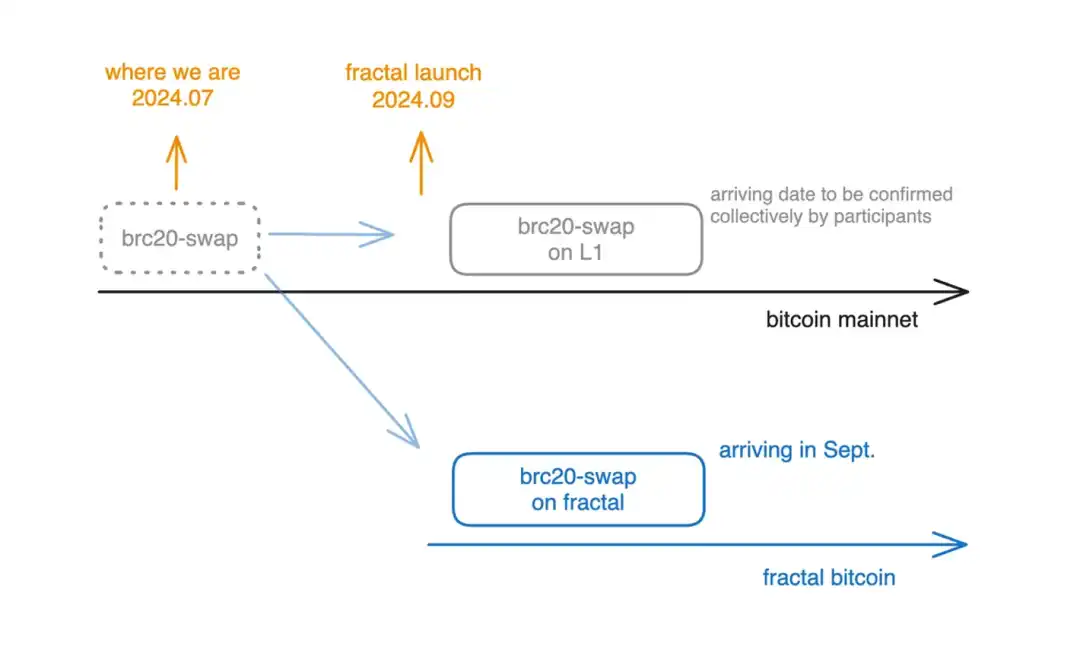
https://unisat-wallet.medium.com/2024-07-unisat-swap-product-important-update-e974084074a1
Botanix
Botanix Labs is building the first fully decentralized EVM equivalent on Bitcoin, combining the usability and versatility of EVM with the decentralization and security of Bitcoin.
The project utilizes Bitcoin's Proof of Work (PoW) as the foundational settlement and decentralized Layer 1, while adopting a Proof of Stake consensus model. The stake (denominated in Bitcoin) is securely stored on the distributed Spiderchain network, protected by a decentralized multi-signature scheme involving a randomly selected subset of participants.
Botanix allows users to directly stake Bitcoin on the Bitcoin network. Once users connect with MetaMask, a special Bitcoin deposit address is generated, encoding the user's EVM address within Taproot.
This innovative mechanism enables users to send Bitcoin directly from major exchanges to this deposit address and then use Bitcoin within MetaMask. The user experience is similar to Ethereum, but in reality, all operations are conducted using Bitcoin. This innovative approach, combining Bitcoin with EVM compatibility, is expected to bring forth more use cases and a user-friendly experience to the Bitcoin ecosystem.
In May of this year, Botanix announced the completion of an $8.5 million seed funding round.
The Botanix testnet went live on November 30, 2023. As of June, the testnet has connected over 300,000 wallet addresses and launched two applications, AvocadoSwap and Bitzy, for interaction.
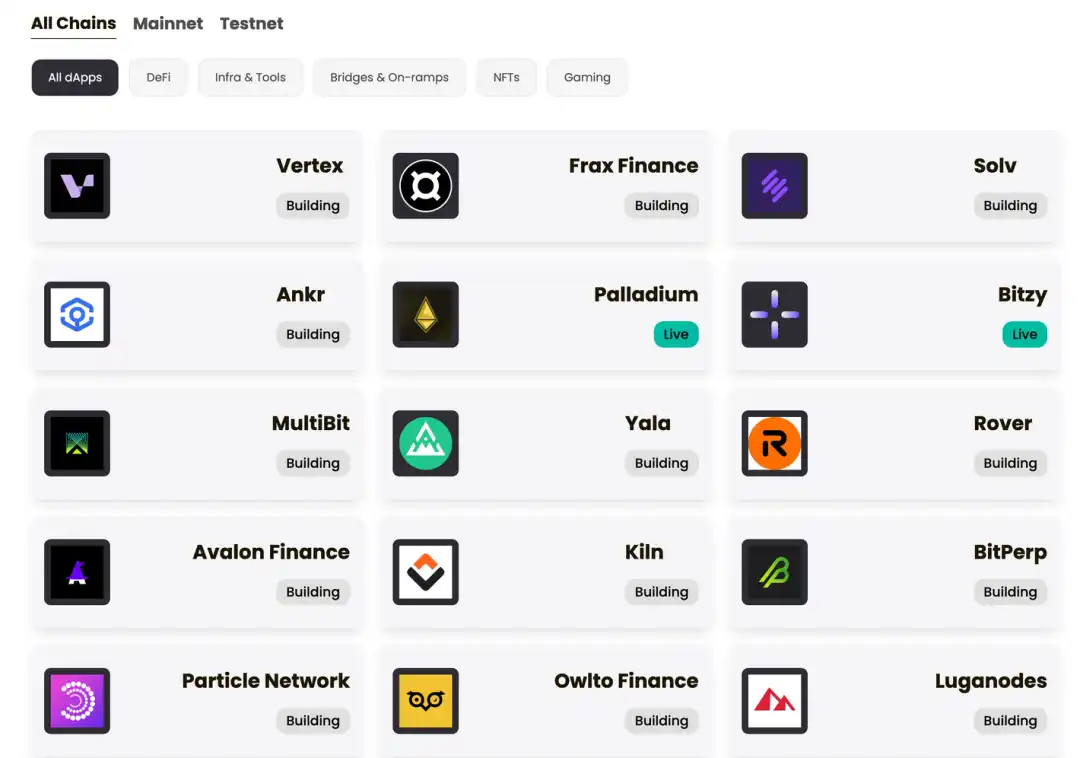
https://botanixlabs.xyz/en/ecosystem
Nervos
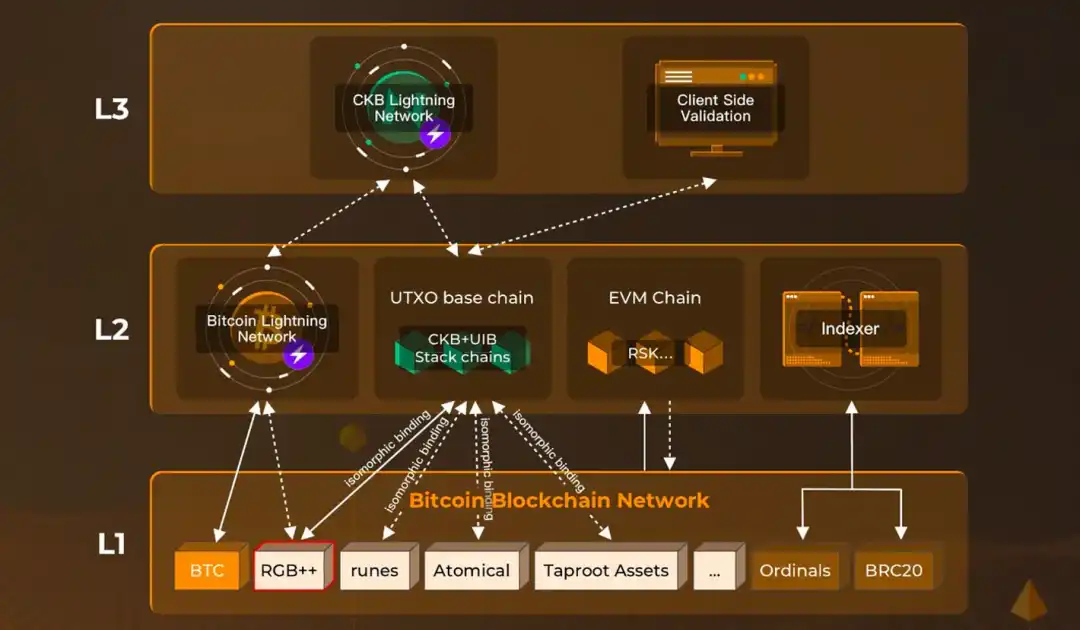
The Nervos Network is one of the Bitcoin scalability solutions that has taken a more native approach, modifying the underlying UTXO model that supports Bitcoin. It adopts a layered architecture, including an L1 blockchain (Common Knowledge Base, CKB) that can be extended through payment channels and RGB++.
CKB leverages the natural structural advantages of POW+UTXO, similar to BTC, and incorporates innovative "homomorphic mapping" technology to seamlessly migrate the RGB's client-side validation paradigm to CKB, known as RGB++. This approach, while sacrificing a bit of privacy, brings extensive functionality and flexibility, with the security tightly bound to the BTC L1.
The RGB++ protocol is an improvement and extension of the original RGB protocol. The original RGB protocol is an L2 solution designed to enable smart contracts and asset issuance without altering the Bitcoin mainnet. It achieves asset transfer by binding assets to specific Bitcoin UTXOs, relying mainly on client-side validation, off-chain transaction processing, and validation.
The Nervos Network addresses the limitations of the original RGB through the RGB++ protocol. RGB++ uses CKB as the data availability and execution layer for Bitcoin, mapping Bitcoin UTXOs to CKB Cells through isomorphic binding technology, seamlessly integrating with CKB's Turing complete smart contracts.
RGB++ introduces on-chain validation of critical transaction elements, enhancing security and data availability. It also enables transaction folding, ownerless contracts with shared state, and non-interactive transfers, achieving Bitcoin cross-chain transfers without the need for a cross-chain bridge.
As an asset issuance protocol, RGB++ allows BTC L1 to have the capability to issue new RGB assets. RGB++ asset transactions on CKB are fully Turing complete and programmable. Not only can RGB++ assets be mapped to CKB, but assets with UTXO properties such as Atomical, Rune, and others can also be mapped to CKB for Turing complete transactions.
UTXO Stack
The UTXO Stack is a modular Bitcoin Layer 2 chain issuance platform, akin to a "one-click chain issuance" platform. It focuses on issuing Bitcoin Layer 2 chains based on the UTXO isomorphic pattern.
The project is developed by the CELL Studio team, a blockchain software company incubated by the Nervos ecosystem fund. The company's founder, Cipher, is also the originator of the RGB++ protocol, with the aim of driving the development and prosperity of the Nervos ecosystem.
The UTXO Stack is essentially the strategic layout of the Nervos project within the Bitcoin ecosystem. Its role is to provide technical support and modular services for projects looking to develop UTXO model Layer 2 chains on Bitcoin.
The UTXO Stack can be likened to the Op stack in the Ethereum ecosystem. Just as Base is an Ethereum Layer 2 built on the OP Stack toolkit, the UTXO Stack provides similar functionality for the Bitcoin ecosystem.
A Bitcoin Layer2 built on the UTXO Stack can natively integrate the RGB++ protocol and can leverage CKB as a data availability layer. This makes the UTXO Stack effectively become the OP Stack + EigenLayer of the Bitcoin ecosystem.
These UTXO Stack-based Layer2 solutions can adopt a POS consensus mechanism, securing the layer2 chain by staking BTC, CKB, and BTC L1 assets.
The security of many emerging PoS chains is limited by the on-chain economic scale, posing a risk of centralization. Bitcoin staking and restaking protocols introduce the most secure asset, Bitcoin, to provide security to PoS networks.
Especially under the education of EigenLayer and various restaking projects, the concept of restaking has become well established, and the extension of this concept to the Bitcoin ecosystem is more natural.
The advantages of Bitcoin restaking include:
1. Bitcoin is the most secure existing blockchain, with an unparalleled foundation of trust.
2. Activating around $1.3 trillion in Bitcoin's market value, creating sustainable earning opportunities for holders.
3. Bridging the gap between PoW and PoS blockchain systems, fully leveraging Bitcoin's security advantages.
4. Bitcoin staking derivative assets have huge market prospects, including building collateralized stablecoins, lending and derivatives, recursive lending, and structured products, among other diverse ecosystem applications.
Babylon
Babylon is a Bitcoin staking protocol that allows Bitcoin holders to stake BTC on a PoS chain and earn rewards while safeguarding the security of the PoS chain, dApps, and sidechains.
Unlike traditional methods, Babylon employs remote staking without requiring BTC to be bridged, wrapped, or custodied on the PoS chain. This approach enables Bitcoin holders to earn from their idle BTC while enhancing the security of PoS chains and dApp chains.
Babylon's core functionality extends Bitcoin's use cases beyond just value storage and exchange, expanding its security capabilities to more blockchains.
The project has introduced the Bitcoin Timestamp Protocol, placing timestamps of events from other blockchains onto Bitcoin, granting these events the same timestamp security as Bitcoin transactions. This enables fast staking unbonding, reduced security costs, cross-chain security, and other functionalities.
From a technical perspective, Babylon comprises two main protocols:
1. Bitcoin Timestamp: Sends a succinctly verifiable timestamp of any data (e.g., a PoS blockchain) to Bitcoin.
2. Bitcoin Staking: Allows Bitcoin assets to economically secure any decentralized system in a trustless and self-custodial manner.
In May of this year, Babylon announced the completion of a $70 million funding round led by Paradigm.
Project Development Stage: Bitcoin Staking Testnet-4 has concluded. Upon the opening of the subsequent testnet, active participation in staking tests is recommended to complete the corresponding Galactic missions.
https://babylonchain.io/
Lorenzo
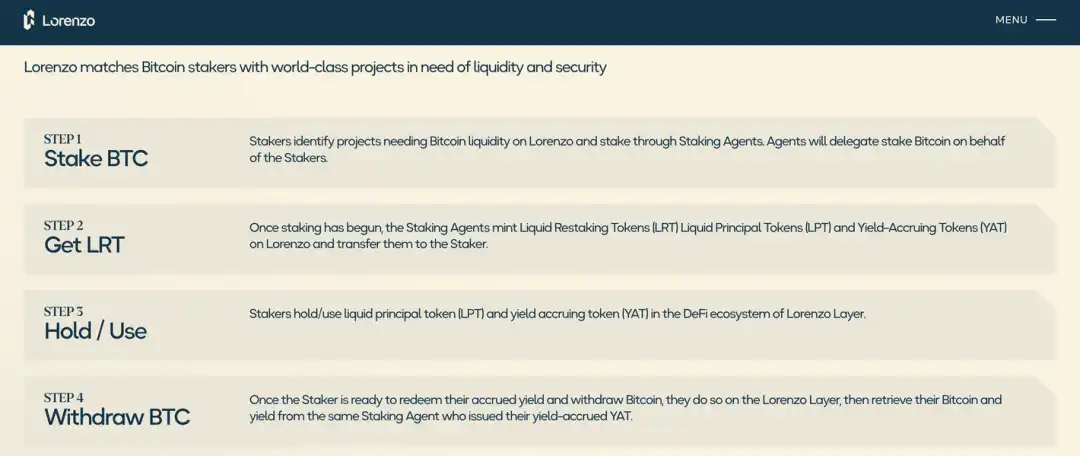
The Lorenzo Protocol is a liquidity rehypothecation protocol built on Babylon, designed to enhance Bitcoin's utility by introducing liquidity staking and privacy-enhancing features. The project enables Bitcoin holders to convert BTC into stBTC, allowing participation in Bitcoin staking and earning rewards without locking funds.
Lorenzo innovatively splits the liquidity rehypothecation token (LRT) into Liquidity Principal Token (LPT) and Yield Accumulation Token (YAT), a mechanic similar to Pendle's PT and YT. This separation mechanism provides a flexible solution for liquidity rehypothecation, enhancing Bitcoin rehypothecation liquidity and accessibility.
An important feature of the project is the absence of a minimum staking period or an unbonding period. This means investors can avoid the risk of being locked into staking and maintain flexibility during market fluctuations.
Lorenzo offers an EVM-compatible Cosmos chain secured by Babylon BTC for issuing and settling BTC liquidity rehypothecation tokens. This establishes the foundation for cross-chain operations and broader DeFi applications.
In the future, Lorenzo plans to build a series of financial products, including interest rate swaps, lending agreements, structured BTC yield products, and stablecoins, among others. The project focuses on building an efficient Bitcoin liquidity allocation market and liquidity assetization.
While specific funding information has not been disclosed, the project has received support from Binance Labs.
The Beta mainnet is currently live.
https://www.lorenzo-protocol.xyz/
Chakra
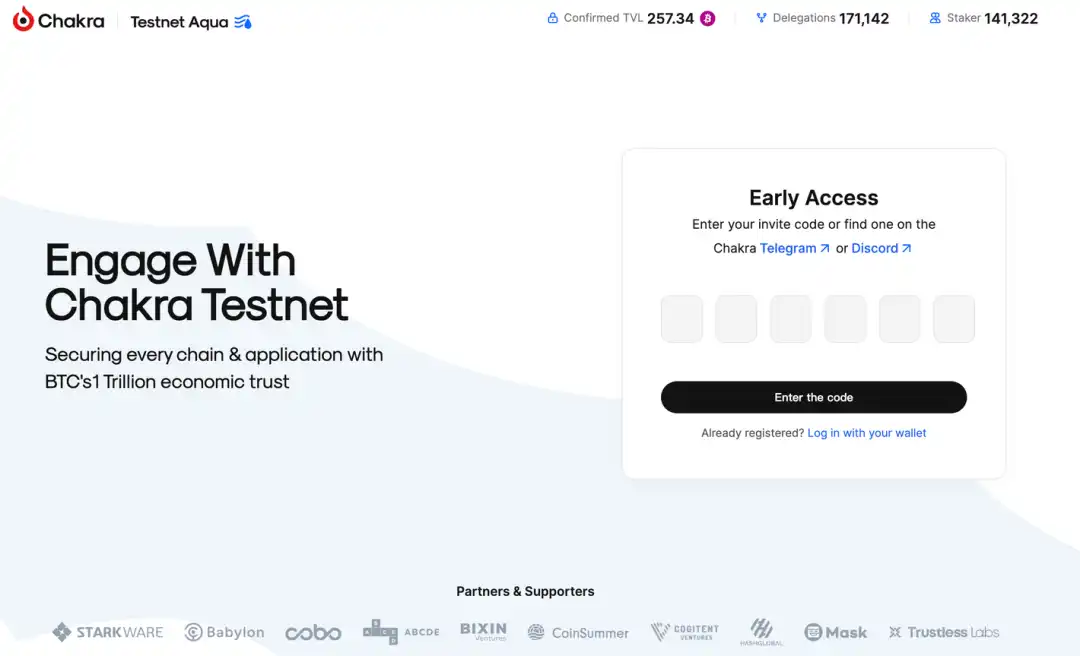
Chakra is an innovative Bitcoin re-staking protocol driven by ZK technology, introducing the concept of SCS (Settlement Consumer Service) to integrate Bitcoin restaking into a PoS system.
The core technical features of the project include:
· Locking BTC using a timelock mechanism
· Generating proofs of staking events through ZK-STARK technology
· Off-chain validation mechanism without direct connection to the Bitcoin network
· Leveraging STARK technology to ensure high security without trust assumptions
Chakra's ZK Proofs design has the potential for various applications, including artificial intelligence, DeFi, and gaming. Users stake once and can expand to multiple use cases through authorization, earning multiple staking rewards.
The project has the potential to establish a staking-based L2 network, allowing stakeholders to participate in L2 consensus and governance. These L2s will share Bitcoin's security while providing data availability services and execution environments maintained by stakeholders.
Chakra plans to integrate with Babylon to expand its utility within the Bitcoin ecosystem.
In April 2024, the project announced its investors, primarily including STARKWARE, ABCDE, and some Asian miners.
Project Development Progress:
· Testnet launched, and participation in the Babylon testnet-4
· In Babylon Testnet-4, Chakra emerged as the top finality provider
· Confirmed a TVL of 258 Signet BTC, representing 36% of Babylon's total TVL, demonstrating strong early performance
https://btcstaking.testnet.chakrachain.io/
BounceBit
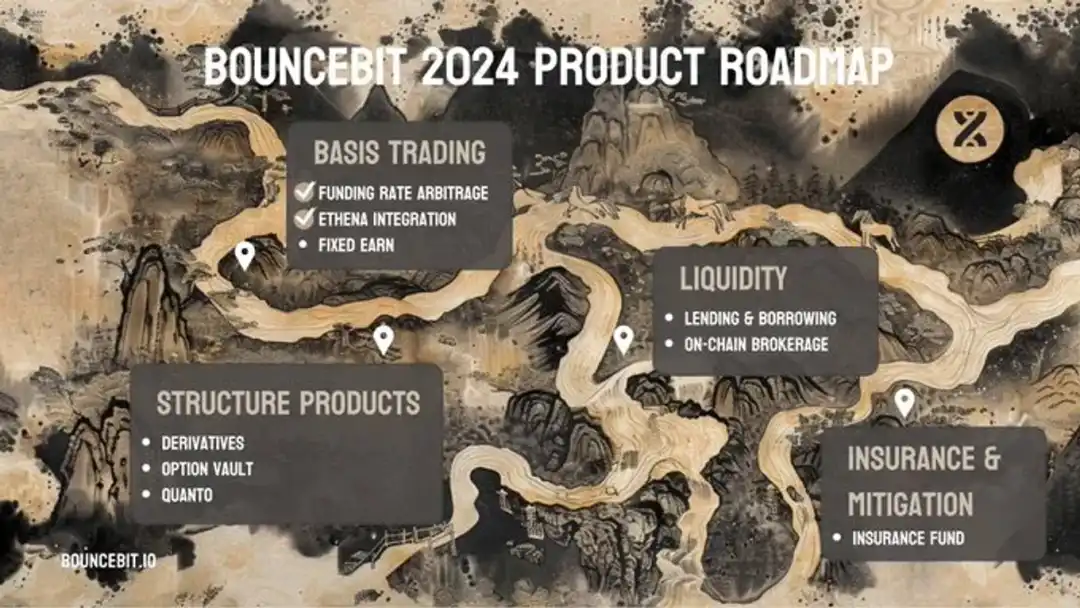
BounceBit is an innovative BTC re-staking infrastructure that provides a foundation for diversified staking products. The project adopts a CeFi + DeFi hybrid framework, enabling BTC holders to earn rewards through multiple channels.
The core idea is to drive Bitcoin's development by utilizing the asset without altering the Bitcoin blockchain. Key strategies include funding rate arbitrage and creating on-chain certificates for re-staking and mining.
BounceBit's Layer 1 consists of two key components:
· Dual Coin PoS: a hybrid consensus mechanism where validators can accept both BBTC and BB tokens
· Native LSD Module: allows validators to delegate stake and receive LST certificates as rewards
The project's CeFi layer includes:
· Compliance Custody: ensuring user fund security through MPC wallets
· OTC Settlement: securely utilizing CEX liquidity with off-chain settlement
· BTC Re-staking: ensuring fund security through regulated custody services, with users receiving bounceBTC (BBTC) as staking certificates
· BounceClub: a no-code DeFi experience creation platform
· Liquid Staking: introducing the concept of Liquid Custody Tokens (LCT) to maintain staked asset liquidity
BounceBit completes a $6 million seed round, led by Blockchain Capital and Breyer Capital.
The project plans to launch the on-chain brokerage service Superfast in the third quarter of 2024, aiming to address the liquidity issue of BBTC and BBUSD and kickstart a large-scale BB reward campaign.
Superfast will combine the concepts of LCT and CEX to achieve fast on-chain settlement and high liquidity, supporting ultra-liquid exchanges of BB, BBUSD, and BBTC.
The innovative model of BounceBit is expected to provide Bitcoin holders with more rehypothecation options and revenue opportunities, while driving the expansion of Bitcoin's application in the DeFi space. The project's hybrid architecture and diversified product line demonstrate its potential in Bitcoin financial innovation.
https://bouncebit.io/
Lombard
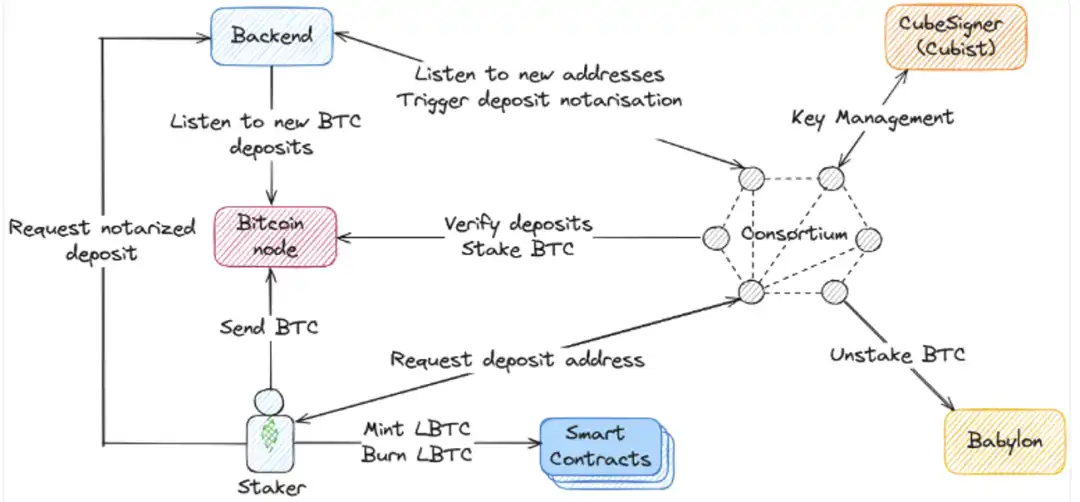
Lombard is a Bitcoin collateral protocol designed to achieve Bitcoin collateralization and liquidity release through the Babylon platform.
The core product LBTC is an interest-bearing cross-chain liquidity Bitcoin token backed 1:1 by BTC. When users collateralize Bitcoin through Babylon, Lombard uses LBTC tokens to represent the collateralized Bitcoin's liquidity and revenue.
The project's key innovation lies in enabling interest-bearing BTC to move cross-chain without diluting liquidity, which could be a significant catalyst for bringing in large amounts of new capital into the DeFi ecosystem.
Lombard plans to integrate LBTC into Ethereum's DeFi protocols later in 2024, significantly expanding Bitcoin's application scope and potential in the DeFi space.
Lombard recently announced the completion of a $16 million seed round led by Polychain.
Currently, Lombard is still in the development stage, and the testnet has not yet launched.
Bitcoin and Ethereum have significant differences in ecosystem maturity, technical genes, and mainnet features. Ethereum's Data Availability (DA) layer is a further enhancement of its already relatively rich mainnet functionality. In contrast, Bitcoin's mainnet transaction processing capacity is extremely limited, handling only about 4 transactions per second.
Therefore, in contrast to Bitcoin, developing a DA layer is more like addressing a pressing need rather than a simple feature enhancement. There is less competition in this space, with only Nubit currently established.
Nubit
Nubit has built a highly scalable, secure data availability layer on top of Bitcoin's economic security, aiming to significantly increase Bitcoin's data capacity without compromising security, in order to support Ordinals, layer 2 scaling solutions, price oracles, indexers, and other applications.
Nubit integrates Babylon's POS staking scheme to ensure that the economic security of the entire DA ecosystem is determined by Bitcoin-native stakers, allowing Bitcoin holders to participate and strengthen the Nubit system, creating the most secure and scalable data availability layer.
In addition to the DA layer, Nubit will also develop an execution layer based on the Nubit DA framework, which is stateless and efficient, allowing users to reliably verify computation results, and this will be widely used in Bitcoin wallets and applications.
In terms of funding, in June of this year, it was announced that Polychain led an $8 million seed round of funding (total funding of $12 million).
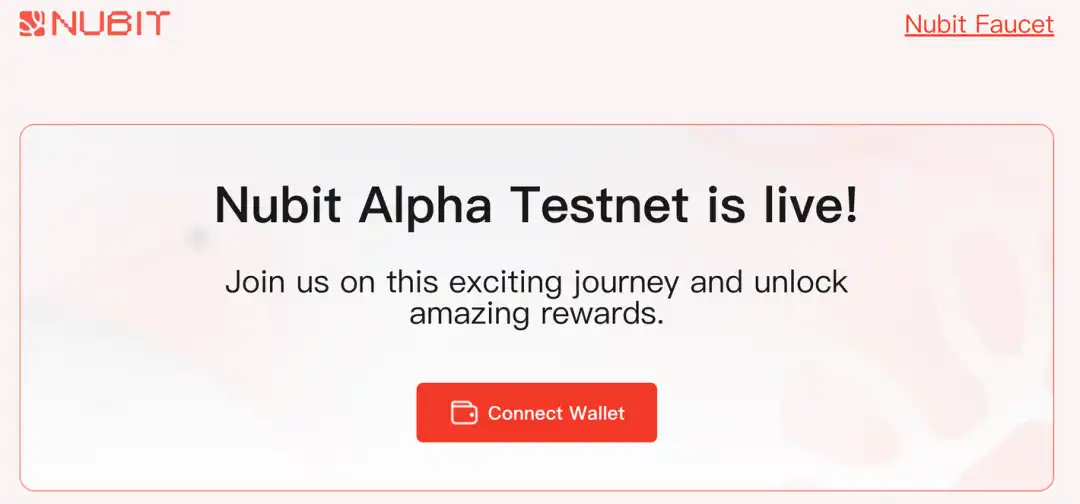
Currently, the Alpha testnet is open, and activities that can be participated in include: Community Assemble, Light Node Quest, and upcoming Testnet Adventure.
This article only roughly introduces the progress of some projects in the ecosystem from the perspective of the Bitcoin layer. In fact, the Bitcoin ecosystem also includes more infrastructure such as cross-chain bridges, wallets, oracles, various asset protocols, and DeFi projects, the scope of which is truly vast.
Our discussion is only a starting point, aiming to glimpse the characteristics of Bitcoin ecosystem development through these examples.
The development of the Bitcoin ecosystem is facing a balance challenge between technical originality and user demand, a challenge reflected in the ecosystem development gradually forming two forces.
The native tech camp is committed to exploring the potential on the basis of Bitcoin's unique UTXO model and script language, developing projects that truly align with the Bitcoin design principles.
While this approach is more technically challenging, it better maintains alignment with Bitcoin's core values. Through the analysis of numerous projects, we found that Native Tech projects generally have a strong academic background, reflecting the high level of difficulty in Bitcoin's ecosystem infrastructure development.
Due to the limitations of the Bitcoin network itself, these projects need to employ new technologies such as advanced cryptography to address challenges, thus requiring a very strong academic foundation.
Relatively speaking, User-Oriented projects focus more on rapidly responding to market demands, using existing mature technologies to quickly develop and deploy products to serve existing user bases.
These projects more often adopt the experience of Ethereum, which has the advantage of reducing user education costs. However, the downside of this approach is the lack of innovation at the application end, with most deployed projects basically replicating Ethereum's solutions on sidechains.
For each cycle, innovation is an indispensable key element. In the BTC ecosystem, technological innovation should be more reflected in breaking through its various limitations.
The Babylon project is a prime example, demonstrating how native technological innovation can enhance the practicality of Bitcoin. By using innovative technologies such as Bitcoin timestamps, Babylon allows users to earn additional income while retaining ownership of BTC.
This BTC yield method not only minimizes additional asset security risks but also creates new value for users, making it highly attractive to market participants. Based on these observations, we believe the future development path of the BTC ecosystem may be:
Through continuous native technological innovation and improvement, develop emerging protocols and projects to increase the capital efficiency of BTC.
This approach can not only break through Bitcoin's original technical limitations but also meet market demands while maintaining its core values, laying a solid foundation for the long-term health of the Bitcoin ecosystem.
Original Article Link
Recommended
The Wall Street Journal: How is AI Trading Stealing the Limelight from Cryptocurrency?
Aug 15, 14:00
Tencent Still Has a Dream
Aug 15, 11:27
To Catch North Korean Hackers, They Set Up a Fake Project
Aug 15, 10:00
From Litigation to Settlement: Positive Signal Released by HTX's Negotiation with FCA
Aug 14, 19:32
11,742 Shipping Addresses Exposed Alongside Trezor Orders
Aug 14, 19:01
Founder Interview: FOMO Creator Explains How They Added 30,000 Users in One Day and Became One of the Fastest-Growing Crypto Apps
Aug 14, 18:37