Banana Gun Decrypted: How Millions of Dollars Were Siphoned Off from Users and Validators

Original Title: 'HEH' : The TL;DR Version
Original Author: JUGGERNAUT
Original Compiler: TechFlow
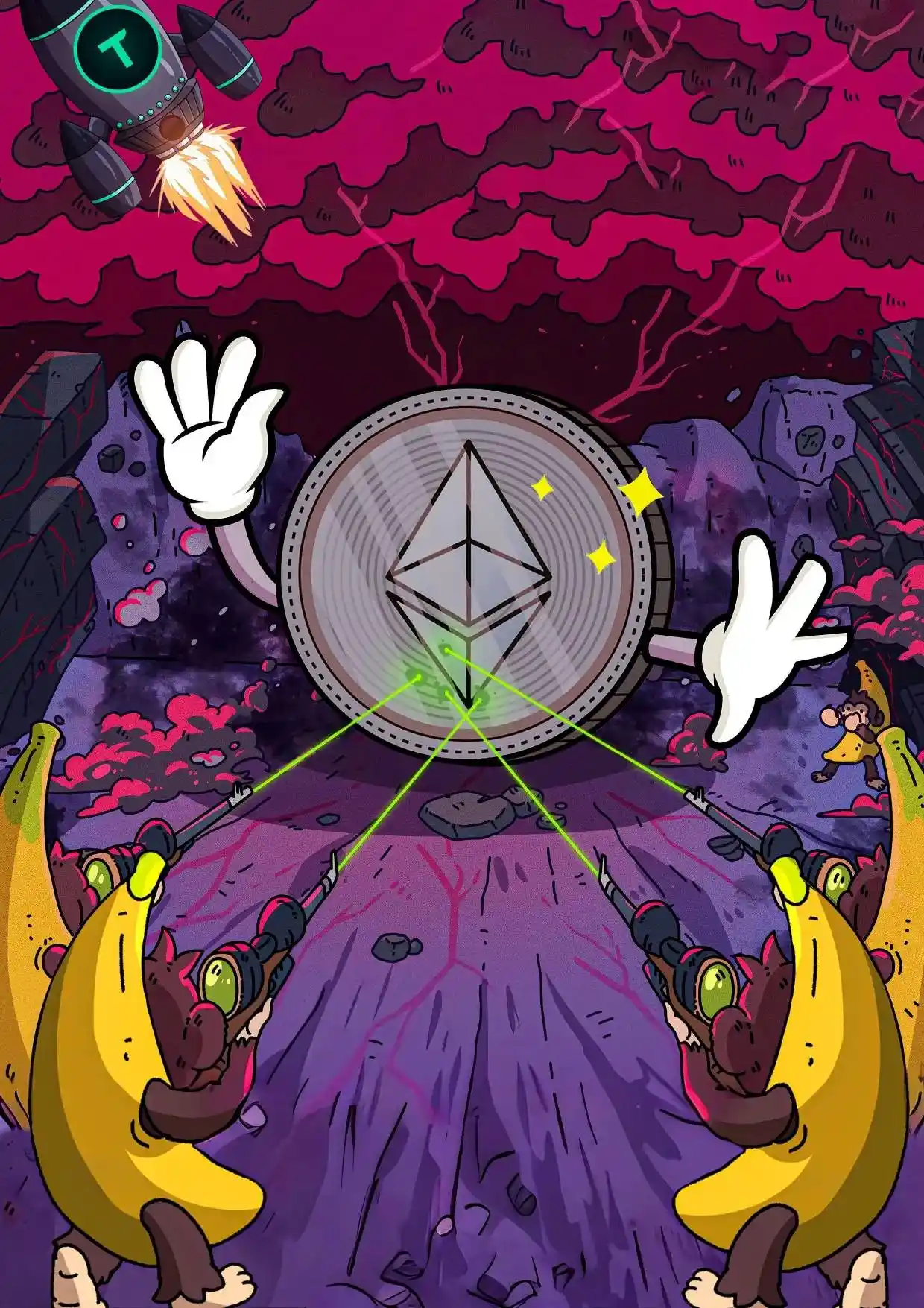
Last year, I published two short articles exploring the origins of the Banana Gun Bot team.
The articles analyzed the on-chain flow of funds used to create the Banana Gun Bot and raised some troubling questions about the developer's background. When the background of the anonymous developer of a leading trading bot appears suspicious, the question that follows is, for whose benefit is the Banana Gun Bot operating?
Ten months is a long time in the micro-cap space. In fact, it's also a long time in the entire decentralized finance (DeFi) space. I sat down to review how right (or wrong) I was about the Banana Team. The problems I uncovered go much deeper than I initially thought — and raise serious questions about how Ethereum will operate in the future.
To set the context, let’s look at some data.
Since May 2023, TG Bots have become widely accepted in the DeFi ecosystem as a stable business model, contributing significantly to daily on-chain transaction volume. Over the past year, TG Bots have accounted for 20% - 30% of total Ethereum transaction volume, as a percentage of the number of transactions. As of June 2024, all TG Bots account for 9.4% of Ethereum transaction volume and come from nearly 5.3% of Ethereum wallets. Therefore, TG Bots like Banana have now become significant transaction initiators on Ethereum and play an important role in the Ethereum ecosystem.
Since June 2023, at least $5.25 billion in capital has flowed through the Banana Gun router. While some of that is on Solana, this puts Banana second in the category only to Maestro (the first entrant in the space, more than a year ahead of the competition) and Bonk Bot (viewed by some as a bet on the entire SOL shitcoin ecosystem).
Observers have been puzzled by the speed with which Banana has captured market share. The main reason for establishing this overwhelming dominance is the success rate of Banana Gun Bot’s sniping bundles. In its early days, Banana became the bot of choice for users who wanted to snipe rather than just trade. And in shitcoins, where transaction lifecycles are often just a few hours, being first in at “block 0” is often the only thing that matters.
In simple terms, a token’s block 0 refers to the block that “opened trading” for that token at launch, and sniping a token at launch means that your buy trade needs to be executed immediately after the token developer’s “opened trading” trade. To do this, Banana Gun has been suppressing all competitors by “bundling” user bribes since its launch in late May 2023. These bundled transactions are more profitable for Ethereum developers because they enhance and aggregate the tips paid to developers.
This strategy of Banana Gun has been so effective that between June and October 2023, Banana Gun users’ “block 0” dominance rose from 7% to winning 88% of the first bundles in the TG Bot field, compared to the industry-leading TG Bot “Maestro” (operating since mid-2022).
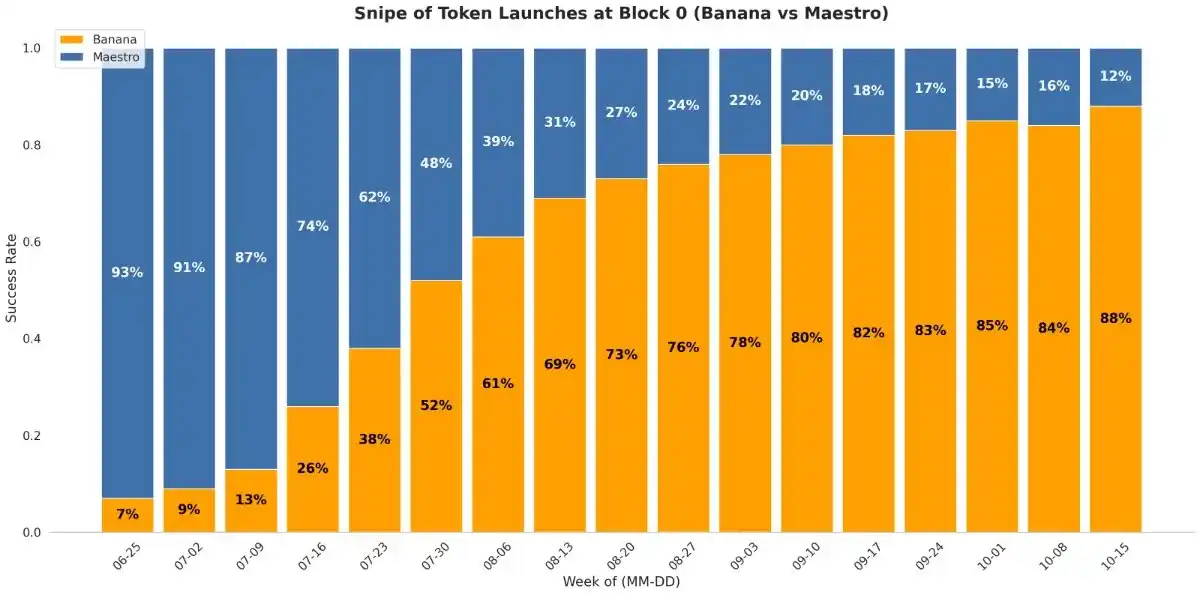
Source: The Scientific Crypto Investor and Duncan | Flood Capital
A new market reality is emerging - one in which the average shitcoin investor is setting themselves up to fail by choosing Banana's competitors. If you want to get in first, you have to join one of Banana's block 0 bundles. A culture of paying high bribes has developed among Banana users, initially mocked on crypto Twitter but soon accepted as a fait accompli.
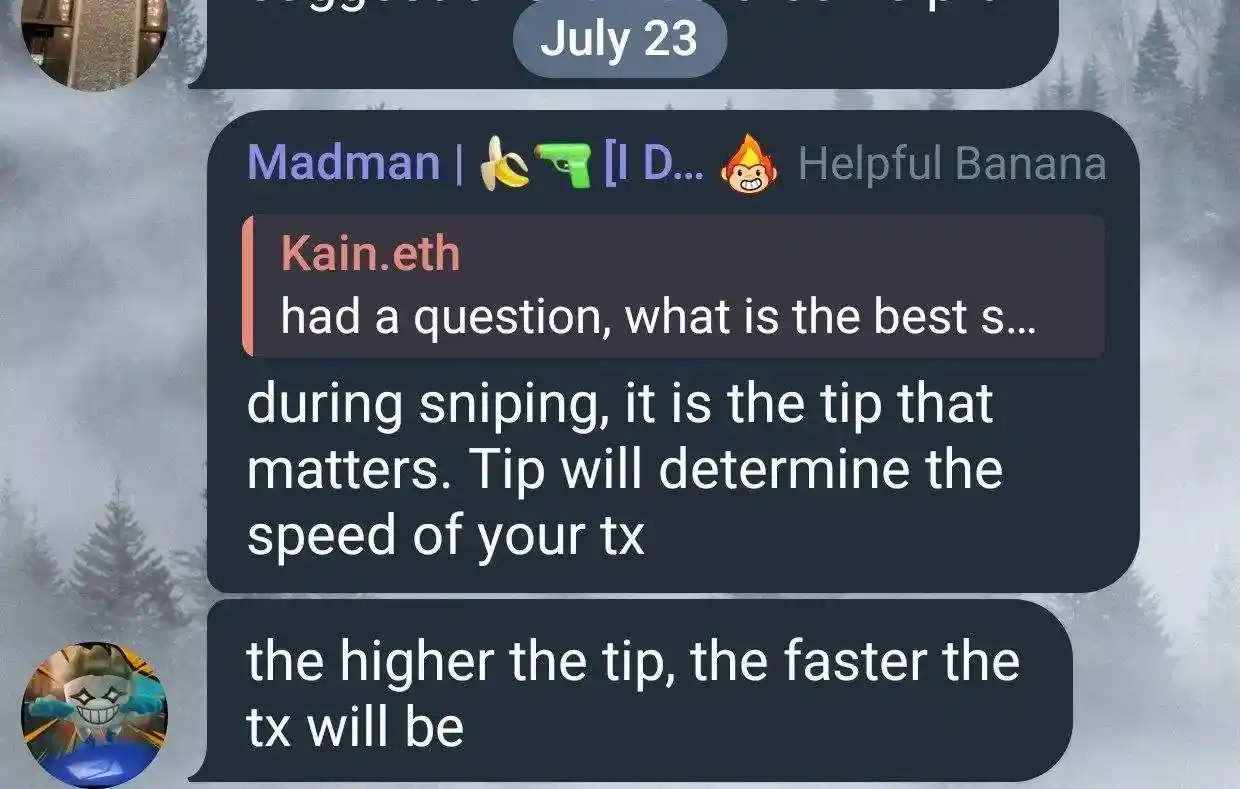
Source: Banana Gun TG
In fact, the high bribe culture of Banana users is seen as a sign of its commercial success and an indicator of value for $BANANA token holders. Of course, a feature of the bribery culture among Banana users is that even within bundles it is a PvP (player vs player) competition, with deep-pocketed users getting in first to the token, and small bribers providing exit liquidity to leading Banana users.
By the Banana team themselves, the bot was initially created for a small circle of “friends”, but was subsequently opened to the public due to the apparent fervent decentralised communists of its development team.
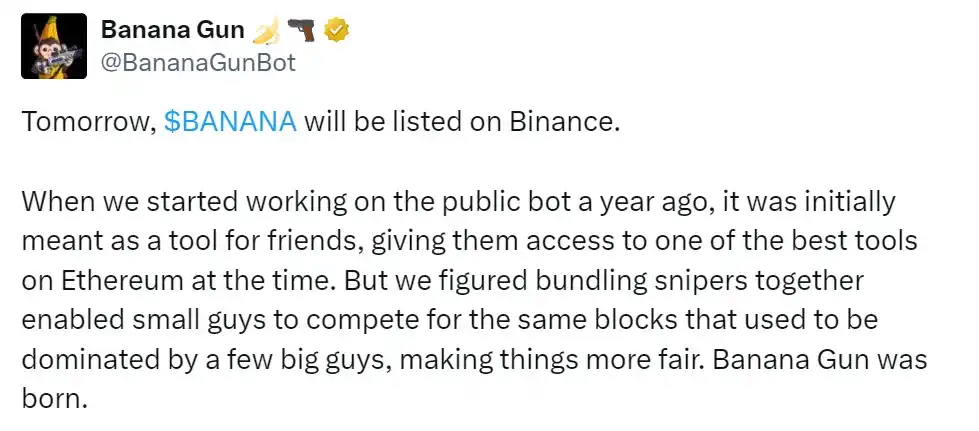
Source: Banana Gun X Handle
It is worth mentioning that the allegations that the Banana team front-loaded transactions by monitoring users for bribes have never been cleared up. Regardless, the second aspect of Banana Gun Bot’s sniping bundle dominance is beginning to evolve into a case study for the entire Ethereum ecosystem.
When dominance becomes the status quo
In September 2023, the Banana Gun Bot team launched the $BANANA token, promising a 40% share of the revenue generated by the bot for users. By November 2023, Banana Gun Bot had received over 90% of all block 0 sniping, far ahead of its competitors in adoption and revenue generation. According to sources, by December 2023, the Banana team had executed a brilliant maneuver. In the ETH shitcoin trade, Banana cleverly turned its early lead in the TG Bot market into an economic moat against competitors by normalizing a culture of high bribery and leveraging its dominant position at Block 0 to exploit a long-theoretical but unrealized systemic weakness in Ethereum.
Understanding this process requires a basic understanding of how Ethereum works after the merger - specifically the concept of Proposer Builder Separation. For the average person like me who doesn't understand but wants to learn the concepts behind PBS, I have a separate note that can be found here.
Normally, in a healthy competitive proposer-based allocation (PBS) block building market, transactions initiated by TG Bot are assigned to various builders, who take pending transactions from the transaction memory pool, optimize them to maximize value, build blocks and bid to proposers to ensure their own blocks are included. Real-time visualization of this transaction process can be seen on Payload during the 12-second life cycle of a block.
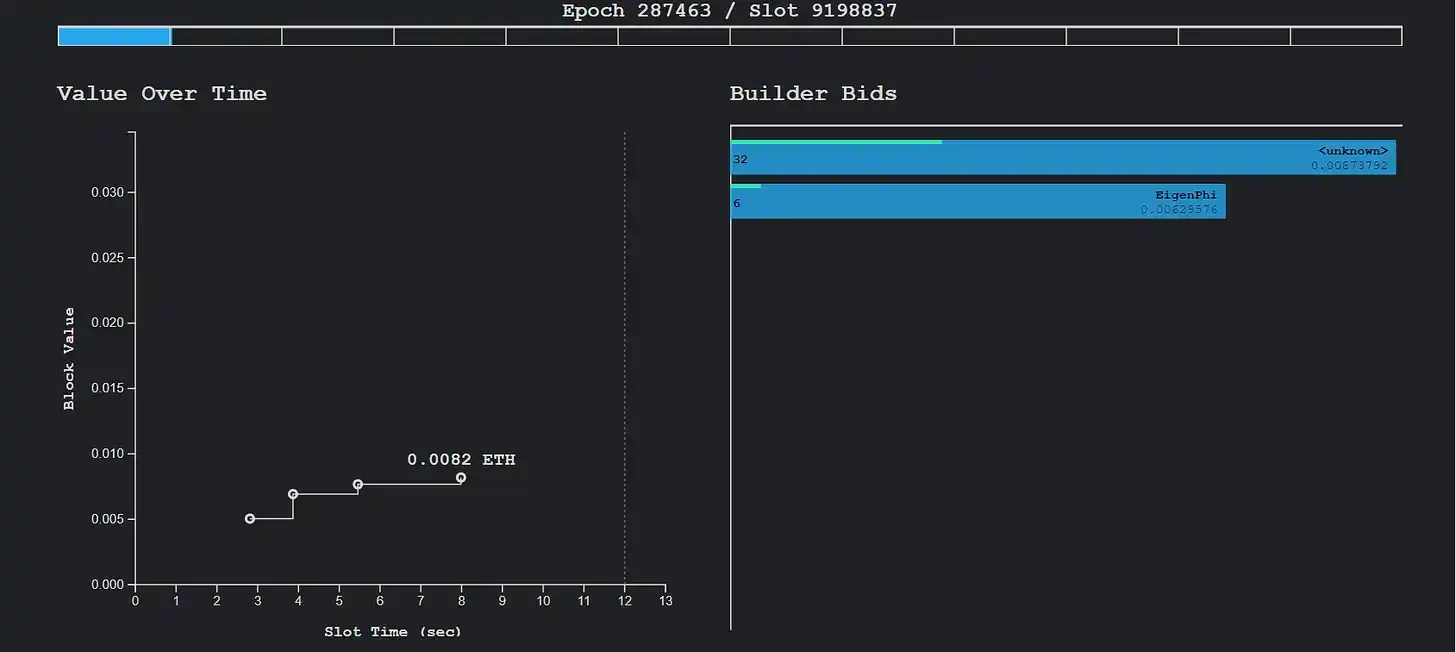
In the best case, in an open competitive bidding process, proposers earn the highest fees by selecting the best bid among competing builders. Value is thus redistributed back to the Ethereum ecosystem (because proposers stake ETH and secure the Ethereum chain), while builders are also rewarded in a competitive manner (because they pass on most of their transaction fees to proposers).
The problem is that the competitive nature of the block construction market can be constrained by a variety of factors. Last year, the Special Mechanisms Group argued in its paper “Concentration Effects” (Gupta et al., 2023) that over time, a small group of savvy builders will naturally dominate PBS. Interestingly, they proposed in May 2023 that this concentration tendency mainly stems from opportunities at the “top of the block”, such as CEX-DEX arbitrage.
“Top of the block” refers to the first few transactions executed in each block. CEX-DEX arbitrage refers to professional traders taking advantage of the price difference between tokens on centralized exchanges (such as Binance) and decentralized exchanges (such as Uniswap) through price arbitrage. SMG mentioned that the advantages of block top opportunities in PBS are mainly monopolized by builders with "rumored connections" to high-frequency trading firms (HFT), such as Manta, Rsync Builder, and Beaver Build. Compared with builders supported by these HFT companies, the SMG team also analyzed Blocknative, Builder69, and Flashbots as other high-volume but non-HFT builders, thus verifying their hypothesis. Ironically, SMG mentioned Titan Builder's June 2023 paper, proving that these top builders received more order flow, leading to their dominance in PBS auctions.
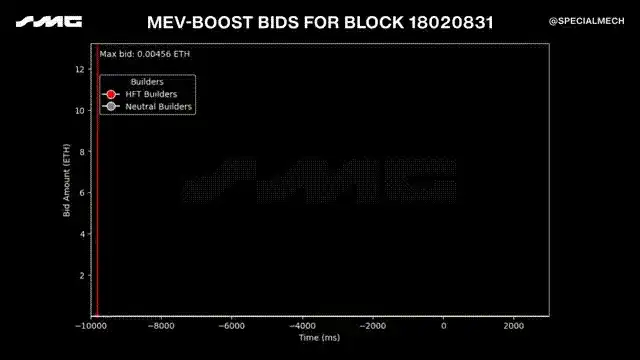
Visualizing the PBS Advantage of HFT-funded Builders
An important conclusion drawn by SMG is that “Builders who earn more revenue from the top of the block will be more willing to pay more for private order flow, as they need to win the entire block to exercise their top of the block advantage”. SMG therefore envisions a situation where savvy, HFT-firm-funded builders could form a monopoly in PBS if they gain private order flow to consolidate their lead. In doing so, they would suppress smaller builders — just as Titan Builder pondered in its June 2023 paper (young Titan’s public RPC only went live on April 17, 2023).
So, what is private order flow?
The rebellious rise of shitcoins in 2020 has created a systemic problem for Ethereum - "MEV". Over the past 3 years, trade senders have become increasingly reluctant to send trades to the public Ethereum pending transaction pool, and have instead turned to private pending transaction pools to avoid being front-runners by MEV bots. To the extent that private pending transaction pools provide protection for trade senders, they constitute a public good. TG Bot's trades are seen as premium trades for MEV bot operators because its users are often advised to set high slippage to ensure that their trades will succeed in high-volatility tokens.
To guard against this possibility, almost 97% of TG Bot's trades are conducted through this private pending transaction pool. But this is not the type of trade that SMG is referring to when it worries about HFT firms monopolizing the PBS system. The "private order flow" mentioned by SMG refers to order flow from a single trade initiator, sent exclusively to a single builder.
First of all, TG Bot provides users with more than just sniping services, as well as ordinary buy and sell transactions, including limit orders on the chain. However, Banana's business model is mainly rooted in its "sniping" narrative. Its high-value block 0 bribe culture drives its strong revenue stream. Therefore, Banana's business model is based on assuring users that they will enter the token transaction before any competitors. Typically, in order to maximize the chances of a block 0 bribe bundle being successful on the chain, such an initiator will send its users' bundles to all leading builders on Ethereum.
For example, suppose you and I, as Ethereum builders, received the same 10 ETH bundle from TG Bot, which included a 5 ETH "tip" to incentivize that bundle to be prioritized in the block over all other bundles. I build a potential block and you build one too. I bid 1 ETH, you see that and bid 1.1 ETH, and so on, until the entire 5 ETH is exhausted. In this case, eventually the 5 ETH will be sent to the proposer, rather than being pocketed by a particular builder.
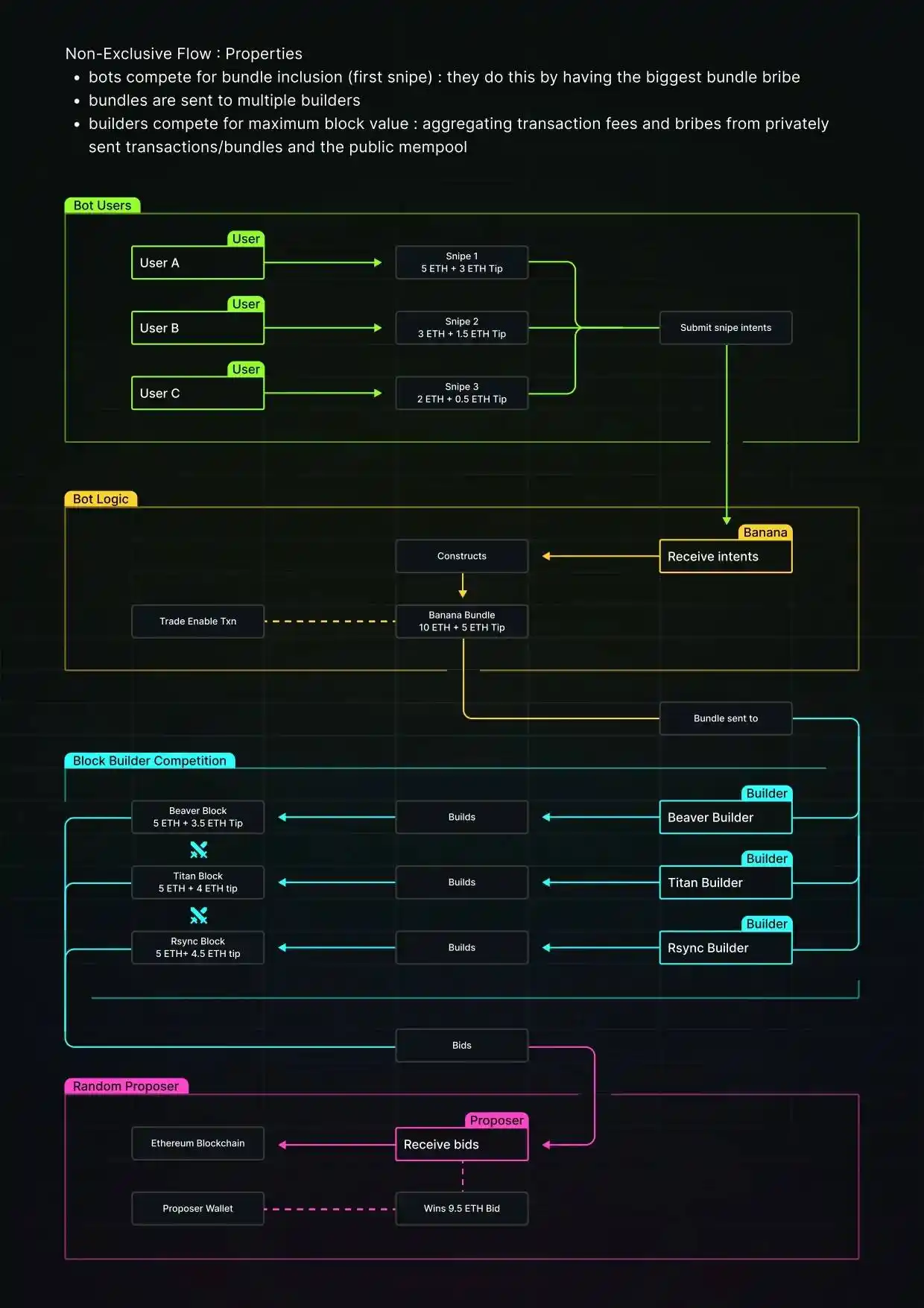
Note: This example assumes no other TXs are sent to the builder
Logically, when the TG bot sends its bundle to multiple builders, it is able to maximize the chances of the bundle being included in the winning block and on-chain, because builders compete with each other to ensure that their blocks are accepted by validators. On the other hand, sending exclusive order flow (EOF) to a single builder means that the builder must successfully get the order flow (and bribe) on-chain. Any delay will weaken this advantage - the bundle will no longer be sniped. Therefore, proposers like Banana should ideally provide order flow to at least the builder with the highest inclusion rate on-chain. From SMG’s research at the time of Banana’s launch, it was clear that builders like BeaverBuild, and others backed by well-funded high-frequency trading firms (HFT), would be ideal EOF recipients for Banana. But as we’ll see next, the Banana team chose a different approach.
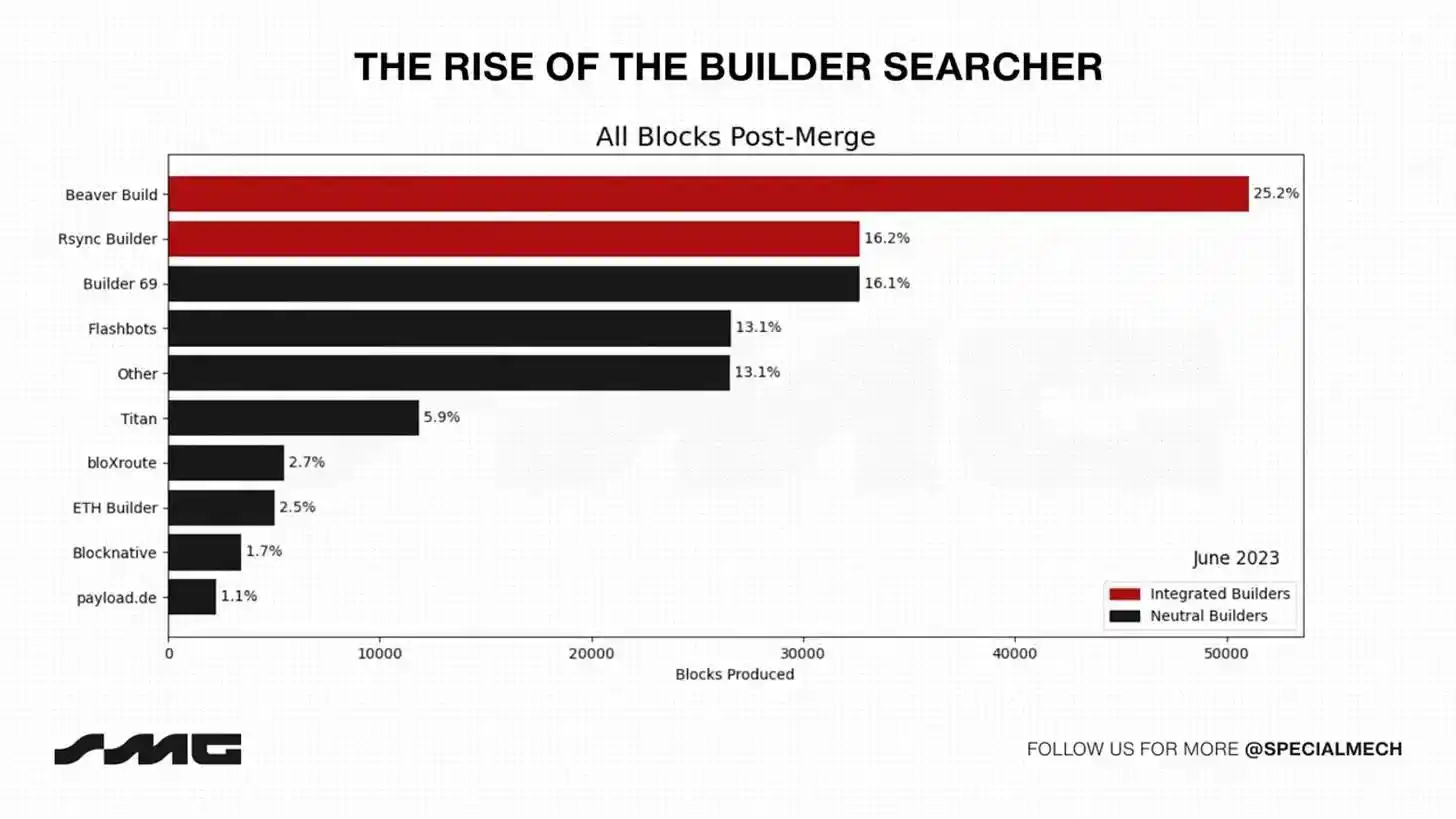
PBS market as of June 2023. Source: SMG
One indirect effect of dedicating Banana order flow to a particular builder could be the following.
When a high bribe bundle is sent exclusively to a particular builder, other builders cannot access the bundle and therefore cannot obtain its bribe. A reasonable strategy for the “selected” builder is to gradually increase the bid to ensure that only the minimum amount has to be paid to the proposer to get the bundle included in the next block. So if a block 0 bundle with a 5 ETH bribe is routed through EOF, and the highest block bid from a competing builder at this time is 1 ETH, then the exclusive builder can bid “just enough” to secure the block (e.g., 1.1 ETH) and keep the remaining 3.9 ETH as pure profit.
What does the Banana team gain from offering an EOF to a single builder? The answer lies in potential kickbacks on the profits brought in by that builder. This EOF protocol means that the builder can return part of the bribe to Banana (as payment for the EOF), so now Banana not only profits from trading fees, but also from the high bribery culture generated among its users. This is not a novel business model - Robinhood Markets in the United States was paid hundreds of millions of dollars by Citadel for "order flow payment".
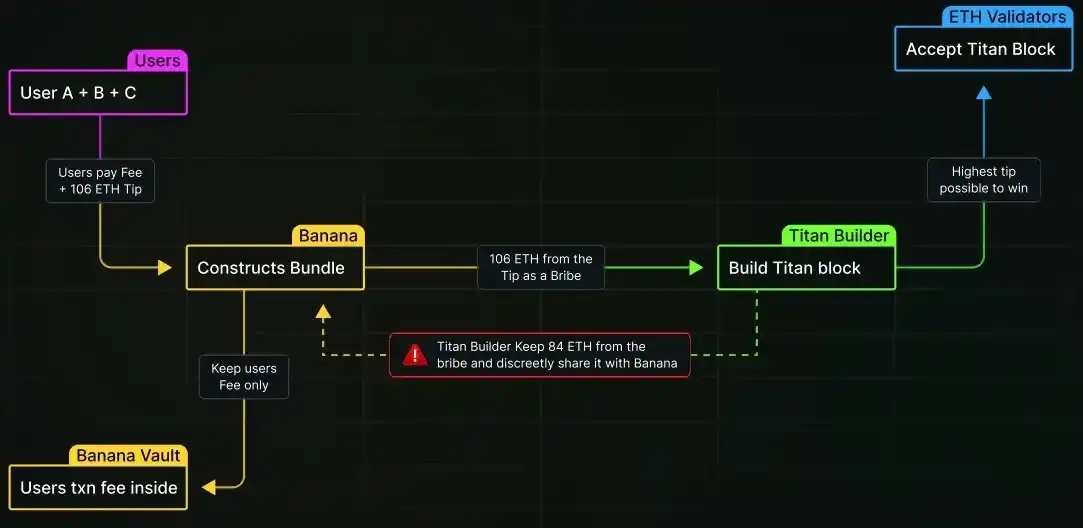
Source: Ethereum Block 19238546
Q: Has the Banana team disclosed the existence of such an EOF protocol?
A: No.
Q: As the issuer of the $BANANA token and custodian of the project treasury, does the Banana team redistribute overpaid bribes to its users or $BANANA token holders?
A: Absolutely not.
Q: But more importantly, in 2023, did the Banana team execute an EOF protocol with the Ethereum builder with the highest market share in block construction to ensure users have the best chance of having their bribed block 0 bundled on-chain in good trust?
Answer: Strangely, no.
Analysis of Banana Gun router transactions shows that the Banana team routes its sniper bundles exclusively through Titan Builder most of the time.
Titan’s market share of PBS block builds in April 2023 was only 1%. When the Banana team began to direct Exclusive Order Flow (EOF) to Titan, Titan’s performance in the PBS market lagged far behind other builders. It is worth noting that in the 7 days before the publication of this article, Titan had contributed nearly 40% of all Ethereum blocks.
In short, in less than a year, Titan has become:
· The second largest builder on Ethereum, and
· The most profitable builder in the Ethereum PBS ecosystem, thanks in large part to its EOF support from the Banana Gun team.
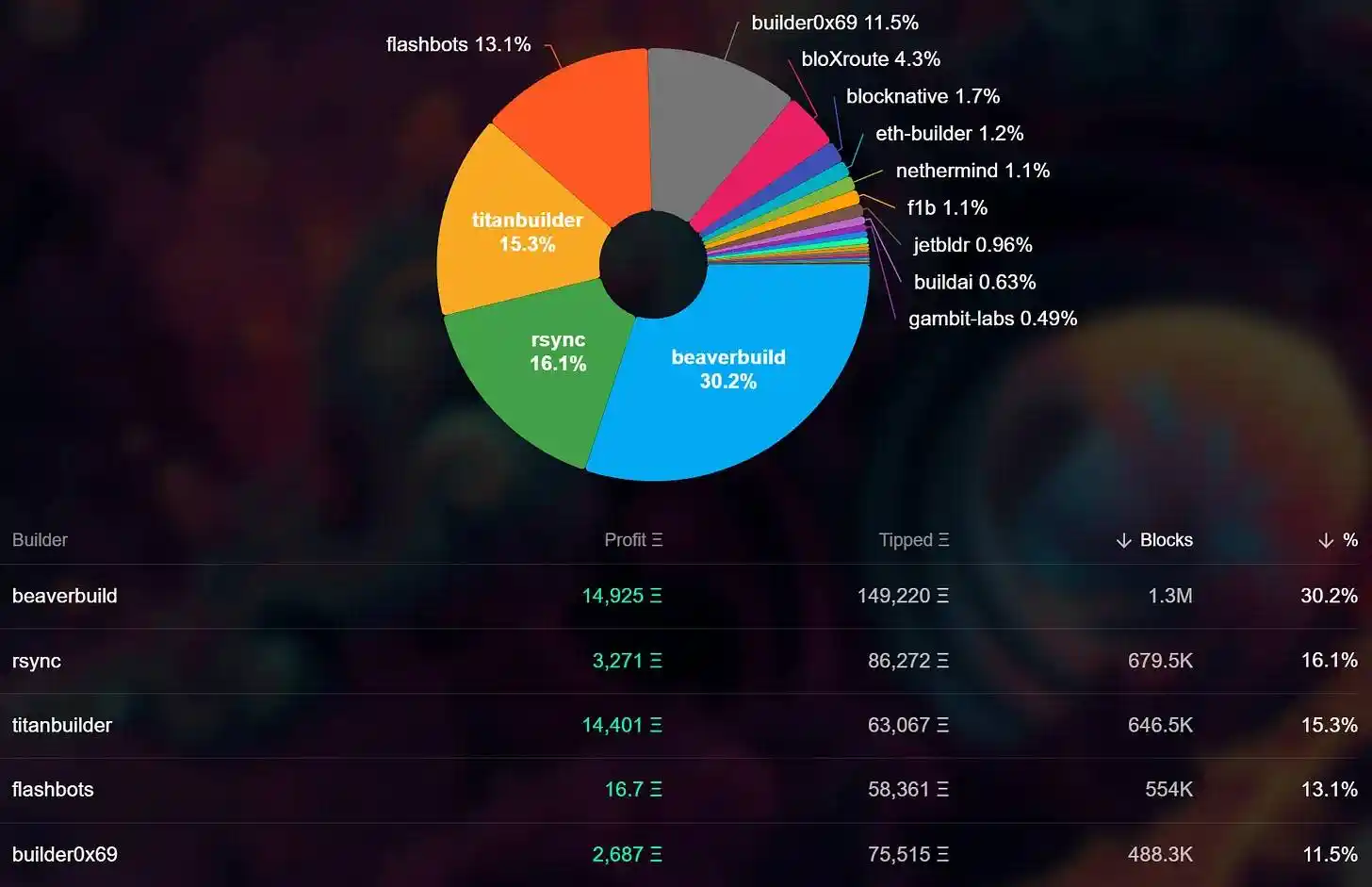
Source: libMEV
A closer look at the data in the libMEV graph above reveals the true scale of Titan’s success.
Beaverbuild is the leading block builder on Ethereum post-PBS. Since the merge, it has built over 1.2 million blocks, earning Ethereum validators 146,241 ETH as a result, while generating 14,520 ETH in profit for Beaverbuild.
Take Flashbots builders for example - having delivered over 552,800 blocks, they have earned 16.7 ETH in profit while transferring 58,349 ETH to the Ethereum ecosystem through their validator fees. Titan, on the other hand, has delivered 615,200 blocks since May 2023, earning 13,151 ETH in profit while transferring 60,912 ETH to the Ethereum ecosystem.
By doing this, Titan has earned almost 787 times as much profit as Flashbots builders while delivering slightly more blocks than Flashbots. Similarly, while Beaverbuild keeps around 9% of the ETH paid by users for building blocks, Titan has earned 17.75% of the ETH as its own profit while building less than half as many blocks as Beaverbuild!
Markovich’s recent excellent paper (May 2024) explores this arrangement in depth. She uses block 19728051 (referred to as block 8930981 in the paper) as an example, which has a total value of 76.38 ETH, a total priority fee of 4.54 ETH, and a total bribe of 72 ETH paid to Titan.
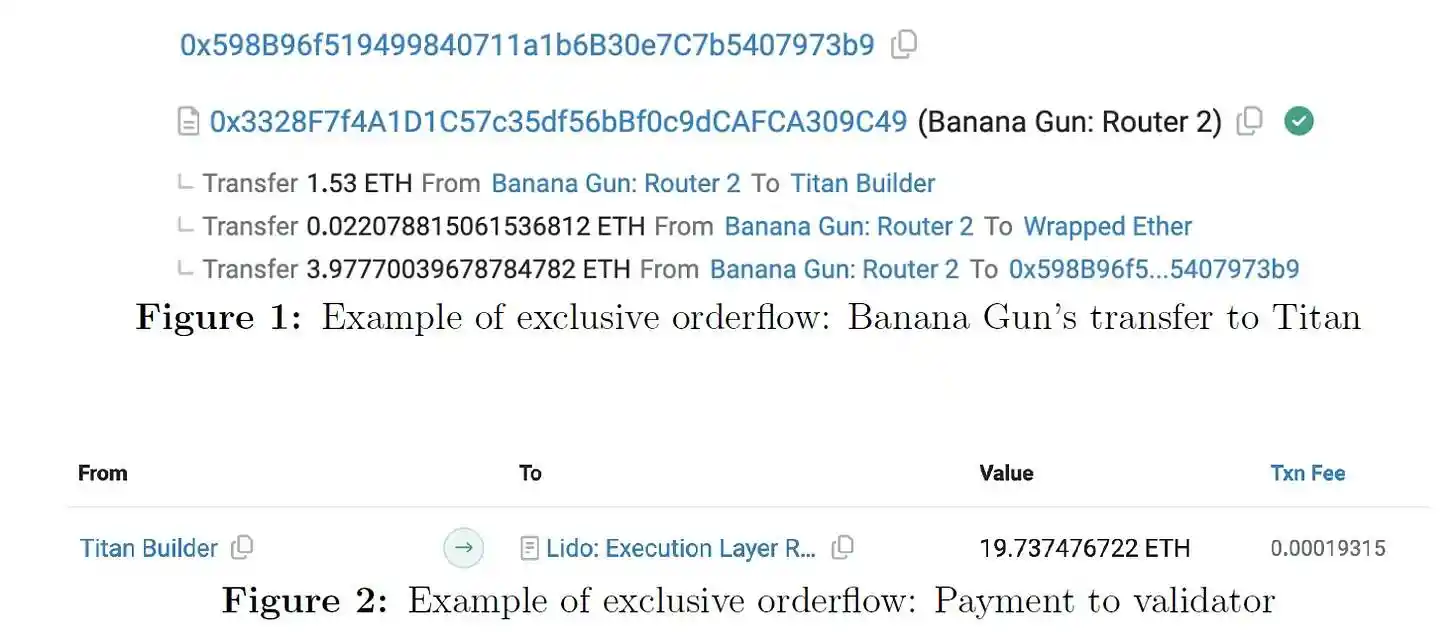
Source: Decentralized Monopoly Power in DeFi, Sarit Markovich
Sarit points out that in block 19728051, the proposer Lido only earned 19.75 ETH from the block, while Titan made a pure profit of 56.6 ETH through the EOF agreement with the Banana Gun team.
Sarit analyzed 181,651 blocks between April 6 and May 5, 2024. She looked at both Banana and Maestro, but the latter team is not relevant for this article because it has no tokens and does not promise any benefits or profits to token holders for staying invested in its ecosystem. Sarit reports that in her dataset, the total block value was 21,406 ETH, of which only 17,127 ETH was transferred to the Ethereum ecosystem through its proposers. Therefore, the proposers lost 4,279 ETH in this short period of time. Specifically, Lido did not receive 1,666 ETH in payments in a single month of this dataset.
This paper supports my initial calculations when reviewing over 3500 blocks on the Ethereum chain between December 2023 and March 2024, where the Banana block 0 bundle was almost exclusively routed through Titan Builder. This shows that of the total 4466.89 ETH paid by Banana users to get their sniped transactions on-chain, only 2915.65 ETH was transferred to Ethereum proposers, while 2271.26 ETH was exclusively taken by Titan Builder. Even assuming a 50-50 split of private EOFs between Banana and Titan, it can be inferred that 1135.63 ETH was sent back to the private accounts of the Banana Gun team during this period. These would be undeclared profits amounting to millions of dollars from innocent users who were led into a high bribery culture by the Banana Gun team.
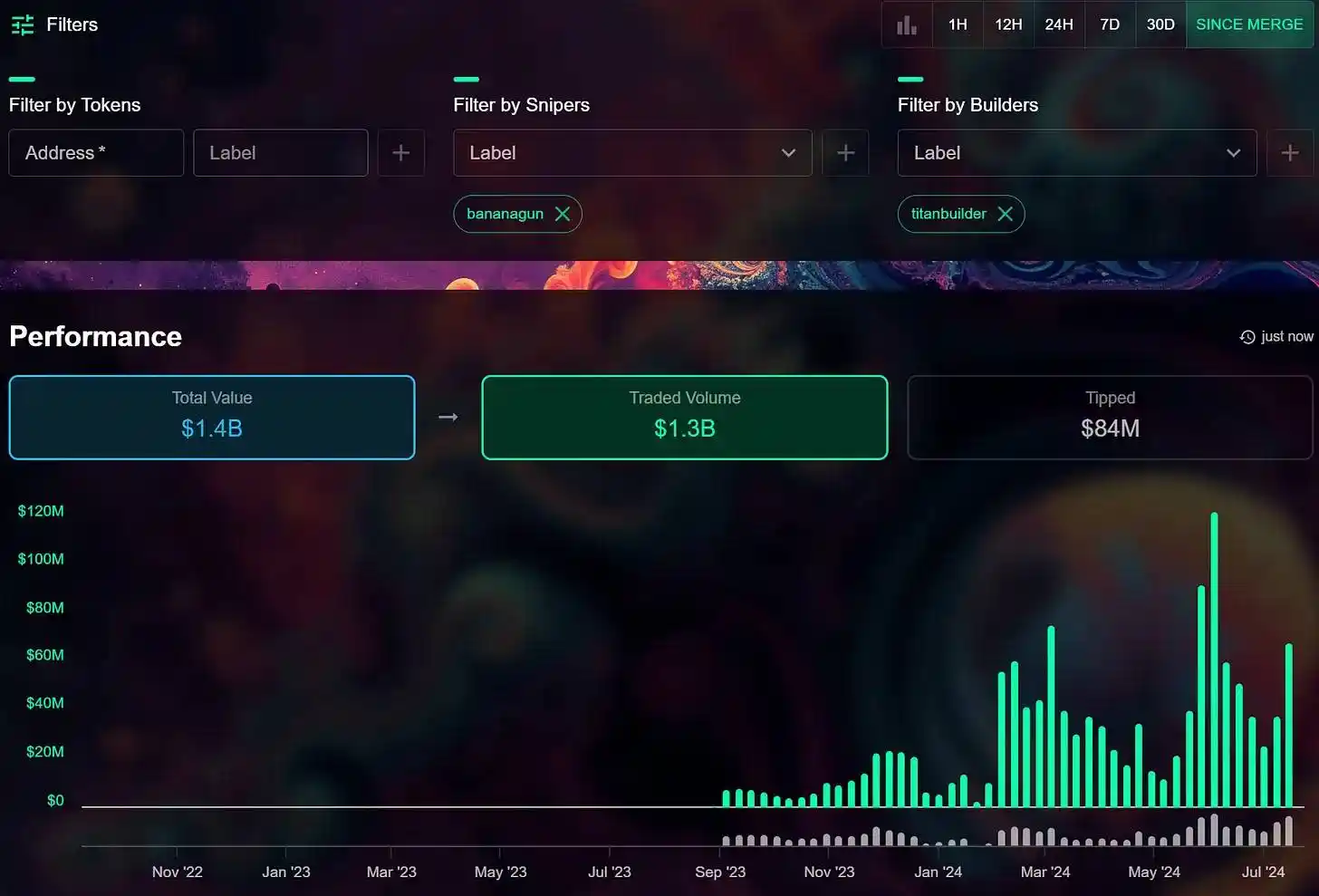
Source: libMEV
1. An undisclosed team with a questionable background;
2. Suspected of monitoring user transactions to front-run (using them as their own exit liquidity);
3. Now extracting millions from an apparent exclusive order flow arrangement, rather than paying it to Ethereum validators, or distributing it to $BANANA holders;
4. At the same time creating a worrying centralization effect, putting pressure on the entire PBS system that Ethereum operates on;
5. What’s more, the listing of $BANANA tokens on Binance has given their brand tremendous legitimacy in the eyes of the public.
So the monkey tricks continue.
Original link
Recommended
The Wall Street Journal: How is AI Trading Stealing the Limelight from Cryptocurrency?
Aug 15, 14:00
Tencent Still Has a Dream
Aug 15, 11:27
To Catch North Korean Hackers, They Set Up a Fake Project
Aug 15, 10:00
From Litigation to Settlement: Positive Signal Released by HTX's Negotiation with FCA
Aug 14, 19:32
11,742 Shipping Addresses Exposed Alongside Trezor Orders
Aug 14, 19:01
Founder Interview: FOMO Creator Explains How They Added 30,000 Users in One Day and Became One of the Fastest-Growing Crypto Apps
Aug 14, 18:37