Bloomberg: Global Stock Market Plunge Intensifies, Fueling Bond Rally

Original Title: Nasdaq Futures Sink as Global Stock Rout Deepens: Markets Wrap
Original Author: Robert Brand, Bloomberg
Original Translation: Tao Zhu, Golden Finance
On Monday, a global stock market sell-off intensified, with concerns growing that the Federal Reserve is falling behind the curve in supporting the U.S. economy's slowdown, prompting investors to flock to bond safe havens. The Japanese stock market plunged as traders bet domestic interest rates would rise further.
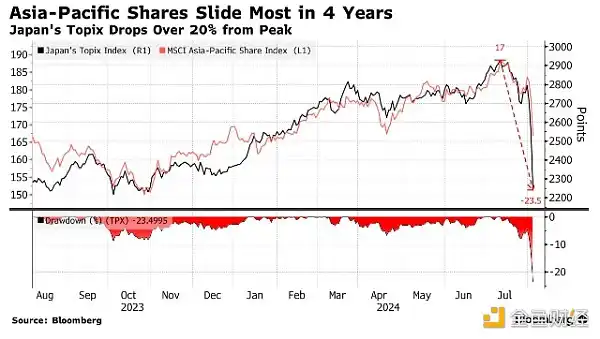
The TOPIX index and Nikkei index both fell more than 13%. Taiwan's benchmark index saw its worst day ever, while the Asia stock index posted its biggest drop in four years, with financial and industrial stocks being the biggest drags. European and U.S. stock futures also declined, while the yen rose more than 2.5% against the dollar.
Data released on Friday showed U.S. nonfarm payrolls posted one of the weakest readings since the pandemic, with the unemployment rate unexpectedly climbing above the Fed's year-end forecast, triggering recession watch indicators. Worries about the health of the U.S. economy pushed U.S. Treasury yields lower, and Asian investment-grade dollar bond spreads are set to see their biggest jump in 22 months.
Charu Chanana, head of FX strategy at Shing Bo Bank, said, "This is quite a dramatic shift signaling that recent trends have been heavily supported by expectations of a U.S. soft landing. The more questions raised about the U.S. soft landing assumption, the larger the potential pullback in equities and strategies funded in low-yielding currencies, as positions in these currencies are severely imbalanced."
Japan's benchmark 10-year bond yield fell to its lowest level since April, dropping 17 basis points on Monday. As the decline in bond yields threatens loan profitability, shares of the country's largest lender, Mitsubishi UFJ Financial Group Inc., saw their biggest intraday drop ever.
Since the end of the pandemic, bond traders have repeatedly misjudged rate movements, sometimes even experiencing bi-directional overshoots. Signs of a deteriorating U.S. economy have fueled demand for fixed income, with global bonds regaining ground this year.
The global stock market decline reflects concerns about economic prospects, geopolitical risks, and doubts about whether the massive investment in artificial intelligence can live up to the hype surrounding the technology. Goldman Sachs economists raised the chances of a U.S. economic recession next year from 15% to 25%, although they added there is reason not to be overly concerned about an economic downturn.
Berkshire Hathaway Inc. cut its stake in Apple Inc. by nearly 50%, part of a large-scale sell-off in the second quarter that also weighed on market sentiment.
Asian currencies rose, with the Malaysian ringgit leading the gains, while the Mexican peso's decline extended as traders continued to unwind emerging-market carry trades. The sudden appreciation of funding currencies like the yen and the renminbi undermined carry trades, which typically involve traders borrowing at low rates to invest in higher-yielding assets.
On other fronts, oil prices fluctuated near a seven-month low as broader financial market sell-offs offset escalating tensions in the Middle East. Israel is preparing to counter potential attacks from Iran and regional militias in retaliation for the assassination of Hezbollah and Hamas officials. On Monday, cryptocurrencies also took a hit amid global market risk-off sentiment.
With only three Federal Reserve meetings left, options pricing reflects a growing belief that the central bank may need to make an unusually large half-point adjustment at one meeting or take action between scheduled meetings—moving swiftly to support economic growth.
Nevertheless, large-scale policy moves and aggressive responses could signal an emergency, prompting more unease among traders. Goldman Sachs has raised the possibility of a recession next year from 15% to 25%.
Charlie Ripley of Allianz Investment Management said: "From the Fed's perspective, this doesn't mean they will hastily make policy decisions, but it should help them take off the rose-colored glasses when assessing policy decisions at the next meeting."
Michael Hartnett of Bank of America Corp. said that when the Fed first cuts rates, the stock market may decline as this shift will come with data indicating the U.S. economy is heading for a hard landing, not a soft one.
The Bank of America strategist wrote in a report that since 1970, rate cuts in response to economic weakness have had a negative effect on the stock market and a positive effect on bonds since the Fed began easing policy, citing seven instances to illustrate this pattern. Hartnett said, "A very important difference in 2024 is how far ahead risk assets are in anticipation of the Fed cutting rates."
Original Article Link
Recommended
The Wall Street Journal: How is AI Trading Stealing the Limelight from Cryptocurrency?
Aug 15, 14:00
Tencent Still Has a Dream
Aug 15, 11:27
To Catch North Korean Hackers, They Set Up a Fake Project
Aug 15, 10:00
From Litigation to Settlement: Positive Signal Released by HTX's Negotiation with FCA
Aug 14, 19:32
11,742 Shipping Addresses Exposed Alongside Trezor Orders
Aug 14, 19:01
Founder Interview: FOMO Creator Explains How They Added 30,000 Users in One Day and Became One of the Fastest-Growing Crypto Apps
Aug 14, 18:37