Facing a Market Crash: Six Tips to "Stay Calm and Carry On"

Original Article Title: "Facing a Sharp Decline, Six Tips to Help You 'Stay With the Green Mountains and Always Have Firewood to Burn'"
Original Article Authors: Viee, Biteye
“Be greedy when others are fearful” – having experienced yesterday, is now the right time to enter the market? Here are 6 pieces of advice from an old leek:
· Bottom-fishing Formula for This Bull Market: Mainstream Coin + Mainstream Meme
· Avoid Touching Contracts
· Set Stop Losses Timely, Here are a few stop-loss strategies
· Bottom-fish in Stages
· Avoid Overly Diversified Positions
· Hold an Adequate Amount of Stablecoins
When the market experiences a sharp decline or a major correction, it usually brings the best "super bottom" opportunity, but it is recommended to bottom fish in stages and not go all in. Additionally, it is recommended to bottom fish in mainstream coins + mainstream memes.
Meme Coin Bottom-fishing Strategy: For meme coins with large trading volumes and sustained popularity, they typically follow a relatively predictable pattern.
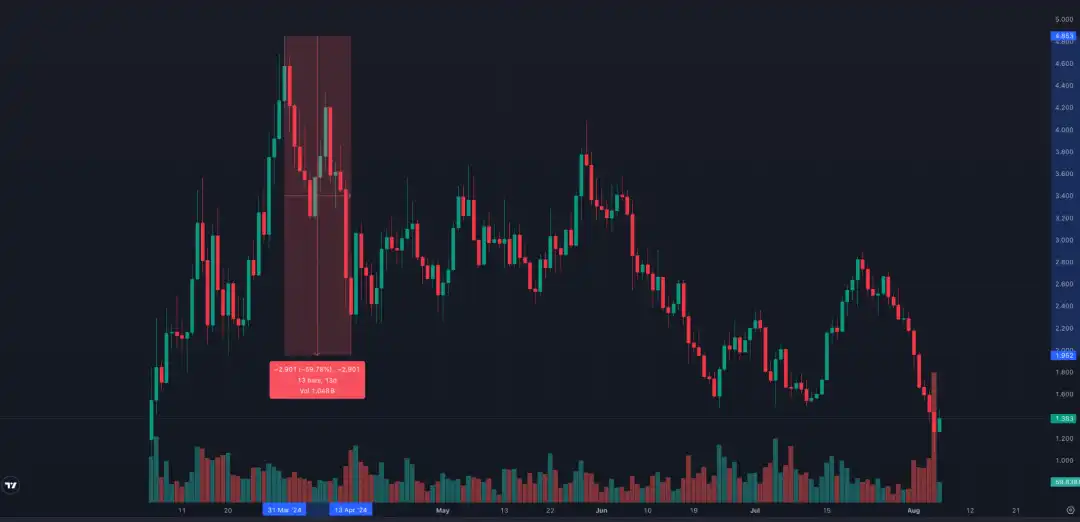
Whenever such tokens reach an all-time high (ATH), their pullback percentage is likely not to exceed 60%. This means that you may consider strategically buying in at the following times:
· When the token retraces from ATH by 40% to 60%
· When the trading volume remains at a high level
· When market discussions about the token are still active
Using WIF as an example, the maximum retracement after ATH is around 59%. This strategy leverages the meme coin's volatility and market sentiment.
However, there are still risks; memes rise fast and fall fast. Careful operation is needed, combined with other technical analysis and market research to make decisions.
The reason is simple: liquidation will leave you with nothing. Coincidentally, today, Synthetix's former CFO, SynthaMan, revealed in a tweet that he had lost all his SNX tokens due to being liquidated in a margin call.
Secondly, while being able to hold through tough times can be satisfying, funding rates are often an overlooked cost. Lastly, contracts have a negative impact on emotions and psychology, further affecting trading operations.
If a position falls below a key support level or no longer fits your investment thesis, do not hesitate to sell to protect your capital.
Instead of risking a major loss, it's better to accept a small loss. When the market conditions improve, you can re-enter the market. It is important to implement risk control when the market starts to decline, rather than waiting until the decline deepens to take action.
Especially when trading highly volatile "shitcoins," choosing the wrong timing and strategy often leads to significant losses, even the possibility of going to zero.
Specifically:
· Quick Stop Loss: If the market shows an unfavorable trend, take swift action and accept a small loss. For example, accepting a 5% loss is not terrifying.
· Set Partial Stop Loss Points: You don't have to liquidate your entire position at a single price point; instead, you can set multiple price points to reduce a certain percentage of your position at each point. For example, if Bitcoin falls below $60,000, you can choose to sell 10% of your position.
· Flexibly Look for Entry Points: If the market truly reverses, you can buy again when the support level is reconfirmed. If the market continues to fall, re-enter at a lower price to get a better entry price. Although this incurs some trading costs, it effectively controls risk.
In summary, incurring a 5% small loss to avoid a potential 50% major drop is a smarter approach.
Going all-in on a dip may backfire; you can combine technical and fundamental analysis, set several possible entry points, such as historical support levels or key moving average positions.
When the price touches these predetermined points, start buying in batches and gradually reduce the purchase amount in a "pyramid" manner, while setting stop loss points for each purchase to control risk. Adjust the strategy promptly as the market changes.
Concentrate investments in 10 (up to a maximum of 20) tokens you approve of, rather than spreading the portfolio across too many tokens, making it easier to actively manage investments during market fluctuations.
The more types of tokens you transact with, the greater the risk of loss. Over diversification can lower the overall performance of the portfolio because it is difficult to effectively manage too many positions, especially avoid holding too many altcoin positions.
Keep at least 20% of your portfolio in stablecoins, which can serve as the "bullets" to seize opportunities in a downturn without being forced to sell existing positions at an inappropriate time.
Even when the market is rising, holding a certain percentage of stablecoins can provide you with enough liquidity to operate during a market pullback.
If you can't remember the above investment rules, just remember to preserve your capital and survive first. This is the most, most, most important thing!
Original Article Link
Recommended
The Wall Street Journal: How is AI Trading Stealing the Limelight from Cryptocurrency?
Aug 15, 14:00
Tencent Still Has a Dream
Aug 15, 11:27
To Catch North Korean Hackers, They Set Up a Fake Project
Aug 15, 10:00
From Litigation to Settlement: Positive Signal Released by HTX's Negotiation with FCA
Aug 14, 19:32
11,742 Shipping Addresses Exposed Alongside Trezor Orders
Aug 14, 19:01
Founder Interview: FOMO Creator Explains How They Added 30,000 Users in One Day and Became One of the Fastest-Growing Crypto Apps
Aug 14, 18:37