Rate Cut Incoming, Will the Bull Market Continue?

Original Title: "Rate Cut Is Here, How Far Can the Bull Market Go?"
Original Authors: Viee, Biteye
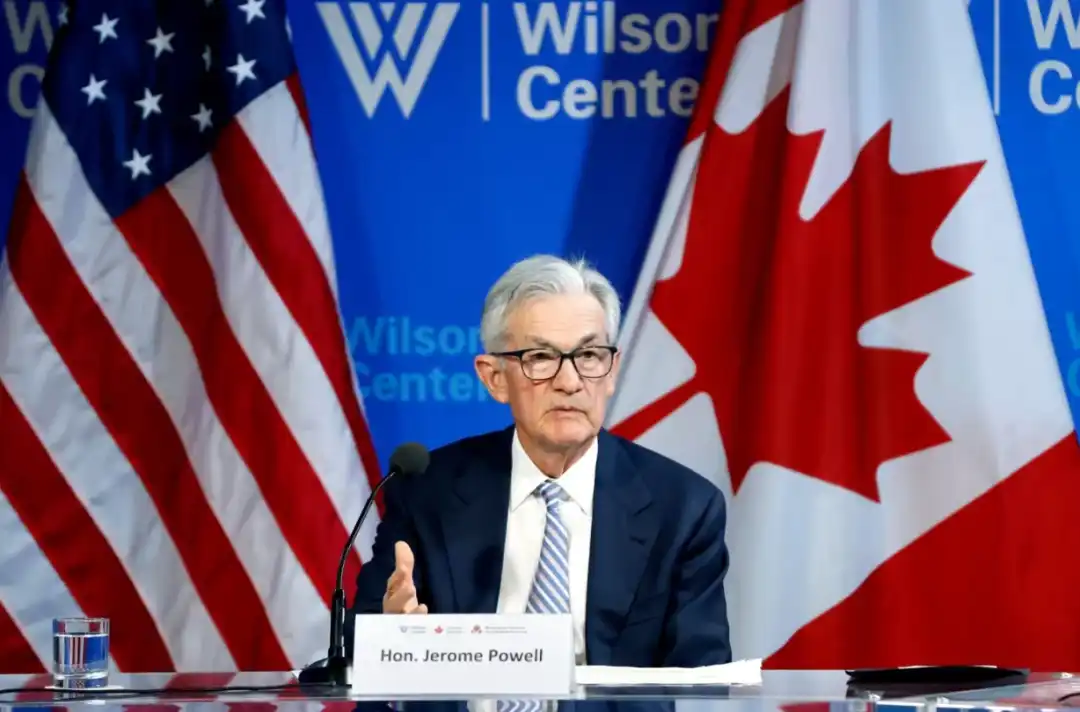
Federal Reserve Chairman Powell recently stated that "it's time to adjust the policy," hinting at an upcoming rate cut. Will a Fed rate cut definitely boost Bitcoin's price?
Will the crypto market definitely benefit from a rate cut?
This article will delve into this issue, analyzing how a Fed rate cut affects Bitcoin price increases, and the risks that need to be noted.
The main purpose of a Fed rate cut is to lower borrowing costs and stimulate economic activity. In recent years, factors such as inflation pressure, global trade tensions, and the COVID-19 pandemic have made the Federal Reserve more cautious in monetary policy. Rate cuts usually occur when economic growth is slowing or facing recession risks. To understand this, we need to grasp the following two concepts:
· Economic Slowdown: When economic growth slows, business and consumer confidence weakens, and investment and consumption intentions wane. The Fed lowers interest rates to reduce borrowing costs, encourage investment and consumption, thus driving economic recovery.
· Inflation Expectations: A rate cut may lead to an increase in inflation expectations. When facing inflation risks, investors often seek inflation-resistant assets, such as Bitcoin and other cryptocurrencies.
Historical data shows that Fed rate cuts usually help drive Bitcoin price increases.
The reason is simple: rate cuts reduce the cost of capital, incentivizing investors to put funds into high-risk, high-return assets, such as Bitcoin.
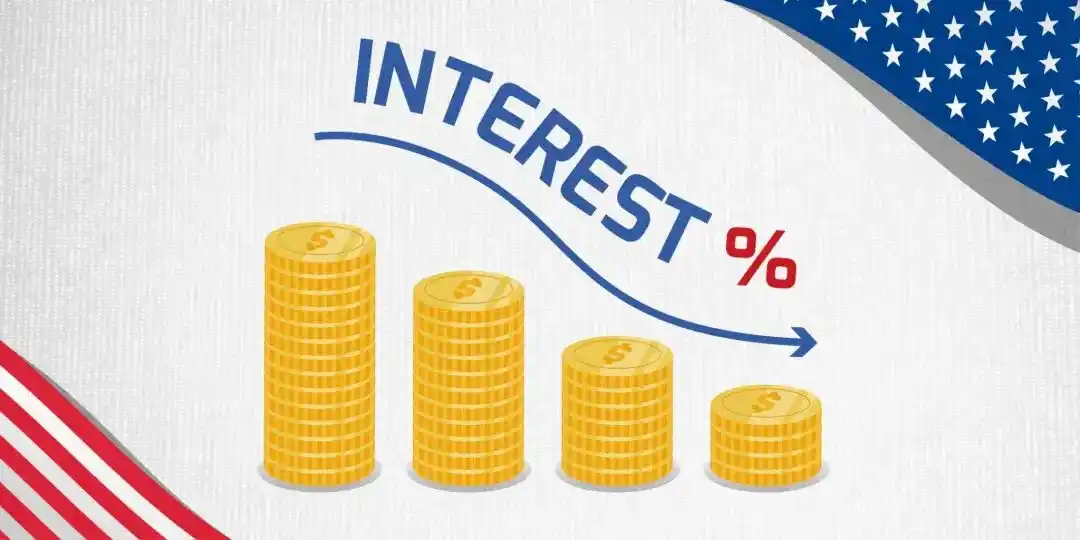
Therefore, the bullish factors of a rate cut on Bitcoin mainly include:
· Investment Stimulus: Investors in a low-interest-rate environment often seek higher returns, driving Bitcoin's price up.
· Improved Market Sentiment: Rate cuts aimed at stimulating economic growth promote economic recovery and convey a positive policy signal from the Fed. This prompts investors to be more willing to take risks, leading to more funds flowing into Bitcoin.
· Boosting Bitcoin's Inflation Hedge Feature: A rate cut may cause a decrease in traditional safe-haven asset yields, an increase in inflation expectations, making Bitcoin's inflation-resistant feature more prominent. Many investors may view Bitcoin as an inflation hedge tool, thereby driving its demand and price up.
· Increased Market Liquidity: Interest rate cuts resulting in monetary policy easing have increased market liquidity, making it easier for investors to enter the market and driving up the price of Bitcoin.
First, let's review the recent interest rate cut/hike cycles.
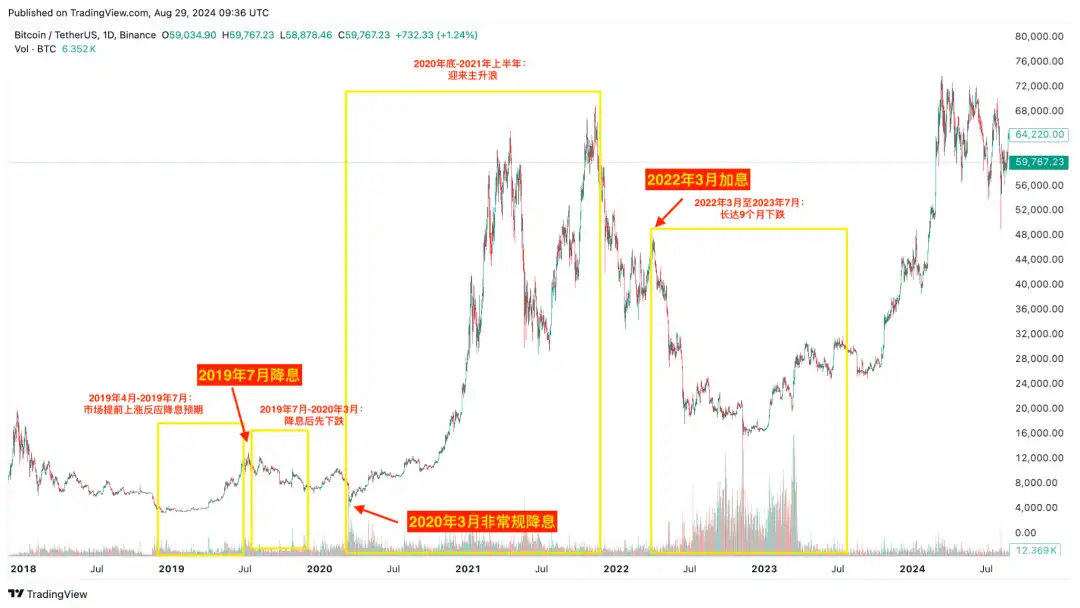
From December 2018 to July 2019, during this period, the price of BTC experienced a rise from $3,000 to $13,000. The Fed started cutting interest rates in July 2019, but the market had already started pricing in the rate cut as early as April 2019.
From July 2019 to March 2020, despite the Fed's rate cuts, the price of Bitcoin initially fell and then rose. After the rate cut, the price dropped from $13,000 to $7,000, a decrease of over 30%. The price fluctuation during this period reflected different market interpretations of the rate cut, showing that rate cuts do not always immediately lead to a positive market response.
In March 2020, due to the impact of the COVID-19 pandemic, the Fed swiftly cut rates and initiated large-scale quantitative easing. The market responded with a slight lag, leading to a major uptrend from the end of 2020 to the beginning of 2021. During this cycle, the price of Bitcoin rose from $3,000 to $65,000.
During the rate hike cycle from March 2022 to July 2023, the price of Bitcoin dropped from a low of $45,000 to $15,000, experiencing a prolonged 9-month decline. The performance during this period indicated that the market is more sensitive to rate hikes, and the expectation of a rate cut did not manifest until after the price recovery.
Therefore, based on historical cases, the market's response to rate cuts may lead or lag, with most situations favoring a Bitcoin uptrend. It is important to note that in rare cases, the market may face selling pressure leading to a decline, potentially resulting in an initial drop followed by a rise.
If a rate cut is seen as a sign of an economic recession, the market may feel pessimistic about future economic prospects. In this scenario, investors may choose safe-haven assets other than Bitcoin. Despite Bitcoin being considered digital gold, during an economic downturn, investors may prefer traditional safe-haven assets like gold, leading to a decrease in Bitcoin demand. Furthermore, regulatory policy uncertainty and significant black swan events can also affect the impact of rate cuts. These situations could all contribute to downward pressure on the market.
With the launch of a spot ETF, the impact of USD liquidity on the crypto market will become more apparent, but the effect of Fed rate cuts on Bitcoin price is complex.
The market's response to rate cuts may be anticipatory or lagging and influenced by various factors. It is important to note that in certain situations, such as concerns about economic recession, regulatory uncertainty, market sentiment reversal, etc., Bitcoin may face some selling pressure.
Moreover, while the Fed's monetary policy is a crucial factor affecting Bitcoin price, it is not the only one. Therefore, close attention should be paid to various market factors in order to make informed investment decisions.
Recommended
The Wall Street Journal: How is AI Trading Stealing the Limelight from Cryptocurrency?
Aug 15, 14:00
Tencent Still Has a Dream
Aug 15, 11:27
To Catch North Korean Hackers, They Set Up a Fake Project
Aug 15, 10:00
From Litigation to Settlement: Positive Signal Released by HTX's Negotiation with FCA
Aug 14, 19:32
11,742 Shipping Addresses Exposed Alongside Trezor Orders
Aug 14, 19:01
Founder Interview: FOMO Creator Explains How They Added 30,000 Users in One Day and Became One of the Fastest-Growing Crypto Apps
Aug 14, 18:37