How Much Is a Bitcoin Actually Worth? Unveiling Four Key Valuation Methods

Original Article Title: "Bitcoin Worth $200,000? 4 Valuation Studies"
Original Article Author: Viee, Biteye Core Contributor
Recently, BTC dropped to around $56,000 amid volatility, while in July, U.S. asset management firm VanEck predicted that by 2050, BTC's price could reach $2.9 million, a truly staggering figure by comparison.
So, what should be the fair price of Bitcoin? $0, $50,000, $1 million, or even higher? In this article, Biteye will explore 4 Bitcoin valuation methods to help everyone gain a more comprehensive understanding of Bitcoin's value.

Traditional assets such as stocks and bonds have established multiple mature and effective valuation methods. However, evaluating the value of Bitcoin faces more challenges, and there is currently no single valuation method that is clearly superior to others. Here are 4 relatively common Bitcoin valuation methods: Cost of Production Model, Stock-to-Flow Model, Metcalfe's Law, and AHR999 HODLer Index.
· Cost of Production Model: Mining not only consumes a significant amount of electricity but also other resources, so the mining cost can be considered the fundamental value of Bitcoin.
· Stock-to-Flow Model: A higher stock-to-flow ratio usually means a higher scarcity of Bitcoin, which may drive its price up.
· Metcalfe's Law: This theory emphasizes that the impact of the increase in the number of network users on value growth is exponential.
· AHR999 HODLer Index: Created by Weibo user ahr999, it assists Bitcoin HODLers in making investment decisions by combining a timing strategy.
Unlike fiat currencies like the Euro or the Dollar, which have almost no cost of production, Bitcoin is generated through a complex mining process. Therefore, the production cost of Bitcoin mainly refers to the mining cost.
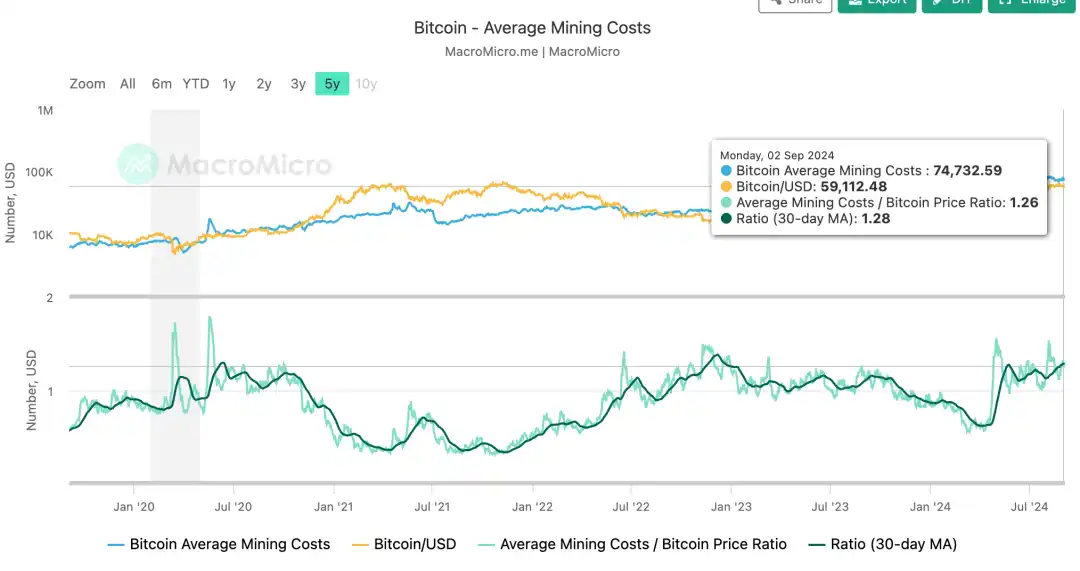
In the long run, the cost of mining one Bitcoin is usually close to the market price of Bitcoin. The mining cost can be considered the floor price of Bitcoin, as historically, the price of Bitcoin has rarely stayed below the mining cost for long periods. This phenomenon is partially due to the correlation between the price of Bitcoin and the total computational power used for mining (hash rate), as well as the impact of the mining competitive environment, where less efficient miners are often forced to shut down operations. The following chart shows Bitcoin's average mining cost:
Data Source: https://en.macromicro.me/charts/29435/bitcoin-production-total-cost
According to data from the MacroMicro website, as of September 2, 2024, the average mining cost of one Bitcoin is approximately $74,000, which is also the estimated value of Bitcoin calculated based on a production cost model.
Since the current price of Bitcoin is below this mining cost (estimated value calculated based on the production cost model), this means that one of the following two scenarios may occur in the near future: either a reduction in the number of miners or an increase in the price of Bitcoin above the mining cost level.
The Stock-to-Flow model, also known as S2F, is a method commonly used to evaluate the value of commodities. Specifically, "stock" refers to the current total supply of an asset, while "flow" is the annual new supply.
A higher stock/flow ratio indicates greater scarcity because it takes longer to reach the current stock level. For example, if a commodity's stock is 100 times its flow, it would take 100 years to replenish the current stock. In contrast, if a commodity's stock is only 10 times its flow, it is less scarce because it would only take 10 years to replenish the current stock. Therefore, the Stock-to-Flow model provides us with a simple and effective way to measure the scarcity of a commodity. This scarcity is an important factor influencing price.
Bitcoin's Stock-to-Flow Ratio
As of August 2024, the current circulating supply of Bitcoin is approximately 19,750,000 (stock), with miners currently receiving 3.125 Bitcoins per block, one block mined every ten minutes, resulting in an annual output of about 164,359 BTC. Therefore, Bitcoin's Stock-to-Flow ratio is:
19,750,000 / 164,359 ≈ 120.1
This ratio indicates that at the current growth rate (flow), it would take approximately 120 years to reach the current circulation supply (stock).
Next, let's take a look at the world's most important reserve asset—gold. Based on data from the World Gold Council in 2023, gold's Stock-to-Flow ratio is:
209000 / 3500 ≈ 59.7
As mentioned earlier, a higher stock-to-flow ratio implies a higher scarcity of the asset. Therefore, according to the stock-to-flow model, Bitcoin's scarcity is approximately twice that of gold!
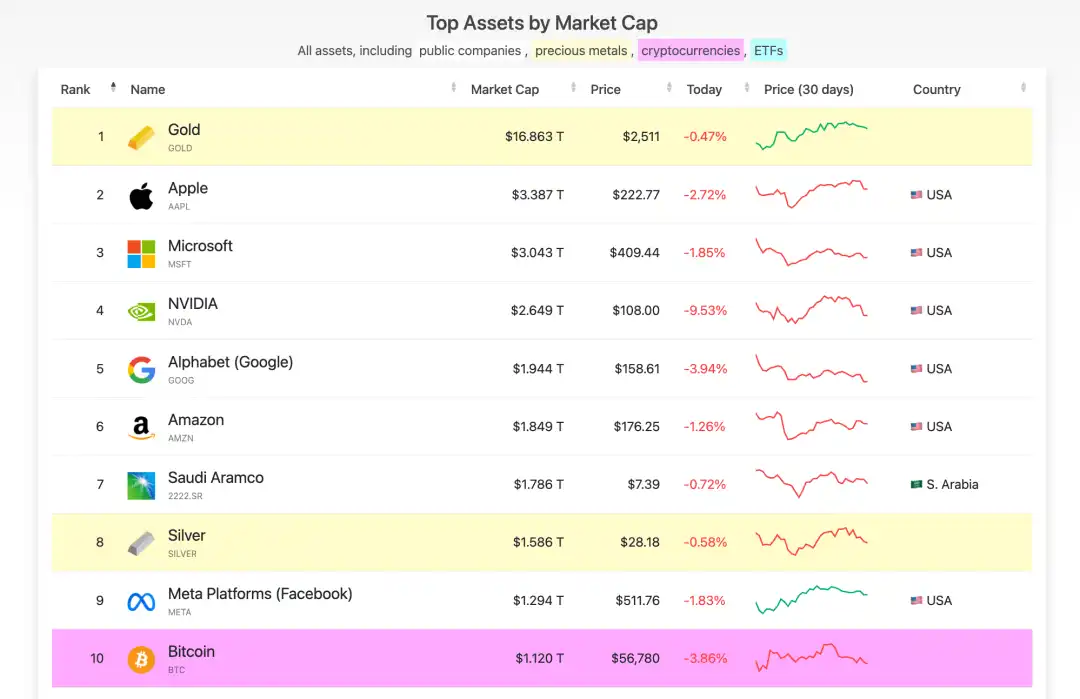
However, in August 2024, the total market value of gold is around $16.8 trillion, while the total market value of Bitcoin is around $1.1 trillion, making the latter only one-sixteenth of the former.
Data Source: https://companiesmarketcap.com/assets-by-market-cap/
Therefore, based on the stock-to-flow model calculation, with Bitcoin's scarcity being twice that of gold, if we bluntly consider Bitcoin's market value to be twice that of gold as well, the result would be $33.6 trillion. Consequently, the Bitcoin valuation would reach an astonishing $170.8 million, which is 30.5 times its current value.
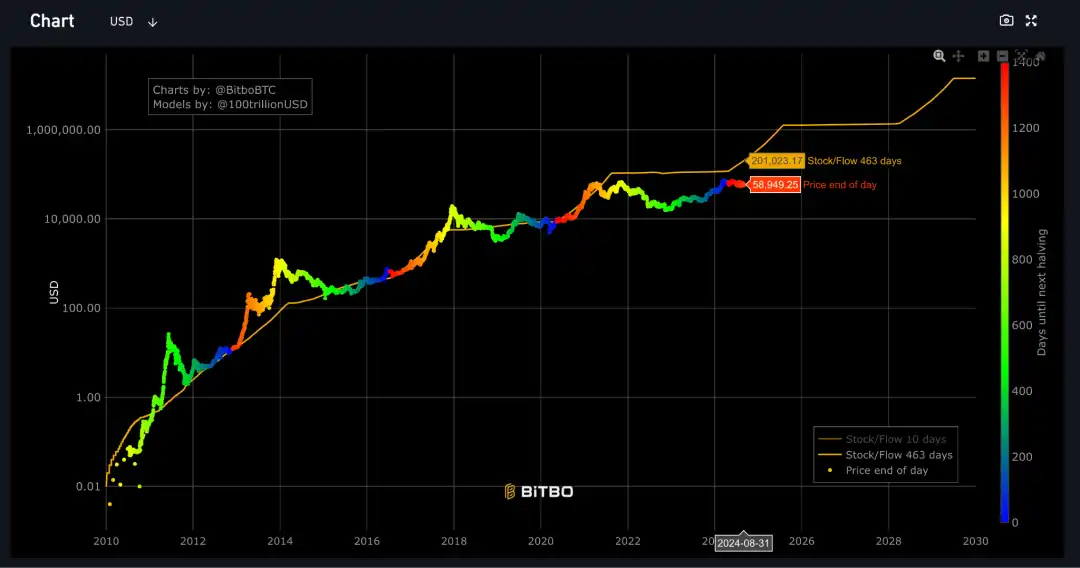
Of course, such a calculation lacks a certain basis, as scarcity cannot be quantified. Hence, we can also refer to the "Bitcoin Stock-to-Flow Ratio Real-Time Chart," which provides a more detailed calculation of Bitcoin valuation. In the chart below, the yellow line represents the model-calculated Bitcoin price, while the colored line represents Bitcoin's actual market price. It is essential to note that since 2022, this indicator has shown a deviation, with the model-predicted price consistently higher than Bitcoin's actual price. This is for reference only.
According to the "Bitcoin Stock-to-Flow Ratio Real-Time Chart," Bitcoin's current valuation should be $210,000.
Data Source: https://charts.bitbo.io/stock-to-flow/
Metcalfe's Law is primarily used to assess the value of communication networks but is also applicable to blockchain technology (such as Bitcoin).
According to this theory, the more users a network or technology has, the greater its attractiveness and value, and the network's value is proportional to the square of the number of users. For example, if a network has 10 users, then the network's value is proportional to the square of the number of users, i.e., 10 * 10 = 100. If the number of users increases to 20, the network's value will increase to 20 * 20 = 400. This indicates that the network's value grows exponentially with each new user's addition, rather than linearly.
As of September 4, 2024, the number of Bitcoin addresses has doubled in the past 5 years from around 26 million to 54 million, approximately a 2.076x increase. According to Metcalfe's Law, the square of Bitcoin's user growth is proportional to the market value change. Therefore, Bitcoin's market value should be 4.3x that of 5 years ago, with one Bitcoin now valued at around $41,000.
This index implies the short-term dollar-cost averaging yield of Bitcoin and the deviation of Bitcoin price from the expected valuation.
When the ahr999 index < 0.45, it's a good time to buy the dip;
When ahr999 is between 0.45-1.2, it's suitable for dollar-cost averaging;
When ahr999 > 1.2, the price is relatively high, not suitable for trading.
In the long term, Bitcoin's price shows a certain positive correlation with block height. By leveraging the advantages of dollar-cost averaging, users can control the short-term investment cost to mostly be below the Bitcoin price.

ahr999 Index = (Bitcoin Price/200 Day DCA Cost) * (Bitcoin Price/Index Growth Valuation)
Calculated based on the September 4 Bitcoin price of $57,481.9:
0.6 = ($57,481.9/ $63,570.07) * ($57,481.9/Index Growth Valuation)
It follows that the BTC Index Growth Valuation is $86,628.
Although this index growth valuation fluctuates daily, currently Bitcoin seems to be at almost $80,000 or above.
These valuation methods each have their own characteristics, helping us to more comprehensively understand Bitcoin's value. However, the ultimate price movement of Bitcoin still requires time to observe and validate, so it is prudent not to solely rely on this as investment advice.
Risk Reminder: Cryptographic assets carry high risks. The above is for information sharing only and not investment advice. Readers should comply with local laws and regulations.
Recommended
The Wall Street Journal: How is AI Trading Stealing the Limelight from Cryptocurrency?
Aug 15, 14:00
Tencent Still Has a Dream
Aug 15, 11:27
To Catch North Korean Hackers, They Set Up a Fake Project
Aug 15, 10:00
From Litigation to Settlement: Positive Signal Released by HTX's Negotiation with FCA
Aug 14, 19:32
11,742 Shipping Addresses Exposed Alongside Trezor Orders
Aug 14, 19:01
Founder Interview: FOMO Creator Explains How They Added 30,000 Users in One Day and Became One of the Fastest-Growing Crypto Apps
Aug 14, 18:37