Bitcoin hot money revolution: How do Web3 applications leverage the $240 billion market?

Article author: Chase
Article translation: Blcok unicorn

Bitcoin was born as a digital currency in 2008, initially for payment purposes, and over time it evolved into a store of value. With the rise of retail-focused Layer-1 and Ethereum Layer-2, Bitcoin's utility is facing a time of disruption. There is currently $240 billion in Bitcoin "hot money" (3.4 times the total locked volume of the entire Ethereum ecosystem) to capture and build on.
It is often believed that Bitcoin is more adopted by institutions than Ethereum. However, data shows this is not the case, and Bitcoin is primarily driven by individual investors, with 57% of the supply held by individuals and only 9.7% held by institutions (including miners). My definition of "individual investors" is non-professional investors and individuals who are more likely to be converted to Bitcoin application users due to the speculative nature of the new market.
There is currently $240 billion of "hot money" in centralized exchanges (CEX) and ETFs, which represents a huge opportunity to capture value by building a programmable layer on Bitcoin. In contrast, Ethereum hot money on CEX totals $76 billion. CEX capital is a good indicator of "hot money" because "cold money" is usually stored in cold wallets as long-term capital. ETFs can also be considered hot money, as both BlackRock and VanEck have stated that more than 80% of ETF inflows come from non-professional investors using online brokerage accounts. In the hypothetical downside scenario, even if it is reduced by 50%, there is still $120 billion of Bitcoin hot money that can be deployed. As a result, a large amount of individual investor capital can be deployed into Bitcoin native Dapps.
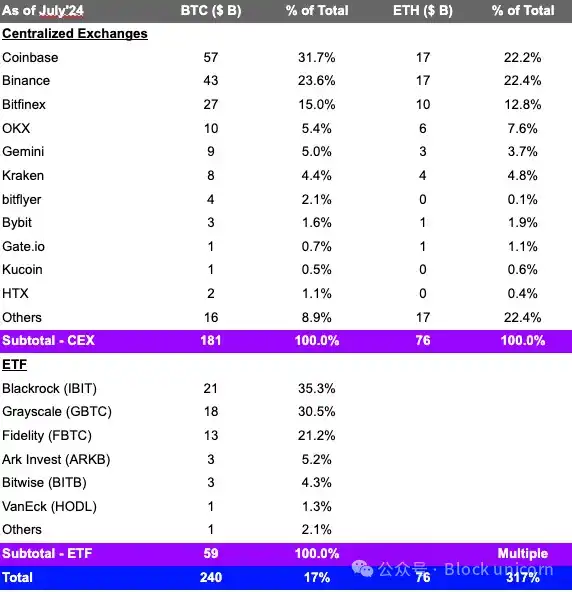
Number of Bitcoins on CEX and ETFs
Bitcoin is the most widely distributed digital asset in the world, with over 460 million unique wallets. Since the advent of Ordinals and inscriptions, demand for Bitcoin has increased significantly. On December 19, 2022, Bitcoin's Dick Butt (pictured above) became the first inscription to be inscribed on Bitcoin. Since then, Bitcoin's mempool utilization has averaged over 50% (pictured below), much higher than before, even reaching twice the 2021 bull cycle. This shows that demand for Bitcoin block space is very strong, but it has also caused transaction fees to rise to the point where it is difficult for ordinary users to use the chain.

Bitcoin memory pool usage
Bitcoin hot money increased by 23% between January and July 2024, during which time the supply of Bitcoin on CEX decreased from 2.9 million to 2.7 million, while the supply of Bitcoin in ETFs increased to 890,000, resulting in a net increase of 680,000 Bitcoins. According to statistics on ETF holders and CEX hot money flows, this was mainly driven by individual investor capital.
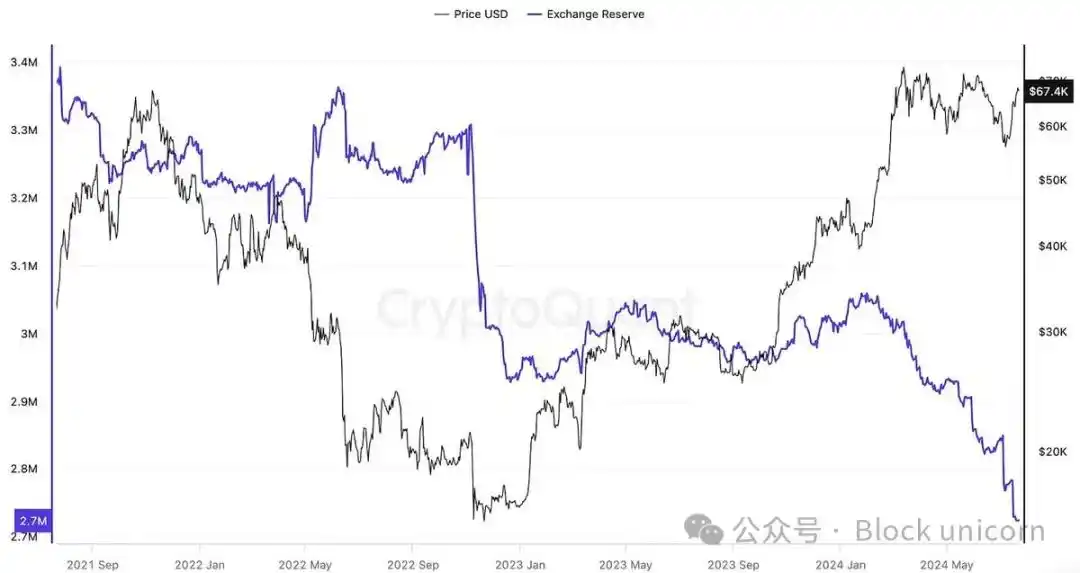
Bitcoin on Centralized Exchanges
Bitcoin may be at the beginning of a speculative cycle, which was first triggered by Ordinals, with cumulative trading volume reaching $117 billion. Combined with Bitcoin-native Dapps and $240 billion in hot money, Bitcoin's speculative cycle will inevitably be longer and larger than the cycle experienced by Ethereum LRTs and Solana DeFi in early 2024. In addition, Bitcoin's individual investor adoption in terms of utility has just begun. According to research, 57% of Bitcoin is held by individuals, and only 3.4% is held by miners who usually sell mined Bitcoin for profit.
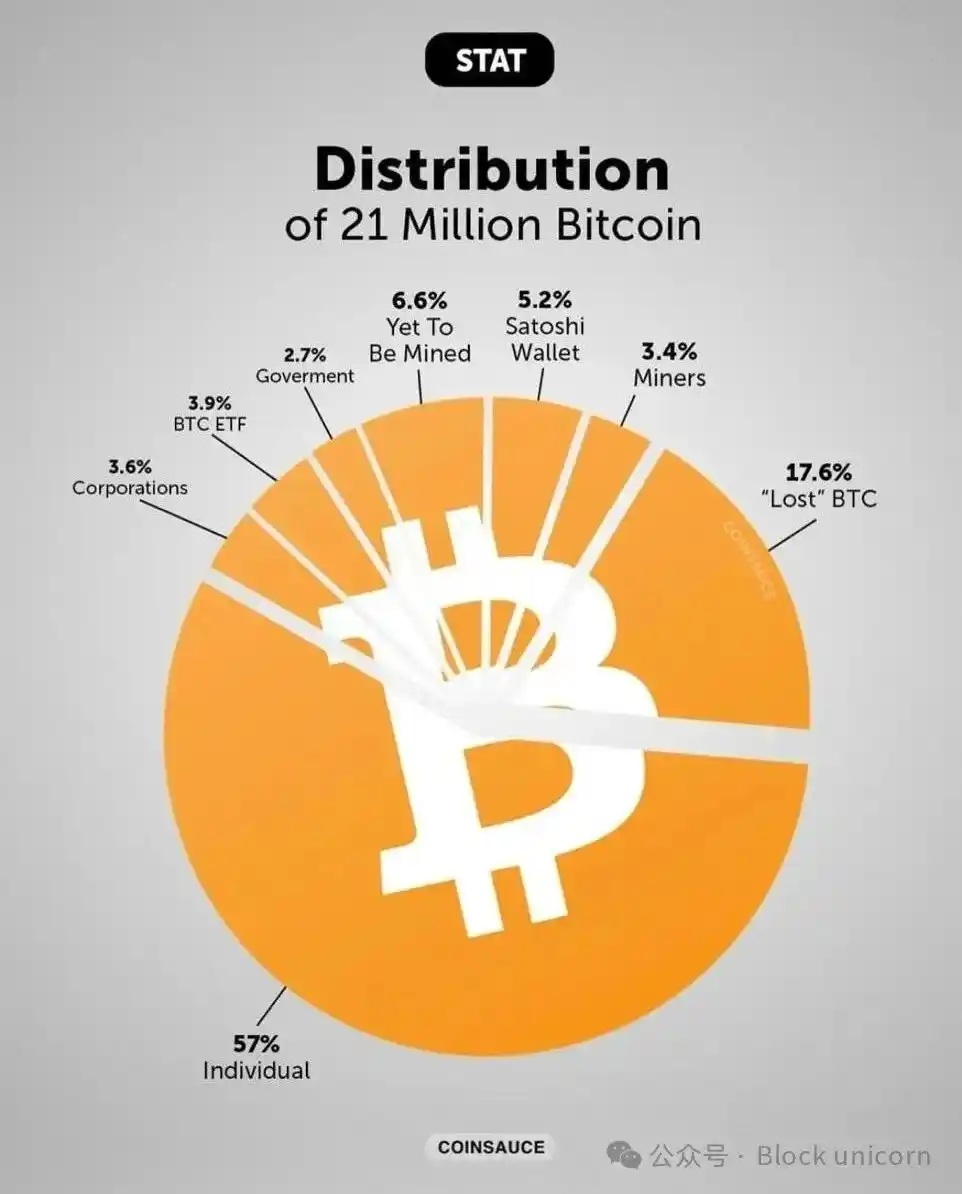
Bitcoin Distribution
Most current scaling solutions cannot effectively serve Bitcoin’s large base of individual investors because they are either slow and costly or focused on institutions. For example, @Stacks, one of the earliest Bitcoin sidechains, still takes 30 minutes to complete transactions after the Nakamoto upgrade. @Lightspark is building a business-to-consumer payment solution based on the Lightning Network, focusing more on merchant and institutional adoption rather than existing individual investor needs, and these solutions are still early in Bitcoin’s adoption cycle. In the future, we may even see high-fidelity DeFi, such as Bitcoin open order book exchanges, perpetual protocols, and prediction markets.
A successful example of a Bitcoin hot money application is @Bounce_bit, a protocol focused on CEX hot money yields, which has reached $1 billion in Bitcoin TVL within six months of its launch. This shows that there is a strong demand among CEX users to leverage Bitcoin.
Bitcoin is the largest and most widely distributed digital asset, and therefore has the strongest network effect in Web3. Bitcoin hot money is 3.4 times the TVL of the Ethereum ecosystem. We may be witnessing the birth of a new global Internet computer.
Since 2019, Ethereum sidechains such as Wanchain, Neo, and Ziliqa have been created as alternative solutions. At their peak, there were more than 700 PoS and EVM sidechains. However, due to technical and economic limitations, these sidechains have not been able to effectively leverage Ethereum's network effects and have been unable to successfully attract and retain developers.
In contrast, @Optimism and @Arbitrum focused on Ethereum’s network effects and worked closely with Ethereum to scale its base layer. As a result, they have been more successful than EVM sidechains and have become the leading scaling solutions. A similar trend is also happening in the Bitcoin ecosystem, where multiple sidechains are being created. If history is any guide, the real winners in the Bitcoin ecosystem are likely to be those scaling solutions that align economics, security, and incentives with Bitcoin. This means native Bitcoin gas (Bitcoin can be used as a fee payment), state validation by any Bitcoin full node, and unilateral asset exits to the Bitcoin base layer.
Bitcoin’s hot money as a percentage of total value is similar to Ethereum’s total TVL, which can be unlocked by implementing programmability on Bitcoin. Ethereum L1 and L2’s combined TVL is $71 billion, or 17% of Ethereum’s total value. Unlike Ethereum, Bitcoin's hot money is mostly underutilized, mainly stored in CEX and ETFs. There is reason to believe that financial instruments native to Bitcoin can significantly increase its utilization.
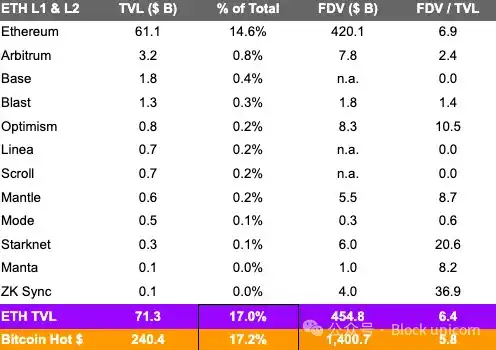
Comparison of Bitcoin and Ethereum's hot wallets
1. Bitcoin's positioning as digital gold is difficult to change, resulting in low utilization of scaling solutions.
Mitigation: The narrative is driven by demand, and existing data shows that there is excess demand from individual investors for Bitcoin. Bitcoin's positioning as digital gold may be misleading. Historically, Bitcoin's price fluctuations have not been correlated with gold prices (see figure below), but have been highly correlated with technology stocks. This suggests that the market prefers to view Bitcoin as a technological innovation rather than a store of value. Bitcoin's roots also indicate future programmability, as it was originally created as a utility token for payments.
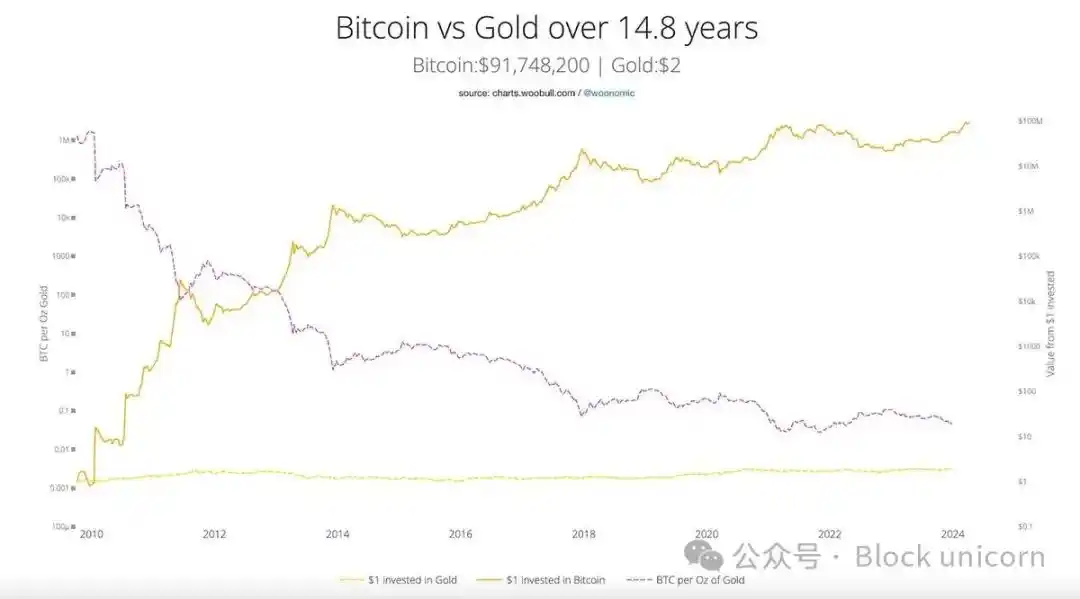
Price comparison of Bitcoin and gold
2. Bitcoin will be mainly oriented to institutions and serve as a decentralized payment settlement layer, and Bitcoin-native applications such as DeFi will find it difficult to rise.
Mitigation: There is $240 billion of hot money in Bitcoin on CEX and ETFs. Referring to the Ethereum ecosystem, the historical utilization of ETH has increased with the increase in the number of applications.
3. Retail users are reluctant to spend Bitcoin.
Mitigation: Smart contracts through scaling solutions can unlock Bitcoin and make it a global digital currency, not just a digital asset. Before the DeFi summer in 2020, Ethereum had low utility and TVL was less than $1 billion. But with the rise of DeFi, TVL grew to $100 billion in November 2021.
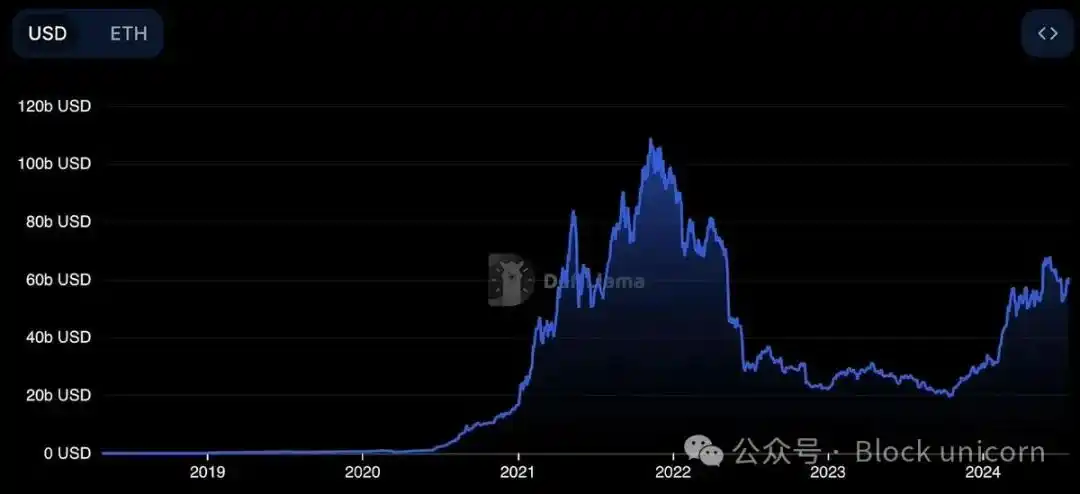
In the next 6-12 months, the following catalysts may allow us to reproduce Ethereum's "DeFi summer" phenomenon on Bitcoin:
1. OP_CAT (technical): New opcodes in the Bitcoin programming language enable verification and trustless bridging of zero-knowledge proofs, which is the missing component to create a Bitcoin native scaling solution. In addition, covenants and vaults will also improve the utility of Bitcoin. This upgrade only requires a soft fork, as the opcode already exists in Bitcoin's codebase.
2. BitVM (Technical): As an alternative to OP_CAT, BitVM can perform arbitrary computations off-chain and enable the creation of trustless bridges.
3. US Monetary Policy (Monetary): Due to the US election and the policy shifts of Trump and JD Vance, it is expected that interest rates may fall by up to 50 basis points in the next 6 months, which will drive capital inflows into Bitcoin, one of the most trusted cryptocurrencies.
4. Liquidity staking on Bitcoin: Liquidity staking driven by @babylonlabs_io can bring a new wave of liquidity to Bitcoin native applications. For reference, @Lombard_Finance was launched in September and attracted more than $260 million in Bitcoin TVL in less than a week.
Recommended
The Wall Street Journal: How is AI Trading Stealing the Limelight from Cryptocurrency?
Aug 15, 14:00
Tencent Still Has a Dream
Aug 15, 11:27
To Catch North Korean Hackers, They Set Up a Fake Project
Aug 15, 10:00
From Litigation to Settlement: Positive Signal Released by HTX's Negotiation with FCA
Aug 14, 19:32
11,742 Shipping Addresses Exposed Alongside Trezor Orders
Aug 14, 19:01
Founder Interview: FOMO Creator Explains How They Added 30,000 Users in One Day and Became One of the Fastest-Growing Crypto Apps
Aug 14, 18:37