Token distribution caused trouble. The hamster game "Hamster Kombat" that once brought fire to the fascia gun still offended players

Original title: Hamster Kombat backlash: why users are boycotting one of the most-hyped crypto games
Original author: Anna Kharton, Crypto.news
Original translation: Zen, PANews
Editor's note: Yesterday, Hamster Kombat (HMSTR) was officially launched on major exchanges such as Binance, and completed user airdrops. However, the market did not give positive feedback as expected, and users complained. Many community members reported that "I worked hard for more than four months, but only got tokens worth less than 100U. The effort was not proportional to the benefits." After HMSTR was launched on Binance, it broke through $0.014 for a short time and continued to fall. As of press time, it was temporarily reported at $0.007. At the same time, the token CATI of Catizen project, which is also a Telegram mini-game, has also fallen for many consecutive days since the opening, hitting new lows. Has the model of "bringing a large number of users through Telegram mini-games + issuing coins to go online on major exchanges" reached the top of the stage? How should it develop in the future?
Whether you are one of the loyal players of "Hamster Kombat", a Telegram-based click-to-earn game, or you don't care about it at all. Since its release in the spring of this year, the heat around this game has been real.
With Notcoin's "beauty in the past", since the registered accounts of "Hamster Kombat" reached tens of millions, most of the news about this game has begun to focus on the release and price prediction of its native token HMSTR. Now, with the end of the first season of the game since its launch in March, players have begun to accuse the team of unfair treatment and accuse it of false promises.
As of last weekend, the resources accumulated by players as part of the game’s promised reward system have been converted into HMSTR tokens, which are expected to be sent in the form of airdropped tokens at the TGE. The game team also revealed more information about the token supply and distribution in a post on the X platform. The team said that of the planned supply of 100 billion HMSTR tokens to be minted, 75% will be reserved for the community, and 60% of the tokens will be distributed to the game’s users at the end of the first season.
According to the team’s post on the X platform, this kind of “hamster math” continues: of the 60% HMSTR token supply allocated to users, 88.75% will be distributed during this week’s token airdrop and listing, and the remaining portion will be locked and can only be unlocked 10 months after the token is listed on the exchange. The team also promised to airdrop an additional 15% of the 100 billion tokens during the upcoming second season of Hamster Kombat.
Since March, the Hamster Kombat team says the game has had as many as 300 million users. Of those users, only a small half, 131 million players, are eligible to receive tokens in the much-anticipated airdrop, currently scheduled for September 26. In addition, 2.3 million players have been identified as cheaters and banned from participating in the token distribution altogether.
Since the Hamster Kombat team’s announcement on Sunday, many users have taken to the X platform to voice their dissatisfaction with the token distribution process and criteria, arguing that the number of tokens they received was far less than what they put in for their time and effort.
HMSTR tokens will be listed and available for trading on exchanges later this week after the airdrop, but several major exchanges have already pre-marketed spot and futures contracts for HMSTR tokens. With prices ranging from 0.01 USDT to 0.1 USDT on different platforms, players are confused about the actual value of their allocated tokens.
Judging from comments in the community, the average user earns less than $50 for hundreds of hours of game time based on the highest USDT price on various exchanges.
A player nicknamed Timbo in the Telegram community said he played the game almost from the beginning, playing for about 4-5 hours a day for two months, earning about 500 tokens. As time goes by, the hype around the game and the upcoming tokens continues to grow, meaning that more and more players are promised token allocations at launch. "My interest faded over time. The game itself is not that interesting. As for potential earnings, I didn't expect much - the number of players has become very large, and everyone needs to be rewarded." Timbo said.
Another bigger wave of negative emotions is that "Hamster Kombat" announced that 2.3 million players will be excluded from token distribution. According to the project party, the ban is to deal with users who allegedly try to obtain game revenue through improper means, such as clicking with multiple devices, playing games from different accounts, or cheating through recommendations. The project party also gave an example: "One person connected more than 400 accounts to the same Binance address, and another person invited nearly 2,000 "friends", all of whom were marked by our anti-cheating system."
However, some of the criteria for determining cheating seem controversial, and one of the most shocking penalties is buying keys. Keys are important game props introduced later, and they also have a high weight in airdrops. In the rules of the game, users need to complete a mini-game to obtain keys, but some players choose to buy them directly with krypton gold and skip the mini-game. The "Hamster Kombat" game system allows users to buy keys without any warnings or explanations that this is a violation. However, this behavior was apparently identified as "cheating" in the airdrop and allegedly resulted in players being banned from obtaining tokens.
Several members of the Hamster Kombat Telegram chat group posted a message that included the following:
"Some of my friends have been wrongly included in the list of cheaters without doing anything wrong. This injustice has seriously damaged the trust of the community and created an atmosphere of distrust."
These players, who were identified by the project as violating the so-called "rules of the game", were given a simple status at the end of the first season: "Cheating is bad." The Hamster Kombat community Telegram group chat was immediately flooded with complaints that the distribution criteria was unfair and asked administrators to reconsider and distribute tokens. Users in Telegram expressed dissatisfaction with being suddenly labeled as cheaters at the end of the season, pointing out that they had spent a lot of time on the game.
“At the beginning of the project, no one knew what violations there would be, and at the end of the project, there was a ban, and the tokens were distributed to fewer people under ridiculous excuses.” A person claiming to be a player complained on the X platform that he had played for four months, collected more than 200 keys, and earned 8.36 million HMSTR every hour, setting alarms and tracking the “up time” of cards. “Now you tell me I don’t deserve it. Hamster Kombat is a liar.”
Meanwhile, the hashtag #boycotthamsterkombat is trending on the X platform—as of this writing, the number of tweets for this tag has exceeded 22,000.
According to community reports, the number of tokens players receive is determined based on the following criteria:
· The number of coins collected by the user during the entire period
· The number of friends the user invited to join the game
· The number of coins the user received through passive income
· The number of keys a user has won in mini-games
· The number of daily tasks a user has completed
Tokens in the Hamster Kombat game are divided into several categories: total HMSTR, claimed, next unlock, and unclaimed. However, the game does not provide an explanation for these different categories.
It turns out that the most important task that determines the number of tokens each player receives is not the passive income HMSTR tokens earned by playing the game, but the number of friends invited through the referral link. Judging from comments on social media, ordinary users are most dissatisfied with the token distribution logic because they spend a lot of time actually playing the game, trying to get into the top 100 players, completing tasks, etc. These players are the core of the community and may not have a wide social network like YouTube influencers, who are able to invite "friends" by sharing referral links and thus earn more tokens.
Is Hamster Kombat deceiving everyone? With a large-scale token distribution plan and reported user statistics, the game is still expected to achieve the largest airdrop in the crypto space. Players who have linked their wallets to their Hamster Kombat accounts are expected to receive their allotment of tokens during this week’s airdrop, which can then be traded on major exchanges such as Binance and OKX.
Given the purportedly large number of users playing Hamster Kombat, it’s perhaps unsurprising that players received fewer tokens than expected. With the total token supply capped at 100 billion and a reported user base in the hundreds of millions, the math becomes at least somewhat clear, albeit disappointing for most players.
Regardless, the fiat value of users’ earnings won’t be truly clear until HMSTR tokens go live for spot trading on September 26 and players actually receive their long-awaited tokens.
According to RTVI, Viktor Pershikov, an independent expert in combating financial crime in the crypto field, said that those who "wanted to get rich by playing Hamster Kombat" "found their expectations dashed." The media pointed out that many people were disappointed to learn that "after playing the game for several months," their efforts "only got $5 to $15" in return. Pershikov also said that the game and its team "never promised to make anyone rich," and that when players eventually begin trading their HMSTR tokens for fiat currency, the token price "will face pressure."
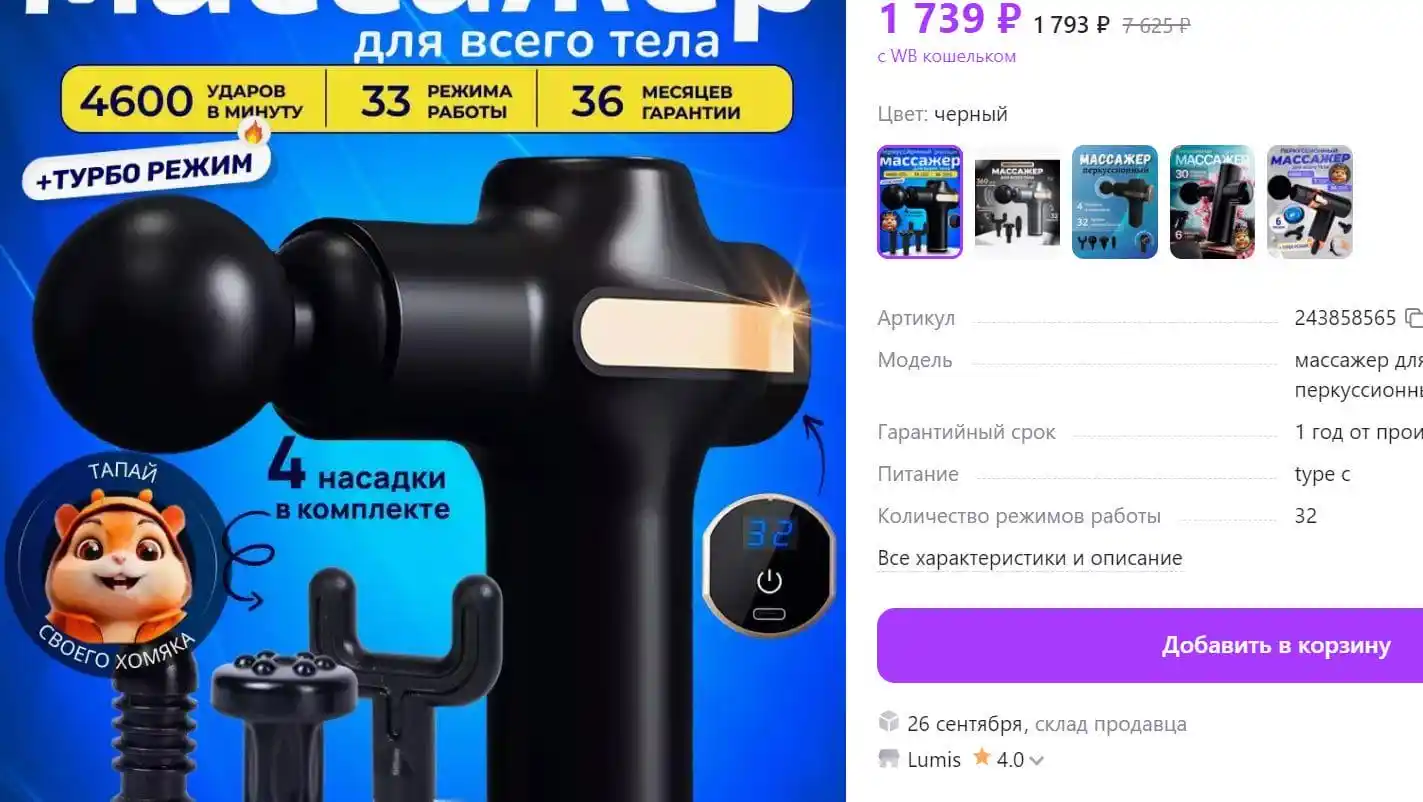
Telegram is the chat app of choice for most Russian citizens, and the explosive Hamster Kombat is naturally very popular in Russia. Some players in the country even buy fascia guns to enhance their knocking ability. Many e-commerce sellers also took the opportunity to promote the role of their fascia guns in "knocking hamsters", thereby driving the sales growth of these fascia guns on Russian e-commerce platforms.
The Russian information and socio-political electronic newspaper Fontanka.ru reported on Hamster Kombat on September 22, saying that the "eight-year-old son" of one of its employees "mined" "Bitcoin" for a total of 120 days. In the end, the boy's "income was about 4.3 rubles (0.046 US dollars)".
Some commentators expressed their displeasure in the comments section of the Fontantka Ru article, with one Russian social media user lamenting: "How did we go from being the most well-read and educated country in the world to being like this?"
Recommended
The Wall Street Journal: How is AI Trading Stealing the Limelight from Cryptocurrency?
Aug 15, 14:00
Tencent Still Has a Dream
Aug 15, 11:27
To Catch North Korean Hackers, They Set Up a Fake Project
Aug 15, 10:00
From Litigation to Settlement: Positive Signal Released by HTX's Negotiation with FCA
Aug 14, 19:32
11,742 Shipping Addresses Exposed Alongside Trezor Orders
Aug 14, 19:01
Founder Interview: FOMO Creator Explains How They Added 30,000 Users in One Day and Became One of the Fastest-Growing Crypto Apps
Aug 14, 18:37