Arthur Hayes: Avoiding the CEX Trap, How Projects Can Stage a DEX Comeback in the Crypto Market

Original Title: PvP
Original Author: Arthur Hayes, Co-Founder of BitMEX
Editor's Note: In this article, Arthur Hayes delves into the current state of token listings in the crypto market, especially the impact of high listing fees on CEX on project teams and investors. The article showcases the advantages of projects listing on DEX through a case study of Auki Labs, emphasizing the importance of focusing on product development and user growth. For those project teams blindly pursuing CEX listings, Hayes reminds them to focus on long-term value rather than short-term price fluctuations and market hype.
The following is the original content:
PvP, or "Player versus Player," is a term frequently used by shitcoin traders to describe the current market cycle. It conveys a predatory emotion, where victory comes at the expense of others. This concept is very common in Traditional Finance (TradFi). The core purpose of the crypto capital markets is to allow those willing to risk their precious capital to enjoy the early rewards of projects, hoping that these projects will grow alongside the development of Web3. However, we have strayed from the bright path laid by the honorable Satoshi Nakamoto, followed by the great angel Vitalik through the highly successful Ethereum ICO, further advancing this path.
In the current crypto bull market, Bitcoin, Ethereum, and Solana have shone brightly. However, I define "new issuance" as tokens released this year, and these new issuance projects have performed poorly for retail investors. VC firms, on the other hand, remain unaffected. Hence, the PvP moniker has been bestowed upon the current market cycle. The result is a series of projects with high FDVs but extremely low circulation. After issuance, the prices of these tokens have been flushed down the drain like common garbage.
While this is market sentiment, what does the data reveal? Maelstrom's clever analysts have conducted some in-depth digging to answer a few perplexing questions:
Is it worth paying the exchange listing fee so that your token has a better chance of price appreciation?
Did the project launch at an overly high valuation?
As I delve into the data to answer these questions, I would like to offer some unsolicited advice to projects waiting for the market to heat up before launching. To bolster my argument, I would like to specifically mention a project in Maelstrom's investment portfolio—Auki Labs. They went against the tide and chose not to debut on a CEX for the first time but instead listed on a DEX with a relatively low FDV token. They hope retail investors can make money with them as they succeed on their journey to build the real-time spatial computing market. They also despise the exorbitant listing fees charged by major exchanges and believe there is a better way to give back more value to end-users than to those big shots living in my Singapore neighborhood.
Sample Set
We analyzed 103 projects listed on major shitcoin exchanges in 2024. This is not an exhaustive list of all projects listed in 2024, but it is a representative sample.
“Pump the Price!”
This is a phrase founders often emphasize repeatedly during our advisory calls: “Can you help us get listed on a CEX? That way, our token price will skyrocket.” Well... I have never fully believed that. I believe creating a useful product or service and steadily increasing paying users is the key to a Web3 project's success. Of course, if you have a garbage project whose value only goes up because Irene Zhao retweeted your content, then yes, you need a CEX to dump it on retail users. Most Web3 projects are in this situation, but hopefully not the ones Maelstrom invests in... Akshat, take note!

Post-listing returns refer to the number of days after listing, and LTD refers to performance since going live.
The token price has not skyrocketed on any exchange post-listing. If you paid the exchange's listing fee hoping to see a chart of the token price constantly rising, I'm sorry.
Who's the winner? VCs are the winners because the media token price has increased by 31% based on the FDV from previous private fundraising rounds. I call it “VC extraction price.” I will explain in detail the VC's distorted incentive mechanism that drives projects to delay liquidity events as much as possible in the latter part of this article. But for now, most people are just fools! That's why the drinks are free at conference social events... Haha.
Next, I'm going to stir things up a bit. First of all, CZ is a hero in the crypto space because he was tormented by the traditional finance devil in a moderately secure prison in the U.S. I love CZ very much and respect his ability to cleverly pocket funds in various areas of the crypto capital markets. But... but... the enormous cost paid for Binance's listing qualification is not worth it. Let me clarify, having Binance as your token's initial listing platform is not of great value. It is only worth it if Binance is your project's primary exchange due to performance and an active community.
Founders often ask on our calls, “Do you have a connection with Binance? We must list on Binance, or our token will not rise.” This “No Binance, No Listing” sentiment is very favorable for Binance as it can charge the highest all-inclusive listing fee of any exchange.
Returning to the table above, while tokens listed on Binance have performed relatively better compared to other major exchanges, they have still seen a decline in price in absolute terms. Therefore, listing on Binance does not guarantee a price increase for a token.
A project must provide or sell tokens to exchanges at a cheap price, and these tokens are usually of limited supply in exchange for a listing opportunity. Some exchanges are allowed to invest in projects at a very low Fully Diluted Valuation (FDV), regardless of the FDV from the last private funding round. These tokens could have been distributed to users to be used for tasks that promote project growth. A simple example is a trading app distributing token rewards to traders to achieve a certain trading volume target, known as liquidity mining.
Selling tokens to a listing exchange can only be done once, but the positive flywheel effect created through increased user engagement will continue to yield returns. Therefore, if you give up valuable tokens just for the sake of listing and only see a slight outperformance in relative terms, as a project founder, you are actually wasting valuable resources.

As I often tell Akshat and his team, the reason you are working at Maelstrom is that I believe you can build a portfolio of top Web3 projects that can outperform my core holdings of Bitcoin and Ethereum. If not, I would continue using my spare money to buy Bitcoin and Ethereum instead of paying salaries and bonuses. As you can see here, if you buy a token at or shortly after listing, your performance is far inferior to the hardest money ever—Bitcoin, and the Layer-1s of two top decentralized computing platforms—Ethereum and Solana. Given these results, retail investors should never buy newly listed tokens. If you want exposure to cryptocurrency risk, just holding Bitcoin, Ethereum, and Solana directly is sufficient.
This tells us that a project must decrease its valuation by 40% to 50% at the time of listing to become attractive in relative terms. Who gets hurt when a token lists at a lower price? VCs and CEXs.
While you might think VCs aim to generate positive returns, the most successful managers understand that they are actually playing the game of asset accumulation. If you can charge a management fee on a large nominal amount, typically 2%, then you make money regardless of whether the investment appreciates. If you invest like VCs do in illiquid assets such as early-stage token projects, which are essentially just promises of future tokens, how do you make them appreciate in value? You persuade the founders to continue raising private funding rounds at ever-increasing FDVs.
As the FDV of the private funding rounds increases, VCs can revalue their illiquid portfolios at market prices, revealing significant unrealized gains. These impressive past performances enable VCs to raise the next fund, charging management fees based on the higher fund value. Additionally, VCs need to deploy capital to earn returns. However, this is not straightforward, especially since most VCs established in Western jurisdictions are not allowed to purchase liquid tokens. They can only invest in equity of a managing company and provide investors with a token warrant through a side letter for the projects they developed. This is also why the "Simple Agreement for Future Tokens" (SAFT) exists. If you want to access VC funding while they have a lot of idle capital, you have to play this game.
For many VCs, a liquidity event is very harmful. When this happens, gravity kicks in, and the token's value quickly returns to reality. For most projects, reality is that they failed to create a product or service that enough users are willing to pay real money for, thus justifying their inflated FDV. At this point, VCs have to mark down their book value, negatively impacting their reported returns and management fee scale. Therefore, VCs will push founders to delay the token release as much as possible and continue with private funding rounds. The end result is that when the project finally goes public, the token price plummets like a rock, as we have just witnessed.
Before I thoroughly criticize VCs, let's talk about the "Anchoring Effect." Sometimes, human thinking is really foolish. If a shitcoin opens at a $100 billion FDV when it's actually only worth $1 billion, you might sell the token, causing a massive sell-off that crashes the token price by 90% to $10 billion, with trading volume disappearing. VCs can still mark this illiquid shitcoin at a $10 billion FDV, which is often far above what they actually paid. Even with a price collapse, opening the market at an unrealistic FDV still benefits VCs.
CEXs want to see a high FDV for two reasons. First, transaction fees are collected as a percentage of the token's notional value. The higher the FDV, the more income and fees the trading platform earns, regardless of whether the project goes up or down. The second reason is that a high FDV and low circulation benefit trading platforms because there are a large number of undistributed tokens they can allocate. According to our sample data, the median circulating supply percentage of projects is 18.60%.
I want to briefly discuss the costs of listing on a CEX. The biggest issue in current token distribution is the initial high price. Therefore, no matter which CEX gets the first listing right, a successful distribution is almost impossible to achieve. If that's not bad enough, projects with high prices also have to pay a large amount of tokens and stablecoins to get the privilege of this "trash listing."
Before commenting on these fees, I would like to emphasize that I do not think there is anything wrong with CEX charging listing fees. CEXs have invested a significant amount of funds to build a user base, which needs to be recouped. If you are an investor in a CEX or a token holder, you should be satisfied with their business acumen. However, as an advisor and token holder, if my project gives tokens to a CEX instead of users, it could harm the project's future potential and negatively impact the token's trading price. Therefore, I either recommend that founders stop paying listing fees and focus on attracting more users or suggest that CEXs significantly reduce their prices.
CEXs mainly extract funds from projects in three ways:
Directly charging listing fees.
Requiring projects to pay a deposit, which is refunded if the project is delisted.
Forcing projects to spend a specified amount on platform marketing.
Usually, each CEX's listing team will evaluate the project. The worse the project, the higher the fee. As I often say to founders, if your project doesn't have many users, then you need a CEX to dump your "trash" into the market. If your project has product-market fit and a healthy, growing real user ecosystem, then you don't need a CEX because your community will support your token price anywhere.
Listing Fees
In top-tier CEXs, Binance charges up to 8% of the total project token supply as a listing fee. Most other CEXs charge between $250,000 and $500,000, usually paid in stablecoins.
Deposit
Binance has devised a clever strategy, requiring projects to purchase BNB and stake it as a deposit. If the project is delisted, the BNB is refunded. Binance requires up to $5 million worth of BNB as a deposit. Most other CEXs require $250,000 to $500,000 in stablecoins or their own token as a deposit.
Marketing Expenses
Binance requires high-end projects to distribute 8% of the token supply to Binance users through platform airdrops and other activities. A mid-tier fee CEX, on the other hand, demands spending up to 3% of the token supply. At the low end, CEXs require marketing expenses ranging from $250,000 to $1 million, paid in stablecoin or project tokens.
Altogether, listing on Binance could cost you 16% of the token supply and $5 million in BNB purchases. If Binance is not the main exchange, the project still needs to spend nearly $2 million in tokens or stablecoins.
For any CEXs challenging these figures, I strongly suggest you provide a transparent account of each fee or mandatory expenditure. I obtained this data from projects that have evaluated the costs of major CEX listings, and some of the data may be outdated. I reiterate once more that I don't believe CEXs are doing anything wrong. They have a valuable distribution channel and are maximizing its value. My complaint lies in the fact that post-listing token performance does not justify the project founders paying these fees.
This game is simple: ensure your users or token holders benefit financially from your project's success. I'm speaking directly to you—the project founders—here.
If you must, only conduct a small private seed round of financing to create a product for a very limited use case. Then, launch your token. Because your product is far from achieving true product-market fit, the FDV should be very low. This conveys some information to your users. Firstly, this is risky, which is why they entered at such a low price. You might mess up, but your users will continue to support you because they entered the game at an extremely low price. They believe in you, give you more time, and believe you will find a solution. Secondly, this indicates that you want your users to join the journey of wealth creation with the project. This will motivate them to tell more people about your product or service because users know that if more people join, they have the potential to receive generous rewards.
Currently, due to the poor performance of most newly listed projects, many CEXs are under pressure to accept only "high-quality" projects. Considering that in the crypto space, "faking it until you make it" is very easy, selecting truly excellent projects is very difficult. Garbage in, garbage out. Every major CEX has its preferred metrics to measure success. Generally, a very young project will not meet their standards. Who cares, there's something called a DEX.
On a DEX, creating a new trading market does not require permission. Imagine you are a project that raised $1 million USDe (Ethena USD) and want to offer 10% of the token supply to the market. You can create a Uniswap liquidity pool consisting of $1 million USDe and 10% of your token supply. Click a button, and let the automated market maker set the clearing price based on market demand for your token. You don't have to pay any fees for this. Now, your loyal users can immediately buy your token, and if you truly have an active community, the token price will rise rapidly.
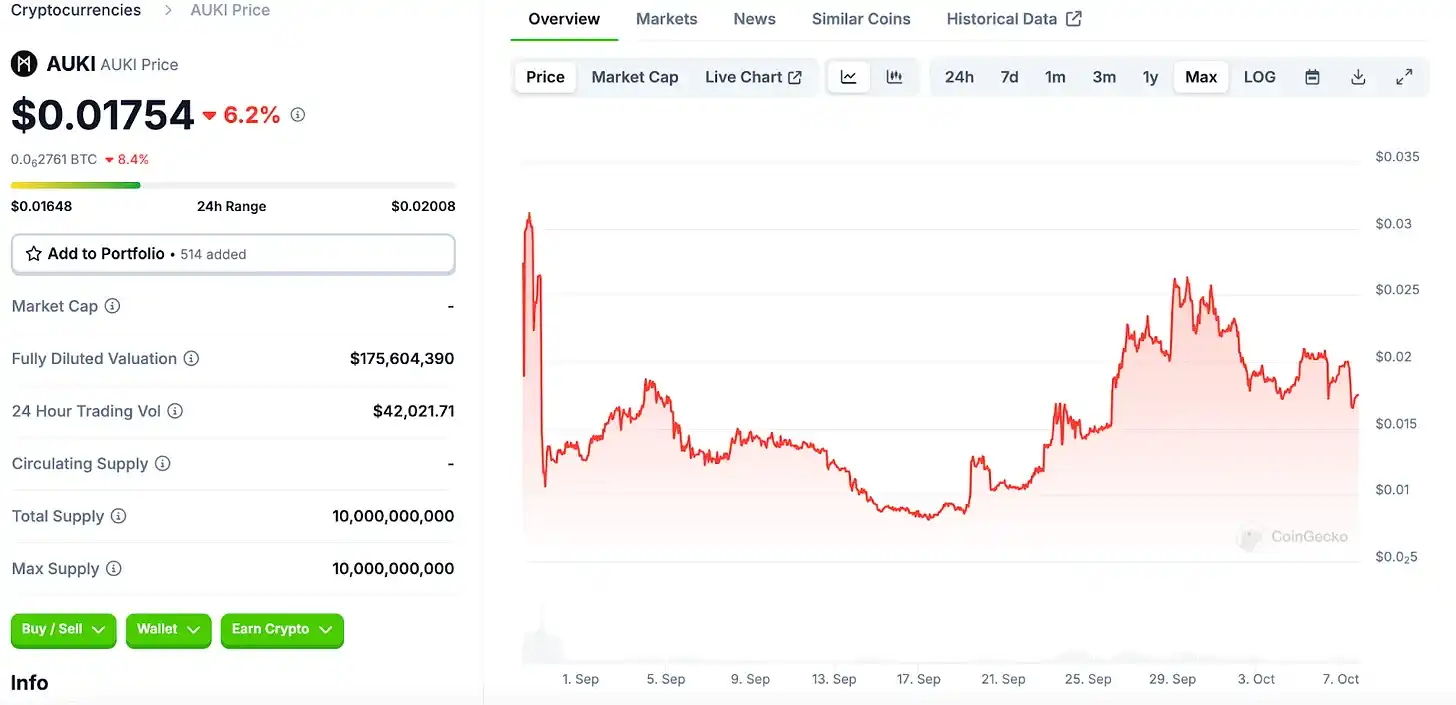
Let's take a look at what Auki Labs did differently when issuing their token. The above is a screenshot from CoinGecko. As you can see, Auki's FDV and 24-hour trading volume are relatively low. This is because it first listed on a DEX before being listed on MEXC's CEX. So far, Auki's token price has increased by 78% from the previous private sale price.
For Auki's founders, the token listing was just another day at the office. Their real focus is on building their product. Auki's token was first listed on August 28 on Uniswap V3 via the AUKI/ETH pair on Base, which is Coinbase's Layer-2 solution. Subsequently, they were first listed on a CEX, MEXC, on September 4. They estimate saving about $200,000 in listing fees this way.
Auki's token vesting schedule is also more equitable. Team members and investors vest on a daily basis for periods ranging from one to four years.
Sour Grapes Psychology
Some readers may think I'm just sour because I didn't make big gains from new token listings on mainstream CEXs. Indeed, my income comes from the appreciation of tokens in my portfolio.
If projects in my portfolio are overvalued in token pricing, pay exorbitant fees to exchanges, but fail to outperform Bitcoin, Ethereum, and Solana, I feel obligated to speak out. That's where I stand. If a CEX chooses to list a Maelstrom project because the project has strong user growth and offers a compelling product or service, I fully support that. But I hope the projects we support stop worrying about which CEX will accept them and start focusing on their daily active user data.
Recommended
The Wall Street Journal: How is AI Trading Stealing the Limelight from Cryptocurrency?
Aug 15, 14:00
Tencent Still Has a Dream
Aug 15, 11:27
To Catch North Korean Hackers, They Set Up a Fake Project
Aug 15, 10:00
From Litigation to Settlement: Positive Signal Released by HTX's Negotiation with FCA
Aug 14, 19:32
11,742 Shipping Addresses Exposed Alongside Trezor Orders
Aug 14, 19:01
Founder Interview: FOMO Creator Explains How They Added 30,000 Users in One Day and Became One of the Fastest-Growing Crypto Apps
Aug 14, 18:37