"a16z is biased against EVM", what does the chairman of the Solana Foundation think of a16z's crypto industry report?

Editor's note:A few days ago, a16z released a Crypto industry report, which caused a lot of discussion in the crypto investment circle. Many people shared their views on this report, among which the tweet of Lily Liu, Chairman of Solana Foundation, was particularly concerned. As an important figure in Solana's ecology and community, Lily Liu has made a significant contribution to the development of Solana, a non-EVM public chain, and therefore has a very deep understanding of the crypto industry, especially the development of public chains. In response to a16z's industry report, Lily Liu pointed out the implicit "EVM bias" and believed that this report ignored Solana's outstanding performance in transaction fees, NFT and DeFi markets. Although Solana ranked among the top in NFT addresses and transaction volume in the past year, the report did not mention DePIN's major innovations, such as helium and Hivemapper. These breakthrough projects demonstrate real-world applications of decentralized networks, especially the thriving Solana ecosystem, which makes us excited about the future.
The following is the original content (the original content has been reorganized for easier reading and understanding):
I read a16z's "State of the Crypto Industry" report and learned a lot! Although I mainly focus on areas outside of EVM, I always cherish the opportunity to learn about other innovations in the self-custody field. However, I noticed a certain implicit EVM bias in the report. Here are some of my observations:
Related reading: "a16z Annual Crypto Report"
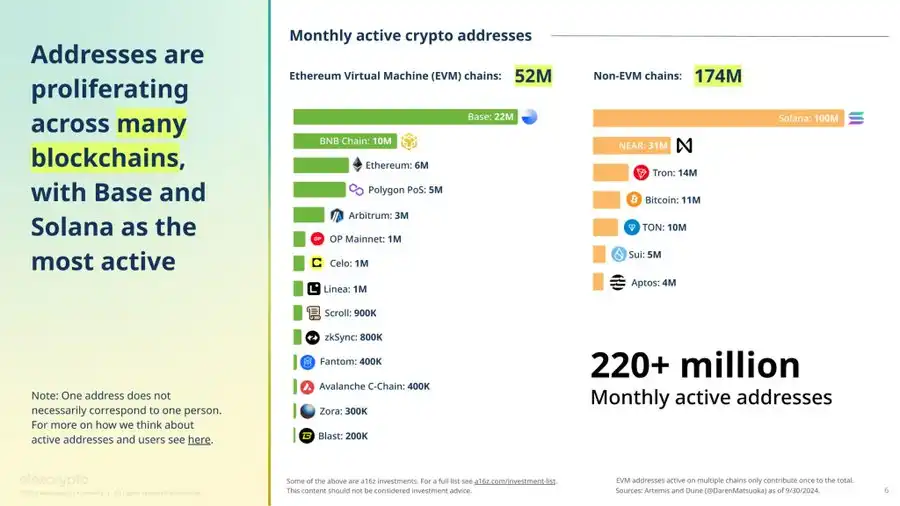
The author frames the world as an opposition between EVM and non-EVM, forming a binary opposition that regards ecosystems and developers that do not choose to develop within the EVM as "others." For example, the visualization of active addresses is misleading. Solana has 100 million monthly active addresses, surpassing Base’s 22 million, yet the chart equates the two. A more accurate approach would be to use a single bar chart, with different colors for EVM and non-EVM bars (if necessary). Additionally, the slides claim that “Base and Solana” have the highest monthly active addresses, but careful readers will notice that NEARProtocol has 31 million active addresses, surpassing Base. Therefore, the title should be changed to “…Solana and Near are the most active.”
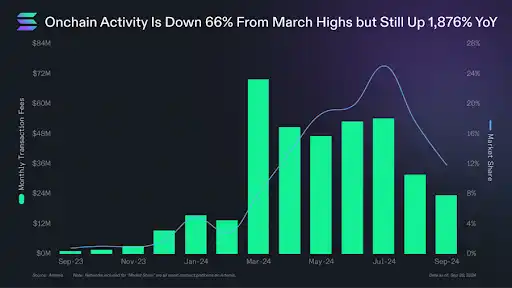
Now let’s talk about metric selection. Our industry often uses active addresses and total value locked (TVL) as standard benchmarks for ecosystems. However, I propose a more meaningful way to measure ecosystem activity, demand, and overall health: transaction fees. Transaction fees are a direct reflection of user participation in valuable economic activity, their willingness to pay for execution, and the ability of validators to be profitable.
With the introduction of fee markets on Solana, we can now distinguish the economic value of different types of activity within the ecosystem and apply this approach to other ecosystems.
Solana has made significant progress in terms of transaction fees. Prior to December 2023, Solana’s monthly transaction fee market share had never exceeded 1.5%. Since April 2024, this share has consistently remained above 10%, peaking at 25% in July. When we factor in MEV tipping to measure “real economic value” (REV), Solana is closing the gap! This chart from blockworksres highlights the closing of the REV gap between Solana and Ethereum.
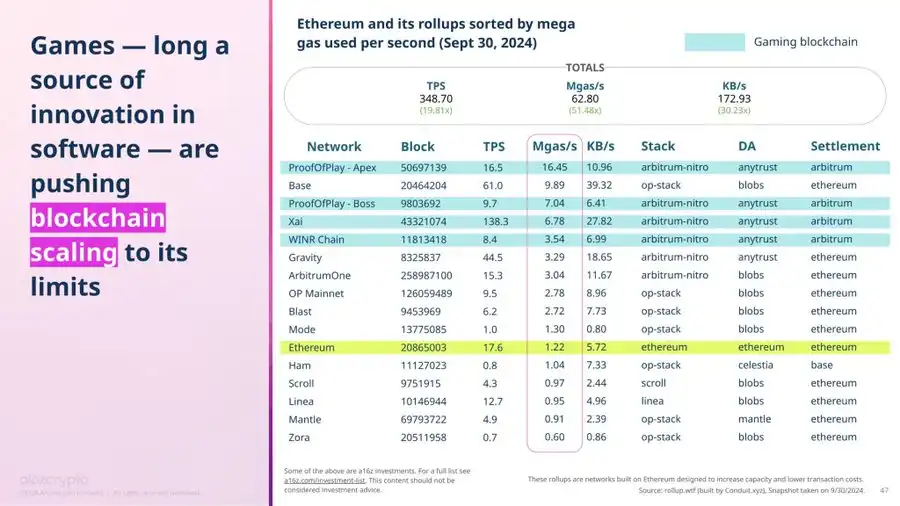
Here’s another EVM-centric perspective, involving the gaming space. Using mgas/s as a metric for evaluating gaming infrastructure excludes Solana and other non-EVM networks, leading to a meaningless comparison that only gives us a partial picture of the blockchain gaming ecosystem.
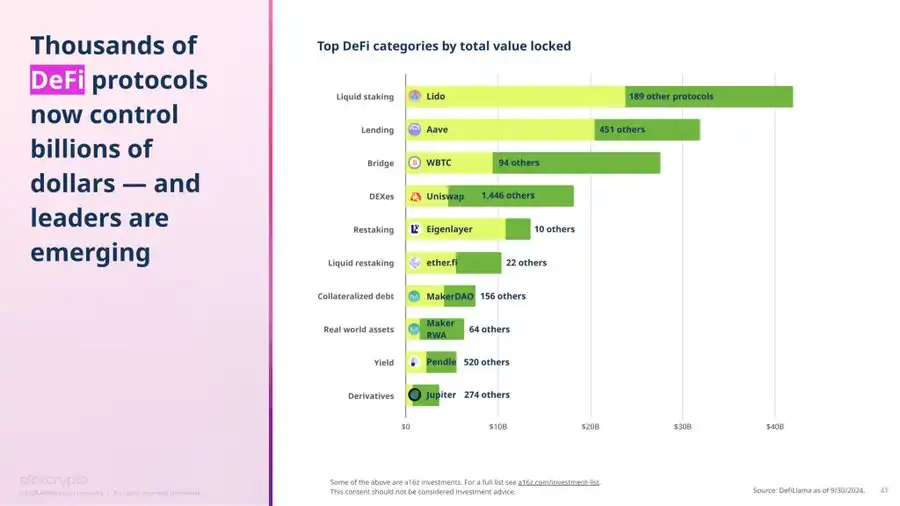
Another example relates to DeFi, where TVL is an inadequate metric for comparing DeFi activity, especially in key categories like DEXs, derivatives, and bridges, where volume is more relevant. While the report highlights overall DEX volume, it only provides a protocol breakdown based on TVL, ignoring key aspects of liquidity activity.
TVL tends to favor ecosystems with large reserves but limited liquidity, such as Ethereum. While Solana’s TVL is only 10% of Ethereum’s, its monthly DEX volume in 2024 fluctuates between 50% and occasionally exceeding Ethereum. To accurately reflect on-chain economic activity, it is important to focus on the economic value of transactions, not just the value held. Against this backdrop, ecosystems with greater capital efficiency and superior on-chain performance stand out.
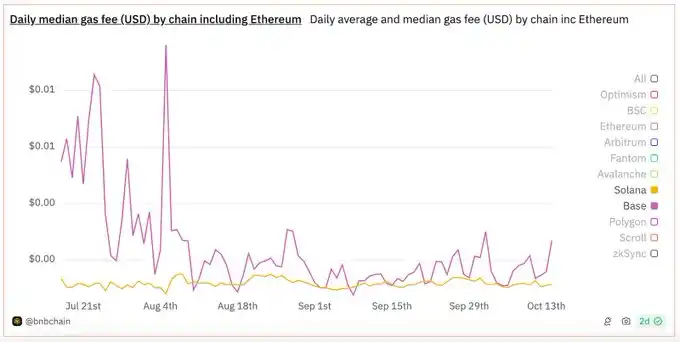
Among the comparable metrics across ecosystems, the report still focuses primarily on Ethereum and EVM L2. It sees the implementation of EIP-4844 as an important milestone in the industry's fee reduction. However, it is worth noting that Solana's transaction costs have also remained low since its launch in March 2020. Moreover, in terms of transaction affordability, Solana's median fee has always been lower and more stable than Base.
Although Solana ranked first in the number of NFT addresses, second in transaction volume, and fourth in unique collectibles over the past year according to data from nftpulseorg, Solana was once again excluded from this NFT comparison.
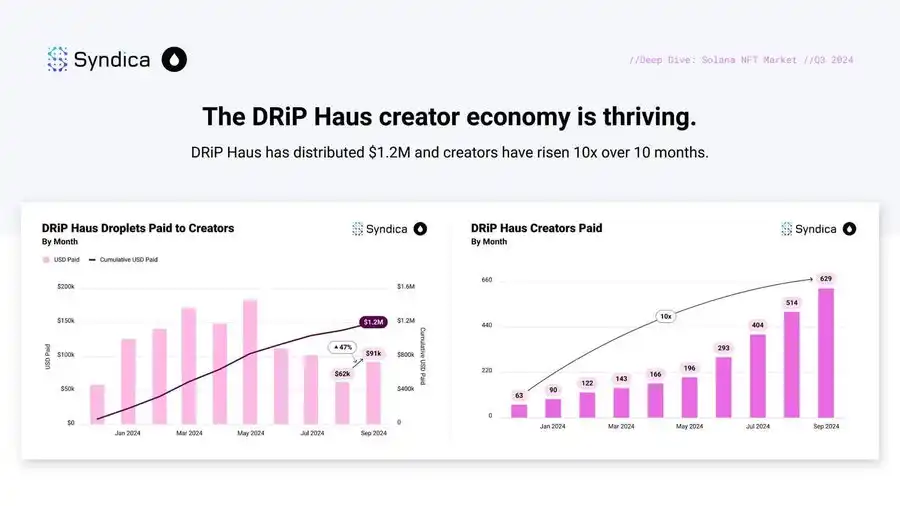
The slides mention low transaction costs driving new consumer behaviors, which can be well illustrated by the example of drip haus. Since March 2023, the platform has achieved a total of 182 million NFT minting, with a total cost of only 1,600 SOL (only $0.001 per NFT at a SOL price of $150), as pointed out by ledger top.
The absence of DePIN is very obvious, helium is revolutionizing cellular networks and currently has more than 1 million active hotspots in 182 countriesHivemapper uses decentralized networks for global mapping, recording more than 7.5 million kilometers of street data in more than 50 countriesRendernetwork provides decentralized GPU rendering services, providing key computing power for industries such as gaming and artificial intelligence. This is an upgraded version of SETI@home, showing actual application value.
More importantly, most of these innovations occurred in Solana rather than the EVM ecosystem. Is this why DePIN is not mentioned at all in the report?
Recommended
The Wall Street Journal: How is AI Trading Stealing the Limelight from Cryptocurrency?
Aug 15, 14:00
Tencent Still Has a Dream
Aug 15, 11:27
To Catch North Korean Hackers, They Set Up a Fake Project
Aug 15, 10:00
From Litigation to Settlement: Positive Signal Released by HTX's Negotiation with FCA
Aug 14, 19:32
11,742 Shipping Addresses Exposed Alongside Trezor Orders
Aug 14, 19:01
Founder Interview: FOMO Creator Explains How They Added 30,000 Users in One Day and Became One of the Fastest-Growing Crypto Apps
Aug 14, 18:37