Tracking those "confiscated" cryptocurrencies, where do they go?

Original title: What happens to seized cryptocurrency?
Original author: James Smith, Cointelegraph
Original translation: CryptoLeo, Odaily Planet Daily
In 2024, after the United States approved Bitcoin ETF and Ethereum ETF, cryptocurrency was one step closer to Mass Adoption, but the inflow data of cryptocurrency into specific cybercrime-related entities is still worrying. Chainalysis previously released a security report on the crypto industry. Compared with the same period last year, illegal transactions have generally declined, but two noteworthy illegal activities-stolen funds and ransomware have been increasing. The stolen funds in cryptocurrency thefts increased year-on-year, doubling from $857 million to $1.58 billion by the end of July. In addition, in 2022 and 2023, there has been a surge in cryptocurrency entities sanctioned by governments or international organizations.
The data also shows that cryptocurrency-related criminal cases are increasingly attracting the attention of law enforcement agencies. Every once in a while, there will be a "big news" in the security field in the industry, such as the theft of funds from a large exchange, participation in illegal activities, etc., and some of the widely watched large-scale cases have the participation of law enforcement agencies, which require law enforcement agencies to freeze or seize the funds involved. Recently, James Smith, an author in the encryption field, wrote a popular science article on how law enforcement agencies deal with cryptocurrency-related criminal cases. The content of the article involves a series of processes from legal investigations of the cryptocurrency involved to the final seizure and processing by law enforcement agencies. The following is the full text, compiled by Odaily Planet Daily:

Seizing cryptocurrency means that law enforcement agencies confiscate crypto assets, usually as part of a legal investigation. This may occur in the case of fraud, money laundering or other illegal activities.
If law enforcement agencies suspect a user or organization of illegal activity, they can seize the crypto assets in their wallets. These funds are usually transferred to a government-controlled wallet until the end of the judicial process. If the defendant is convicted in court, the seized assets will be sold or auctioned. But if they are found not guilty, the cryptocurrency will be returned to their wallets.
The seizure is carried out in the context of an arrest, search warrant or seizure order, which clearly specifies the property to be confiscated. Seizure orders for cryptocurrencies are usually issued to exchanges or other institutional custodians, not individuals.
The warrant will list the exchange's wallet address and the reason for the seizure. The exchange will be required to provide the prosecutor's office with the private key to the wallet. To avoid any liability and facing more serious consequences, exchanges usually comply with the regulations and hand over the private keys.
However, under the pressure of the legal order, requiring exchanges to hand over private keys poses a fundamental challenge to the decentralized spirit that cryptocurrencies rely on. And search warrants are not the only way for law enforcement agencies to confiscate cryptocurrencies such as Bitcoin held by other individuals or entities. The government can also confiscate cryptocurrencies through "confiscation proceedings", which refers to the permanent loss of assets stipulated by a court order or judgment. Cryptocurrency seizures usually occur before confiscation, but not all seized assets will be confiscated.
The process of confiscating cryptocurrency is different from the process by which law enforcement agencies confiscate physical assets such as real estate, vehicles or jewelry. Physical items can be taken away physically, but crypto wallets require corresponding private keys to unlock and transfer funds.
Law enforcement agencies often work with exchanges that host wallets to obtain and recover funds. This works well for hot wallets, as exchanges usually have a copy of the private keys. For offline and personally owned hardware wallets or cold wallets, law enforcement agencies may need to hack into the relevant devices to recover funds.
After seizing crypto assets, law enforcement agencies will keep custody of the cryptocurrencies and liquidate them. Liquidation usually requires a court order, which can take years. The proceeds from the liquidation of assets are either given to crime victims or distributed to government agencies.
The U.S. Department of Justice (DOJ) established the Virtual Asset Exploitation Unit (VAXU) within the FBI in 2022, focusing on blockchain analysis and virtual asset seizures, and VAXU works closely with the DOJ’s National Cryptocurrency Enforcement Team (NCET) on seizures.
In some cases, government agencies use a process called administrative forfeiture, in which the government seizes assets without charging the wallet holder with a crime, meaning that without a court hearing, users could end up losing the cryptocurrency in their wallets.
In related context, the FBI launched a token called NexFundAI in May 2024 as part of Operation Token Mirror, which targets individuals and organizations involved in fraudulent cryptocurrency activities, particularly pump and dump tokens. NexFundAI is designed to mimic legitimate cryptocurrencies as a lure to attract market manipulators, allowing the FBI to collect evidence against them.
Authorities confiscate cryptocurrencies when they are used for illegal activities such as tax evasion, money laundering, fraud or drug trafficking.
If someone uses cryptocurrencies for illegal activities, such as drug trafficking or hacking, it may cause the cryptocurrencies to be considered "proceeds of crime" by the authorities and confiscated by government agencies. The purpose of the confiscation is to stop illegal activities or recover stolen funds.
Criminals use cryptocurrencies to conduct "anonymous" transactions on the chain to conceal the flow of funds. Despite this, law enforcement agencies can still identify the proceeds of crime and confiscate funds through on-chain data traces, and can also require cryptocurrency exchanges to freeze the wallets involved.
When deciding whether to seize, prosecutors will consider the organization of the seizure of crypto assets, the potential challenges of confiscation and management, and the value of the assets.
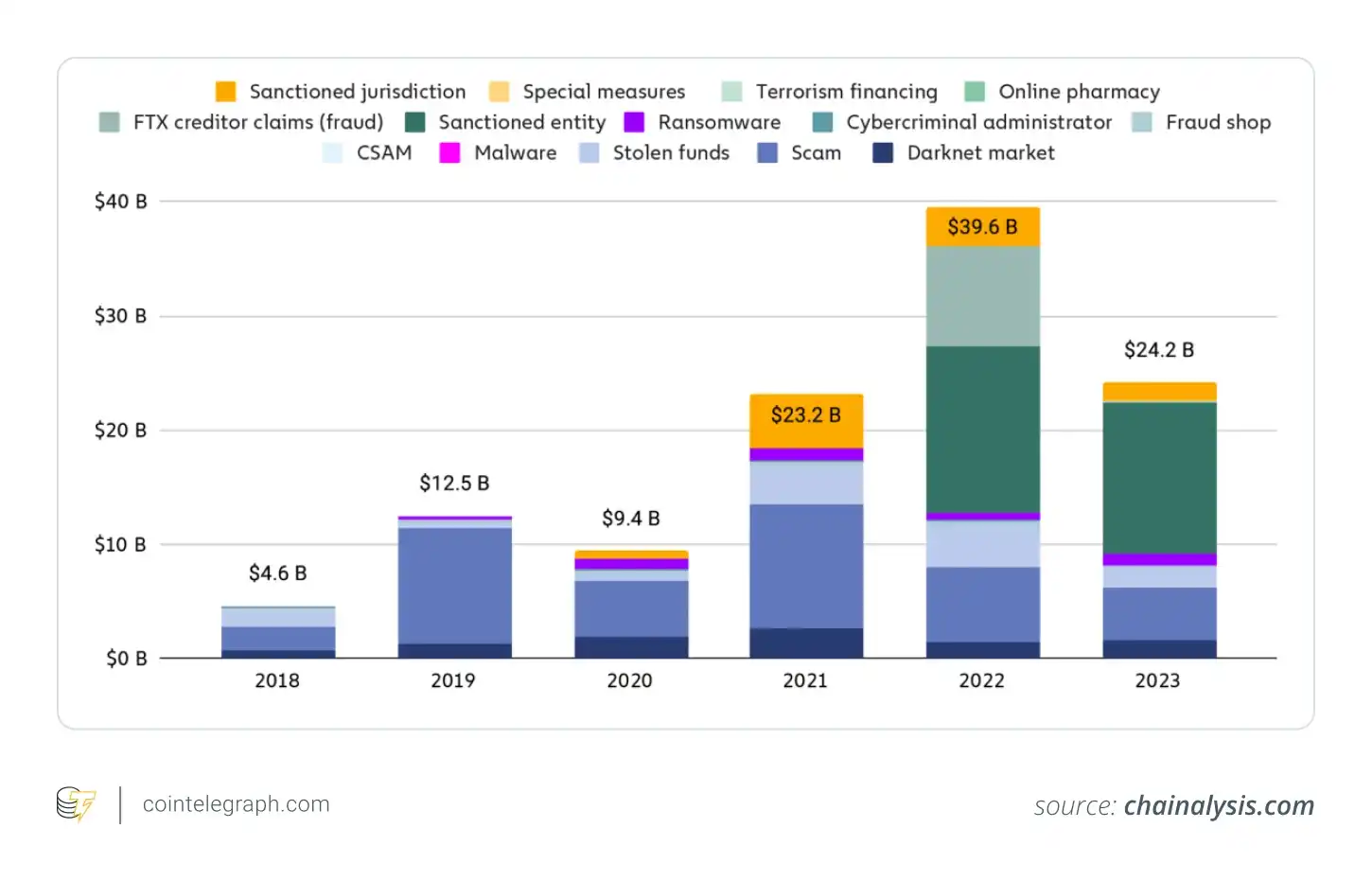
(As shown in the figure above, starting from 2022, there has been a surge in cryptocurrency entities sanctioned by governments or international organizations)
In the United States, under civil law, when funds belonging to you are confiscated under civil law, you need to hire an asset confiscation lawyer and submit a verified claim application to the confiscation agency to take legal action. The agency has 90 days to file a complaint requesting the confiscation of funds or the return of cryptocurrency.
When the agency files a confiscation complaint, the court will send a notice to all relevant parties asking them to present their case. Your lawyer can file a defense, counterclaim, and motion to dismiss the agency's case. If the case is proven, the court may dismiss the agency's case against you and order it to pay your legal fees and return the seized crypto assets.
If the agency files a criminal case against you, the process may be more complicated and you will need to defend other charges. In this case, the defendant will usually accept a plea agreement, so that a seizure order is not required. In this case, the defendant may voluntarily hand over the private keys as part of the plea agreement.
In the UK, the Recovery of Proceeds of Crime Act 2002 outlines how seized cryptocurrencies should be handled. Similar to other confiscated assets, 50% goes to the Home Office and the remaining 50% is divided between the police, the Crown Prosecution Service and the courts. There is also the possibility that some of the confiscated assets will be returned to victims of crypto cases.
In Europe, when illegal cryptocurrency transactions are discovered, authorities seek court orders to freeze or seize assets. To enforce the orders, they work with crypto platforms, and in cross-border cases, regulators such as Europol may provide assistance. Confiscated cryptocurrencies are stored in government-controlled wallets and may be auctioned or liquidated after conviction, depending on the country's laws.
In contrast, India's law enforcement agency (Enforcement Directorate ED) and local cybercrime teams work together or individually to confiscate cryptocurrencies. When illegal activities are discovered, authorities may seek a court order instructing exchanges to freeze or seize assets. The confiscated cryptocurrencies will be stored in government-supervised wallets until the final court decision, but the process may involve a long investigation as India is developing a clear legal framework for dealing with crypto-related crimes.
There are many examples of governments seizing crypto assets that we are familiar with, such as the assets of Bitfinex, Silk Road Silk Road and Mt.Gox.
Bitfinex theft
In 2022, U.S. federal authorities recovered approximately $3.6 billion worth of Bitcoin related to the 2016 Bitfinex exchange hack. Approximately 120,000 BTC were stolen by hackers, and years later, the money was eventually linked to two people (Morgan and Lichtenstein).
As part of the investigation, the authorities seized the assets. Although Bitcoin transactions are anonymous, the case highlights the development of on-chain analysis investigations, showing that even illegal funds from years ago can be found and confiscated.
Silk Road
In 2013, the U.S. government seized approximately 144,000 bitcoins from the darknet market Silk Road after its founder, Ross Ulbricht, was arrested for facilitating illegal drug trafficking. This highly publicized cryptocurrency seizure was part of a broader campaign to combat illegal cryptocurrency activity.
The U.S. Marshals Service subsequently auctioned off the seized bitcoins, now valued in the billions of dollars, and the Silk Road case remains a seminal moment in the regulation and prosecution of crimes involving cryptocurrency.
Mt. Gox
Mt. Gox, once the largest bitcoin exchange, went bankrupt in 2014 after losing 850,000 bitcoins (worth about $450 million at the time), and after filing for bankruptcy, the exchange’s remaining assets, including more than 200,000 bitcoins, were seized by Japanese authorities. The seized funds were held in escrow while authorities worked through the legal process to pay creditors.
In March 2014, Mt. Gox CEO Mark Karpelès gave creditors hope when he announced the discovery of 200,000 bitcoins in an old digital wallet, reducing total losses to 650,000 bitcoins. The Tokyo District Court subsequently appointed a temporary administrator to manage the complex legal case, the biggest challenge of which was revaluing the lost bitcoins as their price had soared since the hack. Karpelès faced charges of embezzlement but was convicted only of falsifying records. Creditor repayments continued in 2024, with an extension to October 31, 2025.
In the United States, federal agencies must submit a seizure fund use plan to the Department of Justice that outlines how the funds will be used. Civil forfeiture became common during the drug war in the 1980s and has been criticized ever since.
Sometimes, seized assets are partially returned to the owner as part of a plea agreement, but only 1% of seized assets are returned to the owner. Seized funds are often used to support law enforcement operations, such as equipment, training and investigations. For example, in 2011, the St. Louis County Police Department spent $400,000 on helicopter equipment.
While some states in the United States, such as Missouri, require that seized funds be distributed to schools, law enforcement agencies typically use federal fair share programs to keep most of the funds. However, the forced seizure of assets from individuals or companies has long been criticized from all sides.
Many believe that reforms in this area are necessary to ensure that asset confiscation is conducted fairly and transparently, and to provide adequate protection for those whose assets are at risk of seizure.
Recommended
The Wall Street Journal: How is AI Trading Stealing the Limelight from Cryptocurrency?
Aug 15, 14:00
Tencent Still Has a Dream
Aug 15, 11:27
To Catch North Korean Hackers, They Set Up a Fake Project
Aug 15, 10:00
From Litigation to Settlement: Positive Signal Released by HTX's Negotiation with FCA
Aug 14, 19:32
11,742 Shipping Addresses Exposed Alongside Trezor Orders
Aug 14, 19:01
Founder Interview: FOMO Creator Explains How They Added 30,000 Users in One Day and Became One of the Fastest-Growing Crypto Apps
Aug 14, 18:37