Binance's Dilemma: From Regulatory Crackdown to User FUD, What's the Real Issue?
Original author: IceFrog, crypto researcher
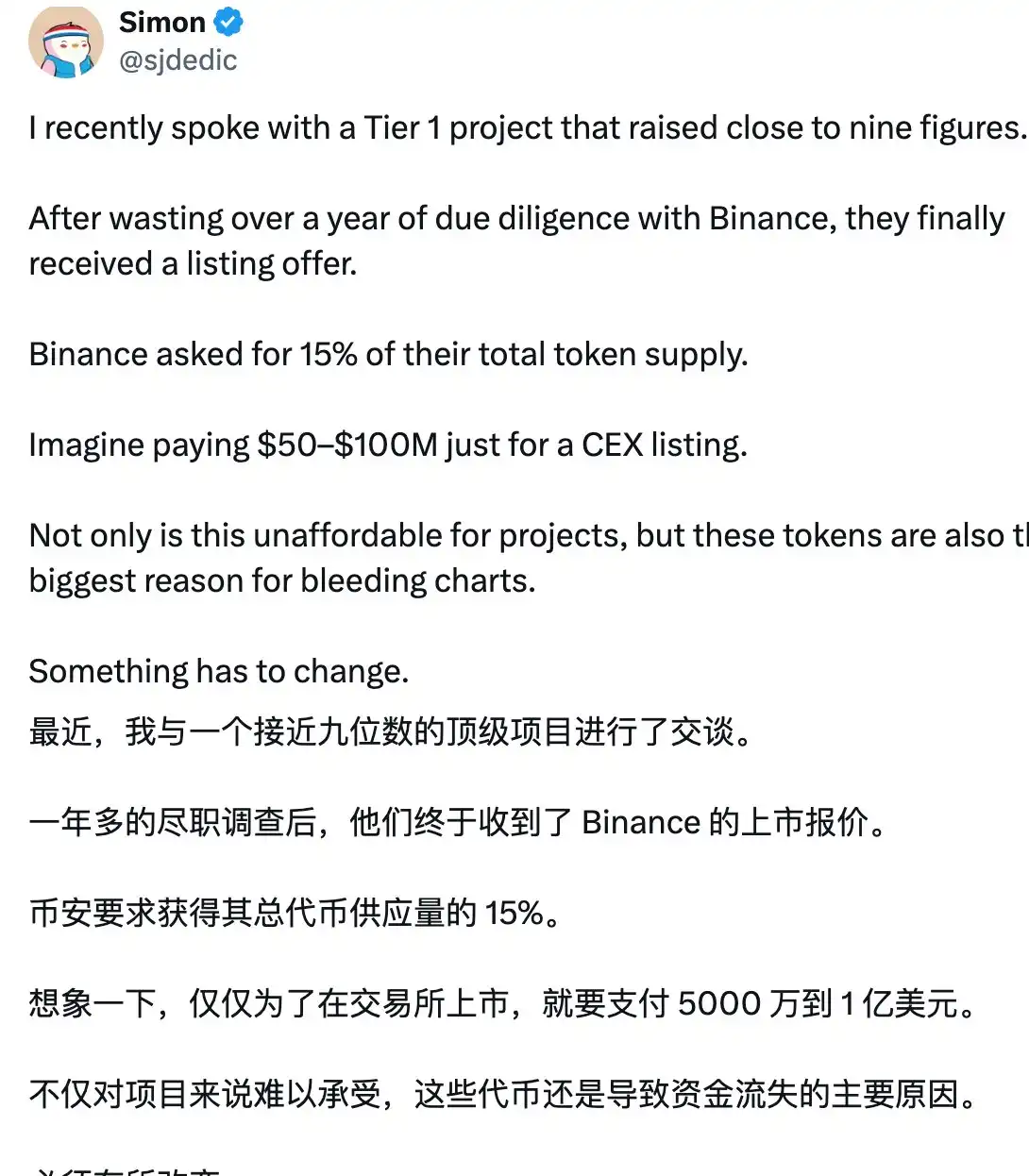
As the industry's top player and the pinnacle of the pyramid, Binance has recently been facing increasing market FUD. Simon, who is labeled as MoonrockCapital CEO on the X platform, claimed that Binance would charge 15%-20% of the total tokens as a listing condition. This caused a lot of controversy, and the market discussion quickly heated up, with both support and opposition.Emotional people even thought that Binance might be the biggest cancer in the industry, while opponents believed that this was not Binance's responsibility, but a problem with the project or the industry's own development.
Finally, Binance's top female social media responded publicly: If you don't pass the Binance screening, no matter how much money and listing fees you pay, you can't be on the Binance list. Token distribution is public, and Binance can't charge such a high token distribution ratio.
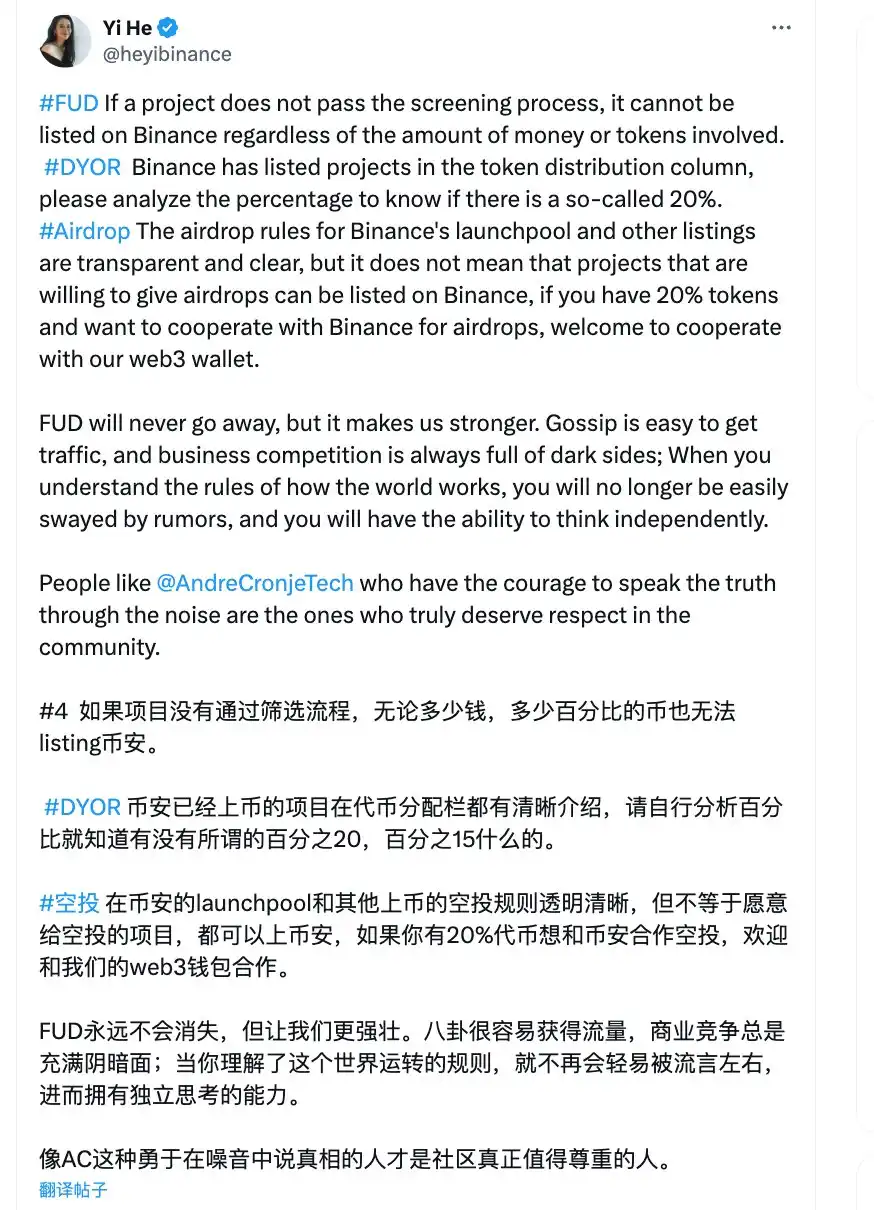
Regardless of whose words are the truth behind the quarrel between the two sides, or whether it is really just a business competition. At least from the response of Yijie, we can see that Yijie is using her own reputation to save the reputation of Binance, actively and promptly responding to such doubts. Yijie has won the respect of the community with her frank and direct attitude in the past and now.
However, this kind of doubt is not the first time, nor the last time. This also indirectly highlights the development difficulties of Binance in recent years, which have been under regulatory encirclement and peer squeeze; and under community doubts. The real crisis is never hidden in the challenges on the surface, just as it is not another Binance that defeats Binance.
Let's assume that the response of the first sister is true, and FUD is the dark side of commercial competition. Unfortunately, the public never has the ability to think independently, otherwise it cannot be called the public. From countless histories, an obvious truth is: the defeat of rumors never relies on the public's self-awakening, but on irrefutable facts and truths. The guidance of KOLs only temporarily disrupts the audio-visual experience, and does not mean that doubts will disappear. It may even be the cause of the next more intense FUD.
When all FUD is attributed to the conspiracy of commercial competition, the victim mentality behind it is not helpful to eliminate the controversy. Perhaps there are indeed peers who are fueling the flames, but this may not be the whole story. When the platform itself has enough convincing evidence, no one will choose to use such a thankless method to challenge an industry leader. This method is only effective when you have flaws yourself. This is the most superficial business logic.
When facing FUD, first look for problems in yourself, rather than doubting your competitors first. This is the attitude that a great company should have. The real enemy has always been your own arrogance, not anything else. If FUD is regarded as a business method, then the real hidden crisis is actually ignored.
1. Liquidity determines pricing power, but the source of liquidity is users
Binance, at least so far, is still the largest liquidity center in the industry. Whoever controls liquidity controls pricing power. This is an eternal truth in the financial world. However, from a longer-term perspective, pricing power in the short term is generally determined by institutions/exchanges, but in the long term it will always belong to users. If pricing power is abused, the transfer speed of this pricing power will be further accelerated.
A significant sign of the abuse of pricing power is the connivance of projects with extremely unbalanced chip structures and projects with extremely poor reputations. Among the projects listed on Binance, there are many projects with low circulation and high market value, and Binance itself takes a large proportion of the chips. This means that investment institutions, project owners, exchanges, and market makers control the vast majority of the chips, and retail investors can only passively take over. Take the recent Scroll as an example.
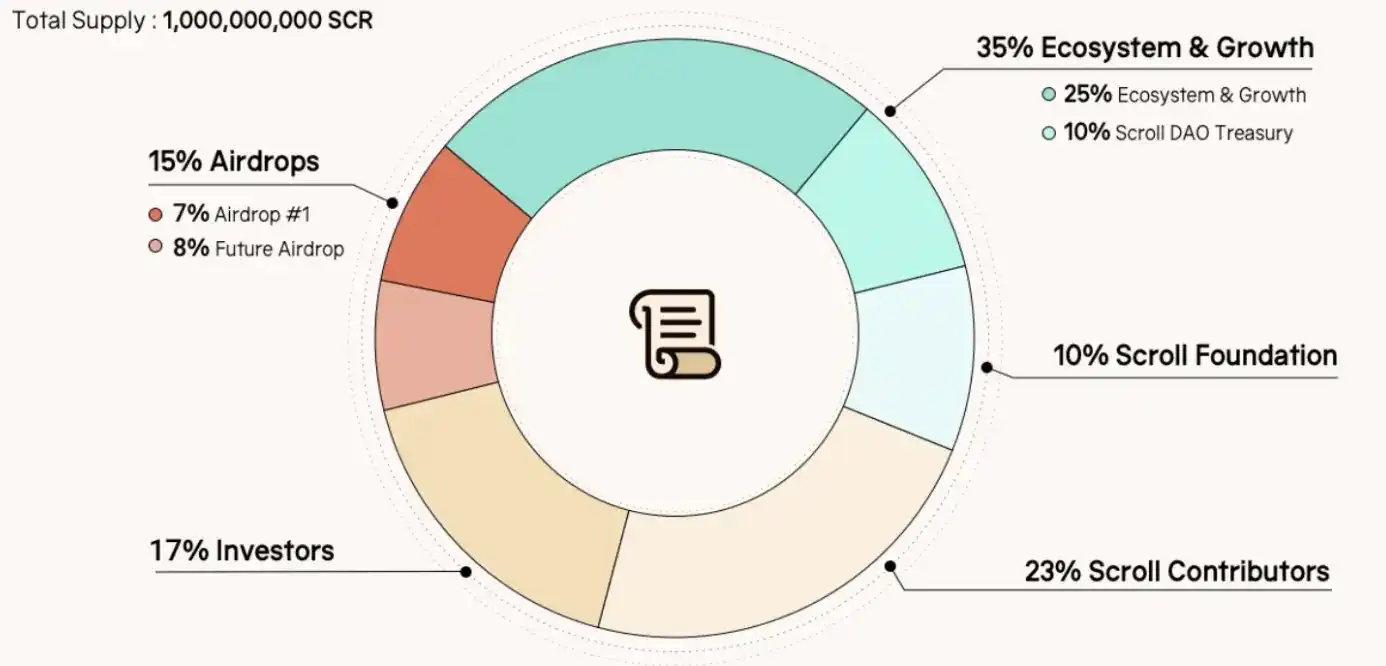
The initial circulation only accounts for 19% of the total circulation, and 5.5% is used for Binance mining. The remaining tokens all include unlocking requirements at different times. A simple arithmetic problem, who will take over such a large and continuous selling pressure? Assuming that the project owner has a good reputation and its own hematopoietic ability, the selling pressure will also be partially fed back, further smoothing the entire price curve. The fact is that after the airdrop and TGE, the data was almost cut in half in a short period of time. What's worse is that this fundamental collapse can be almost 100% foreseen before listing on Binance.

The problem is:
1) Everyone knows that this is a fundamental that will definitely continue to be bad, and the token distribution is extremely unreasonable, with a very bad reputation and easy to form continuous control and selling pressure. Why did Binance choose listing?
2) Where does Binance's screening mechanism stand from the perspective of interests?
Combining these two questions, at least one conclusion can be drawn obviously. At least from the perspective of interests/user feelings, Binance gives people the feeling that it does not stand with users or at least not most of them stand from the perspective of users' interests.
If it really stands from the perspective of user interests, no competitor can discredit Binance, because the sustainable wealth effect in the currency circle is the greatest truth.
A more significant contrast reflects the role of users as the final pricing power, that is, the Grass project, whose financing amount is less than 1/10 of Scroll. The former currently has a total market value of more than $1 billion, while the latter has a total market value of more than $500 million.
Even in terms of the selling pressure of token unlocking, Grass's early circulation volume is not very large, but its fair and sustainable airdrops have won the project a good reputation among users, which is ultimately reflected in the fact that users continue to pay, the project continues to increase incentives for users, and then continues to feed back to users.
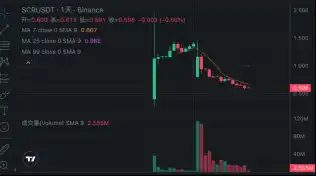
Same environment, same project, different fate. It clearly reveals that no matter how advanced the technology is, or how brilliant the financing background is, even if there is a bonus from a top exchange, if users do not pay, the collapse of this harvesting chain will only get faster and faster, and every collapse is consuming the foundation of Binance, and the transfer of pricing power will also accelerate simultaneously.
2. Transfer of liquidity: Human nature pursues greed, but the premise is fairness and transparency; on-chain Dex has incomparable advantages.
Whether the currency circle is a big casino or not, it absolutely applies the basic rules of casino survival: I am not afraid of you making money, I am afraid that you don't play. Contrary to most people's intuition, almost all regular casinos in Macau will make great efforts in fairness, justice and openness to dispel gamblers' concerns. Casinos never rely on cheating to make money, but rely on the continuous amplification of statistical advantages.
In terms of fairness, transparency and justice, decentralization naturally has stronger advantages than centralization. The growth of Dex is mainly subject to the interactive experience, but in the face of the wealth effect, the impact will be minimized. The data confirms this. According to data from The Block & Defillama, by October, the ratio of spot trading volume of Dex to Cex had risen to a historical high of 13.84%, and this ratio is steadily expanding.
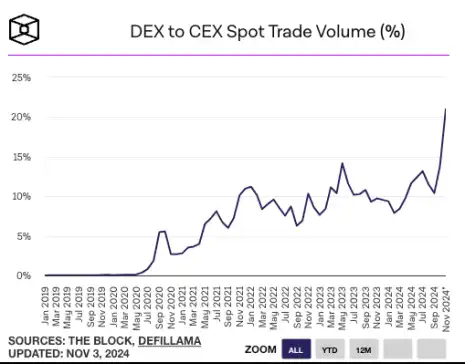
Not to mention that due to the recent popularity of MEME, platforms such as Pump.fun have successively produced several MEME tokens worth more than $1 billion, with more than 670 transactions per day and an average daily trading volume of more than $1 billion.
The data reflects that liquidity is being snatched away little by little by hot spots such as Dex or MEME on the chain. Although the risks on the chain are higher for novice players, few people question the problems of decentralized platforms because they provide a relatively fair gaming environment.
The important difference between Cex and Dex is that the foundation for the establishment of centralized exchanges is that users return the power to screen tokens to the platform. Either you set no threshold or a lower threshold for all, or you set a higher threshold but with sustainable value. The worst case scenario is that you set a higher threshold but choose a junk project.
There is another misunderstanding here. Some centralized exchanges are prone to fall into the elite agency model. They do not think that they have chosen a garbage project. Most of the people in charge of this type of business have good resumes and institutional backgrounds. They are overly superstitious that capital can change the world and have unrealistic fantasies about so-called technology. They naturally tend to believe in institutions, or think that they can see the future direction of the industry clearly, and call it: this is the direction of the industry.
Still taking Scroll as an example, except that the technology seems to be very advanced and the financing is very good, where is its real value, and is it really irreplaceable. If it is not irreplaceable, what is the logic of choosing it. The so-called strict screening mechanism, if the reputation of the project and the pattern of the founding team are not considered, what is the meaning of this screening.
Binance's listing marks the success or failure of a project. This is the power given to Binance by users. If this power is not used well, then the user's doubts are naturally justified.
Behavioral economics master and Nobel Prize winner Chad Thaler has a famous theory: people’s weighing of benefits and harms in decision-making is unbalanced, and they consider “avoiding harm” more than “seeking benefits”.
From “anti-VC coins” to “MEME fever”, it is actually a vivid display of this theory. Within the range visible to the naked eye and telescope, the risk of buying VC coins continues to increase. If the time cost of being locked in and the upward space of high valuation are taken into account, its profit space becomes infinitely narrow, so the VC coins on Binance have become an event where “harm” outweighs “benefits” for ordinary users.
Perhaps you will say that Binance is just a place to provide transactions, just like a casino, it is an objective and neutral third party, and transactions naturally have winners and losers. However, the objectivity of facts cannot replace objective facts. The truly objective fact is that even casinos will not launch a game where you will lose every time you bet. In the case of VC coins, almost no retail investors have ever won, and there is no dispute about the consensus on this point at this stage. In addition, from the perspective of project screening, if a truly objective and neutral exchange is concerned, the rules should be transparent, just like the New York Stock Exchange and Nasdaq. At present, in this industry, the listing of coins on the top exchanges is still a black box, relying on people's speculation and inference, so it has supreme power; some exchanges' listing of coins is semi-transparent, providing a state close to 0 threshold (you can get on the market by spending money). Both are undesirable, because the former specializes power, and even if there is no corruption, it is easy to breed arrogance and a small circle of interest communities; the latter monetizes power and charges high tolls, which is easy to increase project costs, thereby slowing down innovation.
From a broader perspective, the current industry crisis is obvious. Without greater liquidity overflow, BTC is independent of the entire crypto market, and it is gradually controlled and priced by Wall Street capital. Other copycats, like Ethereum, either cannot find a way forward or turn to MEME. The sense of worthlessness and nothingness shrouds the entire currency circle, especially when most value coins have been falsified time and time again, more users have lost confidence in whether the project is built. After all, the largest exchanges also choose to believe in these so-called project parties, not users. This confidence and nothingness collapses faster. The rise of MEME itself is a loss of confidence in the so-called narrative value of industry development.
As the de facto industry leader, Binance should shoulder more responsibilities and user expectations. Instead of pushing the problem to its peers, it is better to face up to its own mechanism loopholes. What users need is fairness, and damn fairness. Like Scroll, Binance took a large proportion of the chips at almost no cost. It is difficult to say that this is fair, and it is also difficult to say that this is beneficial to the development of the project and the industry.
From the perspective of traffic and status, you can say that there is no problem, but don’t forget where the traffic comes from, and an old idiom: water can carry a boat, but it can also overturn it.
Do we still need Binance? There is no doubt that we do. No one denies the huge contribution Binance has made to the industry. We still believe in the professional ethics of CZ, He Yi and other industry mainstays. However, as mentioned above, this is not an individual problem. It involves the operation of the entire mechanism and the ecological problems of the macro environment. How to solve these problems is still unresolved and there is no clear path yet. What we expect is that Binance really stands on the side of users and uses its own influence and huge energy to reverse the current situation, so that users can rebuild their confidence in "value coins" and the entire industry.
From Binance's own perspective, whether users can do without Binance and whether irreplaceability is declining is a question worth thinking about by Binance's management, especially in the industry environment where Dex trading volume continues to rise, on-chain MEME continues to be hot, supervision tends to be strict, and competition becomes increasingly fierce.
Remember that in history, no company has gone bankrupt because of too many rumors. Most of them are because the rumors are confirmed and finally decayed due to arrogance.
Recommended
The Wall Street Journal: How is AI Trading Stealing the Limelight from Cryptocurrency?
Aug 15, 14:00
Tencent Still Has a Dream
Aug 15, 11:27
To Catch North Korean Hackers, They Set Up a Fake Project
Aug 15, 10:00
From Litigation to Settlement: Positive Signal Released by HTX's Negotiation with FCA
Aug 14, 19:32
11,742 Shipping Addresses Exposed Alongside Trezor Orders
Aug 14, 19:01
Founder Interview: FOMO Creator Explains How They Added 30,000 Users in One Day and Became One of the Fastest-Growing Crypto Apps
Aug 14, 18:37