Trump Victory, Cryptocurrency, and DeFi Opportunities

Original Article Title: 2024 U.S. Election For Crypto: A Potential Turning Point from Tight Regulation and Ban to Support and Innovation
Original Article Author: HTX Ventures
Original Article Translation: zhouzhou, BlockBeats
Editor's Note: This article focuses on the impact of the U.S. election on the cryptocurrency market, especially on the potential drive for prediction markets and BTCFi. By interpreting innovation in prediction platforms like Polymarket, DeFi, and the BTCFi space, it explores the possible opportunities for crypto projects in terms of policy, regulation, and technology. The article also discusses the incentives for developer innovation from Bitcoin technology upgrades (such as OP_CAT) and their significance for the entire crypto market.
The following is the original content (reorganized for easier reading comprehension):
Full Article Summary:
Singapore / November 4, 2024—Since the inception of Bitcoin, it has gone through three election cycles and has become a key issue in the 2024 U.S. presidential election. With the Bitcoin concept proposed by Satoshi Nakamoto in its whitepaper deeply rooted, supporters have now formed an undeniable voting bloc, becoming a significant force in American politics.
This article analyzes the various factors that make Bitcoin and cryptocurrency increasingly important in elections, including real wage decreases due to inflation, challenges to the U.S. dollar's global dominance, the growing interest of U.S. voters in cryptocurrency, and the current government's regulatory strategy towards the crypto industry.
The article further explores the different stances of presidential candidates on cryptocurrency and how their attitudes are shaping future policies and market expectations. Additionally, this article discusses the role of prediction markets, particularly the role of Polymarket in the election, potential innovative paths for prediction markets, and how elections influence the crypto market through macroeconomic liquidity flows.
Finally, this article predicts the potential impact of the election results on crypto companies. If Trump wins, a clearer and more lenient regulatory environment is expected to be implemented, supporting the incubation and growth of crypto startups. This environment will also provide an IPO path for crypto companies, secure exits for traditional investment institutions, enhance wealth effects, and improve the financing environment. At the same time, DeFi will enter the mainstream financial market more quickly, and innovation and development in BTCFi will also accelerate.

The Significance of Bitcoin for the United States
1. Growing Demand to Combat Inflation
A survey by Forbes shows that real wages in the United States (adjusted for inflation) have remained almost unchanged since the mid-1980s. Adjusted for inflation, the average hourly purchasing power in the U.S. today is nearly the same as it was in 1978. This has exacerbated wealth inequality: the upper class has become wealthier by holding a significant amount of assets, while the wealth of the working class has shrunk.
Since the 2008 financial crisis, an increasing number of people have seen Bitcoin as a potential tool to combat inflation and economic uncertainty, especially offering hope for financial independence to the middle class. Bitcoin's decentralization and limited supply make it an alternative asset under government and central bank intervention. Despite the U.S. dollar remaining the global reserve currency, as investor demand for hedge assets grows, Bitcoin's appeal continues to rise. Particularly for the increasingly burdened working class, Bitcoin is seen as an effective tool to combat inflation.
Regardless of whether Trump or Harris wins the presidential election, U.S. fiscal policies could lead to larger budget deficits. The Congressional Budget Office predicts that over the next decade, the federal budget deficit will reach 6.2% of GDP. If Trump reinstates the 2017 tax cuts and further reduces tax rates, the deficit may rise to 7.8% of GDP. In contrast, Harris plans to raise the corporate tax rate to 28%, but her other reform proposals could still push the deficit up to 6.5% of GDP.
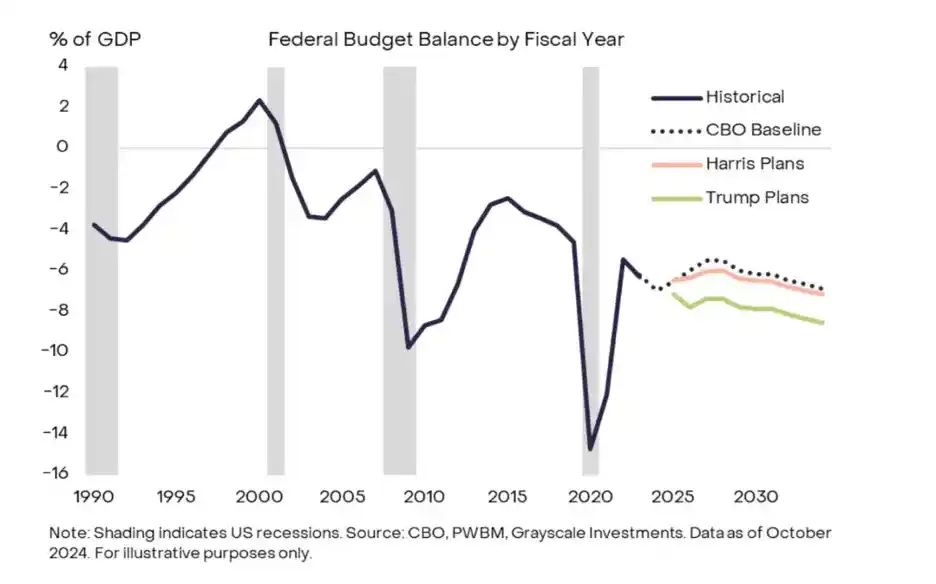
Over the past 25 years, U.S. federal debt has surged from 40% of GDP to 100%, and this ratio could rise to between 124% and 200% over the next 10 to 30 years. The upcoming presidential election could trigger a "sensitive moment" where the bond market, realizing the severity of the debt issue, may demand higher returns to offset financing risk. This moment could lead to a bond market collapse, triggering a financial crisis.
Both Trump's tax cut policy and Harris's tax increase policy could further exacerbate America's fiscal deficits and debt burden, increasing the risk of financial market turmoil. Faced with such high levels of debt, solutions are limited, and perhaps inflation to dilute the debt might be the U.S. government's only way out. However, the adverse effects of inflation will erode the purchasing power of the working class and worsen wealth inequality.
It is worth noting that the pending Bitcoin Act, awaiting approval by Congress, could provide a new avenue for addressing the U.S. debt issue. The act aims to integrate Bitcoin into the broader financial system, potentially attracting a significant amount of private and institutional capital to help stabilize the U.S. debt structure and may even bring some level of stability to the global financial system.
As a decentralized and scarce asset, Bitcoin can serve as an effective tool for governments and investors to hedge against inflation and risks, especially in the face of debt and inflation pressures, holding potential strategic significance.
2. Strengthening the Dollar's Global Influence
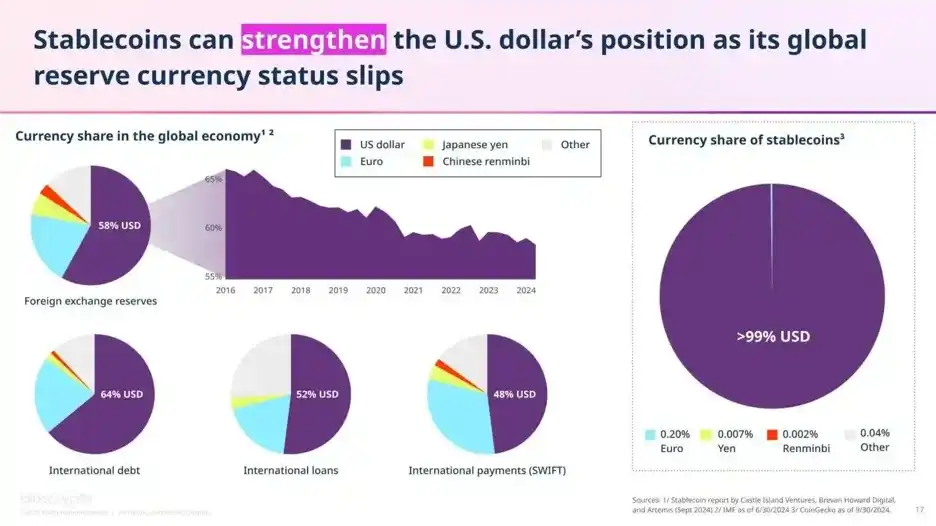
As one of the most popular cryptocurrency products today, stablecoins have become central to policy discussions, with the U.S. Congress considering several related bills. A key driver behind these discussions is the belief that stablecoins can help expand the international influence of the U.S. dollar, particularly as the dollar's status as a global reserve currency faces challenges.
Currently, over 99% of stablecoins are pegged to the U.S. dollar, far surpassing the second-ranked euro at 0.20%. The exponential growth of stablecoins further solidifies the dollar's dominance in the digital asset market and offers the U.S. a new way to maintain its advantage in the global financial system.
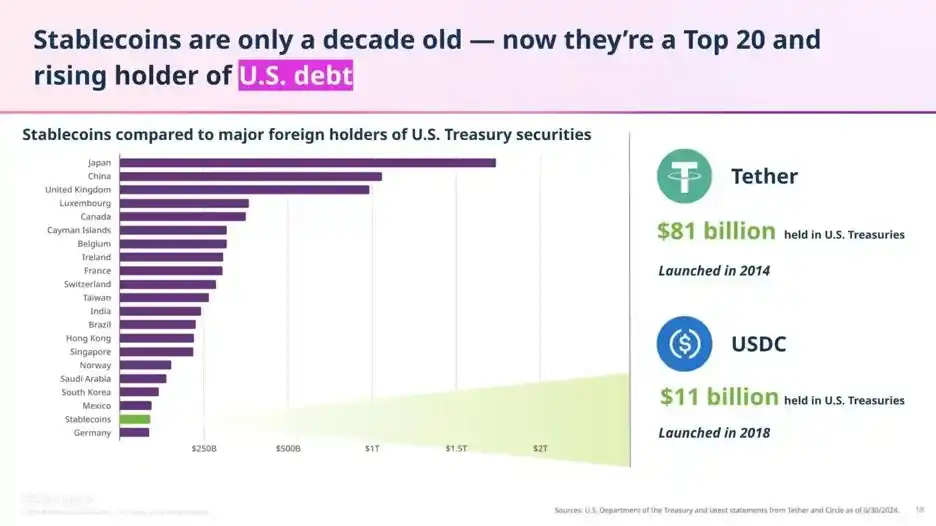
In addition to enhancing the dollar's international influence, stablecoins could also bolster the U.S.' domestic financial foundation. Despite being launched only a decade ago, stablecoins have already become a top 20 holder of U.S. Treasury securities, surpassing countries like Germany. This indicates that stablecoins not only expand the dollar's global dominance but also, by absorbing a significant amount of Treasury securities, become a vital part of the U.S. financial system, providing additional liquidity support to the economy.
Rising Voter Interest in Cryptocurrency
According to a national survey conducted by Grayscale in partnership with Harris Poll, over half of voters expressed a preference for candidates who understand cryptocurrency rather than those who do not.
Meanwhile, swing state voters' interest in cryptocurrency has significantly increased. Since the 2020 election, two key battleground states expected to see fierce competition—Pennsylvania and Wisconsin—have surged to the fourth and fifth positions in cryptocurrency search interest rankings on Google. Michigan, on the other hand, ranks eighth in this metric.

Escalation of Regulatory Pressure on Cryptocurrency Companies by the Biden Administration
Since the Biden administration took office, it has been committed to strengthening regulation on cryptocurrency and has pledged to establish a more stringent regulatory framework. Measures taken include filing an unregistered securities offering lawsuit against Ripple, imposing additional tax reporting requirements on cryptocurrency companies and Bitcoin miners, and levying capital gains tax.
Following the FTX collapse, the government intensified its efforts to crack down on major cryptocurrency companies and made several significant legal advancements. For example, Zhao Changpeng, the former CEO of Binance, the world's largest cryptocurrency exchange, was sentenced to four months in prison as part of U.S. and international litigation. Subsequently, the U.S. Securities and Exchange Commission filed a lawsuit against Coinbase, alleging that it operated an unregistered securities exchange while operating a cryptocurrency asset trading platform. If successful, this case could pose a significant threat to Coinbase's business model, with other companies facing lawsuits including the cryptocurrency exchange KuCoin.
The Central Role of Cryptocurrency Company Donations
By 2024, cryptocurrency companies have become major contributors to U.S. political donations. Coinbase and Ripple are the top corporate political donors this year, contributing nearly 48% of the total corporate donations. Fairshake, a Super Political Action Committee (Super PAC) founded by former aide to the Governor of New York Josh Vlasto in 2023, has raised over $2 billion to support pro-cryptocurrency candidates, making it the highest-spending PAC in this election cycle.
Fairshake aims to elect pro-cryptocurrency candidates and combat skeptical opponents, receiving support from companies such as Coinbase, Ripple, and Andreessen Horowitz. These funds have influenced not only presidential candidates' policies but also driven congressional election strategies supporting cryptocurrency. As a result, the cryptocurrency industry has moved from behind the scenes to the forefront, becoming a significant force in American politics.
An illustrative example occurred in March this year when progressive Democratic star Katie Porter raised over $30 million in the California Senate race and was expected to win. However, because she adopted Elizabeth Warren's political stance and had stood with Harris on banking regulation issues, Fairshake identified her as an "ally of the anti-crypto movement."
During the California primary, Fairshake spent over $10 million opposing Porter, undermining her support among young voters. Through Hollywood billboards and targeted messaging against her, Fairshake claimed Porter was misleading voters in support of pro-corporate legislation. As a result, her campaign funding was affected, and she ultimately did not advance to the fall election.
As a result, many Democratic candidates have added a section supporting crypto to their campaign websites, seeking funding from crypto PACs, which now wield significant influence over candidates' stances.
Candidate Policy Proposals
Harris
Harris has had limited statements on cryptocurrency policy, only saying that her administration would "encourage innovation like AI and digital assets while protecting our consumers and investors." Recently, facing lower-than-expected support among Black voters, she has introduced a series of economic security plans, including a commitment to establish a cryptocurrency regulatory framework aimed at protecting Black male crypto investors.
However, this framework targets only Black voters, lacks clear regulatory details or specific policy positions, and has thus been criticized by the crypto community as opportunistic, seen as leveraging cryptocurrency solely for votes. The current Biden-Harris administration has taken a more adversarial regulatory approach to the crypto industry, with multiple lawsuits, restrictions on traditional banking services, and vetoing bipartisan legislation.
The government is also considering imposing capital gains taxes on cryptocurrency, and while Harris's crypto policy may be more industry-friendly than Biden's, potentially improving the regulatory environment, she remains cautious on key issues such as taxation, Bitcoin mining, and self-custody, falling far short of Trump's pro-crypto stance.
Trump
The Republican Party has consistently emphasized individual freedoms, a value that aligns with the decentralized principles of cryptocurrency. In its party platform, the Republican National Committee pledges that Trump will defend Bitcoin mining rights and "ensure every American has the right to self-custody digital assets and can freely transact without government surveillance." In contrast, Democrats typically advocate for expanding government power and regulation, potentially causing ideological friction with the crypto community.
Trump has shown a keen interest in the digital asset industry, stating that his goal is to make America the "global crypto hub and Bitcoin superpower." He supports Bitcoin mining and pledges to protect self-custody rights. Additionally, during his campaign, Trump once used Bitcoin to buy burgers for restaurant customers and criticized the Securities and Exchange Commission's (SEC) tough stance on crypto, vowing that if reelected, he would appoint a crypto-friendly chairman. Trump has even launched his own DeFi project—World Liberty Financial.
Trump has proposed a series of crypto policies, including:
· Establish a Strategic Bitcoin Reserve:
Trump stated that the government will "hold all Bitcoin currently held or acquired in the future by the U.S. government" as the "core of a strategic national Bitcoin reserve." As of October 2023, the U.S. government holds over $5 billion worth of Bitcoin, primarily seized through criminal investigations. However, it is currently unclear how this Bitcoin reserve will be utilized, its feasibility, and whether the crypto industry will widely accept this move.
· Establish a Crypto Presidential Advisory Council:
Trump pledged in Nashville to establish a "Bitcoin and Crypto Presidential Advisory Council," stating that the council will be formed by "industry supporters" rather than "crypto skeptics" to set rules.
· Ban the Federal Reserve from Issuing a Digital Currency:
While many countries are advancing central bank digital currencies, this trend has faced resistance in the U.S. crypto community. Despite the Federal Reserve not yet deciding on issuing a digital dollar, a report released in January 2022 detailed the potential costs and benefits of a CBDC.
Trump has openly opposed this proposal, calling it a "dangerous threat to freedom." In May 2024, the House of Representatives passed a bill to ban the Federal Reserve from issuing a CBDC, although the bill still needs further advancement to become law. It is worth noting that while Trump supports cryptocurrency, his tariff policies may lead to economic uncertainty. The long-term impact of his policies on the market and the crypto industry remains to be seen.
Potential "Divided Government"
Currently, a period of political instability seems almost inevitable unless one party can control both houses of Congress and the presidency.
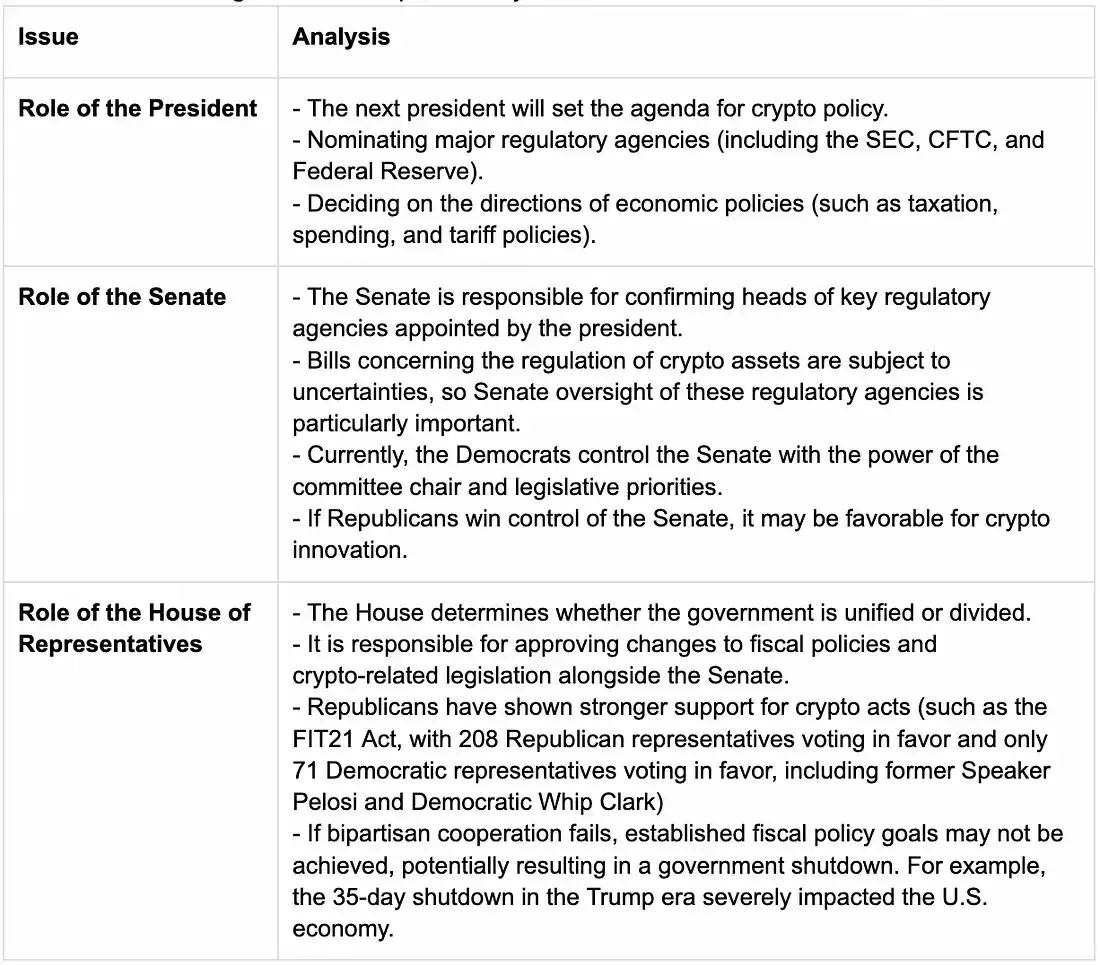
As of October 25th, Polymarket data shows significant discrepancies in the odds of each party winning the presidential election, Senate election, and House of Representatives election. The only relatively possible outcome at the moment is for the Republican Party to control the Senate. Meanwhile, the likelihood of a "divided government" is also high—meaning the presidency and the Senate will be controlled by different parties. The last divided government occurred during Obama's administration, and both Biden and Trump governed without a divided government.
This political landscape typically leads to policy gridlock as the president and the Senate must compromise on major legislation and appointments. If the Republicans achieve a full victory, they may enact new laws within three to six months, which would be a favorable outcome for the cryptocurrency market, as Republicans generally advocate for a more lenient regulatory framework for cryptocurrency.
On Wednesday, September 25, 2024, the U.S. Congress passed a temporary government funding bill, ensuring that government agencies would stay funded through December to avoid a shutdown. The bill deferred final spending decisions until after the November 5 presidential election. In other words, from December until the new Congress is sworn in on January 3, there will be some limitations on the government's fiscal budget. This means that during this transition period, the President's power to influence fiscal policy may be limited, and the formal budget can only be passed after the new House of Representatives takes office.
Potential Changes in the U.S. Securities and Exchange Commission Leadership
Since Gary Gensler took office as SEC Chairman, his tough regulatory stance has sparked opposition from the cryptocurrency community. While he has made some progress in combating illegal security issuances, his strict enforcement has been met with protests from many crypto companies.
Trump has publicly stated that if re-elected, he would "fire" Gensler and push the SEC to take a more pro-cryptocurrency stance. Traditionally, SEC chairs tend to resign when a new president takes office. If the Harris administration comes into power, adopting a position similar to the opposing camp to garner industry support would not be surprising. Therefore, whether Harris or Trump is elected, the SEC leadership could undergo significant changes.
Macroeconomic Liquidity: Inevitable Volatility and the Decisive Role of Quantitative Easing Levels
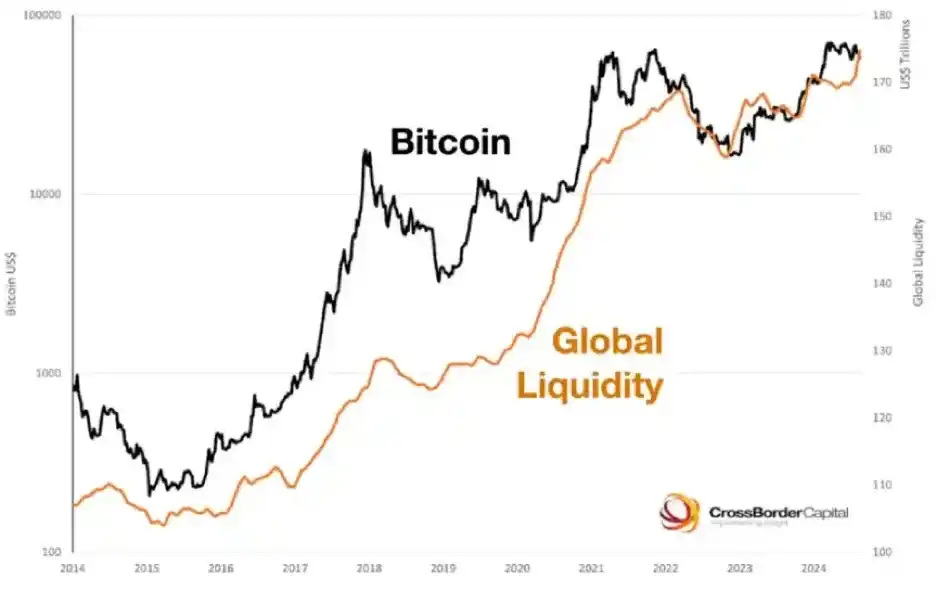
When the Fed cuts rates and global capital liquidity rises significantly, Bitcoin's price tends to trend upward, indicating that macroeconomic liquidity still has a decisive impact on the cryptocurrency market.
In 2020, in response to the COVID-19 pandemic, the Trump administration initiated an unlimited quantitative easing policy, injecting a substantial amount of funds into the cryptocurrency market. On March 15, 2020, the Fed cut the federal funds rate by 1 percentage point to between 0% and 0.25% and launched a $700 billion quantitative easing plan. Subsequently, the Fed announced the removal of QE limits and pledged to conduct asset purchases as needed, thus initiating unlimited quantitative easing. This move brought significant liquidity to the crypto market.
On October 21, 2024, during a town hall meeting in Lancaster, Pennsylvania, Trump reiterated that if re-elected on November 5, he would significantly lower U.S. interest rates. This commitment may once again drive the prices of cryptocurrencies such as Bitcoin, especially in a scenario of further increased liquidity.
Web3 Prediction Markets Outcompeting Web2 Competitors
Since its launch in 2020, Polymarket has quickly risen to become a leader in the space, capturing 80% of the volume driven by bets on the U.S. presidential election. As an on-chain developed application, Polymarket competes against its counterparts in traditional markets and holds the largest market share, a rarity in the industry. Polymarket allows users to speculate and bet on future event outcomes related to sports, politics, business, science, and more. The platform saw its first major attention during the 2021 U.S. presidential election, handling 91% of the total betting volume, equivalent to $3.5 million in bets.
Polymarket has faced numerous challenges, including reaching a $1.4 million civil monetary penalty and settlement agreement with the U.S. Commodity Futures Trading Commission, after which it ceased its official operations in the U.S. and geofenced U.S. users from accessing the website. CFTC Chairman Rostin Behnam warned that if its "footprint" in the U.S. was significant enough, it would have to register its derivative contracts or face enforcement action.
Prediction markets have gradually evolved into a broader financial tool, moving beyond mere speculation. As Polymarket expands, the impact of prediction markets has extended to public opinion, financial hedging, and business decision-making across various domains.
How Prediction Markets Operate
A prediction market is a derivative market where participants bet on the outcome of events. These markets often use binary options. For example, in a binary market, a question like "Will a Bitcoin spot ETF be approved?" can be answered with "Yes" or "No." The price distribution of "Yes" or "No" is determined by market participants' predictions and bets, with the sum of the two prices being one dollar or slightly above one dollar.
On the expiration date, when the event's outcome is revealed, the share price will converge to either $0 or $1. Participants who predicted correctly will receive a $1 reward, while those who predicted incorrectly will receive $0. This is how gains and losses are determined.
Aside from cryptocurrency, offshore centralized providers often restrict the amount wagered on specific outcomes, akin to sports betting. This limits individuals from fully leveraging their insights, with the ultimate outcome usually controlled by centralized operators. On-chain prediction markets eliminate these barriers as smart contracts and decentralized ledgers create a transparent global market, ensuring these platforms are fair and tamper-proof.

Polymarket's order book operates on a hybrid decentralized model. Orders submitted by users are sent to Polymarket's operators, who match them off-chain. The foundation of this trading system is a custom trade contract that facilitates atomic swaps (settlement) between signed limit orders, binary outcome tokens, and collateral assets (ERC20).

In addition to the aforementioned binary markets, Polymarket offers categorical markets and scalar markets. Categorical markets allow betting on multiple options, with each option resolving to either $1 or $0 based on the outcome. For example, a market predicting the 2025 NBA champion could include options like the Celtics, Thunder, Knicks, and Nuggets.
Given the uncertainty early in the season, users can bet on multiple teams. Scalar markets, on the other hand, differ from the first two types, with profits and settlements based on where the final result value lies within a predefined range.
Product Iteration in Prediction Markets
Augur was one of the earliest blockchain prediction markets. By 2018, it had reached a $400,000 trading volume, a significant figure considering the on-chain activity at the time, demonstrating the market demand for on-chain prediction markets. However, Augur failed to maintain a stable user base, primarily due to its complex and vulnerable-to-malicious-attacks mechanism.
Unlike Polymarket, Augur allows anyone to create markets by staking its governance token, REP. Augur's system is designed to nullify a market if any of its fundamental components (market definition, expiration date, or resolution conditions) are detected as incorrect during the market creation.
Therefore, attackers could intentionally create flawed markets with the intention of invalidating them and profiting from the situation. At the same time, Augur's permissionless market creation has led to several controversial events, such as markets like "When will a certain singer die?"
In order to attract users during the early stages of application development, Polymarket internalized the market creation process, selectively conducting centralization operations. By providing a user-friendly market and striving to avoid ethical controversies, Polymarket established a stable initial user base. This selective centralization strategy aims to help successfully attract early users while ensuring the transparency and traceability of core trading activities.
Prediction Markets Break Boundaries and Go Mainstream
According to the Efficient Market Hypothesis, asset prices in capital markets rapidly and fully reflect all information held by market participants. Therefore, prediction markets are always efficient, with the potential to address the problem of inaccurate predictions, that is, market inefficiency, and achieve accurate forecasting.
The founders of Polymarket pointed out that the platform was launched in response to widespread errors and misinformation during the pandemic. In fact, Polymarket effectively transformed market participants' speculative demand into a tool for collecting public sentiment data. For example, it predicted Kamala Harris would be the Democratic Party nominee and that J.D. Vance would be Trump's running mate before any formal announcements were made.
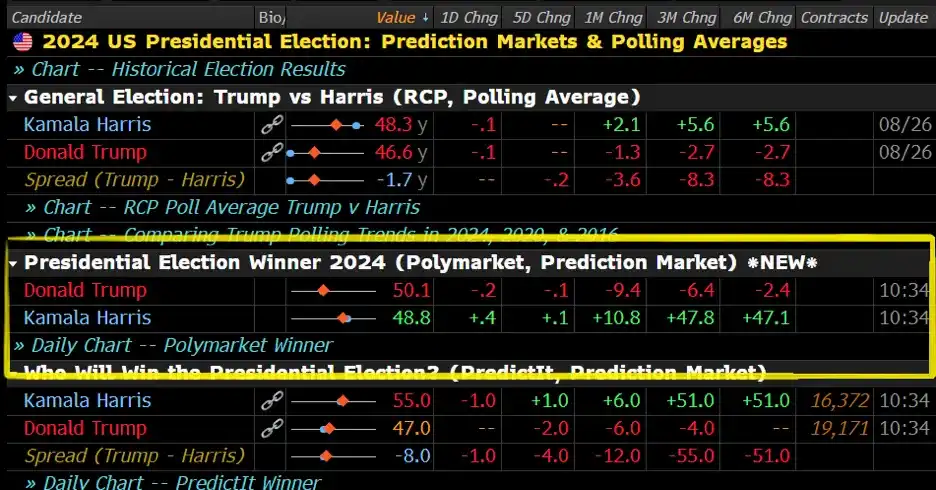
As a result, Polymarket has been widely adopted by several mainstream media outlets (even in cryptocurrency-skeptic media in mainland China) as an alternative news source. The widely purchased and used Bloomberg Terminal will even begin incorporating Polymarket data into its panel in August 2024.
Polymarket is also integrating with content platforms. On July 30, 2023, the popular content subscription platform Substack announced the integration of Polymarket's prediction markets, launching the new "Substack The Oracle by Polymarket."
On "The Oracle," readers can find insights and analyses from thousands of active markets on the Polymarket trading platform. Polymarket's "The Oracle" regularly summarizes significant markets and key statistics, providing in-depth analysis of some of today's hottest topics.
The Future Direction of Prediction Markets
Currently, Backpack Exchange has launched prediction tokens for the U.S. presidential election. SynFutures and dYdX have introduced election-related leveraged trading products, incorporating advanced order functionalities (such as limit orders and stop-loss orders) to help users manage risk. This leveraged trading allows users to operate larger positions with a smaller initial investment, thereby amplifying potential returns.
dYdX is particularly focused on perpetual contracts for the Trump Prediction Market, allowing traders to participate in the market with 20x leverage and engage in long or short trades. This flexible trading structure enables users to take advantage of every market swing and potentially earn significant returns in a short period. Overall, the combination of leverage trading and prediction markets is still quite complex for the average user and is more suitable for professional traders.
Trump Win Could Encourage Crypto Companies to List in the US
Under the Trump administration, there will be a clearer regulatory framework and a more relaxed regulatory environment, reversing the current trend of crypto companies fleeing the US and blocking US IP addresses. At the same time, according to Bloomberg, several crypto-related companies such as Circle Internet Financial, Kraken, Fireblocks, Chainalysis, and eToro may go public in the coming years, and other eligible crypto companies are also expected to follow standard IPO procedures.
Looking back at the Biden administration, due to the strict regulatory stance taken by the current Chair of the US Securities and Exchange Commission, Gary Gensler, only a few crypto companies have completed IPOs in recent years. Therefore, it has become more challenging for crypto companies to secure mainstream institutional funding. Despite the Coinbase IPO in 2021 attracting traditional funds to establish crypto divisions, Coinbase remains the only crypto project listed on the Forbes 2024 Midas List.

DeFi and BTCFi Will Benefit First
Although Trump's own DeFi project—World Liberty Financial (WLFI)—sold only 4.3% of its tokens and faced criticism for its lack of utility, this reflects his interest in DeFi.
In DeFi, BTCFi stands out for its ease of consensus building and legitimization, with a stronger foundation ensuring its continuous growth.
Bitcoin remains the biggest common denominator between the crypto industry, Wall Street, and the US Securities and Exchange Commission. The core of BTCFi lies in leveraging BTC through various operations such as staking, lending, trading, and derivatives. Over time, the value of BTCFi will grow to multiple times that of BTC, reflecting trends in other major asset classes. However, this development requires a favorable external environment over a relatively extended period. If Trump wins the election, this process may accelerate.
Cryptocurrency companies developing BTC financial tools will be incentivized and able to operate in a more lenient regulatory environment, thereby solidifying BTC's status as a foundational asset. On the other hand, BTCFi innovation will be developer-driven, promoting various groundbreaking applications based on Bitcoin's programmability. For example, Bitcoin's upgrade in 2025, following Taproot in 2021, is expected to enable OP_CAT.
Once OP_CAT is activated, developers will be able to use advanced Bitcoin native programming languages such as sCrypt to directly build decentralized, transparent smart contracts on the Bitcoin mainnet. sCrypt is a TypeScript framework for writing smart contracts on Bitcoin, allowing developers to write smart contracts directly in TypeScript, which is one of the most popular high-level programming languages.
Furthermore, Bitcoin's current second-layer solutions may also transition to zk-rollups, and the total market potential of BTCFi is expected to exceed ten times BTC's current market value.

Many projects have already been exploring how to leverage sCrypt for development around OP_CAT. For example, the parallel chain of Bitcoin, Fractal Bitcoin, has already adopted OP_CAT and introduced the CAT protocol.
Currently, projects like Babylon, a rehypothecation project developed using Bitcoin script, and the stablecoin lending platform Shell Finance are also considering relevant development post OP_CAT release to achieve full decentralization and more sophisticated on-chain functionality, relying on the Bitcoin consensus mechanism to ensure security.
Recommended
The Wall Street Journal: How is AI Trading Stealing the Limelight from Cryptocurrency?
Aug 15, 14:00
Tencent Still Has a Dream
Aug 15, 11:27
To Catch North Korean Hackers, They Set Up a Fake Project
Aug 15, 10:00
From Litigation to Settlement: Positive Signal Released by HTX's Negotiation with FCA
Aug 14, 19:32
11,742 Shipping Addresses Exposed Alongside Trezor Orders
Aug 14, 19:01
Founder Interview: FOMO Creator Explains How They Added 30,000 Users in One Day and Became One of the Fastest-Growing Crypto Apps
Aug 14, 18:37