After reaching a new high, will Bitcoin see a sell-off?

Editor's note:This article discusses Bitcoin's price fluctuations during the election, pointing out that Bitcoin's price is closely related to Trump's chances of winning. The short-term rise is overestimated, and the actual rise has already occurred. Bitcoin's value as an inflation hedge asset will gradually become apparent, and it is believed that the price will not change much after Trump's victory, and the final long-term rise of Bitcoin will occur in 2025/2026.
The following is the original content (the original content has been reorganized for easier reading and understanding):
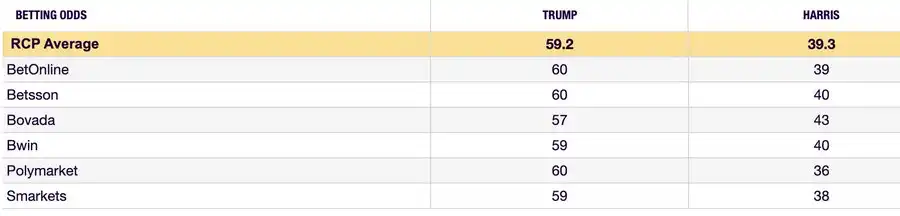
First, we start with an analysis of the odds in the betting market that currently dominates Bitcoin's price trend. FYI: At the time of this post (14:02 UTC), Trump's odds of winning are 61.7%, and the Bitcoin price is $70,047.38.
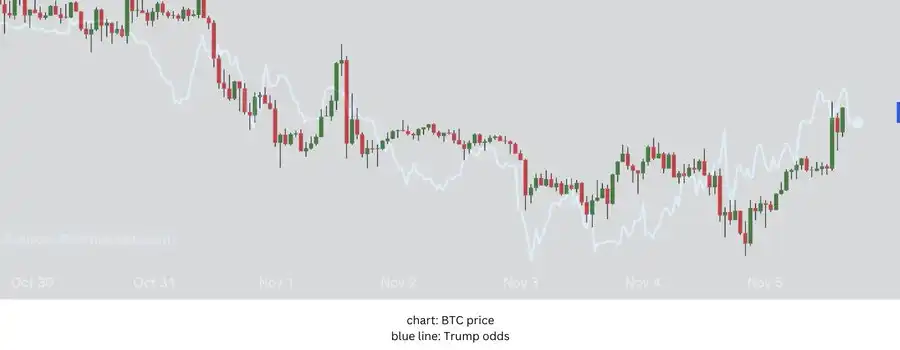
BTC Price Action vs. Trump's Odds
I will first compare BTC price action vs. Trump's odds, assuming that the Bitcoin price movements over the past few weeks were based entirely on Trump's odds of winning. Next, I will divide these price movements into four different phases.
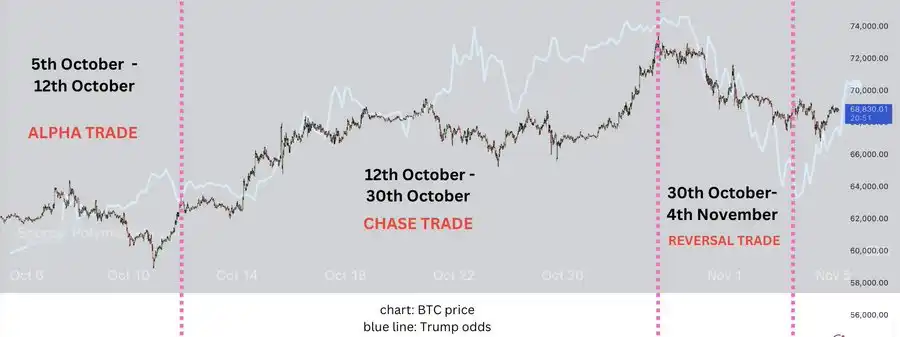
Oct. 5 - Oct. 12: First Opportunities
During this week, the mindset of market participants began to change:
Trump’s chances of winning (slowly rising to over 50% in betting markets) were not zero. In fact, the race looked closer than expected (especially after Biden’s retirement). The initial impact of this realization was that market participants began to hedge their expectations of a Harris win or reassess their previous biases.
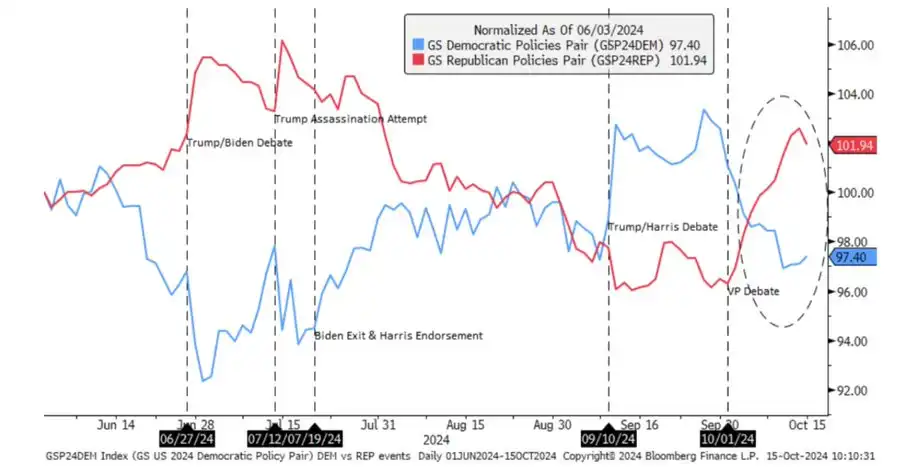
By comparing the two baskets, GSP24DEM and GSP24REP, it is clear that the market’s confidence in a Harris win was overly complacent after the debate between Harris and Trump.
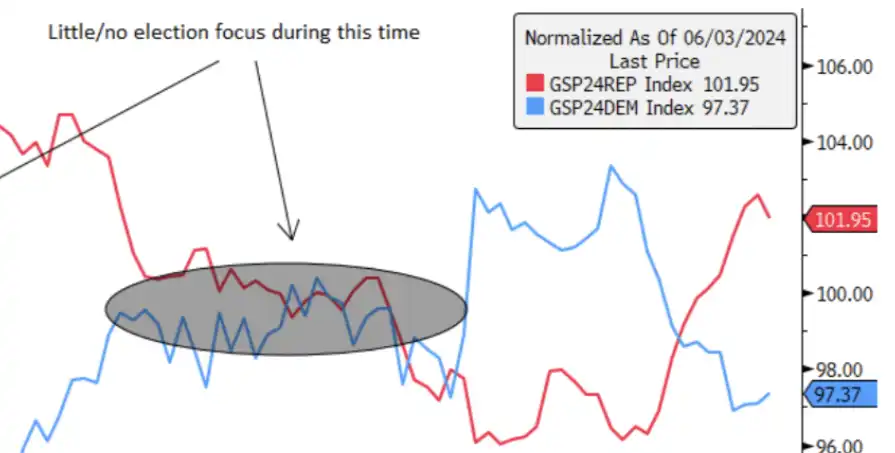
Not only did the market show complacency about the outcome, it also grossly misjudged the likelihood of a Trump victory. With little attention paid to the election in August and September, the market came close to fully pricing in a Harris victory.
As a result, here’s what happened:
1. More than 75% of people thought Harris had a very high probability of winning
2. Almost no one paid attention to hedging a Trump victory, and everyone focused on hedging index risk
3. The betting market suddenly began to tilt in favor of Trump
Another interesting thing happened in traditional financial markets at the time, which helps better understand the speed of sentiment change at the time. In the first phase (Oct 5 - Oct 12), the demand for hedging at the index level was very high. This means: everyone thought that the market index (e.g. S&P 500, NASDAQ) might fall sharply. [Remember the situation with Iran, etc.? ]
So investors bought index hedges to avoid a huge "explosive" shock. However, every time there is a lot of index hedging without actual risk, the "pain trade" tends to go in the opposite direction. So, the market starts to rise. The worst-case conflict (e.g. Iran and Israel) did not happen, and the market sentiment calmed down.
(See the image, the returns after short-term hedging are usually extreme).
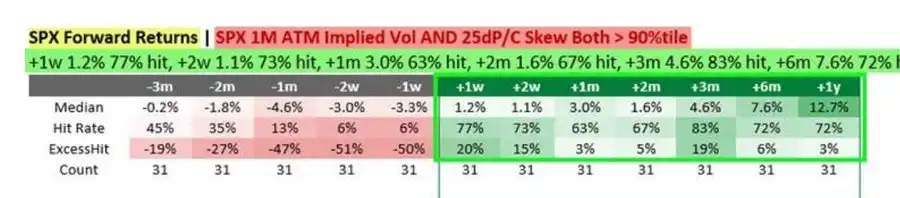
The "FUD" in the Middle East is not irrelevant, although Crypto Twitter (CT) seems to have wrongly downplayed its impact. During this week, the premium for index hedging reached unprecedented heights, and investor nervousness caused them to focus almost all their attention on the downside risk of the index and pay little attention to the "yet to come" election.
This reversal of sentiment did not occur when oil prices peaked in early October (see graphic: Oil Price Pressure), but in late October. The Trump/election trade began when investors were preoccupied with index risk (see Bitcoin's strong performance on October 10), not recently.
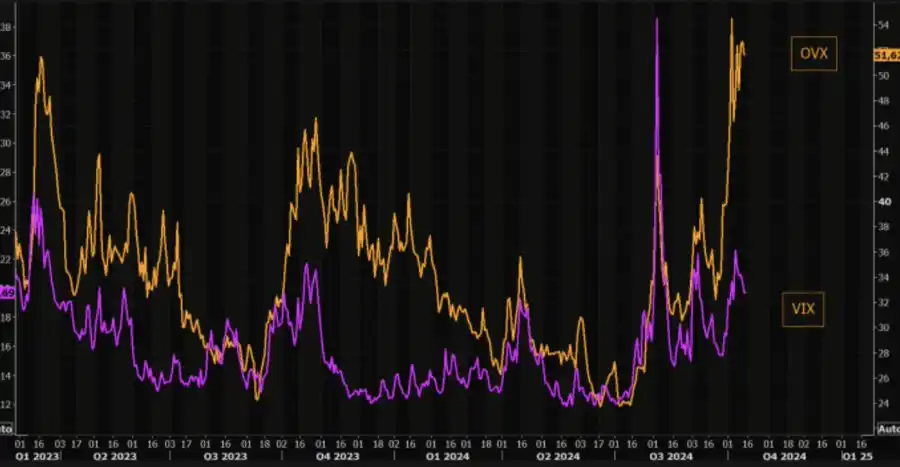
The above is to help readers understand the theme of the period from October 5th to October 12th, why there was not enough attention paid to this trade, why the "Trump Trade" became such an important dominant theme, and why there were no buyers to take profits.
In summary: the exponential risk brought by the situation in the Middle East provided a good buying opportunity for funds that dared to challenge the panic sentiment, and the "Trump Trade" began. The complacency about Harris's victory began to reverse, and the market's focus shifted to the FUD in the Middle East.
So, one thing happened: Trump sensitive stocks ushered in the most hated rally, driven by "no one owns right tail risk" and Trump's mean reversion. Bitcoin was slow to react to this sentiment change, and we were one of the last assets to follow the change, along with Trump media (a bit like MEME stocks), rising as the probability of Trump's victory increased. (The actual stock basket adjusted faster, and most Republican stocks had adjusted by early October.) Mean reversion is happening.
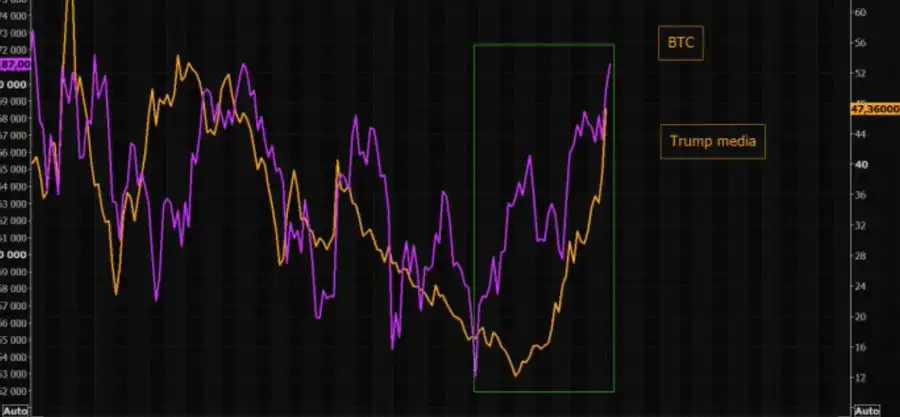
Bitcoin has shown strength since the last pullback on October 10th as market participants realize that the election trade has begun and the entire market is now in a "risk-on" state.
Oct. 12 - Oct. 30: The Rally
The amount of Bitcoin accumulated during this 18-day window just to wait for the election results is insane. This rally was basically one-way up, shorts were teased, and the pullback was completely swallowed up. ETF inflows hit new highs. It's just an insanely bullish environment.
But why is this happening? Saylor forward trading? Actually not, there was almost no volatility caused by the MSTR announcement. It all stems from the election trade, nothing more. There is no other factor (such as interest rates or inflation) that can provide buyers with this rally signal except the rising probability of Trump's victory.
During those days, the market was rising almost every day, and geopolitical risks and Nasdaq's weakness were completely ignored (for example, on October 15, the trend difference between Nasdaq and Bitcoin). The entire market showed a big green candle. All of this is closely related to Trump's chances of winning the election. Trump-sensitive stocks were bought in large quantities, and Bitcoin also rose accordingly.
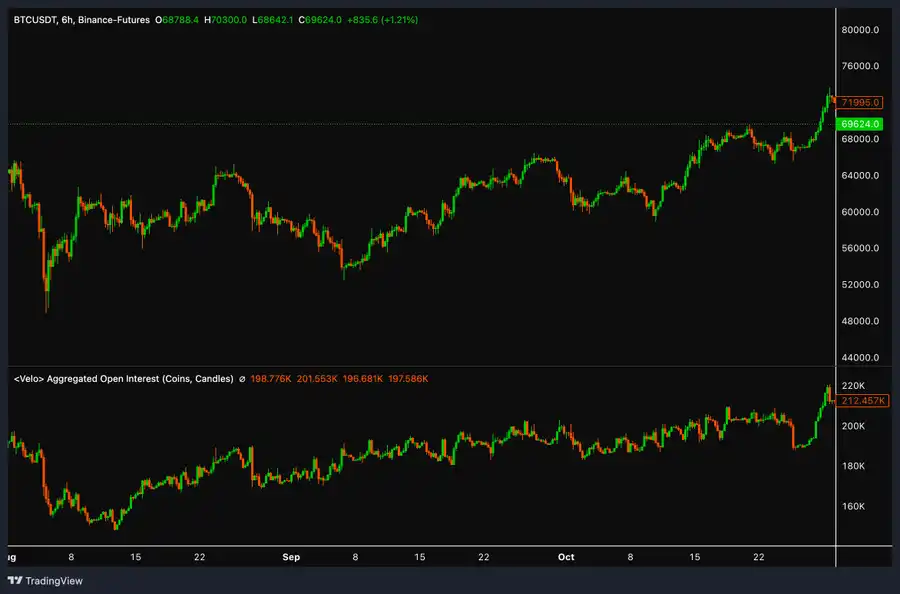
We have been chasing prices, with increasing open interest (OI), and even with the perpetual contract leading by a very large margin, Bitcoin has continued to rise without a sharp pullback, even with the Nasdaq's weakness. For example, on October 17, the price around 67K remained stable for a while, and then the spot market followed up slightly, but without a sharp pullback. This shows that there is not only short-term leverage liquidation demand in the market, but also actual demand is supporting the rise. This also suggests that this wave of rise is event-driven and investors want to enter the market at this time.
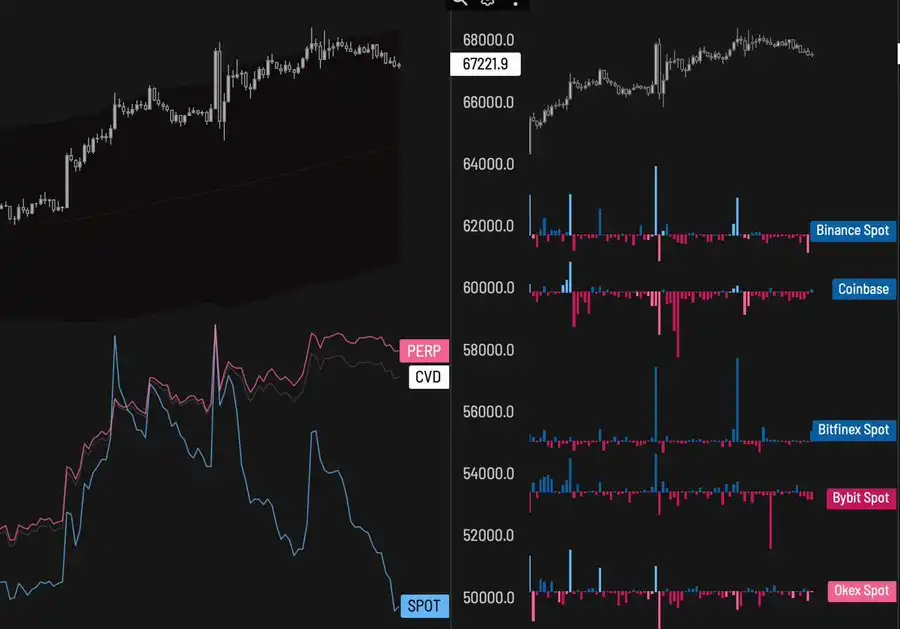
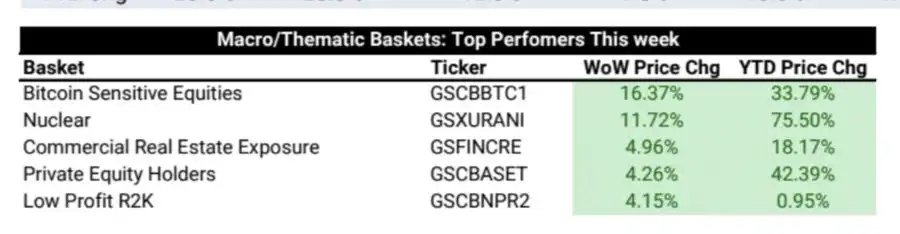
Around October 14, the market shifted from "We didn't properly consider the probability of Trump's victory" to "Trump seems to be winning, and now we have to chase the rise quickly." That week, the performance of the macro market showed a clear correlation with the Trump trade, especially the nuclear power and commercial real estate sectors, which rose with Bitcoin-sensitive stocks. Obviously, this wave of rise was not accidental, but the result of the Trump trade. The real core of this rally happened that week, and any subsequent gains were just speculative funds betting on short-term results.
After several days of continuous gains, the turning point finally occurred. October 30 - November 4: During the reversal trading, the price of Bitcoin was highly correlated with the probability of Trump's victory. For the first time since October 10, the market did not absorb the pullback as easily as before. Although the price hit a new high and technical factors (such as the improvement of open interest OI) did not change much, the market became hesitant.
This hesitation is due to the decline in the probability of Trump's victory, not the so-called "electoral risk relief". For example, the S&P 500 and Nasdaq 100 rose by 1% and 1.2% respectively, but this was not behind the relief of election risks, but the decline in the probability of Trump's victory, which led to a sharp sell-off. This correlation would have been unthinkable a few months ago, and the supply currently in the hands of market participants holding election bets is so large that it completely dominates price action.
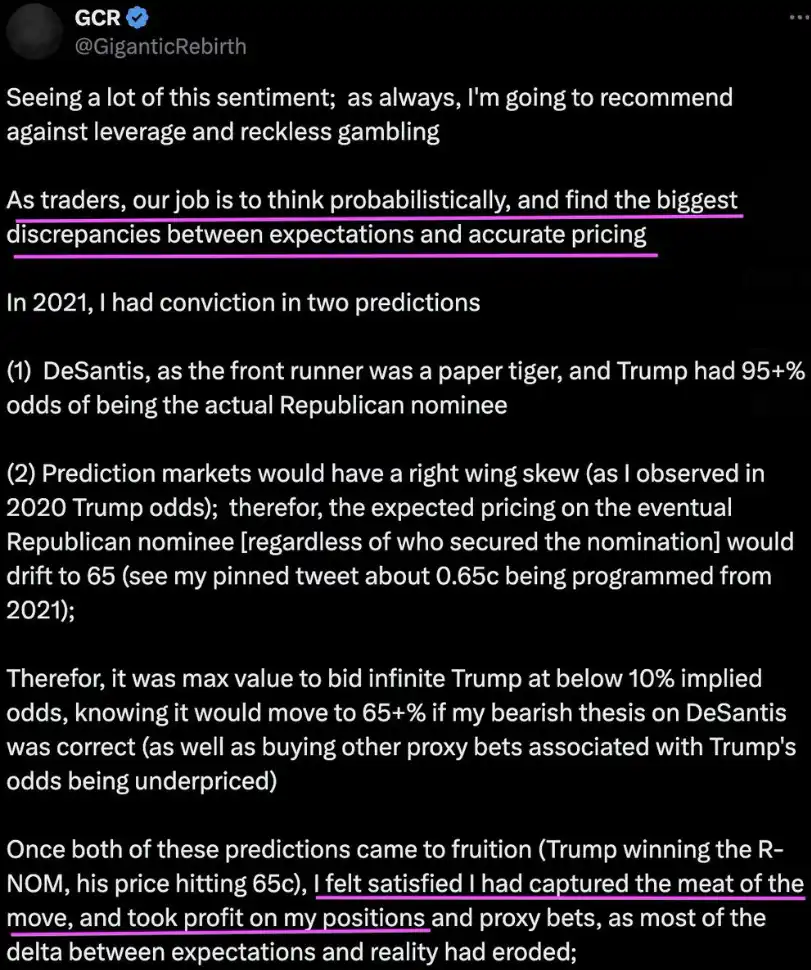
Why didn't Trump's victory - if it is so important to Bitcoin price action now - push Bitcoin above 80k? Why wouldn't Trump's victory, when every tiny price fluctuation is currently correlated with the probability of Trump's victory, directly push Bitcoin up?
Who will be the next buyers and why? Who will come out after Trump wins and say, “Yes, now is a good time to buy a lot of Bitcoin”? Of course there will be people buying, but will these people be able to outpace the investors who have been accumulating Bitcoin for more than a month and are ready to take profits once the bet works out? The answer is no.
We may see the whole rally pull back after Trump wins. So what are the short-term incentives for people to buy Bitcoin at this stage? Will Trump announce a sovereign Bitcoin fund on Inauguration Day? No. What policies need to change? The United States is already moving in a Bitcoin-friendly direction. How many times did Trump mention Bitcoin or cryptocurrencies on the campaign trail, especially compared to issues like immigration? No.
So not much will change in the short term, people are now facing a window of more than 2 months (until Trump officially takes office on January 20th), and after that, it may be a long time before we see real changes.
Traders don't bet on something that might happen at least 2 months from now, buying Bitcoin now is not a bet on Trump's presidency, but a bet on the outcome of the upcoming election. A 40% chance of Harris winning makes it less attractive to go long Bitcoin now, as you are still facing a sell-off of a large short-term supply. If the assumed reward for going long is a 60% chance of winning $4 and a 40% chance of losing $10, then going long is not very attractive from a risk/reward perspective. Therefore, many people forget that the market for this election is more like a "mowing field" full of short-term funds.
Summary of my Bitcoin price prediction: Trump wins: Initial excitement, may rush to all-time highs, but there is no support around 70k, then it falls back, and smart holders will buy Bitcoin with the logic of inflation hedge assets. Harris wins: 1 month of "early bets" on Trump's victory fail, a big sell-off occurs, more savvy holders will buy supply, and prices slowly recover to all-time highs as an inflation hedge asset.
I don't think the outcome of this election matters, I'm bullish on Bitcoin as an inflation hedge, but the upside volatility in the short term is overrated, and the core part of the market has already happened.
Recommended
The Wall Street Journal: How is AI Trading Stealing the Limelight from Cryptocurrency?
Aug 15, 14:00
Tencent Still Has a Dream
Aug 15, 11:27
To Catch North Korean Hackers, They Set Up a Fake Project
Aug 15, 10:00
From Litigation to Settlement: Positive Signal Released by HTX's Negotiation with FCA
Aug 14, 19:32
11,742 Shipping Addresses Exposed Alongside Trezor Orders
Aug 14, 19:01
Founder Interview: FOMO Creator Explains How They Added 30,000 Users in One Day and Became One of the Fastest-Growing Crypto Apps
Aug 14, 18:37