Analysis of the counterintuitive phenomenon of the FOMC meeting: Why did bond yields rebound after the rate cut?

Editor's note:This article analyzes the abnormal impact of the Fed's interest rate cuts on bond yields. The core point is: In the current environment, the Fed's interest rate cuts will lead to lower short-term interest rates, but due to the large scale of debt and deficits, the market requires higher yields on long-term Treasury bonds to maintain the balance of the portfolio. In addition, the operations of the Federal Reserve and the Treasury Department invisibly transfer public wealth to asset holders, and the recession will make this problem worse.
The following is the original content (the original content has been reorganized for easier reading and understanding):
Tomorrow is a key day for the Federal Reserve, and many people expect a 25 basis point rate cut. I am not surprised that bond yields rose sharply after the last 50 basis point rate cut. So why in 2024, the Fed's interest rate cut will lead to higher bond yields?
For the sake of brevity and clarity, I have designed a chart to best illustrate my point. The chart shows the annual growth rate of the US deficit and the total interest paid on existing Treasury bonds (data directly from the Treasury website). Note that before 2008, the US debt-to-GDP ratio was maintained at 40-60%, which means that the private sector (banks) can issue a lot of money relative to the public sector, and the funds can be used to purchase new debt without worrying about the high proportion of Chinese bonds in the portfolio. In fact, it is beneficial to issue Treasury bonds for the market to hold high-quality assets.
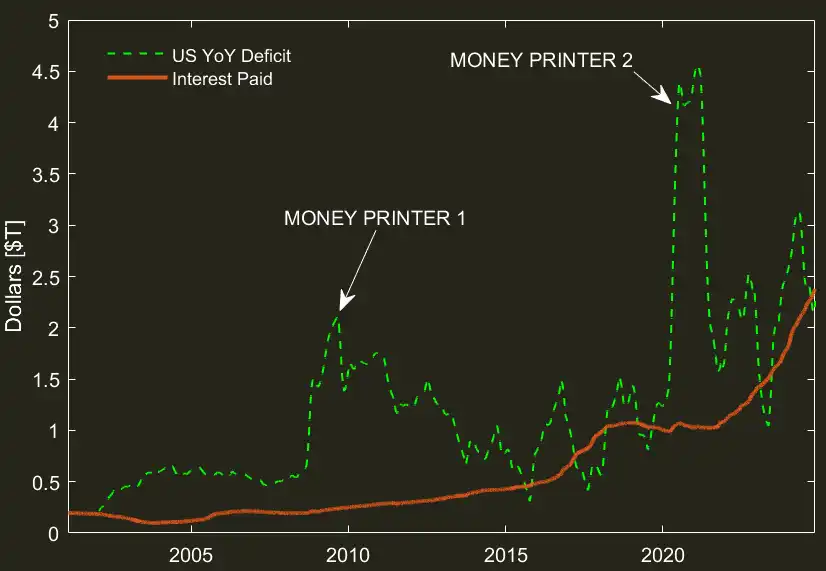
But in 2008, the Fed's "original sin" occurred and Pandora's box was opened. Faced with a sharp drop in tax revenue, the government spent a lot of money, and the Fed monetized it through quantitative easing (QE). People worried that this would cause inflation, but surprisingly, inflation did not appear. This laid the foundation for the government's massive spending without consequences. So the Fed can buy our debt, keep rates low, and have no inflation penalty? "Free money"!
The government spent like crazy. From 2009 to 2013, the debt went from 60% of nominal GDP to 100% and stayed there until 2020. Many people forget that we already had some inflation problems pre-pandemic, and the Fed was raising rates. The benefits we gained by exporting inflation overseas faded away. In retrospect, we were already heading for a dangerous situation.
In 2020, a new money printing program began, further confirming the end of our era of free money. When the Fed monetized these expenditures, inflation quickly soared. There is no more QE without causing inflation.
So, what did the Fed do? They stopped printing money, and the Treasury continued to issue debt. That is, the Fed no longer bought these Treasury bonds, which meant that the private sector had to absorb them.
Slipping out some details, in essence, the Fed and the Treasury created an environment in which they rewarded debt holders by raising short-term interest rates and concentrating all debt on the short end. For Treasury holders, this is great because they can buy this additional debt, get cash flow, and take on lower term risk. This equals "more free money."
It is worth mentioning that this free money is a wealth transfer from the public to asset holders (the rich). The Fed's raising of interest rates and the Treasury's reduction of term risk are intentional ways to direct money from the poor to the rich. Deficits are borne by everyone, while interest on the Treasury bond benefits only a few.
But there is a problem. The Treasury must issue a lot of debt, which means it must be bought by the private sector (because the Fed will not risk inflation by buying it). But the private sector wants to maintain a certain percentage of bonds in its portfolio. The only way to avoid Treasury bonds gradually taking over the entire portfolio is the interest payments.
This brings me to the point of my chart. In an environment where portfolio allocation determines valuation, and portfolio allocations are relatively rigid, bondholders will generally only buy more bonds if they are compensated by cash flow. As a result, interest payments on existing debt must balance the rate of new debt issuance.
The conclusion is simple: Treasury interest payments must equal the rate of new debt issuance. The current deficit growth is about 6%-7% of nominal GDP, so bond interest rates must rise to 6%-7% to achieve balance. But remember, if the private sector grows fast enough, some of that money creation can be used to lower bond interest rates.
Okay, back to the Fed. In an environment where interest cash flow is king, what happens when the Fed cuts the interest rate on short-term Treasury bonds, where the Treasury is concentrated? Short-term interest payments fall sharply. So what does the market do to maintain portfolio allocations? It will demand that long-term interest rates rise.
So the first layer effect of the Fed's rate cuts must be to push interest rates higher elsewhere to meet the cash flow needs of bondholders. So we are in a strange world where rate cuts cool the economy (the economy relies on long-term maturities), while rate hikes stimulate the economy.
I fully expect the Fed to cut rates tomorrow, and I also expect the long end of the yield curve to continue to rise as bondholders demand returns on their portfolios. Counterintuitively, a recession will only make this problem worse because the private sector can't naturally absorb these bond issuances. Conversely, a booming economy will keep interest rates at reasonable levels.
I don't envy those who were just elected into this mess, because I'm almost certain they know nothing about these circumstances. Everything will look great until it suddenly goes very bad.
Recommended
The Wall Street Journal: How is AI Trading Stealing the Limelight from Cryptocurrency?
Aug 15, 14:00
Tencent Still Has a Dream
Aug 15, 11:27
To Catch North Korean Hackers, They Set Up a Fake Project
Aug 15, 10:00
From Litigation to Settlement: Positive Signal Released by HTX's Negotiation with FCA
Aug 14, 19:32
11,742 Shipping Addresses Exposed Alongside Trezor Orders
Aug 14, 19:01
Founder Interview: FOMO Creator Explains How They Added 30,000 Users in One Day and Became One of the Fastest-Growing Crypto Apps
Aug 14, 18:37