Is a veteran VC, who has seen three market cycles, feeling FOMO during this meme cycle?

Original Title: "Is a Value-Oriented VC Who Has Experienced Three Crypto Cycles Anxious About This Meme Cycle?"
Original Author: YettaS, Primitive Ventures Investment Partner
"Yetta, are you feeling anxious in this kind of market right now?" This was a serious question posed to me at a dinner party, and I was initially puzzled, not understanding why it was thought we should be anxious. "Because many people think that the Meme trend is prevailing and VC coins are dying, haha." The biggest topic at this DeVCon is indeed all about Meme, and colleagues jokingly say that discussing at level one delays the meme hype. Some also ask us if we include Memes in our asset allocation.
To be honest, we are not really anxious, or rather, we roughly anticipated this situation at the beginning of the year. Primitive is a perpetual fund without external capital, which allows us to take a longer time perspective on the industry. We also don't have the pressure of capital deployment, nor do we need to explain to LPs who don't understand our industry the reasons for investing in any particular track (often LPs can be a huge pressure point). Everything we do is guided by our curiosity to learn where the value and talent flows in this industry.
In this crypto market, which is both first-level and second-level, and experiencing a second-level bubble, the definition of VC is actually closer to its essence: Bet on Things with Venture Return. Following any ideology or engaging in any political struggle is meaningless; learning from the market is key.
At the beginning of this year, we conducted a lot of retrospectives on the industry's structural changes and wrote an internal report titled "Cycle of Front Running." TLDR: The polarization of our industry is becoming more and more severe. On the one hand, as the industry grows in size, TradFi has integrated a large amount of crypto assets into Wall Street through compliant means such as ETFs, siphoning off liquidity from this part that is now hard to convert back to our on-chain funds. On the other hand, the strong expansion of populist capitalism has further compressed the attention economy, making the entire financialization process more blunt and direct. The most Crypto Native way has become directly speculating on memes, an area that TradFi cannot reach.
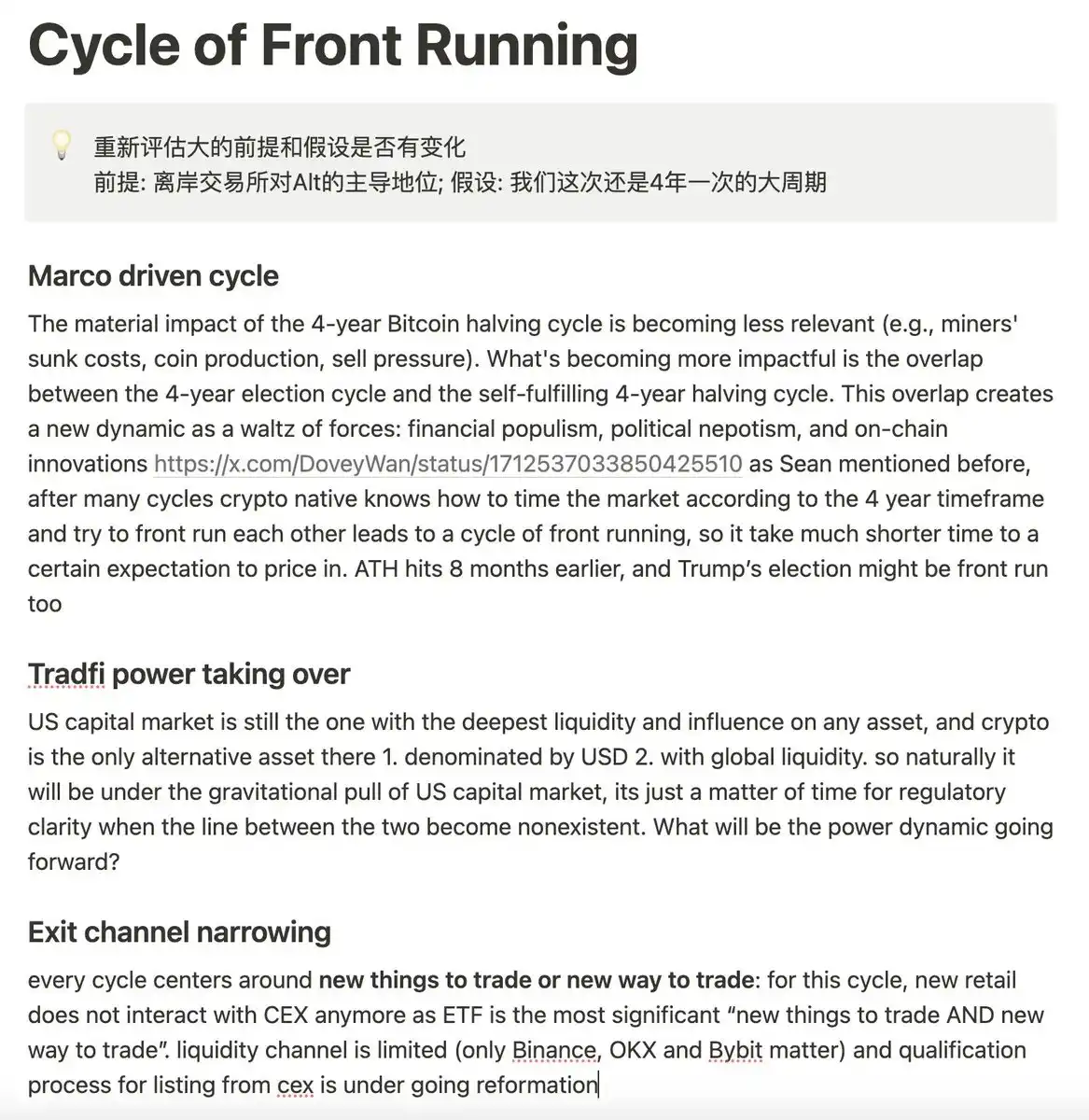
In such a macroeconomic and social context, on-exchange liquidity continues to shrink. In the past, we talked about the Barbell Strategy hoping that the two ends could merge, but the opposite has happened, and our polarization has intensified. As a result, the intermediaries in our industry are finding it increasingly difficult.
Who are these intermediaries? They include all institutions that have benefited from the grassroots era. Offshore CEXs, Trading Firms, Crypto financial service providers, and VCs, none can escape.
This structural change will make Offshore CEXs anxious. CME's Future Open Interest has already exceeded Binance's. If mainstream coins are increasingly traded on compliant trading venues due to TradFi entry, and Meme coins can pump out projects of over 1 billion on-chain, is Binance's space being squeezed?
Apart from Offshore CEXs, how can those who relied on Crypto-native Market Makers respond to Wall Street's high-frequency quant teams entering with their own infrastructure and funds? With their decline, the third-party financial institutions serving them are also losing relevance, not to mention VC firms that cannot actively trade.
This polarization and liquidity squeeze are the fundamental changes in our industry. Those who find the breakthrough point will be the winners.
I completely understand the market's sentiment towards VC tokens. Projects with extremely high FDVs at launch, continuous unlocking and profit-taking after listing—if it's all a gamble, why not go to a relatively fairer gambling arena, play Meme PVP, where if you lose, you can only blame your slow hand speed, instead of helping VC coins worth several billion dollars catch a falling knife.
What is the essence behind this issue? Our industry's Liquidity Supply Chain has a problem.
Why can Solana keep hitting ATHs? Because they have a real product that generates consistent revenue in Sol, turning users into a trading community. The positive feedback loop between the two has become a self-fulfilling prophecy, forming a key part of the Buy Pressure.
The last DeFi cycle was similar. The product launched with a small innovation, DEX created liquidity for continuous price discovery, and once consensus was reached between the product community and the crypto community, CEX listing further released liquidity, leading to a triple win for the project, community, and CEX.
A healthy ecosystem consists of participants who not only buy tokens but also actively promote the project. This creates a positive feedback loop in liquidity supply.
And now? The issue facing VC tokens is the disconnect between these two communities. Projects go straight to Token Generation Event (TGE) upon mainnet launch without the product being implemented. The community is mostly there for airdrops, resulting in selling pressure. In the previous cycle, we had individuals like Sam/Su leveraging to buy altcoins, but this cycle leverage has been mostly unwound. Additionally, during the previous bull market, many VCs raised significant funds, leading to pressure to make strategic investments. To show attractive returns to LPs, there was a need to repeatedly drive up project valuations.

This has led to the current situation of VC tokens, where high-value listings lack buying pressure, leaving little room for anything other than price drops.
This naturally explains the emergence of Memes. If VC-backed projects are not delivering results, why not speculate on something with a lower valuation for a fairer opportunity?
Amidst the analysis of the two-tiered system at the beginning of this article, Memes have become one of the most unignorable tracks in our industry.
I always thought Meme coins were purely speculative, but it wasn't until this time that I realized I was wrong. They are a vessel for carrying a cultural trend, not just about specific functions and technology but about the unique ability to carry collective consciousness, emotions, and identity—a logic akin to religion. Beneath the absurd surface, they express profound social-psychological needs and values. What they do is tokenize and capitalize on trends and emotions.
In other words, the core product of Memes is the trend and narrative they carry, where the size of these trends and narratives determines a Meme's ceiling. From cutting-edge technology and idol worship to IP sentiment and subcultural trends, analyzing the potential behind them is similar to how VCs assess a product's market outlook and position.
For a Meme, the Token is its product, so what it needs to do around the product is to mutually promote price and community. Price, in a sense, represents the product's iterative development, building a strong community foundation through price fluctuations, transforming Paper Hands into Diamond Hands, motivating them to spread the word, and ultimately fulfilling a self-fulfilling prophecy.
At this point, Meme Tokens actually have a huge advantage that VC Tokens do not have. Because the Token is the product itself, the product's community and the hodling community merge into one, creating synergy between the two.
Due to its low initial capitalization, Meme suffers from a very low signal-to-noise ratio in investment and cannot be analyzed from a tangible product standpoint. It requires a keen understanding of trends and market sentiment. I am still striving to learn whether there is a structured methodology to study this track, in order to identify targets in a very low signal-to-noise ratio, and if possible, determine which targets are suitable for us to enter and when to enter.
But I firmly believe that Meme will become a cross-cycle-level opportunity because it is essentially a cultural phenomenon of the digital age, where trends are immortal, and emotions iterate endlessly.
More importantly, I have always believed that providing the opportunity for outsiders to become wealthy is the vitality of our industry. Before this wave of Memes, it was said that the demands on entrepreneurs in this Cycle were more than ten times that of the past, and it seemed like all the investment had been consumed by VCs, suppressing the emotions of the community and retail investors. However, through Memes, young people can once again seize the opportunity to achieve 100x returns through early ambushes. Antiauthoritarianism is one of the core spirits of Crypto, I believe it will always be.
When everyone is enthusiastic about sacrificing themselves for the community and believes they can make eternal profits, don't forget that profit-taking will definitely occur. This is an enduring principle of the financial industry. Think back to the NFT community of the past: everyone proudly displayed their monkey avatars, helped connect with the brand owners, organized events and collaborations everywhere, NFT Parties were held worldwide, and then what?
When various inflated self-confidence and unrealistic expectations emerge, when holding a Major is considered less profitable than holding a Meme, when various hacks and rugs appear, we should start being vigilant. Once our industry lacks larger liquidity opportunities, and BTC starts encountering resistance, all pumped-up Alphas will plummet even faster.
So, is DeSci's logic in this cycle the same as PeopleDAO's in the previous cycle and the logic of saving Assange? Do we have the ability to distinguish between belief and speculation under the guise of "justice"?
In fact, a significant turning point in the Meme occurred on Binance Little Neiro, when the VC Token was in trouble. The breakthrough came when Little Neiro was brought on board, embracing Community Meme, allowing the project, community, and CEX users to all make money, thus giving rise to ACT.
But now, does the blind liquidity on-chain Meme resemble the TVL competition after high TVL projects on Binance, similar to the competition after the issuance of the Ton ecosystem coin following Binance's Huge User Base?
CEXs are expected to change their listing strategies based on market expectations, thereby guiding the market. However, our industry will inevitably fall into a chaotic situation of homogenized competition due to the low cost of asset issuance and liquidity premium. Everyone will certainly become numb and weary of this chaos.
This is the power of cycles.
In the short term, do not just do things for the sake of betting on CEX support. Projects truly dedicated to industry building will surely emerge.
In the long term, the bear market will undoubtedly eliminate those who have done nothing but oversupply, bringing the market back on track.
The market is always oscillating between long-termism and short-termism, existing on a spectrum. The Main Character and Meme will become the two ends of the barbell, with one rising as the other falls based on market sentiment.
No need to panic; just find your own rhythm.
Investment is a game where we place our bets based on understanding, reap rewards when right, reflect when wrong, always remain curious, and always show respect.
Recommended
The Wall Street Journal: How is AI Trading Stealing the Limelight from Cryptocurrency?
Aug 15, 14:00
Tencent Still Has a Dream
Aug 15, 11:27
To Catch North Korean Hackers, They Set Up a Fake Project
Aug 15, 10:00
From Litigation to Settlement: Positive Signal Released by HTX's Negotiation with FCA
Aug 14, 19:32
11,742 Shipping Addresses Exposed Alongside Trezor Orders
Aug 14, 19:01
Founder Interview: FOMO Creator Explains How They Added 30,000 Users in One Day and Became One of the Fastest-Growing Crypto Apps
Aug 14, 18:37