Following MicroStrategy's Lead, How Long Can the Stock Market's "Hodl" Craze Last?

Original Article Title: Bitcoin Buying Plans Are Supercharging Stocks. Is This a Michael Saylor Redux—or Another 'Long Island Iced Tea' Fad?
Original Article Authors: Aoyon Ashraf, Nick Baker, CoinDesk
Original Article Translation: Bitpush News
Abstract:
· Following the success of MicroStrategy's hodling strategy, many companies (including some small-cap stocks and those unrelated to cryptocurrency) have begun announcing similar moves.
· This strategy has led to significant short-term stock price increases for some of these companies, but market observers note uncertainty regarding long-term sustainability.
· While optimists see this as a step towards broader Bitcoin adoption, skeptics view it as mere hype for a few small companies in the short term.
Fitness equipment manufacturers, biopharmaceutical companies, battery material producers... What do these diverse companies have in common?
Bitcoin, of course.
As BTC surged to unprecedented levels this month, at least 12 publicly traded companies previously unrelated to the crypto business have announced their plans to purchase Bitcoin (BTC) as an intermediary for storing idle cash—a move that has recently proven highly profitable. This follows the path illuminated by Michael Saylor with his "laser eyes" since 2020 when he began transforming his obscure software manufacturer, MicroStrategy, into a Bitcoin treasury.

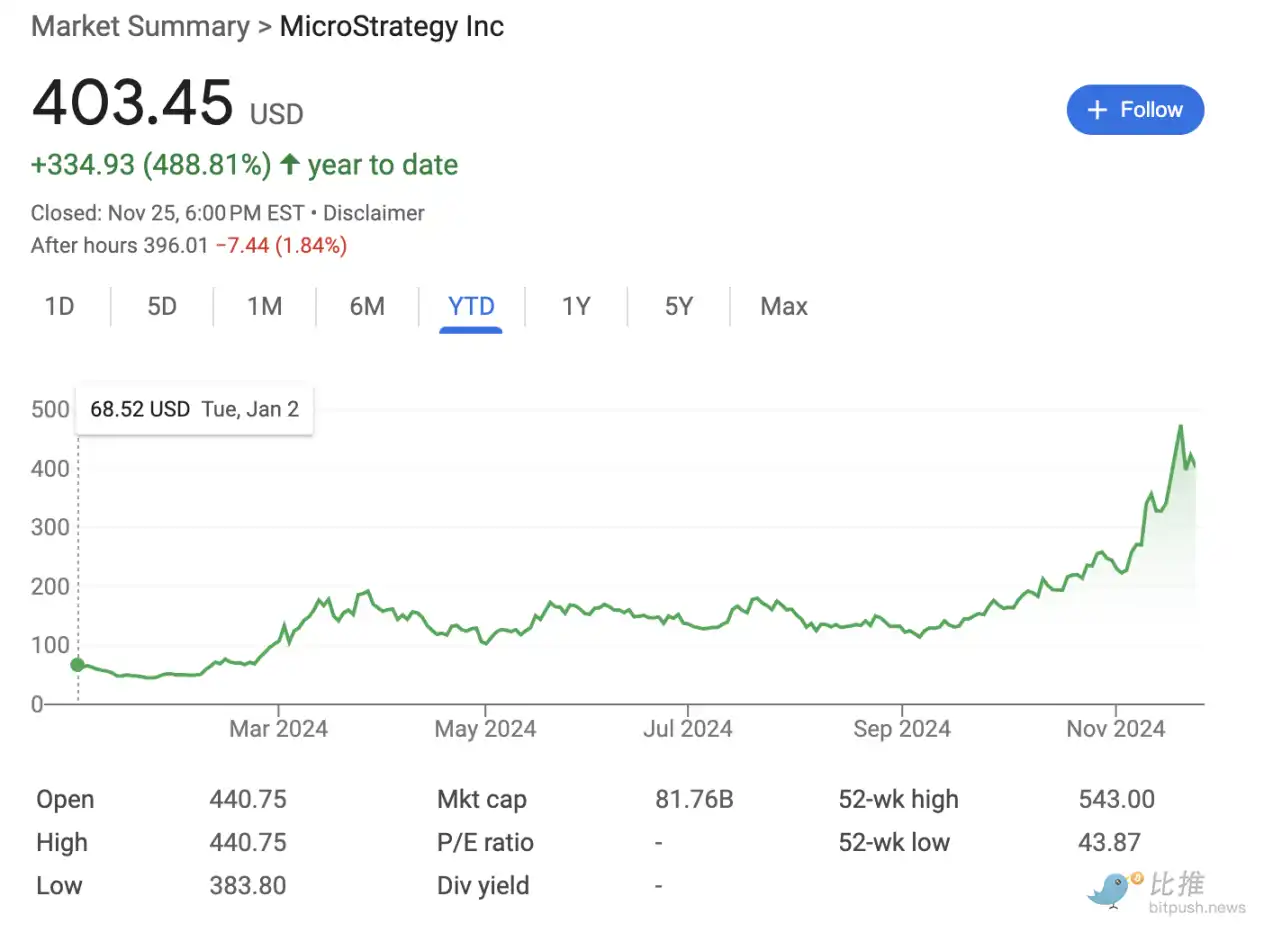
This move has brought significant success to MicroStrategy in the U.S. stock market—since Saylor began purchasing Bitcoin for the company, its value has increased by about 30 times, amassing a massive reserve (as of the time of this writing) worth around $38 billion.
Just this month, following Donald Trump's commitment to embrace cryptocurrency and his election as U.S. president, the company's stock price nearly doubled. (Other crypto stocks have also seen increases. Exchange operator Coinbase has risen by almost 70% since the day before the election.)
Other companies have attempted to replicate this success.
On Friday, biotech company Anixa Biosciences (ANIX) announced that its board has approved the purchase of a certain amount of Bitcoin to diversify the company's cash reserve. The stock surged as much as 19% but closed the day up only 5%. Meanwhile, fitness equipment company Interactive Strength (TRNR) disclosed on Thursday that following board approval to hold cryptocurrency as a treasury reserve asset, the company plans to buy up to $5 million worth of Bitcoin. The news initially caused the company's stock price to soar over 80%, but it ended the day with a mere 11% increase.
Earlier last week, biopharmaceutical company Hoth Therapeutics (HOTH) revealed a $1 million Bitcoin purchase plan, triggering a price surge of up to 25%—although almost the entire gain was wiped out by the closing bell. Similarly, companies such as LQR House (LQR), Cosmos Health (COSM), Nano Labs (NA), Gaxos (GXAI), Solidion Technology (STI), and Genius Group (GNS) saw temporary spikes in their stock prices after announcing Bitcoin treasury plans in November. Only one company saw a decline after this announcement: Acurx Pharma (ACXP).
"The recent Bitcoin frenzy, coupled with MicroStrategy's stock price surge of over 500% in 2024, has triggered a wave of companies, especially small caps, announcing Bitcoin purchase strategies," said Youwei Yang, Chief Economist at BIT Mining (BTCM).
Whether these MicroStrategy emulating companies will achieve success akin to Saylor's remains to be seen.
Yang commented, "This behavior could end in the same way [as the previous bull market]: unsustainable hype followed by a significant pullback as the market realizes many of these announcements lack substance."
Moreover, the persistence of these new entrants is also unknown from a technical standpoint. So far, only the artificial intelligence company Genius Group is known to have truly bought Bitcoin.
But who can blame them?
Early investors in MicroStrategy have reaped significant rewards, and even recent investors have seen easy gains. Saylor primarily raised funds through issuing stocks and bonds, which were then used to buy Bitcoin. These emulators may have gained access to capital markets channels they wouldn't have had otherwise.
The market follows the ancient adage of "never fight the market," meaning that regardless of the fundamentals, one should always go with the flow. Companies want to meet market demands, and no one wants to be the person who has to tell their boss or shareholders that their performance suffered because they did not follow in MicroStrategy's footsteps.
"Just a few years ago, buying Bitcoin was seen as almost too risky. However, now the risk seems to be tipping in the opposite direction—not buying is the real risk," said Brian D. Evans, CEO and Founder of BDE Ventures, adding, "Not being exposed to Bitcoin is truly painful."
For those hopeful individuals, this sudden corporate scramble may signal the long-awaited mainstream adoption of Bitcoin, especially as the newly elected President Trump expressed a desire for the U.S. government to also hoard Bitcoin.
"For BTC supporters, expectations of inflation and other macro factors, along with new regulatory friendliness, are expected to drive more companies to include this asset on their balance sheets," stated Toronto-based crypto platform FRNT Financial in a report.
Furthermore, a Bitcoin buying strategy can open up the capital markets for companies, as seen with both MicroStrategy and miner MARA Digital (MARA). These two companies have recently been able to raise funds through convertible bonds that do not require them to pay interest to investors, meaning these investors are willing to forgo current income in exchange for the ability to eventually convert the debt into equity, thereby gaining Bitcoin exposure.
Evans of BDE stated that their plans to purchase Bitcoin are "a useful way for the company to raise funds, no different from what MicroStrategy has done over the past few years."
However, for some, this sounds like a re-enactment of a short-lived trend from the late 2010s, when many non-crypto-related companies added the word "blockchain" to their company names.
The most notable example was the obscure beverage maker Long Island Iced Tea renaming itself to Long Blockchain, which initially saw explosive results: after rebranding to a cryptocurrency company, its stock price nearly doubled within a day. The surge was not sustained, and the stock was later delisted from Nasdaq (three individuals were charged by the SEC with insider trading).
There were other "magic" words. In the 2021 crypto bull market, many major companies jumped on the bandwagon of "Web3," "metaverse," and "NFTs" in an attempt to boost their stock prices. Even Facebook renamed itself Meta, going all-in on the metaverse. However, these moves ultimately resulted in significant losses.
Meanwhile, some low-performing, non-crypto-related companies have also begun to venture into Bitcoin mining, which was seen as a lucrative business at the time. However, the subsequent brutal bear market caused these once-promising crypto concepts to fall from grace and become "pariahs."
Youwei Yang noted that while MicroStrategy has been able to raise billions of dollars from the capital markets to fund Bitcoin purchases, if others were to adopt this strategy, it could have a detrimental impact on small companies. "For small-cap stocks, it may be seen as a short-term gimmick, thereby deter serious investors. If the price of Bitcoin stabilizes or falls, the speculative allure of these stocks may weaken, making these companies vulnerable to investor skepticism and regulatory scrutiny."
Wave Digital Assets Co-Founder and CEO David Siemer expressed a similar view, stating, "Although this approach may yield short-term gains in a bull market, it also carries significant risks. Unlike direct asset holding, leverage can amplify potential losses during a market correction, highlighting its inherent dangers." He pointed out that some companies are leveraging the hype around Bitcoin to increase debt on their balance sheets.
Regardless of who is right, after Trump won the U.S. presidential election, Bitcoin has repeatedly hit all-time highs, the magic is still there: announce a Bitcoin plan similar to Saylor's, and then see if your stock can take off.
"We seem to be at a point where many companies feel they have to do this," said BDE Founder Brian D. Evans.
Anyway, welcome to the new cryptocurrency bull market.
Recommended
The Wall Street Journal: How is AI Trading Stealing the Limelight from Cryptocurrency?
Aug 15, 14:00
Tencent Still Has a Dream
Aug 15, 11:27
To Catch North Korean Hackers, They Set Up a Fake Project
Aug 15, 10:00
From Litigation to Settlement: Positive Signal Released by HTX's Negotiation with FCA
Aug 14, 19:32
11,742 Shipping Addresses Exposed Alongside Trezor Orders
Aug 14, 19:01
Founder Interview: FOMO Creator Explains How They Added 30,000 Users in One Day and Became One of the Fastest-Growing Crypto Apps
Aug 14, 18:37