Why is Enso Key Infrastructure in the DeFI Boom?

In the Internet travel field, Uber was able to quickly change people's way of travel because it cleverly integrated basic functions such as maps, payments, messaging, etc., rather than developing everything from scratch. Google Maps provided the location, Stripe handled payment processing, Twilio was responsible for message delivery, and Uber focused on creating a first-class ride-hailing experience.
Similarly, for DeFi developers, whether they can efficiently "call upon" instead of "self-build" infrastructure has become a key factor determining innovation efficiency. However, in the crypto field, there is currently no infrastructure mature and universal enough to compare with Stripe or Twilio. Developers are often forced to deeply study the underlying logic of each public chain or protocol, write and maintain a large number of smart contracts, and additionally pay high audit fees. Just as in any project involving DeFi social trading, lending, automation, etc., the first step is to dig into protocol documentation, write integration code, and developers should focus on creating differentiated features, but they end up spending a lot of time and resources in endless "reinventing the wheel."
In the process of exploring the DeFAI narrative, the author found that the "DeFi+AI" narrative also faces the same issue. Although AI agents can discover arbitrage opportunities, design yield strategies, there is a huge gap between AI being able to conceive these strategies and actually execute them on-chain. Enso's existence makes the DeFAI narrative more actionable.
Enso has now become a dark horse in the DeFi infrastructure field, integrating 180 DeFi protocols across multiple ecosystems such as Ethereum and Berachain. Enso has also launched in the form of an API, and these functions will play a greater role once the network is officially launched.
As the flagship target of the narrative, CowSwap, once publicly supported by figures like Vitalik and Trump, was able to complete complex DeFi execution paths and fulfill user requests at the lowest gas cost because it integrated Enso's DeFi-intent-based API, allowing CowSwap to focus on DeFi trading experience just like Uber focuses only on ride-hailing.
Enso, as a DeFi middleware, did not have such a product implementation from the beginning. Initially, Enso was simply a social trading platform derived from its founder Connor's "copy trading" demand to disrupt the market through "vampire attacks." Later, Enso integrated over 50 DeFi projects, launched social trading features, allowing anyone to create investment strategies and invite others to follow, during which time Enso's TVL reached between $8 million and $9 million.
However, as user demand surged, the team needed to continuously integrate more DeFi protocols and undergo frequent code audits. Auditing just 12 protocols cost over $500,000. "The DeFi market updates too quickly, and the maintenance cost makes it difficult for us to keep up," - this is the team's most intuitive feeling. To break through this bottleneck, they decided to completely rebuild the underlying infrastructure to achieve a unified abstraction of various protocols and launch an open API based on this.
Enso's officials once showcased a typical case, vividly illustrating the core value of their product that simplifies complex processes into easy-to-use interfaces. Developers only need to call Enso to easily integrate with over 40 DeFi protocols, using 25 different assets to complete a series of complex on-chain operations. The entire process seems simple, but in reality, it covers over 100 steps of on-chain interactions.
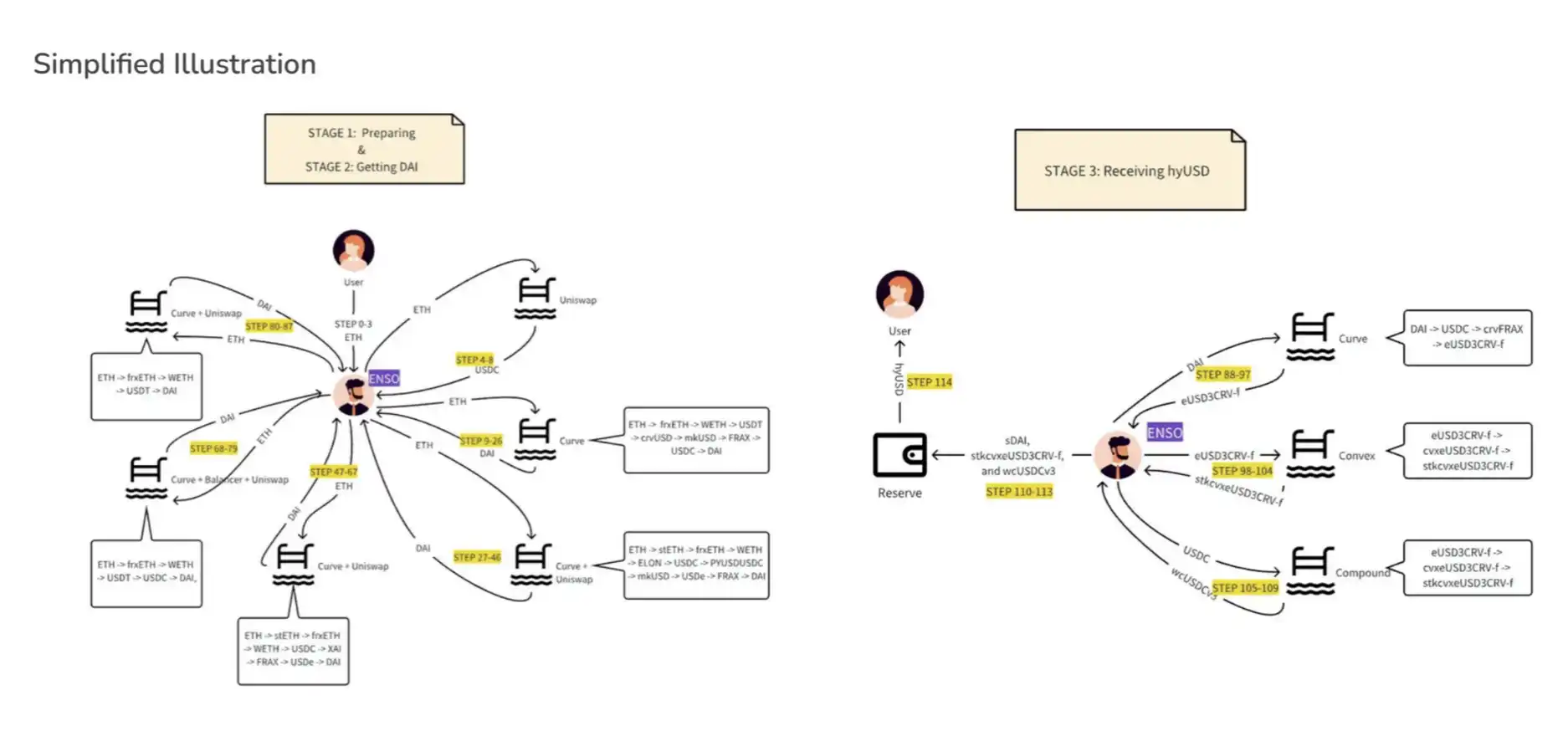
Using the example of a user swapping ETH for hyUSD, wcUSDCv3, and sDAI, funds need to flow successively through multiple protocols such as Curve.fi, Compound, Balancer, and Uniswap. Without Enso, the team would need to independently integrate and audit these protocols, resulting in extremely high time and cost.
The value of Enso lies in encapsulating complex on-chain operation processes into a unified development interface. Behind the scenes, Enso precisely designs the optimal path for exchange rates and gas costs, efficiently integrates multiple protocols. For developers, "swapping ETH for a basket of assets" is just a simple API call, with all the complex calculations and integrations handled by Enso. This simplification not only reduces developers' maintenance and audit costs but also highlights the core role of middleware APIs in accelerating the development of the DeFi ecosystem. Through Enso, developers can focus on product innovation while leaving the underlying cumbersome technical details to this powerful tool.
To understand the above product application scenarios, we need to understand the concept proposed by Enso called "shortcuts".
The so-called shortcuts are essentially pre-combinations of a series of on-chain actions. A single action may only include one transaction or it may cover multiple steps that need to be completed consecutively. For example, merging approval and entering vault into a deposit action, and if leverage is added on top of this, it can be combined into a more complex functional module. Through this combinatorial design, developers can greatly improve the efficiency of building on-chain applications.
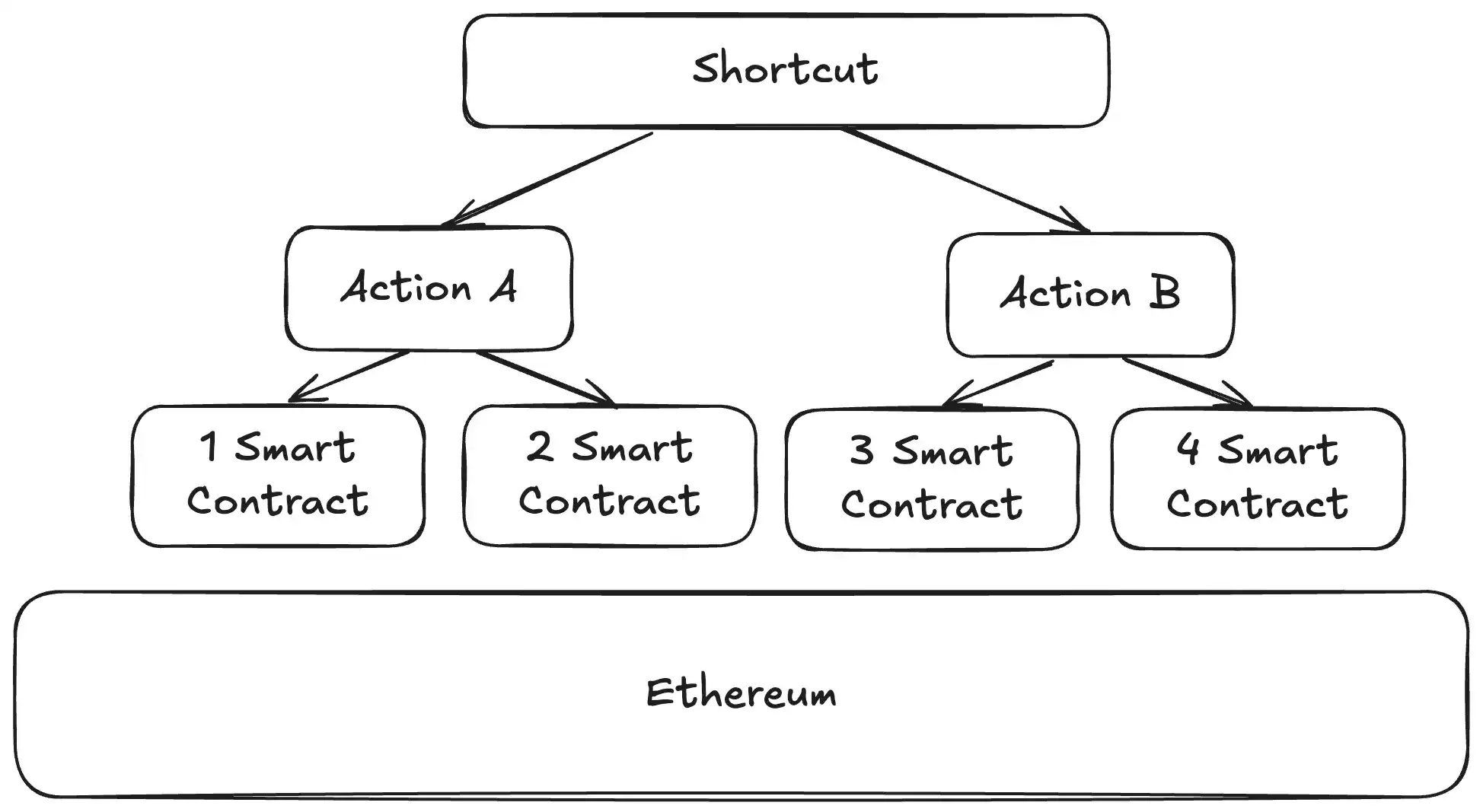
Currently, Enso's existing shortcuts include token exchange and DeFi routing, asset management, fund management tools and automation, DeFi protocol integration, smart contract interaction, complex trade bundling, and more.
Furthermore, Enso is gradually evolving into a more open decentralized network, meaning all contributors are network participants rather than just a team behind a product. In the future, anyone can contribute their skills or resources around Enso's underlying architecture, avoiding bottlenecks caused by a single team's resource constraints and allowing the network to iterate rapidly through multi-party collaboration.
Enso also provides three paths for operators to participate, catering to developers with different expertise and resource conditions.
1. Action Providers
For developers with programming skills, they can contribute smart contract abstractions on the network, providing specific behavioral logic, such as defining how to borrow on Aave. These action providers become core contributors of behaviors in the network by proposing methods to address user needs. At the same time, they can earn revenue through fee-sharing, incentivizing more high-quality behavioral logic contributions.
2. Graphers
Some participants focus on algorithms and data processing, similar to solving problems like the "shortest path on a map." They monitor intent requests in the network, traverse all contributed action operations, and find the optimal path. For instance, converting from USDC to aDAI on Aave can have multiple methods, including multi-step paths or direct conversion paths.
Graphers are responsible for finding a route that balances Gas costs and final rewards through computation and then providing the final solution to the network. In this process, as they optimize for different goals (such as Gas savings or higher yields), there may be competition among graphers. These participants are typically experts in mathematics and algorithms, unconcerned with data sources, focusing solely on efficiently utilizing data to perform computational tasks.
3. Validators
Any contribution submitted by action providers or paths proposed by graphers require validation by validators to simulate and verify the security and validity of underlying logic and execution results. Validators are responsible for checking if operations include authorized behaviors, if delegate calls are invoked, if transfer operations are carried out, and if there are potential malicious behaviors, among other tasks.
In addition, validators will also run the resolver-proposed path call data, validate its output, Gas consumption, and other key parameters. For users with node operation experience, this is a relatively low-threshold role but crucial for network security and execution accuracy.
It is important to emphasize that as Enso gradually evolves into a network, these three roles will participate in the maintenance and operation of the network together. Any developer, algorithm expert, or node operator can join seamlessly to contribute to the entire ecosystem and receive incentives.
Aside from developer-oriented contribution roles, Enso also offers different types of use cases for users. Enso's product provides three types of intent abstractions to meet users' diverse needs and preferences.
1. Explicit Intent: Users explicitly specify the operation protocol, such as implementing leverage in a specific protocol, for example, "I want to leverage in Aave."
2. Semi-Explicit Intent: Users only define the target leverage factor or yield rate, allowing the system to automatically select the optimal path in protocols like Aave, Maker, or GMX.
3. Fully Abstract Intent: AI selects the best solution automatically based on user history and market conditions, requiring almost no explicit instructions from the user. This mode significantly simplifies user participation complexity.
Currently, Enso has raised a total of $9.2 million, with over 60 angel investors participating. From DeFi Summer to the present, Enso's product iteration across cycles and protocol integration capabilities have been widely recognized in the market.
For example, as mentioned earlier, projects like CowSwap, Berachain's Boyco, and the recently popular DeFAI are integrating and interfacing with Enso at the protocol level. Currently, Enso has integrated with over 180 protocols, and more than 60 applications have adopted the Enso API.
We can understand how Enso collaborates with other DeFi projects or protocols in the current market through specific cases to provide a better development environment for developers.
The Royco Protocol is an Incentive Action Market (IAM) protocol that allows anyone to create transaction markets or a series of transaction markets around any on-chain. Enso collaborated with Royco to jointly create an incentivized Boyco market treasury for Berachain. The Boyco project supports project owners to access the Royco Protocol, enabling them to directly receive liquidity support from Berachain to focus on project development and community operations.
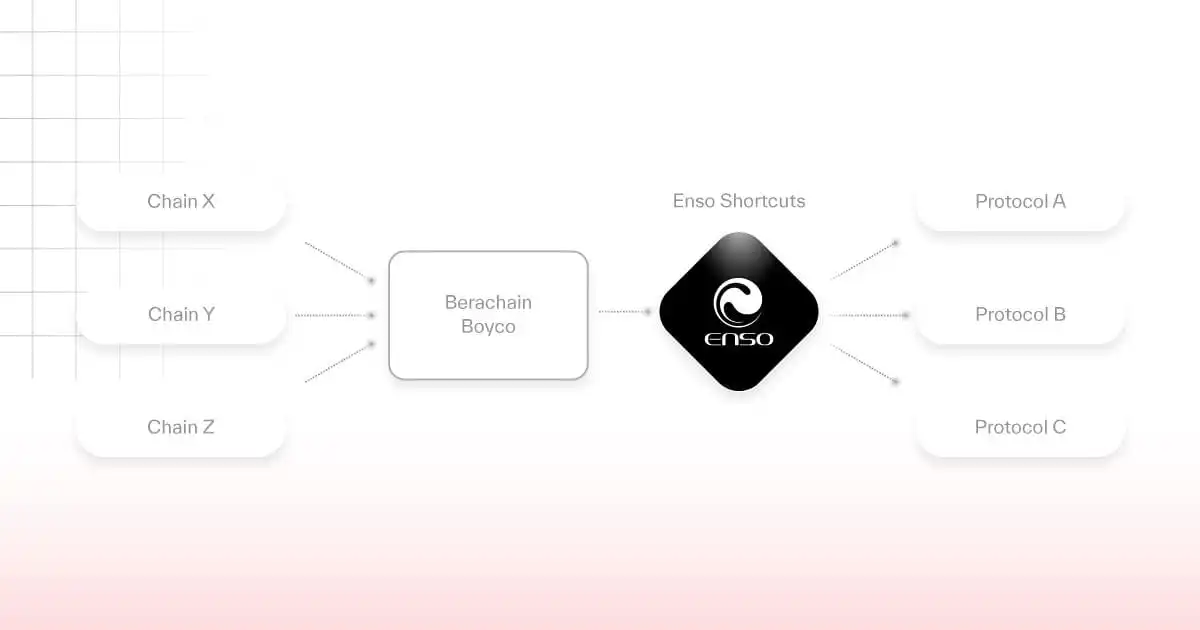
The complexity of the Boyco Market varies, ranging from single-token deposits to multi-token strategies. Without Enso's support, the team would need to manually integrate multiple protocols, write custom code for each market's specific needs, and invest a significant amount of engineering resources in testing and auditing, making the process very cumbersome.
When users enter the Boyco Market and need to obtain specific deposit assets, the traditional approach would require users to leave the Boyco platform and complete multiple actions on other interfaces, including granting token permissions, submitting transactions, and then returning to Boyco, which can easily lead to user churn. However, with Enso's integration, Boyco can keep users within its platform at all times and complete all operations in a single transaction: for example, using USDC, users only need to approve the use of the required asset, then exchange USDT for USDC in a single transaction and complete the deposit, all without navigating between different application interfaces.
Enso also keeps up with the latest market trends and, leveraging the advantage of protocol integration, supports DeFAI projects. For example, projects like BrianKnowsAI, which executes transactions through natural language prompts, searches for resources, and retrieves on-chain data; SphereOne, which converts dialogic commands such as "send," "exchange," or "cross-chain" into executable transaction operations; and AI-driven portfolio management tools like Velvet Unicorn.
"Enso" was originally a circular symbol in Japanese culture, symbolizing cyclicality, uniqueness, and the idea that the human mind can break through boundaries to create infinitely. In the DeFi field, composability between projects is the core value. However, to truly support large-scale innovation, developers first need an efficient and unified infrastructure. Enso aims to be such a foundational pivot, providing developers with abstracted "road-building" work in an increasingly fragmented multi-chain world.
If this step can be successfully navigated, it is of significant importance to the industry and users. For DeFi protocol providers, it means faster user traffic and funding. Developers can avoid redundant code writing and high audit costs, focusing more on optimizing product functionality and user experience. Ultimately, end-users can unknowingly enjoy the optimal returns and paths from multi-protocol combinations without needing to understand complex underlying logic.
In the blockchain field, every seemingly mundane call may involve a series of cumbersome cross-chain, cross-protocol operations. DeFi is hailed as a "permissionless playground for financial innovation," but to bring about truly massive applications, developers and users must first experience the convenience of "flattened barriers." When the cost of "reinventing the wheel" significantly decreases, DeFi developers have the opportunity to unleash their creativity further. With the increasing modularity and intelligence of Enso, blockchain is also moving one step closer to an "Uber-style minimalist experience."
Website: https://www.enso.build/
X/Twitter: https://x.com/EnsoBuild
Recommended
The Wall Street Journal: How is AI Trading Stealing the Limelight from Cryptocurrency?
Aug 15, 14:00
Tencent Still Has a Dream
Aug 15, 11:27
To Catch North Korean Hackers, They Set Up a Fake Project
Aug 15, 10:00
From Litigation to Settlement: Positive Signal Released by HTX's Negotiation with FCA
Aug 14, 19:32
11,742 Shipping Addresses Exposed Alongside Trezor Orders
Aug 14, 19:01
Founder Interview: FOMO Creator Explains How They Added 30,000 Users in One Day and Became One of the Fastest-Growing Crypto Apps
Aug 14, 18:37