X Space Review | IP Soaring, What Are the Early Wealth Effects of Participating in the Story Ecosystem?
On February 13, Story launched its mainnet, and the IP airdrop claiming started simultaneously, appearing on major exchanges such as OKX and Coinbase. After the launch, there was almost no pullback, and it rose against the trend as BTC performed poorly, experiencing a continuous one-week increase. The IP token once surged past $7, showing outstanding performance among recent TGE projects.
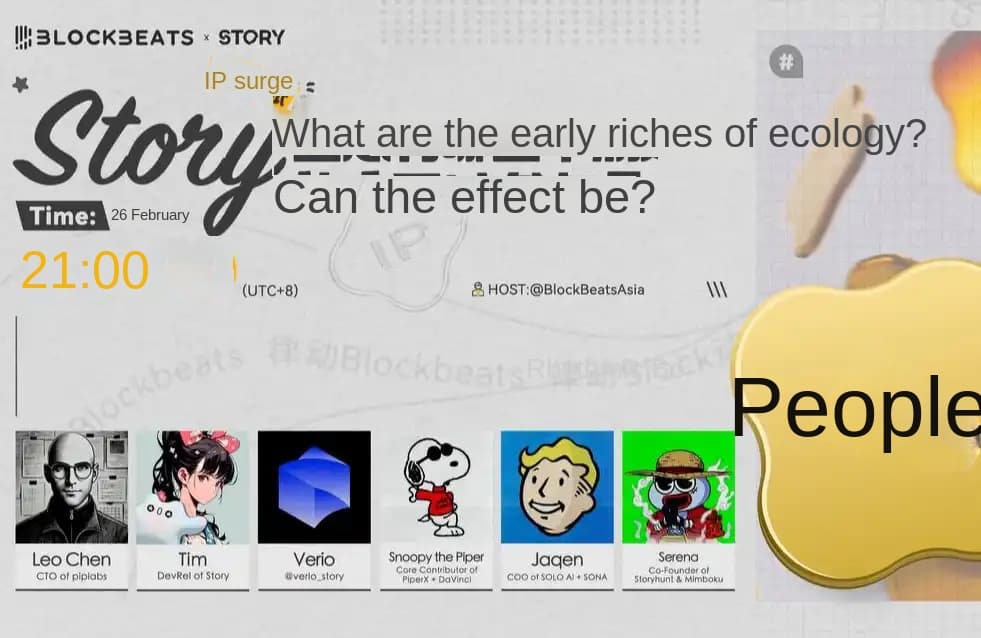
On February 26, BlockBeats invited Story's Developer Relations lead, Tim, PIP Labs CTO Leo, as well as representatives from Verio, Piper, SOLO AI, and Storyhunt – four promising projects within the Story ecosystem – to discuss the topic "IP Surges, What Early Wealth Effects Can Participate in the Story Ecosystem?"
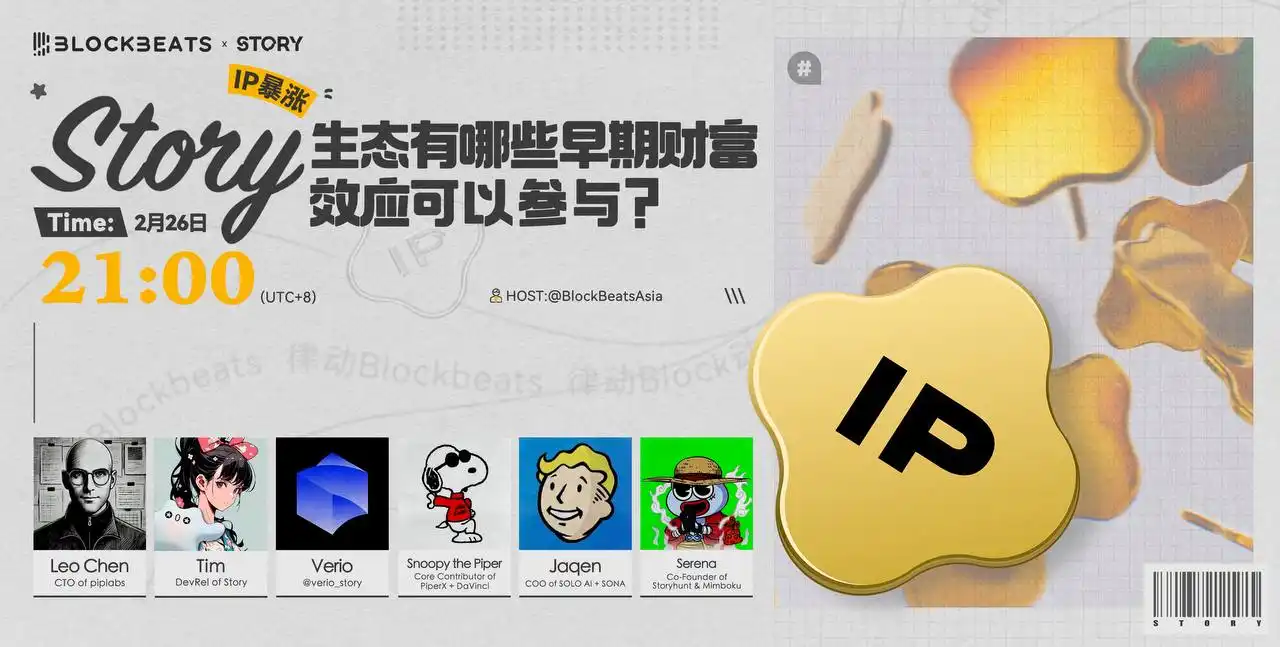
BlockBeats: We warmly welcome our guests today and ask each of you to introduce yourselves.
Tim: Hello, everyone. I'm Tim, currently mainly responsible for Developer Relations at Story, and also in charge of Node Ecosystem and Infrastructure Partnerships.
Serena: Hello, everyone. I'm Serena, the co-founder of Storyhunt. Storyhunt is a native DEX on Story, utilizing the AMM model, Uniswap V3, and a mining mechanism, supporting ERC-20 tokens. Our goal is to digitize IP assets and IPFI on Story, allowing creators and traders to easily transform stories into assets and trade directly on the DEX. Additionally, I am also a core member of Mimboku, a community built from the ground up, focusing on the ecosystem development on the Story platform. We drive the NFT development in the Mimboku community through three projects.
Verio: Hello, everyone. I'm a co-founder of Verio. Verio is a liquidity repledge protocol tailored for Story, with the native IP token being IP. Users can earn interest by pledging IP to obtain the VIP token. VIP tokens can be re-staked on various IP assets on Story, providing support and protection.
Snoopy the Piper: Hello, everyone. I'm Snoopy, a core contributor of PiperX. PiperX is the first and largest native DEX on the Story platform. We integrate the AMM mechanism and mining features of Uniswap V2 and V3, providing users with a seamless trading experience and attractive liquidity incentives. On PiperX, users can find high-quality IP-backed RWA, Meme, AI, and Agent assets. Additionally, we have developed a DeFi Agent named DaVinci. Previously, we collaborated with Luna (luna_virtuals) to release Luna's first IP asset on Story, marking the first on-chain collaboration completed through self-negotiation between agents (TCP/IP) on Story. I'm delighted to exchange ideas with everyone today.
Jaqen: Hello everyone, I'm Jaqen, a core contributor of SOLO AI. We are the first AI music generation platform on the Story protocol, enabling users to generate personalized music with a single click. On the first day of the Story mainnet launch, we released the digital composition tool DJ Sona. Feel free to visit the Solo AI official website to explore more possibilities of music generation.
Leo Chen: Hello everyone, I'm Leo, the CTO of PIP Labs. PIP Labs is the development company behind Story.
BlockBeats: Last week, the IP token price saw a sharp rise. What is the current focus of attention in the ecosystem?
Tim: I am currently focused on the creator ecosystem. Story is fundamentally optimized and improved based on IP, while also building a solid infrastructure to help IP go on-chain and have legal effects. I originally started in the cultural and creative industry going global, and currently, my main focus in the ecosystem is on the appeal of short video creation and text-based content creation. For example, we have collaborated with t2 World on text-based content creation, where they previously built a blog forum based on Links. Apart from that, I haven't seen many other applications related to the creator ecosystem. I believe starting from text-based content creation still has a lot of potential, especially with platforms like Mirror, Paragraph, and others that have been launched. Although there has been some progress, I have not yet seen a very groundbreaking text-based creator economy project. Therefore, I am looking forward to seeing more text-based creator economy projects emerge.
Serena: This cycle is centered around Memecoins, and the uniqueness of Memecoins on Story is that they are supported by IP. We hope to further drive the development of these IP-supported Memecoins, especially how to support this market through infrastructure, including how to overcome current challenges, as most liquidity is currently around Solana. We want Memecoins to be more liquid in the market and easily tradable. Our goal is to enable members of the Story community to capture the value of IP-supported Memecoins and create wealth.
We are also thinking about how to better discover community-driven Alpha. StoryHunt is a trading platform itself, able to capture early which IPs are fermenting, which emerging IPs are rising, and which ones may become hot topics. A lot of Alpha information will first appear on our platform and be traded on Piperx. So, everyone can pay more attention to our DEX; opportunities in this area are just beginning.
Verio: We have now launched multiple IP assets on the Verio website, including Mimboku. I myself am also a GT of Mimboku. In addition, others like Sofamon have also partnered with Story Official to customize a set of emoji-like clothing for Story. (16:34)
Now, by pledging LSD to different IP Assets, participants can receive special rewards. The first batch of rewards has been distributed, with some users receiving a lottery opportunity. Prizes include Sofamon's hat, valued at approximately 1.5 ETH at the current market price. Additionally, regardless of how much VIP is staked, users have the opportunity to participate in the lottery. Users staking on different IPs can also win different special rewards. So, we highly encourage everyone to participate in staking.
Snoopy the Piper: From the PiperX perspective, we are positioned as high-quality blue-chip assets, and users trust us very much. So, we hope to find the best assets for everyone.
Currently, within the IP ecosystem, one of the highest quality assets is the IP's native token. Previously, we discussed how IP's native tokens serve as a universal currency for AI and IP, driving the development of creator economies and decentralized economies. In the future, Story's ecosystem roadmap will also focus on promoting the utility of IP's native tokens to grow the IP's GDP. There will be more and more ways to play with IP's native tokens in the future, and everyone can pay attention to PiperX's main liquidity pools, including stablecoins, WETH, and more.
I reviewed today's data, for example, the APY from IP to stablecoin (USDC) is over 100%, while the IPY from IP to WETH is over 4000%. This indicates that the trading activity of IP tokens is very high, and many IPs in the pools have been exchanged completely. Therefore, I recommend everyone to pay attention to the various ways to use IP's native tokens and their utility.
Secondly, we value three types of assets: firstly, IP-supported Memecoins, like WTF and Sona mentioned earlier, which are very interesting meme assets in the Story ecosystem; the second type is IP related to the real world. For example, Aria recently joined BTS as a partner. If you are a fan of these stars, you will find many high-quality IPs in the Story ecosystem, including Black Pink, Justin Bieber, and others, all of which are unique and practical assets; the third type is AI Agent-related assets, especially those related to AI computing power, algorithms, and data.
Previously, Jason has also shared content about the AI field. AI data itself is a high-quality IP, and in this regard, everyone can look forward to new assets that Story will release in the future. Additionally, Story has collaborated with multiple AI projects, such as Stability AI. DaVinci has previously collaborated with Luna, assisting Luna in registering the songs released on EDC in Thailand as IP assets on Story and sharing revenue with the community, allowing the community to contribute content to Luna. The collaboration between these two Agents also illustrates the various innovative gameplay possibilities on Story. Through these partnerships, we can provide more creative opportunities and value for community members. Agents outside the Story ecosystem can also release IP Assets on Story, create pools, engage in trading, and more. More Agents will participate in the issuance in the future.
Jaqen: Our main focus on the Story platform is asset-related, especially asset issuance. In addition to asset issuers like us, there are also gameplay aspects at the DeFi level. Because Story itself does not create content, it is more like a PGC stack, so we need native asset protocols like ours to create valuable AIGC content. We are one of the few native content creation projects.
In addition to us, there are Agents assets like Mimboku and DaVinci mentioned earlier, as well as projects like WTF that are also worth paying attention to. The issuance status of these native assets is crucial. Although we launched our AI Agent on the mainnet on the first day with Story and had a good market performance, SoloAI's GTM (Go-to-Market) goes far beyond this.
Currently, our focus is on automating revenue management for artist content and building a low-threshold artist data market to promote the efficient circulation of AI-generated IP assets. These are the directions we are currently focusing on. We have also had conversations with some users deeply involved in liquidity mining and found that retail investors' focus is very direct: they are more concerned about whether the project's token has a celebrity effect, as such projects tend to attract more market attention. Additionally, innovative applications in DEFAI also easily attract retail investor attention, which are two important aspects I have observed.
Leo Chen: I would like to share an English project called Emergence with everyone. This is a sci-fi IP co-creation project on Story. The reason I am interested in this project is that I am a fanatic of science fiction novels myself. The project's main creators, worldview, and framework are by David S. Goyer, a well-known creator in Hollywood who is currently guiding the Apple TV series "Foundation," which is considered one of the origins of Star Wars and has already released its second season.
David S. Goyer is also one of the creators of "The Dark Knight" and "Blade," and he has had a significant influence in Hollywood. This project started several years ago and took a lot of time collaborating with many renowned writers to co-create this world. David S. Goyer was responsible for building the entire world, storylines, and character settings, with other writers participating in the co-creation, including collaborating with some Chinese-language writers. I believe this is one of the most distinctive projects on the Story platform. Currently, there is an AI agent behind the scenes to help everyone participate, generate their own characters, and engage in story creation. This team also has support from A16z and a Hollywood background, but there is currently no Chinese content.
BlockBeats: Tonight's guests include those involved in DEX and those with backgrounds related to AI and memes. I would like to ask how, in the Story ecosystem, IPFi combines with DeFAI to better promote asset trading efficiency?
Tim: The direction we are currently focusing on is IPFi. In the traditional world, IP (Intellectual Property) is often seen as an intangible asset, lacking an effective bidding process and value capture mechanism. When we explore IP, we often encounter pricing issues, and at the same time, we are not very clear about what rights IP brings and whether it can be considered an asset.
The core reason for putting IP on the chain is that traditionally, power is vague and hard to capture. Although the concept of NFT was initially understood by many as PFP (Profile Picture) NFT, EIP-721 mentions that NFT, as a token, is more of a "container," including negative assets, credentials, etc. Therefore, when we encapsulate IP on the chain, we can clearly define and price these rights, thereby increasing liquidity. This is very attractive to the traditional world because currently, we find it challenging to price power and enhance its liquidity.
The key to IPFi is how to further innovate once we price the power, such as using it as collateral or enhancing its liquidity. In addition, IP itself is divided into two levels, one is ownership, and the other is property rights. Property rights are more complex, for example, whether it is possible to launch a meme based on a certain IP or to turn it into IP licensing, etc.
An important point of innovation is that with license templates, we can better disaggregate and monetize these rights. For example, suppose I hold the meme issuance rights of a certain IP, can I use it as collateral for lending? Or even further, bundle various rights for DeFi operations. These are all directions we can explore in the future.
Currently, the phase after IP on-chain is still in its early stages, and we can combine it with tokens to try it out like a regular loan pool or other liquidity operations. In the future, I believe that with the integration of DeFi and AI, we will be able to better tokenize IP, creating more value.
Serena: I would like to further discuss how we, as a DEX on the Story platform, view the DeFi agent issue and how we enhance the user experience through a DeFi agent, simplifying complex operations to allow more mainstream users to seamlessly enter Story's IPFi application for interaction and mining. We have noticed that the majority of Story platform users are not as knowledgeable about blockchain and DeFi as DeFi users, providing ample space for a DeFi agent, as in some ways, DeFi and blockchain are designed for agents as well.
In the Agent direction, we are collaborating with Unleash to explore more AI applications in DeFi. Current DeFi interactions are still relatively complex, especially in liquidity management, asset allocation, and identifying high-potential arbitrage opportunities. The threshold is high, especially after the release of Uniswap V3 — how to manage liquidity? We hope to automate these operations through a DeFi agent, where users can simply set basic strategies, such as purchasing the most popular IP assets, or in terms of mining, automate reinvestment or compounding of earnings.
Additionally, we have launched the TCP/IP protocol, allowing more IP assets and IP agents to have stronger composability. Through this protocol, agents can automatically trade between different DeFi protocols and IP assets, and execute various strategies.
Verio: I believe that within the Story platform, the entire architecture is very suitable for decentralized IP management. Story supports decentralized IP registration, making it a permissionless open platform where anyone can register IP. Verio aims to identify which IPs have high value, potential, or legitimacy through various staking mechanisms, enabling creators to collaborate with these IPs for derivative works or other applications.
Story's native system also has a module called "dispute" for challenging the authenticity of IP to ensure the rights of IP are protected. We previously co-authored a paper with a senior IP lawyer discussing how to efficiently judge and protect the authenticity and rights of IP on-chain, especially through a DeFi Agent to achieve this goal.
Snoopy the Piper: IPFi is actually a relatively new concept. I remember we first introduced this concept around March or April last year. Story is very focused on the IP field, and as part of IPFi, our goal is to build a robust infrastructure to support our IPFi ecosystem.
From the perspective of PiperX, IPFi can facilitate asset trading by enhancing asset liquidity and transaction efficiency. In DEX, user experience is crucial, and we have found that users are very sensitive to speed and reliability. Therefore, we have invested a lot of effort in the product, especially in transaction speed and asset exchange success rate. We have increased the processing speed by ten times on the backend and made many optimizations to ensure a smoother user experience. Story platform has many existing and new users, and we aim to provide them with the best experience by enhancing transaction reliability and performance.
Regarding innovative gameplay, such as the DeFi agent, we have also made some attempts. For example, we introduced the DaVinci Agent, where users can directly create and register IP by issuing simple commands like "I want to create an IP asset." Many users issued tokens on the Story platform for the first time using this feature. Additionally, users can quickly perform asset swaps, manage liquidity, and other operations through similar actions. For liquidity management in the V3 pool, we also provide automated tools to help users easily adjust price ranges and manage asset liquidity.
Overall, first, we are committed to optimizing the user experience in trading and liquidity management to ensure high reliability and success rate. Second, the DeFi agent feature allows users to enhance asset trading efficiency through simplified operations. We will continue to serve all asset issuers and users, enhancing the overall platform experience.
Jaqen: Before joining Story, I was involved in DeFi derivative trading, including perpdex and some more complex options projects. From my perspective, for creator-centric ecosystems like Story, the current IPFi gameplay is not really suitable for complex DeFi Lego or snowball growth strategies or high leverage arbitrage operations. Platforms like PiperX, Verio that focus on liquidity staking, one-click issuance, and one-click swapping are more suitable. We can see that from the meme trend last year to the rise of AI agent projects, throughout this period, user trading behavior has gradually shifted towards a bubble-like state, moving towards FOMO-style short-term trading.
The Story platform has catered well to these user behaviors and successfully aligned with their transaction patterns. However, in the long run, Story's goal is to engage in more long-term IP-related business. The recently released TCP/IP Whitepaper and the encouragement of the creator economy indicate Story's direction towards long-term development. If we draw a parallel comparison, projects like Solana and initiatives launched by its foundation have also shifted their focus to constructing a long-lasting DeFi architecture post-hype. Similarly, Story is making significant strides in building both IPFi and DeFAI sectors, driving some very positive dynamics.
Regarding the combination of DeFi and AI, this concept has been around for the past two to three months. From a traditional industry perspective, automated one-click trading still predominantly exists in Wall Street's quantitative trading, while in Web3, this concept becomes more innovative. Looking at the fermenting logic of DeFAI, I tend to believe its development will follow a trend similar to the early BTCfi heat-up. It primarily depends on two aspects: project recognition and hot money recognition. What we need to observe is whether this concept can encompass more IP projects and asset layers while attracting funds like a16z and Polychain to enter DeFAI projects.
From the perspective of Solo AI, our current focus is to tokenize artists and virtual artists, bringing their assets onto the blockchain. In this model, a clear ownership relationship is formed between the artists and their creative content. When artists earn IPFi revenue through their work, we can automate on-chain transactions through smart contract design. Specifically, this transaction model has several advantages: first, automated management of artists' asset portfolio income distribution, making cash flow clearer. Second, achieving transparent tracking of copyright revenue for works, and fans can participate in the artist's career development by holding artist tokens.
All of this is still in a stage full of possibilities and has not been fully defined. So, we welcome everyone to continue following our future collaborations with some top artists. Thank you.
Leo Chen: Returning to the essence of blockchain, personally, I believe that blockchain's technological advantage mainly manifests in two aspects, with two main suitable application directions. The first is asset issuance. This is essentially a comprehensive disruption of Silicon Valley to Wall Street. The traditional asset issuance process is very complex, with many barriers, and usually involves various intermediaries, mostly monopolized by various investment banks or asset issuers. However, the emergence of blockchain has made asset issuance more decentralized, and almost everyone can issue their own assets.
For example, with the rise of memecoins, we can see that everyone can turn their influence or cultural phenomena into assets. This has significantly lowered the barrier to asset issuance. Of course, this has also brought about some challenges, such as how to filter out fraudulent projects or how to identify valuable assets. Nevertheless, blockchain has made asset issuance extremely simple and open. This is a major transformation that blockchain has brought to the global financial system and asset issuance system.
The second advantage is the transaction function. On the blockchain, transactions do not require complex intermediaries, and the entire process is open and transparent. With the emergence of Automated Market Makers (AMMs), everyone has the opportunity to participate, not only in trading but also in providing liquidity. Originally, these functions were controlled by a few financial companies or trading platforms, but now everyone can participate. This is a fundamental change brought by blockchain.
BlockBeats: Solana's PayFi, Sonic's DeFi, and BearChain's APY have all anchored an attractive direction. As Layer 1s, how does Story build its unique ecosystem and culture?
Tim: Regarding community building, I think we should look at this issue from two perspectives. Assuming we really want to integrate Story with the communities of Solana, Bera, and Monad, which I believe everyone is very familiar with, and many friends are building within these ecosystems. First of all, their timeline is definitely longer than ours. It took us 8 months to complete the transition from the protocol layer to Layer 1. Our earliest testnet was launched in August, and the first version of the testnet has just started to be used. From some extent, if we look at community building, we have done relatively well.
Secondly, our focus must be on intellectual property (IP). This is also why we need to build our L1 platform. You may ask, why does IP need L1? I think the simplest explanation is that sometimes when we examine the technology or its usage, we may not realize its maintenance cost. Suppose we are still at the protocol layer stage, then its overall maintenance cost is very high because we are not a directional service like a cross-chain bridge or L1. For example, they only deploy when you need them or because cross-chain bridges have many competitors, so in the IP field, our protocol layer does not have many competitors. This means we must deploy the protocol layer to every chain. Suppose we now have close to 200 chains, or even 250 chains, then we must deploy on these chains to avoid potential risks.
Returning to the specific focus of our chain, I believe we should concentrate on how to bring the traditional artist ecosystem onto the chain now that we have a chain in place, helping everyone achieve IP assetization. This will be the direction we will focus on in the coming months. Because before we contacted some IP rights holders, especially in our Web2 collaborations, our biggest pain point was that they would often ask, "What successful cases do you have? I need to see successful cases, successful ROI, or successful IP in order to better evaluate." So, when we were in talks with many IP rights holders in Japan, such as Asahi TV, Toei Animation, and companies holding a large number of emoji IP on Line, their common feedback was that they needed to see successful cases in order to proceed with further cooperation.
This is also why we created our mascot IPPY and why today we have an NFT auction on Color—featuring our community manager's duck. Our first step is to understand how to hatch IP and build a successful case through these IPs to attract more existing IPs to join our chain and further participate. You can also see that Arweave has already made a lot of preparations in the music sector. I believe IP is still at the core of our focus.
Serena: As Professor Tim just mentioned, the construction of the chain and the accumulation of culture is a long process full of ups and downs and value accumulation. Furthermore, Story is currently in a very early stage, and we are continually exploring which cultures and unique asset types people like. Many speculated directions now, such as from a technical perspective of Story, Story has a rather unique module—the IPFi module. For example, there are many remixing features, which are different from other on-chain assets. All assets have a narrative, and the design of the IP module allows these assets to be reworked, or to continue to grow through agency in an ongoing manner. As a result, after launch, various derivatives can be derived, and this flywheel effect will be stronger, making the assets more sustainable.
Secondly, as Professor Tim mentioned earlier, Story will initially focus on introducing top-tier IPs and creators. For example, there are two forms of memecoins behind IP. One is a memecoin entirely driven by the community, such as Pnut, which has grown very rapidly. The other is memecoin driven by creators, which is more of a top-down model driving the issuance of IP by top creators. For example, IPs like Tag Girl, Kanye West, Trump, Miranda, and others. In the first form, where the memecoin is entirely community-run, it does not provide sufficient value support for the original creators, and as a result, these creators are likely to abandon the project, leading to potential failure and a lack of vitality.
Relatively speaking, creator-led memecoins tend to lean more towards a top-down model, with many creators possibly being indecisive and struggling to stabilize the community. So, how can this problem be addressed? One possible solution is to first reserve a certain percentage of tokens for the original creator and conduct proper validation. If indeed there are creators or celebrities involved in this memecoin, these shares can be distributed to them. This way, the memecoin behind the IP can more reasonably distribute interests, ensuring the long-term sustainability of the ecosystem.
Through this approach, not only can memecoins be more vibrant, but it can also drive a longer-lasting and more sustainable development of asset culture and community. This is also an important significance of the IPFi module and remixing, as it can bring about a more equitable interest distribution, allowing the entire ecosystem to develop more healthily.
Snoopy the Piper: As an L1, how should Story build its unique ecosystem culture? From an overall narrative perspective, Story's features are very distinctive compared to other chains. Story is a purpose-built chain, meaning if you want to do something related to IP or AI, you wouldn't choose the "Bear Chain" as your first option, but rather, you would think of Story.
Within this narrative, although Story's L1 activities have only started in the past year, in reality, Story has been deeply rooted in this field for three years. Therefore, the team has put a lot of thought and technical effort into how to combine IP and AI, especially how to integrate these technologies on the blockchain. These are also reasons why Story has been able to develop rapidly in this field; the team's deep expertise and innovativeness have allowed us to make such swift progress in a short time.
As an ecosystem project that has been growing with Story, we can feel the speed and depth of Story's ecosystem construction. At the core of the Story ecosystem is the foundation, followed by ecosystem projects and the collaborative development of Story community members. The close collaboration between the Story Foundation and ecosystem projects is key to the rapid development of the ecosystem. For example, the collaboration with PiperX has not only accelerated the development of the DEX but also provided liquidity for IP assets. The Story community members possess a high degree of innovativeness and forward-thinking, creating a cultural atmosphere that attracts more high-quality projects and developers. By hosting hackathons, developer competitions, and other events, Story can further ignite the community's creativity. The work style of the Story Foundation within and beyond the entire ecosystem is rapid and challenging, continuously exploring new directions and making many groundbreaking attempts. As an ecosystem project partner, in our daily work, we can clearly feel the unique culture of the Story ecosystem.
Returning to the narrative itself, our team and Sarina, along with other members, have actually done a lot of sharing before, especially about why the concept of IP+AI is very unique in the Story ecosystem. Story holds a top-tier position in this field, and many ecosystem projects are also centered around this direction. New assets, with real-world IP such as BTS and BlackPink, IP-supported high-quality memecoins, creators and DJs are more willing to participate because they have incentives to build and issue these assets, achieving efficient value capture. Story collaborates with globally renowned IP projects, such as Asian K-pop IP and Hollywood film and television IP, further enriching the ecosystem content and international influence.
Furthermore, the tokens of AI and agency mechanisms each have a unique technical architecture, including technology systems such as TCP/IP, to help us achieve these goals. Therefore, Story's ecosystem culture is built on these strong foundations. These directions allow us to differentiate ourselves from other protocols or L1 in the ecosystem, focusing on more sustainable TVL and liquidity growth, and exploring truly unique assets, ultimately issuing and shaping them on the Story platform. These are key features of Story's unique ecosystem culture and our differentiation from other L1 networks.
Jaqen: Regarding the development issues of Solo AI, initially, we discussed for a long time where to deploy Solo. For many projects, the first step is to think about the content: whether you want to position yourself as a project focused on the ecosystem or aim high to be an independent chain. I think building culture, building ecosystem culture, in simple terms, is to build broad user consensus based on the characteristics of your own chain.
For example, when Solana was being promoted, it focused on its transaction speed and low-cost advantages, aiming to attract applications such as cross-border payments, which could bring high transaction volume and fees. Solana itself, as infrastructure, can support long-term cash flow and business models, which is one of the reasons it can attract so many users. Everyone knows that Solana has a natural advantage in cross-border payment settlement.
During this cycle, users who have participated in the "meme coin" frenzy should have a deep understanding. Tron, led by Sun, is more advantageous in the settlement layer. As far as I know, Tether seems to have a similar plan, but unsurprisingly, everyone engaging in these activities will carry their own advantages and goals to build their own unique ecosystem culture.
In fact, we can feel the attempts of other ecosystems to do these things, such as the craze around Bera BGT, where its super high APY has attracted a large number of users, and its core gameplay is the BERA PoL high-yield strategy. This has fundamentally created an appeal that surpasses Solana and other EVM-compatible chains.
Going back to Story, Story's logic has two distinct characteristics. The first is the incubation of its own native IP, and the second is leveraging existing real-world IP for exponential growth. In terms of incubating native IP, Story drives user-generated content (UGC) and professional-generated content (PGC) through projects like Solo AI, which is a major highlight of Story, especially in the music industry application.
As for existing real-world IP, Story's core essence is actually IP-driven creator ecosystem. We all know that Story's founders were once involved in South Korea's Jinjiang Literature Platform, and based on this background, Story has deep IP resources. Today, the projects Emergence and Ablo that Leo and Tim will promote are fun, visually appealing, and user-friendly, serving as the cornerstone of the creator economy.
Users' attention and liquidity are both very valuable. For a project to attract users to provide liquidity, there must be a target with sufficient short-term/long-term value proposition — either being profitable or fun and visually appealing. Otherwise, why would users come over? Story aims to collaborate with these high-quality IPs to help establish an ecosystem culture jointly built by retail investors and users, with IP becoming a core element of the Story ecosystem. The ultimate goal of all these efforts is to build a culture consensus centered around IP, driving the rapid growth of the Story ecosystem.
BlockBeats: What are the upcoming plans for the projects you are responsible for?
Tim: Basically, as a project team, we should remain neutral. The pinned part in my tweet lists many projects on our mainnet, so feel free to try them out. At this stage, I think what we mostly hope for is to guide exchange users onto the chain and transform them into active on-chain users. There are also some very interesting projects, such as ABLO. In fact, I came into contact with them when I was at KPW's printing factory. At last year's KPW offline event, they brought their own printing equipment, and everyone could design and make their own clothes through their website. I also made some clothes based on my own designs at that time. I've always thought that this return of the printing factory is meaningful because it gives everyone the opportunity to become a creator, regardless of their background. As long as you have good ideas, others will be willing to buy. If you can make your own clothes, you have the opportunity to be recognized in this market. So, everyone can go and try it out, design, and make your own clothes.
From scratch, you are the designer of the new era of clothing, and such an opportunity is worth trying. Additionally, of course, everyone is welcome to check out other projects on our platform, such as PiperX, Storyhunt, SOLO AI, all of which are excellent ecosystem projects for everyone to experience. Finally, what I want to say is that we are still in a very early stage, and many things are just beginning. If anyone has any ideas or suggestions, feel free to reach out to me.
Serena: Storyhunt will soon launch more incentive programs. Currently, we already have some incentive programs underway. In addition to the currently very high Farming rewards, Mimboku's APR has also reached 700%, so everyone is welcome to participate. Furthermore, the Mimboku community program, which just started yesterday, also provides additional API Boost for Mimboku holders, and we hope Mimboku holders will also participate.
Let me highlight the NFT project Mimboku. Mimboku is a project we created in collaboration with a third party, bringing many excellent project teams into the Mimboku family. In the future, Mimboku will launch more incentive programs, initially in collaboration with all Story projects. We hope that through these collaborations, we can bring about a wealth effect, provide more opportunities for everyone, and help everyone achieve better results in various areas such as Meancoins, Tradfi, GameFi, and more.
In fact, Mimboku is also a community with Japanese characteristics. In Japanese, Mimboku read backward is "i m meme," meaning "I am meme." We hope everyone can pay more attention to Mimboku, as we will have very exciting activities coming up, so stay tuned.
Snoopy the Piper: We have always been continuously improving the trading experience and bringing more high-quality assets to everyone. Our incentive feature has been online for a long time now and is now in the second season. If you have not yet claimed your rewards for the first season, hurry to do so, so you can receive more rewards for the second and third seasons.
Later on, we will also cooperate with more major traffic entry points to provide more practical incentive measures. The platform's APY is currently as high as 100% to 3000%, and everyone can explore these opportunities. For example, projects like WTF, Real-world IP, and others have already been added to the default list for everyone to pay attention to. If you have any product suggestions, feel free to share them, and we will improve and address issues based on each community member's suggestions. Hopefully, in the future, we can build the ecosystem of the story together with everyone.
Jaqen: We have previously received some Story support, so we are deeply rooted here. We have some unique features in the music generation and AI field, which align well with Story's cultural development. We have been preparing for a super large project, but we have not yet conducted public relations or promotion on Twitter. The main reason is that we hope to promote it on a large scale after the project is ready. We will directly collaborate with some very talented artists instead of acquiring IP distribution rights through their agencies. Our collaboration will involve AI interacting with artists, such as synchronized singing, remixing artists, and other interactive gameplay. We hope everyone will pay more attention to us. The true value of IP lies in activating it, allowing more users to participate and enjoy interactive scenarios and use cases. I believe this is the most important aspect.
Recommended
The Wall Street Journal: How is AI Trading Stealing the Limelight from Cryptocurrency?
Aug 15, 14:00
Tencent Still Has a Dream
Aug 15, 11:27
To Catch North Korean Hackers, They Set Up a Fake Project
Aug 15, 10:00
From Litigation to Settlement: Positive Signal Released by HTX's Negotiation with FCA
Aug 14, 19:32
11,742 Shipping Addresses Exposed Alongside Trezor Orders
Aug 14, 19:01
Founder Interview: FOMO Creator Explains How They Added 30,000 Users in One Day and Became One of the Fastest-Growing Crypto Apps
Aug 14, 18:37