Ethereum's Crossroads: Go or Die Trying?
Original Article Title: "Ethereum Crossroads: To Go or to Tough It Out?"
Original Source: Biteye
ETH/BTC Hits Five-Year Low, Old Ecosystem Exodus, New Narrative Absent — Ethereum is stuck in a limbo of technical upgrades and value dilution.
The Etherean Guard speaks of ideals while reality tests faith.
This time, we set aside emotions and focus on assessment: Is holding ETH still worthwhile? What are the bulls and bears betting on?
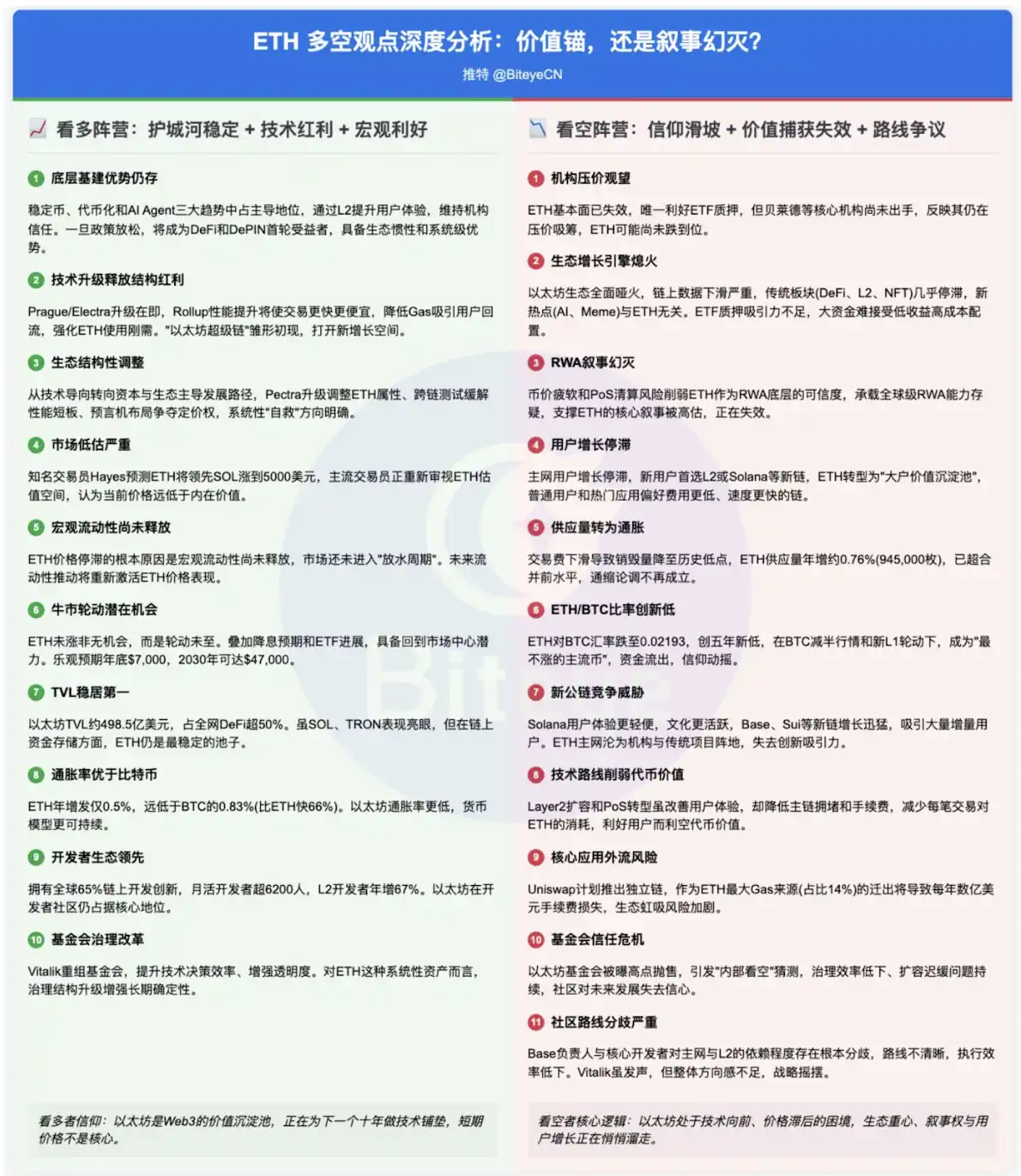
Despite Ethereum's price not yet taking off, the bullish view believes that ETH's long-term value is still gradually accumulating. A solid ecosystem foundation, ongoing technical upgrades, and improving macro outlook provide it with a triple support.
1. Ethereum Remains the Absolute Core of Infrastructure: Bitwise CIO @Matt_Hougan pointed out that stablecoins, tokenization, and AI Agents are all dominated by ETH. As long as Ethereum achieves a better user experience through Layer 2 without losing its institutional standing, the future looks very optimistic, leaning towards a bullish stance. Saul Rejwan, Managing Partner at Masterkey, predicts that once regulations ease, ETH will be the first beneficiary of DeFi and DePIN. @BTW0205 believes that although short-term outlook is bearish, in the medium to long term, Ethereum still possesses ecological inertia and systemic advantages. As long as it can reshape its value proposition and drive the new narrative, a comeback is still possible.
2. Ongoing Technical Upgrades Continue to Unleash Structural Dividends: With the Prague/Electra upgrade imminent, Rollup performance enhancements will make ETH faster, cheaper, and more accessible. Gas fee reductions attract more users back and strengthen the essential use of ETH. The bulls believe the market has not yet priced in these structural optimizations. @binji_x similarly believes the emergence of an "Ethereum superchain," opening up new growth opportunities.
3. Ecological Structural Adjustment Signals: @feifan7686 believes Ethereum is shifting from a technology-oriented development path to a capital and ecosystem-driven one. The Pectra upgrade adjusts ETH properties, cross-chain tests alleviate performance bottlenecks, and oracle layout battles for pricing power — behind them is a systemic "self-rescue" revolving around capital structure and ecological discourse. Although it may not immediately translate into prices in the short term, the direction is clear, overall leaning towards a bullish view.
4. Secondary Trader Calls Out "ETH Undervaluation": Prominent crypto analyst @rovercrc and well-known trader, former BitMEX CEO @CryptoHayes, took to Twitter to directly state that ETH is undervalued by the market. Hayes went further to predict that ETH will outperform SOL and rise to $5000. While such views are aggressive, they reflect mainstream traders reassessing ETH's valuation space.
5. Macro Liquidity Drive Impact: @0xVeryBigOrange believes that regardless of how much technical or ecosystem discussion surrounds Ethereum, the root cause of the current price stagnation is one—macro liquidity has not yet been unleashed. It's not that ETH is not capable, the entire market has not entered the "liquidity release cycle" yet.
6. Potential Opportunities in Bull Market Rotation: ETH not surging doesn't mean it lacks opportunities; it's just that the rotation has not reached it yet. Coupled with interest rate cut expectations and ETF progress, ETH has the potential to move from the periphery back to the center. DigitalCoinPrice estimates that in an optimistic scenario, it could reach $7,000 by the end of the year, and by 2030, it could potentially see $47,000.
7. TVL Maintains the Lead, On-Chain Funds Still ETH-Dominated: Ethereum currently has a TVL of $498.5 billion, representing over half of the total DeFi market. While Solana and Tron have shown impressive performances, when it comes to "on-chain savings," ETH remains the most stable pool.
8. Lower Inflation Rate, Supply Model Superior to BTC: ETH's annual issuance is only 0.5%, much lower than BTC's 0.83% (66% faster than ETH). This viewpoint emphasizes that Ethereum's inflation rate is significantly lower than Bitcoin's, making its monetary model more sustainable.
9. Leading Developer Ecosystem Scale: Venture capital firm Electric Capital released its annual report stating that ETH commands 65% of global on-chain developer innovation activity, with over 6200 monthly active developers and a 67% annual growth rate in L2 developers. These data indicate that Ethereum still holds a central position in the developer community.
10. Foundation Reform Enhances Governance Expectations: Vitalik announced a foundation reorganization to improve technical decision-making efficiency and enhance transparency. For an asset like ETH, governance structure upgrades signify a long-term certainty enhancement.
In summary, the bullish view is: Ethereum is the value foundation of Web3, laying the technical groundwork for the next decade, with short-term price not being the focus.
The core argument of the bearish camp is: times have changed, ETH lags behind competitors in terms of price appreciation, structure, efficiency, and narrative, the technical roadmap has failed to translate into token value, and the ecosystem is facing fragmentation.
1. Institutional View on ETH May Not Have Bottomed Yet: @jason_chen998 believes that the Ethereum fundamentals have failed, the only current positive factor being ETF staking, but core institutions like BlackRock have not yet entered the market, indicating that they are still suppressing the price to accumulate, suggesting that ETH may not have bottomed yet. Overall, the sentiment leans bearish.
2. ETH Ecosystem Has Lost Its Growth Engine: @Loki_Zeng believes that the Ethereum ecosystem was completely muted in Q1 2025, with on-chain data plummeting significantly, traditional sectors (DeFi, L2, NFTs) almost stagnating, new hot trends (AI, Meme) unrelated to ETH. The previously highly anticipated ETF staking incentive has failed to attract significant interest, as large funds find it hard to justify low returns and high-cost allocations. In general, it is believed that ETH lacks substantial growth momentum, leaning towards bearishness.
3. RWA Narrative Disillusionment, Ethereum May Not Be the Optimal Solution: @yuyue_chris questions Ethereum's actual ability in the RWA track. Although ETH has long been seen as the "secure settlement layer" for RWAs, its weak price performance and the liquidation risks posed by the PoS mechanism are undermining its credibility as the underlying layer for RWAs. Overall, the ability of Ethereum to support global-scale RWAs is questionable, the role of the RWA narrative in supporting it is overestimated, leaning towards bearishness.
4. On-Chain Growth Slows Down: @PANewsCN researcher @wsy2021111 mentioned in a December 2024 commentary that ETH mainnet user growth has stagnated over the past year, with many new users preferring L2 or Solana and other new chains. In his view, Ethereum is now transforming into a "value reservoir for whales," while regular small users and emerging popular applications prefer chains with lower fees and faster speeds. This view highlights the pressure Ethereum faces in terms of user growth.
5. Supply Enters Inflationary State: Due to the continuous decline in network transaction fees, Ethereum's daily burn rate has dropped to a historic low. This has significantly reduced the expected burn rate of ETH, leading to an annual supply increase of approximately 0.76%, or around 945,000 ETH per year. Currently, Ethereum's overall supply has exceeded pre-merge levels.
6. ETH/BTC Ratio Hits Five-Year Low: On March 31, analyst James Van Straten stated that the ETH to BTC exchange rate dropped to 0.02193, hitting a five-year low. Amid the BTC halving rally and the emergence of new Layer 1 solutions, ETH has become the "least bullish mainstream coin," experiencing gradual fund outflows and wavering faith.
7. Rise of New Public Chains like Solana Intensifies ETH Competition: Solana offers a lighter user experience and a more active cultural atmosphere, attracting a large number of new users and developers. Chains like Base and Sui are seeing increased activity, while the Ethereum mainnet is gradually shifting towards institutional and traditional projects, losing its appeal to younger projects.
8. Technical Roadmap Questioned: Empowerment or Value Erosion? Investor John Pfeffer suggests that Ethereum's current technical roadmap favors users but weakens token value. Layer 2 scaling and the transition to PoS will reduce mainnet congestion and fees, improving on-chain experience but diminishing ETH's per-transaction burn.
9. Core Applications Drift Away: Rumors within the industry suggest that Uniswap is planning to launch an independent chain by the end of 2024. Uniswap is the largest source of Gas fees for ETH, accounting for over 14%. If it migrates to a new chain, ETH could lose hundreds of millions of dollars in annual fees, along with a significant source of token burn, intensifying the risk of ecosystem draining.
10. Foundation Accused of Opportunistic Selling, Governance Trust Questioned: By the end of 2024, the Ethereum Foundation was exposed for selling at a peak, sparking speculation of "internal bearishness." Combined with issues like inefficient governance and slow scalability, the community has lost confidence in the project's future.
11. Community Divisions Emerge: Base's Jesse Pollak and core developer Dankrad Feist hold fundamentally different views on the mainnet's reliance on Layer 2 solutions, leading to a lack of clarity in the roadmap and reduced execution efficiency. While Vitalik has voiced opinions, the overall directional sense is lacking, causing strategic oscillation.
In conclusion, the core logic of bears is that Ethereum is currently trapped in a situation where it is technologically advancing but its price is lagging, while the focus of the ecosystem, narrative control, and user growth are quietly slipping away.
Based on the above long and short factors, we can conduct the following comprehensive analysis starting from the hodlers' mindset and decision-making.
1. Holder Focused on Long-Term Value
If you believe that ETH represents the future infrastructure layer of Crypto, with the most extensive developer community, a robust DeFi ecosystem, and a continuously evolving technical roadmap; if developers, funding, structural narratives have not yet collapsed, and it remains the core anchor chain for new narratives (DeFi 2.0, AI Agent, RWA), then holding or even accumulating in batches at this time and waiting for the next cycle is a logical choice.
2. Holder Focused on Medium-Term Profit with High Risk Aversion
At this moment, moderately reducing ETH positions may align more with the strategy. After all, many of the aforementioned bullish factors are more likely to gradually materialize in the medium to long term, while in the short term, ETH may continue to oscillate or even weaken. The competitive landscape and value dilemma mentioned in bearish arguments are not issues that can be resolved in one or two quarters.
You can consider reducing positions, keeping a core holding for flexible reallocation, adding more after ETH's trend becomes clear, or engaging in moderate swing trading to enhance capital efficiency. A neutral strategy could involve keeping a portion of the core holding (to avoid missing out on potential breakouts) while using another portion of funds for swing trading or allocating to other assets to hedge the opportunity cost of holding ETH.
3. Holder Concerned about Short-Term Performance and Certainty, or Doubtful about Ethereum's Roadmap
Exercising caution is also a wise choice. You can consider gradually exiting most of your positions on rebounds, while continuously monitoring key metrics of the Ethereum ecosystem (such as on-chain activity). If there are significant signals of fundamental improvement in the future or if a new narrative emerges, then consider reallocating in a timely manner.
Risk Warning: The above is for information sharing only and not investment advice.
Recommended
The Wall Street Journal: How is AI Trading Stealing the Limelight from Cryptocurrency?
Aug 15, 14:00
Tencent Still Has a Dream
Aug 15, 11:27
To Catch North Korean Hackers, They Set Up a Fake Project
Aug 15, 10:00
From Litigation to Settlement: Positive Signal Released by HTX's Negotiation with FCA
Aug 14, 19:32
11,742 Shipping Addresses Exposed Alongside Trezor Orders
Aug 14, 19:01
Founder Interview: FOMO Creator Explains How They Added 30,000 Users in One Day and Became One of the Fastest-Growing Crypto Apps
Aug 14, 18:37