Aster Debuts as Top BNB Chain Project on Contract Leaderboard, Can It Take Over Hyperliquid's Narrative Torch?
Original Title: "Starting with a 1650% Surge, Is Aster Taking Over Hyperliquid's Narrative Torch?"
Original Author: Ding Dang, Odaily Planet Daily
In a recent TGE project, Aster was undoubtedly the most dazzling presence. The ASTER token caused a sensation on its launch day: the 24-hour total trading volume exceeded $345 million, with the price starting at $0.03015 and soaring to $0.528, marking a staggering 1,650% daily gain. This performance not only caught the market's attention but also prompted a shoutout from CZ, stating, "Well done! A good start, keep building!" Behind such a strong start, it is worth asking: Why does Aster have such confidence?
Aster is backed by YZi Labs (formerly Binance Labs) and is expected to be the next-generation Perp DEX on the BNB Chain. Looking at the entire crypto industry, Hyperliquid has already proven to the market through its amazing trading volume and capital-carrying capacity: decentralized perpetual contracts are no longer a financial experiment for small funds but a battlefield capable of accommodating huge capital.
However, shifting focus to the BNB Chain, a public chain known for its large user base and activity, has yet to produce a flagship perpetual contract platform that represents its ecosystem. This gap is precisely Aster's entry point. It is not only a response to the Hyperliquid model but also a filling of the derivatives ecosystem gap on the BNB Chain, attempting to open up its own path in on-chain finance.
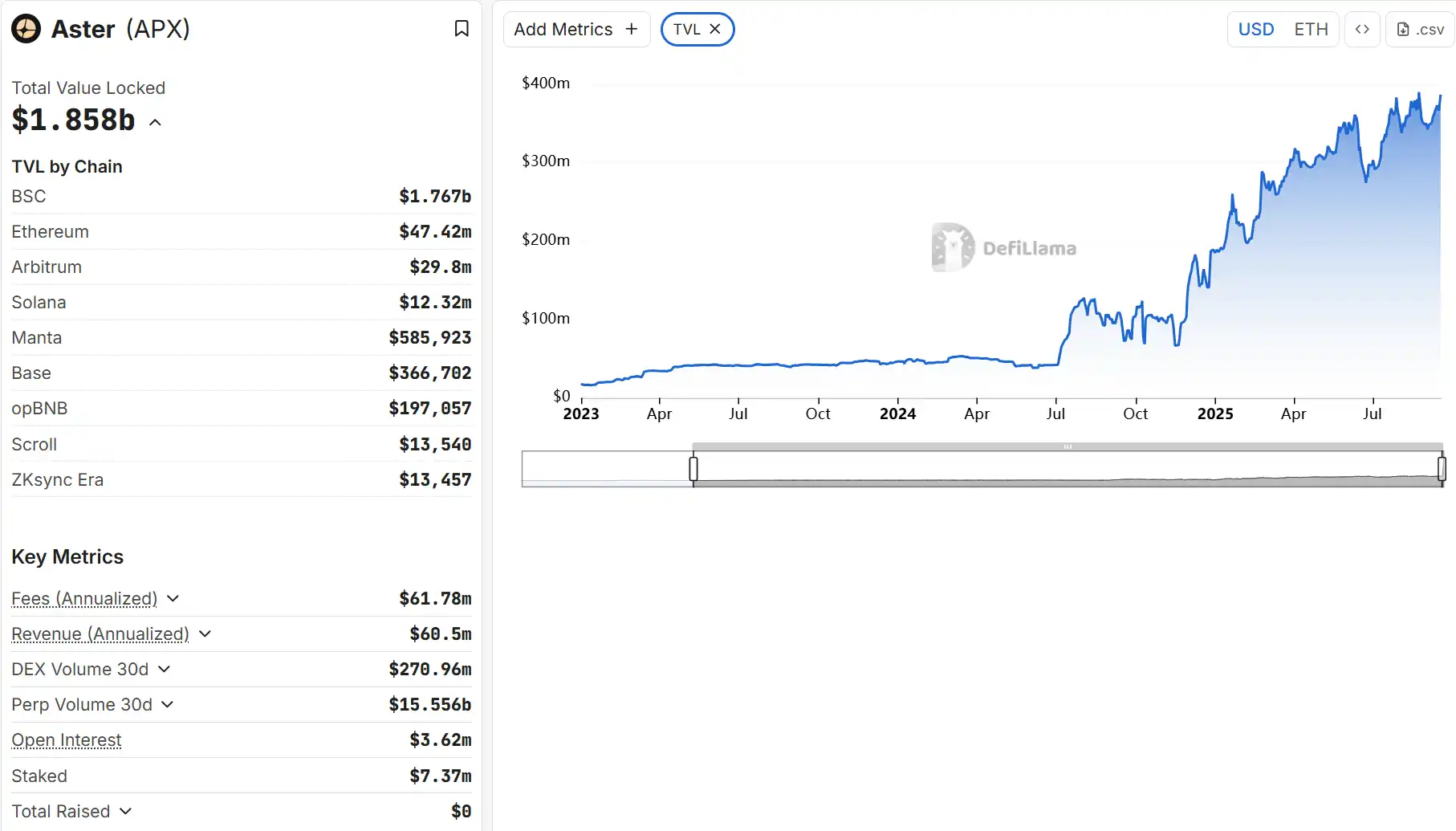
This statement is not without reason. Data from defillama.com shows that in the past 30 days, Aster has ranked first on the BNB Chain in terms of contract trading volume. Its total on-chain lock-up value has exceeded $1.8 billion, with an annualized income of over $60 million and an annual income growth rate close to 700%. Behind these numbers, it means that Aster has not only optimized product experience and liquidity moat but has also preliminarily established itself in user stickiness and revenue model, rapidly rising as a core node in the BNB Chain ecosystem.

In fact, in the decentralized derivatives arena, Aster is not a completely new player but a product of long-term accumulation and integration. Its predecessor can be traced back to Astherus and APX Finance, with the former being a multi-asset liquidity protocol and the latter deeply focusing on decentralized perpetual contracts. Both are star projects in the BNB Chain ecosystem and have received investment support from YZi Labs (formerly Binance Labs).
By the end of 2024, two major projects joined forces and completed a merger, integrating their technology, resources, and community strengths to make a comeback in the perpetual contract arena as a "veteran with a new look." On March 31, 2025, they officially debuted under a new identity, Aster. This merger not only represented a rebranding but also signaled a clear direction for their development: transitioning from a single perpetual contract trading platform to a comprehensive derivatives platform with an ecosystem map and product matrix.
It is worth noting that Aster's development trajectory naturally carries the genes of the "Binance ecosystem." The deep support from YZi Labs has given Aster a differentiated advantage on strategic, traffic, and capital levels. In contrast to other similar DEXes that often struggle to find liquidity and users during the cold start phase, Aster, leveraging the natural entry point of the BNB Chain ecosystem, started from a higher position at the starting point.
Within the Binance user base, Aster's identity label is even a testament of trust. For the many users transitioning from the Binance trading platform to DeFi, Aster's barrier to entry is much lower than that of unfamiliar projects. The "traffic dividend" brought about by this psychological inertia means that it has a natural first-mover advantage in user acquisition and ecosystem penetration.
Therefore, Aster is not just "another perpetual DEX" but more like a missing piece in the BNB Chain ecosystem puzzle. Its strategic significance lies not only at the single product level but could also become an important carrier for the extension of the Binance DeFi narrative.
If the merger and renaming gave Aster a clearer identity, its real competitive edge lies in the diversified layout of its product matrix and ecosystem map. Unlike many Perp DEXes that follow a single breakthrough pattern, Aster seems to be attempting to expand outward from "contract trading" as its core, gradually building a multilayered product matrix and ecosystem map.
Core Product: Aster Pro Perpetual Contract
At the product matrix level, Aster's foundation is still perpetual contract trading. Its core product is Aster Pro, which is a perpetual contract trading system based on an order book model. Unlike most AMM-type Perp DEXes, Aster Pro, through a professional matching engine and order book mechanism, can provide users with depth and liquidity closer to that of centralized trading platforms while maintaining on-chain transparency and self-custody advantages. This means that users can enjoy a trading experience with low slippage and precise quoting while avoiding centralized custody risks.
The core design of Aster Pro lies in its flexible margin system and risk management tools. It supports both Single-asset Mode and Multi-asset Mode, providing differentiated choices for different types of traders.
Single-asset Mode means that the margin is limited to USDT only, suitable for users who prefer a simple structure. Additionally, positions are independent of each other, with P&L calculated separately, leading to a stronger risk isolation effect, similar to the isolated margin logic of centralized exchanges. Multi-asset Mode accepts mainstream assets such as BTC, ETH, BNB, as well as repledged assets (SlisBNB, asBNB, etc.) as margin. All positions can share the margin, and P&L between positions can be hedged in real-time, enhancing capital utilization efficiency. The system supports automatic asset balancing, automatically converting other assets through the matching engine to make up for shortages of a specific asset, without additional fees.
This dual-margin system provides users with a set of professional and flexible contract trading experiences. It not only narrows the gap in experience between on-chain and CEX but also offers DeFi traders a higher-level space for fund management and strategy implementation, allowing users to choose based on their risk preferences.
Stock Perpetuals
Aster Pro has also pioneered Stock Perpetuals, opening up a new frontier for decentralized exchanges. Unlike conventional DEXs that can only trade crypto assets, Aster allows users to trade stock perpetual contracts directly on-chain based on USDT margin. The first trading pair to go live is AAPL/USDT (Apple stock contract), allowing users to engage in long and short operations with up to 50x leverage. Positions and P&L are all settled in USDT, with the index price provided by the Pyth Oracle and multiple data sources to ensure pricing transparency and fairness.
This innovation is not only a reconstruction of traditional financial products on-chain but also provides a new asset allocation channel for crypto traders and global investors. The launch of AAPL/USDT can be seen as Aster's starting point in exploring the on-chain capital market, with its potential going far beyond just a new trading pair, potentially hinting at a unified trading platform for stocks, crypto, and RWA assets in the future.
Ecosystem Matrix
Aster's ecosystem is not limited to the contract market; spot and pre-market trading markets are also part of it. Aster has introduced a Centralized Limit Order Book (CLOB) mechanism, combining CEX's matching depth with DEX's self-custody advantages. On September 7, 2025, Aster officially launched the spot market and entered into a deep partnership with Four.meme, a representative incubation platform on the BNB Chain. The first projects to go live cover Creditlink (CDL), which set a new record in fundraising on Four.meme recently. Of particular note is Four.meme's long-term focus on early-stage investments and continuous support for on-chain innovative projects, and through the BNB Guardians program, it introduces funds and community enthusiasm for new assets. This collaboration signifies the deep integration of Four.meme's incubation advantage with Aster's trading ecosystem, building a complete ecological cycle within the BNB Chain, from incubation, financing to actual trading.
In addition, stablecoin is also one of Aster's key products. Aster introduces liquidity into its own ecosystem through the dual-layer design of USDF and asUSDF. On one hand, USDF, as a fully backed stablecoin, can be freely exchanged with USDT at a 1:1 ratio, aiming to attract and leverage USDT liquidity, while also generating additional yield for users through decentralized finance (DeFi) strategies. On the other hand, asUSDF provides staking derivative rewards, further expanding the DeFi application scenarios. This means that users can not only conduct perpetual and spot trading within Aster, but also achieve efficient asset circulation through stablecoins.
By the end of 2024, Astherus officially merges with APX Finance, completing the integration of resources and technology. This step sets the foundation for subsequent product upgrades, marking the reentry of the new Aster into the market. On April 10, 2025, Aster launches the first phase plan of Aster Spectra, where users can earn Rh points through trading and unlock ASTER airdrop eligibility. The event concludes successfully on June 22, with 527,224 unique wallets generating over $37.7 billion in trading volume over 20 weeks, propelling Aster to hold nearly 20% of the decentralized smart contract market monthly trading volume share in just a few months. This not only brings early user accumulation to Aster but also kickstarts its tokenomics.
Currently, Aster conducted its TGE on September 17. As ASTER tokens are currently only tradable on Aster DEX for spot trading, the platform serves as the sole entry point for funds and users. As a result, within 24 hours, the platform's daily TVL surged from $660 million to $1.005 billion, with a daily total trading volume of nearly $1.5 billion and over 330,000 new unique wallet addresses.
Presently, Aster Genesis's second phase has been launched, allowing users to obtain Rh points through trading on Aster Pro for the second phase rewards.
If the short term focuses on the "dual-drive of product and user," the long-term vision is a comprehensive upgrade of infrastructure and ecosystem.
Launching Aster Chain: In future planning, Aster aims to build a chain dedicated to high-performance derivatives, providing Aster with greater autonomy and scalability. Constructing Aster's financial ecosystem: Around Aster DEX, gradually expanding to stablecoins, RWAs, and other dimensions of financial products to form a relatively complete financial ecosystem. Becoming a pillar of BNB Chain perpetual trading: Aster's ultimate vision is to emulate Hyperliquid, becoming a representative protocol for perpetual contract trading on the BNB Chain, and even a key piece in Binance's DeFi strategy.
In other words, Aster's development path is clear: from a single product to an ecosystem matrix, from BNB Chain infrastructure to a cross-market financial platform. Its narrative is not just a Perp DEX, but an impact on the on-chain derivatives market landscape.
Track Overview
In the crypto financial market, perpetual contracts are one of the most representative products. Compared to the spot market, it features high leverage, no expiration date, and a funding rate equilibrium mechanism, making it a core tool for traders for hedging, speculation, and arbitrage. At the centralized exchange level, the trading volume of perpetual contracts is nearly 5 times that of spot trading volume, making it almost like the "traffic engine" of the crypto market.
With the rise of the decentralized wave, the demand from users for asset self-management and transparent settlement continues to rise, and Perp DEX has gradually become a new growth point. Its logic is as follows: to migrate derivative trading that originally relied on centralized matching and clearing to the chain, using smart contracts and oracles to complete matching, clearing, and funding rate settlements. This not only reduces centralized risk but also provides users with greater flexibility.
More importantly, as Layer 2 scaling and cross-chain interoperability mature, the user experience gap for on-chain derivatives is narrowing. For example, dYdX approaches the experience of CEX through an order book model, while GMX's GLP pool provides users with a new gameplay of "liquidity mining." In other words, the competition in perpetual contracts has entered the second half: transitioning from "proof of concept" to "competition in efficiency, depth, and ecosystem synergy."
Perpetual DEX Market Landscape
Looking at the overall market, on-chain perpetual trading is still in a rapidly growing uptrend. According to the 2025 Q2 Industry Report released by Coingecko, the total quarterly trading volume of the top ten decentralized perpetual contract trading platforms (Perp DEX) reached $898 billion, an 11.3% growth from Q1's $806.6 billion, hitting a new all-time high.
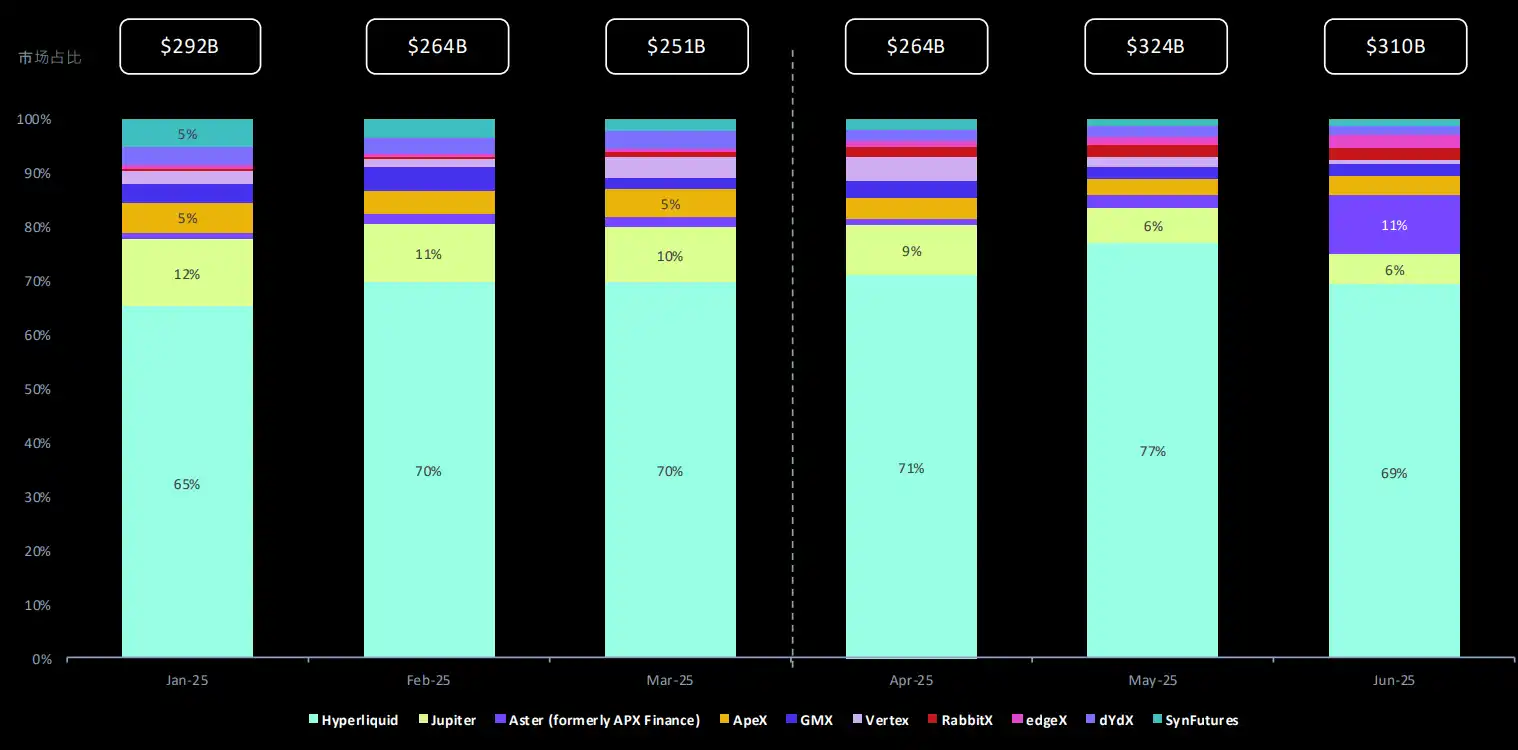
However, more notably, in the Top 10 list, only Hyperliquid, Aster, RabbitX, and edgeX saw growth, with Aster standing out: with the launch of Aster Pro, its quarterly trading volume doubled compared to the previous quarter, swiftly establishing itself as one of the industry's fastest-growing newcomers.
In stark contrast, the former leader dYdX saw a continuous decline in trading volume, with an average monthly trading volume of only $53 billion in Q2, less than half of the volume at the beginning of the year. This trend of one rising as the other falls highlights the market validation that the new generation of Perp DEX, represented by Aster, is receiving.
Aster's Unique Advantage
In an increasingly competitive on-chain derivatives market, how to stand out is the test Aster must face. Currently, Aster's strength lies not in superficial "faster growth" or "more users" but in building a differentiated moat.
(1) Product Diversification, Breaking Through a Single Track Ceiling
Most Perp DEXs still focus solely on crypto perpetual contracts, while Aster is attempting to build its own ecosystem map by introducing stock perpetual contracts, opening up new frontiers. This move can not only serve native crypto users but also potentially cater to cross-market demands from traditional markets, a dimension that other similar projects have not yet touched.
(2) Technological Architecture and User Experience Advantage
On the user experience front, Aster's order book model narrows the gap between on-chain and CEX experiences. The flexible single/multi-asset margin mechanism meets the risk isolation needs of novice users and the capital efficiency pursuit of professional traders. This design that "considers both ends" expands Aster's target user base and enhances the platform's scalability.
(3) Strategic Depth and Narrative Space
A deep integration with YZi Labs provides Aster with a triple advantage in funds, technology, and traffic. Its ecological linkage with BNB Chain naturally gives Aster a head start in traffic and market awareness, creating a unique trust moat in the fiercely competitive early stages. In the long term, Aster's goal is not to remain just a "Perp DEX on BNB Chain" but to move towards a higher level of strategic depth through the launch of Aster Chain and the expansion of the financial ecosystem. Externally, it can capture cross-chain traffic and traditional market demands; internally, it will become the core infrastructure of the BNB Chain derivatives market. In other words, Aster is not just a follower in the race but is attempting to reshape the entire competitive landscape of on-chain derivatives.
In the decentralized derivatives arena, the key word of competition is no longer "running model," but "who can build barriers to efficiency and ecosystem." Aster's emergence serves as both a filler of the BNB Chain derivatives market gap and a narrative representative of this round of evolution in the race. Through a diversified product matrix, it attempts to construct a broader on-chain financial market prototype.
In the future, whether Aster can truly become the "pillar" of the BNB Chain perpetual contract, or even move towards cross-chain financial infrastructure, still requires time to verify. But what can be certain is that it has already thrown out a new proposition for the industry: the second half of decentralized derivatives is not only a competition in trading experience, but also in ecosystem synergy and narrative depth.
Recommended
The Wall Street Journal: How is AI Trading Stealing the Limelight from Cryptocurrency?
Aug 15, 14:00
Tencent Still Has a Dream
Aug 15, 11:27
To Catch North Korean Hackers, They Set Up a Fake Project
Aug 15, 10:00
From Litigation to Settlement: Positive Signal Released by HTX's Negotiation with FCA
Aug 14, 19:32
11,742 Shipping Addresses Exposed Alongside Trezor Orders
Aug 14, 19:01
Founder Interview: FOMO Creator Explains How They Added 30,000 Users in One Day and Became One of the Fastest-Growing Crypto Apps
Aug 14, 18:37