When Dogecoin Puts on an ETF Suit: The Wall Street Domestication Saga of an Internet Meme
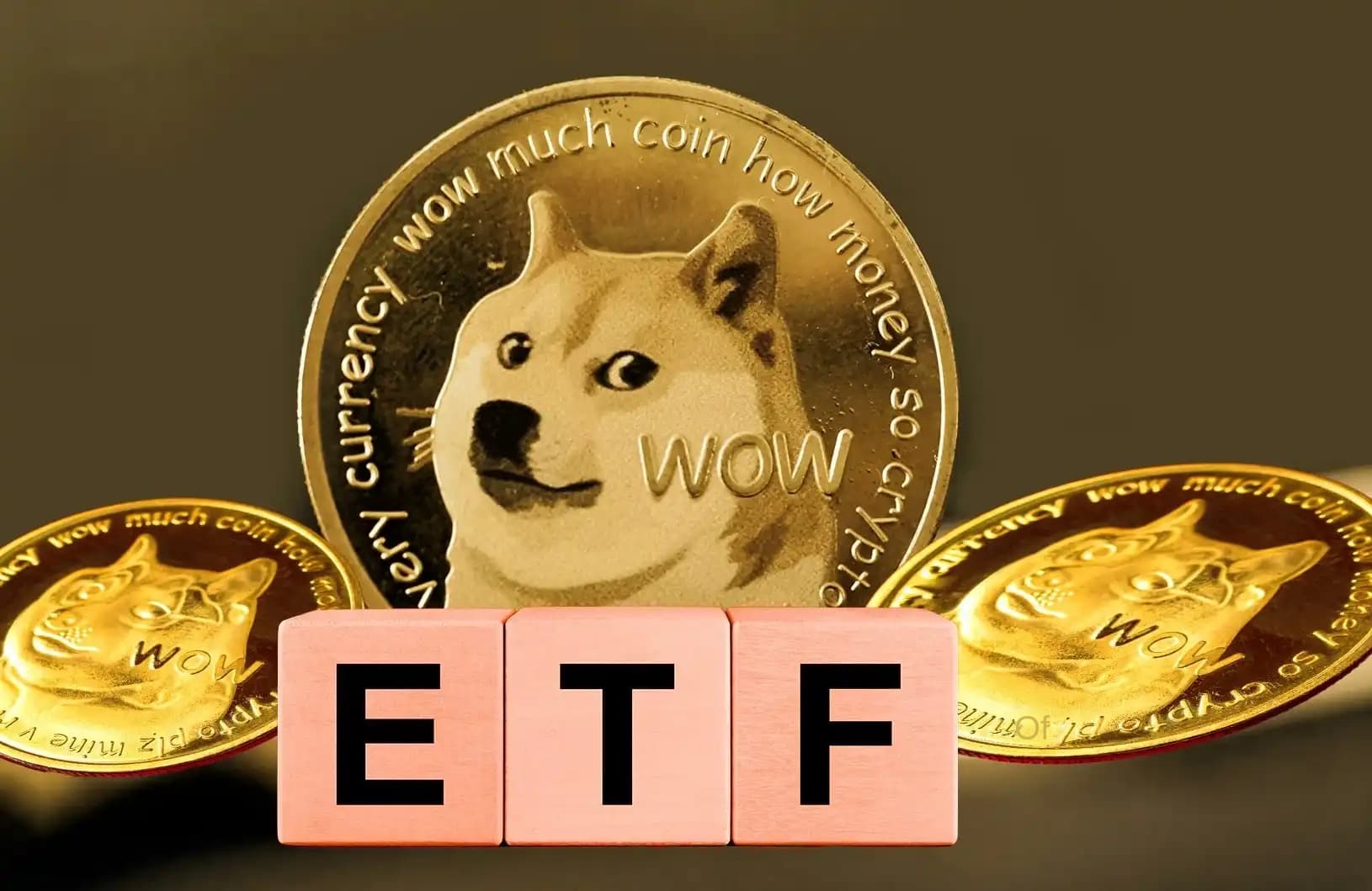
Original Article Title: "Sculpting Speculation"
Original Article Author: Thejaswini M A, Token Dispatch
Original Article Translation: Luffy, Foresight News
The birth of Exchange-Traded Funds (ETFs) originated from a crisis. In 1987, on "Black Monday," the Dow Jones Industrial Average experienced a single-day drop of over 20%. Regulators and market participants realized the need for more reliable investment tools. Mutual funds could only be traded after the market close, leaving investors helpless during market panics.
ETFs emerged as a key solution to this problem. These "basket of securities" could be traded like individual stocks, providing instant liquidity during market turmoil.
ETFs simplified index investing, offering broad market exposure at a low cost advantage. Their design ethos was "hands-off, high transparency," merely tracking an index rather than attempting to outperform it. The first successful ETF launched in 1993—the S&P 500 Index ETF, with its commitment to "precisely track the S&P 500," became the world's largest fund.
The original ETF was a pure stroke of genius. If you wanted to invest in the "entire stock market" without researching individual stocks or paying high management fees for fund managers to do the work, it was the optimal choice.
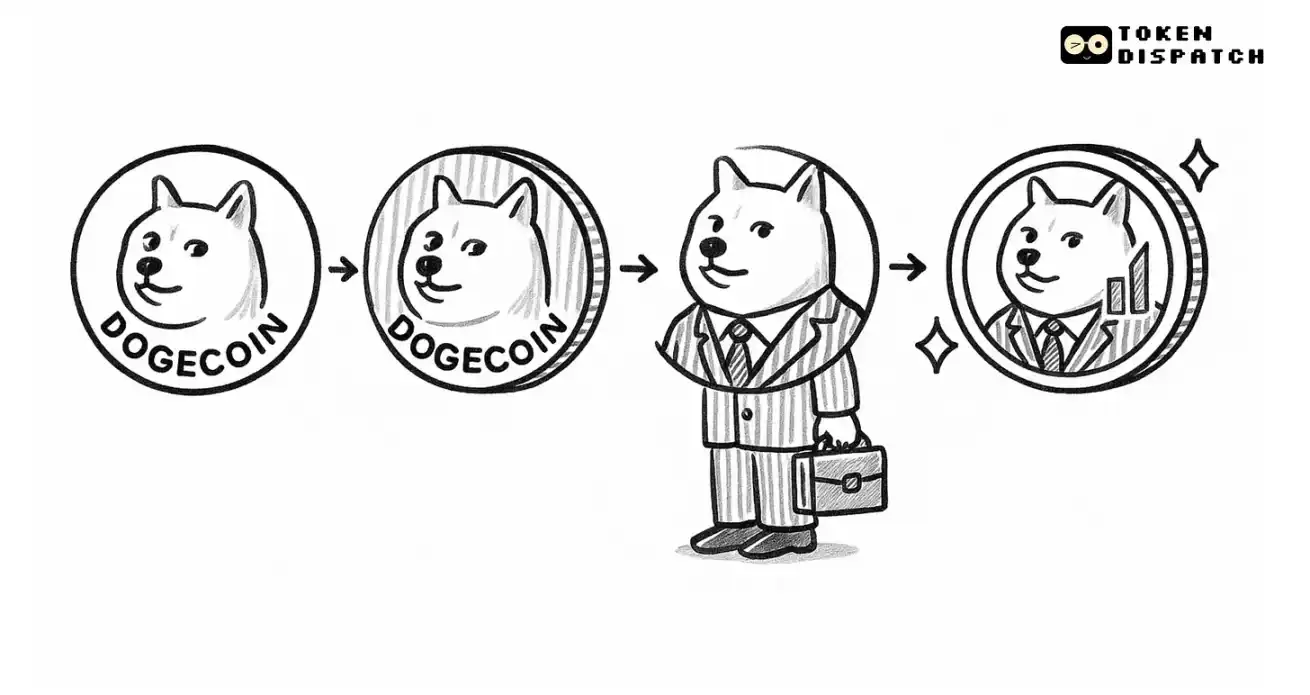
In September 2025, Wall Street crossed a new threshold: packaging Memecoins into a regulated investment product and charging a 1.5% annual fee for it.
ETFs have evolved from a "tool to simplify investments" to a "complex vessel that can package any strategy." Strategies like portfolios, hedging, timing, and more are endless, but the number of investable entities is limited.
Today, the number of ETFs in the U.S. market has exceeded 4300, while the number of publicly listed companies is approximately 4200. The share of ETFs in all investment tools has risen from 9% a decade ago to 25%, marking the first time in market history that there are more funds than stocks.
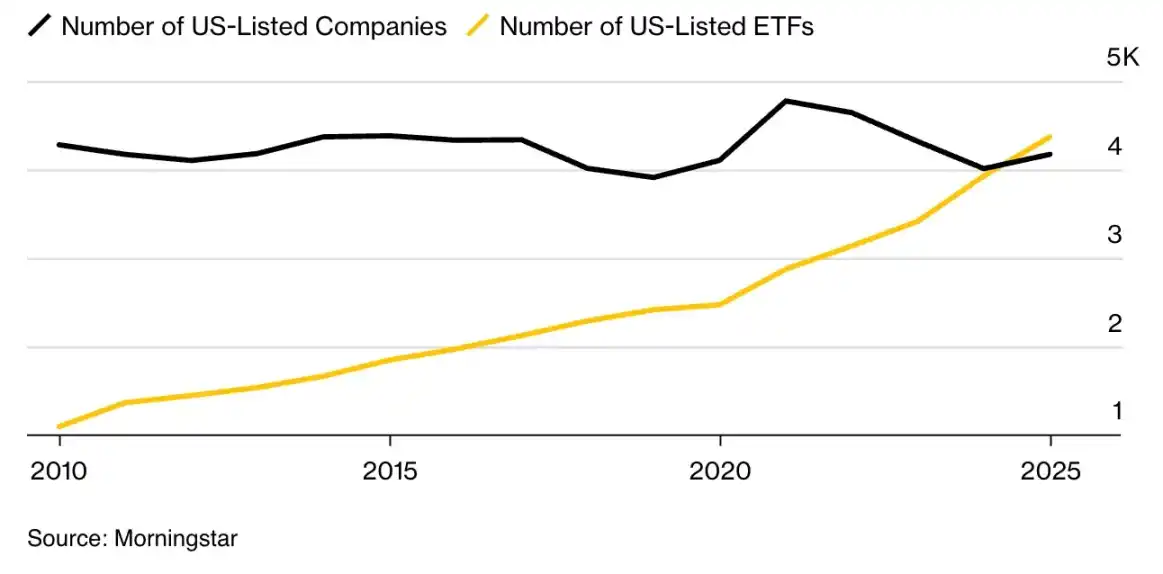
This has given rise to a fundamental issue: rather than empowering investors, option overload has paralyzed them. Modern funds cover every imaginable theme, trend, and even political stance, blurring the lines between serious long-term investment and entertainment-driven speculation, making it nearly impossible to distinguish between products designed "for wealth accumulation" and those designed "to ride hot trends."
Hold on a second… This kind of anxiety is completely missing the point; a Dogecoin ETF is not a distortion of the cryptocurrency mission.
For 15 years, cryptocurrency has been questioned as a "valueless virtual currency." Traditional finance called us "speculators obsessed with worthless tokens," asserting that we could never build anything real, would not receive institutional approval, and did not deserve serious regulatory treatment.
And now, they are attempting to extract value from our "playfully created assets."
The crypto industry has created a brand-new category of value that traditional finance cannot ignore, cannot suffocate, and ultimately cannot remain detached from. Dogecoin being able to have its own ETF before more than half of the Fortune 500 companies is the strongest proof of cryptocurrency culture's dominance.
Alright, enough with the celebration; let's seriously examine the nature of this victory.
The economic logic of a Memecoin ETF makes no sense for investors but is all too rational for Wall Street.
You can directly buy Dogecoin on Coinbase in just 5 minutes with no ongoing fees; however, the REX-Osprey Dogecoin ETF offers the same exposure but charges a 1.5% annual fee. Keep in mind, the fee for a Bitcoin ETF is only 0.25%. Why would someone be willing to pay 6 times the cost of "digital gold" for a Memecoin?
The answer reveals the true target clients of such a product. The Bitcoin ETF caters to institutional investors and experienced wealth managers who need to comply with regulations but understand cryptocurrency. They compete on fees because their clients have other options and know how to use them.
The Memecoin ETF, on the other hand, targets the retail investors who "saw Dogecoin trending on TikTok but don't know how to buy it directly." What they are paying for is not market exposure but rather convenience and a stamp of legitimacy. These investors do not price compare; they just want to click "Buy" on the Robinhood App and get a taste of the Meme hot topic they often hear about.
The issuers are well aware of how absurd this is and know that their clients could buy Dogecoin cheaper elsewhere. They are betting that most people either won't realize this or won't bother dealing with cryptocurrency exchanges and wallets. The 1.5% fee is essentially a tax on financial illiteracy, disguised as institutional legitimacy.
The traditional definition of an ETF is: "A regulated investment fund that holds a diversified portfolio of securities and trades on an exchange like a stock, providing broad market exposure while adhering to professional oversight, custody standards, and transparent reporting."
In a classic model such as an ETF tracking the S&P 500, it holds hundreds of stocks across multiple industries; even sector-specific ETFs (such as Technology, Healthcare) cover dozens of relevant stocks. They achieve risk mitigation through diversification while capturing market trends.
Now, let's examine the essence of Dogecoin: In 2013, someone copied the Litecoin code, added a meme dog logo, and created a cryptocurrency purely for satirical purposes. It lacks a development team, a business plan, a revenue model, or technological innovation; it mints 5 billion tokens annually, deliberately designed in an inflationary model solely to mock Bitcoin's scarcity.
This token serves no economic purpose: it cannot host applications, generate staking rewards; its sole function is to exist as an internet meme and occasionally experience price surges due to celebrity tweets.
The listing journey of this product exposed the true nature of "financial innovation": technically complying with legal provisions while exploiting regulatory arbitrage.
The REX-Osprey Dogecoin ETF (ticker: DOJE) did not list under the regulatory framework for commodity ETFs in the 1933 Securities Act but instead utilized the 1940 Investment Company Act, a crucial choice. Under the 1940 Act, if the SEC does not object, the application automatically receives approval after 75 days, serving as a regulatory shortcut. However, the issue lies in the fact that this Act was originally designed for "mutual funds investing in multiple assets," not for a "single Memecoin speculative tool."
To comply with diversification requirements, DOJE cannot directly hold Dogecoin; instead, it gains exposure through derivatives using a Cayman Islands subsidiary, with related holdings capped at 25% of assets. This leads to a ludicrous outcome: a Dogecoin ETF can have at most 25% of its assets tied to Dogecoin.
It fundamentally alters how investors actually purchase the asset. An ETF that directly holds the asset can precisely track its price, but using derivatives through an offshore subsidiary introduces tracking errors, counterparty risks, and complexity, causing the fund's performance to diverge from the actual Dogecoin trajectory.
This regulatory workaround has also brought about transparency issues: Retail investors buying Dogecoin ETFs are looking to directly participate in the social media Meme craze, but what they actually end up with is a "complex derivative product portfolio": Three-quarters of the investment has no correlation with Dogecoin price movements, and the returns will be diluted by the remaining 75% of the fund's holdings.
Even worse, this structure completely goes against the original intent of the 1940 Act. Congress established diversification rules to lower risk through multi-asset allocation; however, Wall Street has used these rules to package high-risk speculation as regulated products, circumventing the intended regulatory oversight. Instead of protecting investors from risks, the regulatory framework has used "institutional legitimacy" to mask new risks.
Contrast this with a Bitcoin ETF. Most Bitcoin ETFs (such as ProShares BITO or Grayscale Bitcoin Trust) operate under the 1933 Securities Act or other commodity fund frameworks, allowing for direct exposure to Bitcoin (either physically or through futures) without the need to comply with a 25% holding limit; they typically hold futures contracts directly or seek Bitcoin spot custody (once approved), enabling a more precise tracking of Bitcoin's price.
The Dogecoin ETF represents a perfect storm of regulatory arbitrage. An ETF of a "largely non-investable asset" holding assets "publicly claimed to have no utility" listed under a 1940s Act meant to prevent such speculation. This is the epitome of financial engineering's cynicism, exploiting regulatory loopholes to create speculative products under the guise of investor protection.
Wall Street no longer pretends to focus on fundamentals but is relentlessly chasing yield regardless of asset quality.
Data from Dow Jones Bank shows that institutional portfolios are overweight in equities to the highest level since 2008. Investors are pouring into options income ETFs, high-yield junk bonds, and cryptocurrency yield products offering double-digit returns through derivatives, all in pursuit of monthly income promises.
Capital always chases yield first and asks questions later. As interest rates rise, investors swiftly rotate from safe investment-grade bonds to high-yield corporate debt; thematic ETFs around AI, cryptocurrency, and Meme assets are being launched at record speeds catering to speculative demand rather than long-term value.
Risk appetite indicators are all flashing green. Despite a macro environment filled with uncertainty, the volatility index (VIX) remains low; after the market turbulence in early 2025, defensive sectors briefly attracted funds, only to quickly flow back into high-risk, high-reward sectors like industrials, technology, and energy.
Wall Street has basically concluded that in a world of unlimited liquidity and constant innovation, yield is everything. As long as something can provide excess returns, investors will find a reason to buy, disregarding fundamentals or sustainability.
What happens when the quantity of investment products exceeds the actual investable assets?
We have crossed the threshold where the "number of ETFs is greater than the number of stocks," marking a fundamental shift in market structure. Essentially, we are "creating a synthetic market on top of the real market," with each layer adding costs, complexity, and potential points of failure.
Matt Levine has pointed out: "As ETFs become increasingly popular, technology lowers the cost of implementation, and more trades that used to be bespoke become standardized ETFs. The potential number of trading strategies is far greater than the number of stocks... In the long run, the potential market for ETFs is constrained by the infinite number of trading strategies, not the dwindling number of stocks."
The Memecoin ETF phenomenon is accelerating this trend. Rex-Osprey has filed for TRUMP Coin ETF, Bonk Coin ETF, as well as traditional crypto assets ETFs such as XRP, Solana, among others; the SEC currently has a backlog of 92 cryptocurrency ETF applications. The successful listing of each product will drive demand for the next, regardless of whether its target has any practical use.
This mirrors the 2008 subprime crisis: back then, Wall Street repackaged derivatives into new ones until financial products were completely detached from underlying assets; now we have merely replaced "mortgages" with "attention and cultural phenomena."
The market appears to be more liquid than it actually is because there are multiple products trading around the same underlying asset. However, when a crisis hits, these products will move in sync, and the so-called liquidity will evaporate instantly.
A deeper story is unfolding: finance has evolved into a "comprehensive attention-capturing mechanism," where anything that can cause price fluctuations can be monetized.
ETF listings self-reinforce through network effects. In the month before DOGE was listed, Dogecoin's price rose 15% due to the "expectation of institutional funds entering"; the price increase attracted more attention, thereby generating more memes, enhancing cultural influence, which in turn rationalizes more financial products, and success will spawn imitations.
Traditional finance monetizes productive assets such as factories, technology, and cash flow; modern finance can monetize anything that can move prices, such as narratives and memes. The ETF, as this packaging shell, transforms cultural speculation into institutional products, extracting fees from the communities that originally created these phenomena.
The more fundamental question is: is this innovation or exploitation? Is the financialization of Memes creating new value, or is it merely extracting value from a spontaneous cultural movement by layering institutional costs?
Internet culture has already created significant economic value: advertising revenue, merchandising, platform traffic, creator economy...
I have been pondering what is driving the valuations of these companies to reach billions of dollars by 2025. I recently even ordered matcha from Mitico Coffee Roasters in Bangalore; not because I enjoy the taste of this green powder, but because matcha has become a ritualistic symbol of "efficiency and serene luxury," making me feel like I'm part of some global health aesthetic.
This is the current state of Internet culture: a series of "participation fees" disguised as lifestyle choices. Monetization opportunities are ubiquitous, ranging from the absurd to clever innovations, covering everything.
Take the hot topics of 2025, for example. The Kiss Cam incident from the Coldplay concert turned a couple's awkward moment into a corporate resignation scandal, with Gwyneth Paltrow inexplicably becoming a "temporary spokesperson"; the internet erupted over the debate of "whether 100 men can defeat a gorilla"; the Labubu blind box craze turned a $30 collectible into a "symbol of identity people fight over in stores."

Then there's the language barrier I can never seem to overcome. Gen Z's slang updates are too rapid. Last week, someone said my outfit was "bussin," and I really didn't know whether to be mad or happy; apparently, it's a compliment? My nephew tried to explain that "rizz" means "charismatic," but then started saying words like "skibidi" and "Ohio," and I suddenly realized I am completely out of touch. Honestly, I'm trying to keep up, but every time I attempt to use these words correctly, I feel so cringey. It's a total "Millennials trying too hard" vibe that is not the aesthetic I want.
Just minutes after the news of Taylor Swift's engagement to Travis Kelsey broke, the entire marketing world collectively shifted: from Walmart to LEGO to Starbucks, all brands immediately jumped on this trend.
The key is: this cultural momentum itself is an economic engine. When Katy Perry takes an 11-minute space flight, the internet debates for a week, and this attention can be converted into advertising revenue, brand exposure, and cultural capital in over a dozen monetization ways; when a TikTok couple makes "pookie" a popular term, a complete ecosystem of "pookie playlists, pookie merch" emerges instantly.
Internet culture, through the creator economy, merchandising, platform traffic, and "can drive stock prices faster than financial reports," has created significant economic value. If one Elon Musk tweet can increase Dogecoin's market cap by billions of dollars, if Tesla's valuation is more influenced by cultural trends than fundamentals, then "cultural phenomena" are a legitimate economic force and should receive the same institutional packaging as other asset classes.
The ETF as a "wrapper" did not extract value from the community. It formalized existing value, allowing previously excluded individuals to participate. Now, a retiree in Ohio can access internet culture through their 401(k) retirement fund without needing to learn about cryptocurrency wallets or browse Discord communities.
However, on the flip side: this retiree may also lose a significant portion of their retirement savings on a "forgotten internet meme." With just a 1.5% annual fee, that's $1,500 eaten up each year for a $100,000 investment. Additionally, due to regulatory requirements, an ETF can only have a maximum of 25% exposure to Dogecoin, so this retiree may not even get the "cultural exposure" they were hoping for.
The lack of financial education coupled with "financial accessibility" is dangerous. Making speculative assets easier to purchase does not reduce their risk; it just shields those who "don't know what they're buying" from seeing the risk.
However, the financialization of memes may strengthen communities rather than exploit them. When a cultural movement gains institutional investment support, it gains stability and resources.
If internet culture can drive prices, it becomes an asset class; if social momentum can create volatility, it becomes a tradable asset. The ETF simply transforms cultural energy into an institutional product.
Recommended
The Wall Street Journal: How is AI Trading Stealing the Limelight from Cryptocurrency?
Aug 15, 14:00
Tencent Still Has a Dream
Aug 15, 11:27
To Catch North Korean Hackers, They Set Up a Fake Project
Aug 15, 10:00
From Litigation to Settlement: Positive Signal Released by HTX's Negotiation with FCA
Aug 14, 19:32
11,742 Shipping Addresses Exposed Alongside Trezor Orders
Aug 14, 19:01
Founder Interview: FOMO Creator Explains How They Added 30,000 Users in One Day and Became One of the Fastest-Growing Crypto Apps
Aug 14, 18:37