South Korean Retail Investor Portrait: 14 Million 'Ant People' Diving into Cryptocurrency and Leverage
Original Title: Wipeouts Threaten Korea Retail Army Chasing Riskiest Investments
Original Authors: Sangmi Cha, Haram Lim, Bloomberg
Original Translation: Luffy, Foresight News
At a textile firm in Seoul, manager Tony Kim goes all in on a stock if he believes in it.
Thirty-four-year-old Tony Kim has never held two stocks at the same time in his ₩140 million (approximately $98,500) investment portfolio. The father of two said, "Koreans, including myself, are obsessed with that dopamine-fueled rush. It's like it's engraved in our genes."

Tony Kim
For many retail investors, this approach may seem reckless or unusually resilient to pressure. But among around 14 million retail investors in Korea, known as the "ant army," this is just a microcosm of their extreme desire for returns and continuously increasing risk appetite.
This desire has driven funds to pour into investment accounts at a near-record pace. Over the past five years, Korean retail investors have leveraged up, leading to a doubling in the size of margin loans; they have flooded into highly speculative leveraged and inverse exchange-traded funds (ETFs), accounting for 40% of some leveraged ETFs' total assets registered in the U.S. At the same time, trading volumes for high-risk cryptocurrencies have also surged to historic highs.
The frenzied trading by retail investors has not only reshaped the market but has also made them a powerful political force. The strength and anxiety of these investors were so intense that they even forced the Korean government to make a policy U-turn for the first time.
Currently, as the global market is driven to historic highs by the artificial intelligence infrastructure boom, Korean retail investors with high leverage are in an extremely precarious position. Once market sentiment shifts suddenly, speculative positions could collapse instantly, and losses could be further magnified.
Such a reversal occurred just over a week ago. The escalation of the U.S.-China trade dispute triggered a cryptocurrency crash, with numerous altcoins instantly going to zero. Korean retail investors are known for gambling on small-cap tokens. These tokens have highly volatile prices, with altcoins accounting for over 80% of the total trading volume on Korean cryptocurrency exchanges; whereas on global platforms, Bitcoin and Ethereum usually comprise over 50% of the trading volume, presenting a stark contrast.
For many South Korean retail investors, all high-risk operations are aimed at one goal: to accumulate enough wealth in the cutthroat market to buy their own home. South Koreans use the term "borrowed soul" to describe this struggle, a word that precisely reflects the emotions and economic pressures behind the dream of homeownership.
Recent government policies in South Korea have further intensified retail investors' risky behaviors. Measures such as President Lee Jae-myung's mortgage loan limits and rental market reforms leading to rent hikes have made homeownership even more out of reach. Last week, the government introduced multiple measures to cool down the overheated real estate market, including tightening loan-to-value ratios in the greater Seoul area and reducing the loan-to-value ratio for mortgaged properties.
"Our parents' generation achieved wealth accumulation through the Han River Miracle's real estate boom, but our generation is not so lucky," said 36-year-old Kim Su-jin. She used to be a business consultant and started investing in cryptocurrency with all her severance pay after quitting her job. "Out of about 30 people I know in my circle, roughly 30 have 'graduated'—meaning they've earned enough money and exited high-risk investments," she said. "I also hope to 'graduate' one day."

The Han River in Seoul
The FOMO (fear of missing out) trend among South Korean retail investors is evident in various markets. Since Donald Trump won the U.S. presidential election last year and began his second term, the trading volume of domestic cryptocurrency exchanges in South Korea has skyrocketed, at one point reaching 80% of the trading volume of the Korean benchmark stock index, the Kospi. Stablecoins pegged to fiat currencies have also attracted a large amount of retail investor funds.
Investors have also been rushing into leveraged and inverse ETFs, financial products that amplify returns (and losses) by 2 to 3 times through derivatives. Due to strict regulations in South Korea on such products, including simulation trading drills and high margins, retail investors have turned to overseas markets and have now become significant participants in the global leveraged ETF market.
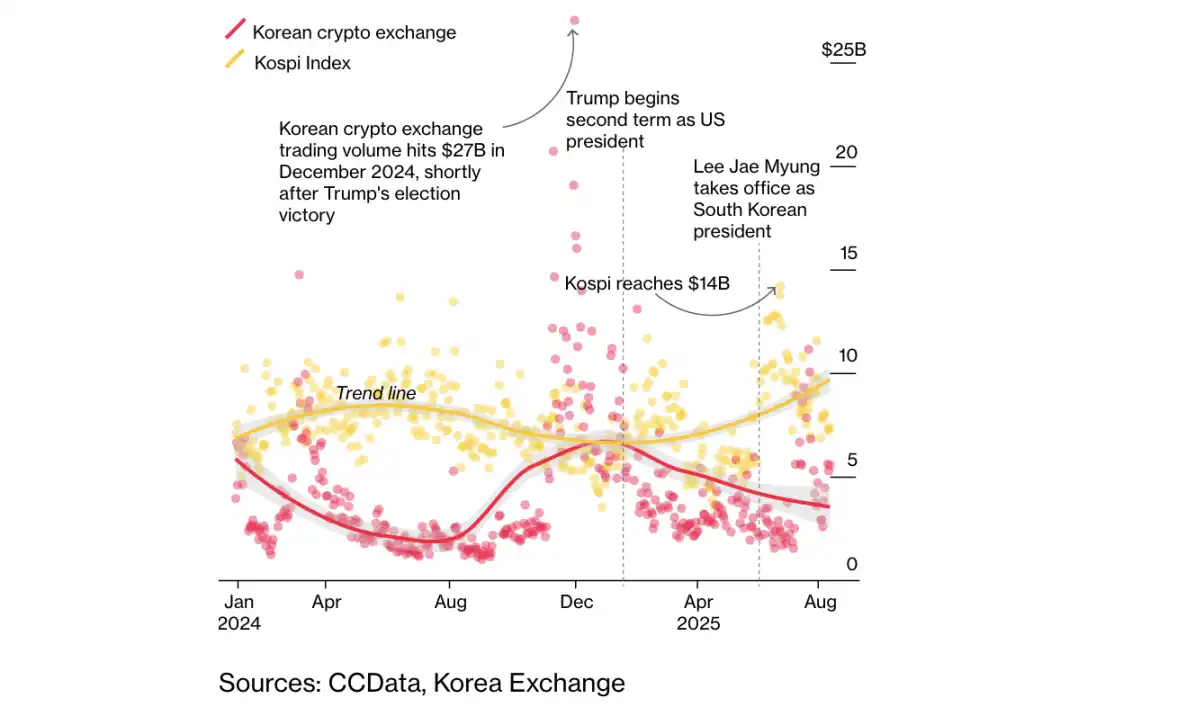
Comparison of trading volume on South Korean cryptocurrency exchanges and Kospi index trading volume
The high-risk behavior of South Korean retail investors not only puts household savings at risk but also puts pressure on the financial system, threatening overall economic stability. As investors flock to high-yield, high-risk assets, traditional financial instruments are gradually falling out of favor, and banks' channels to acquire funds are being constrained. In the six weeks after July this year, major South Korean banks lost nearly 40 trillion Korean won (approximately $281 billion) in deposits.
“In Korea, investment is often seen as gambling rather than long-term planning — almost as brutal as 'Squid Game.'” said Choi Jae-won, an economics professor at Seoul National University. “Once the bubble bursts, individuals face a wealth shock, leading to escalating issues: personal debt crises, decreased spending power, ultimately affecting the entire national economy.”
Regulatory bodies are equally concerned. “We are worried that a market collapse would impact retail investors' assets and the overall economy,” said Lee Yoon-soo, a standing commissioner of the Korea Securities and Futures Commission.
Psychiatrists point out that high-risk investments are increasingly taking a toll on individuals' mental well-being. “Without inherited wealth, owning an apartment in Gangnam (Seoul's affluent district) is a fantasy,” said Park Jong-sik. He once lost around $250,000 in investments and has since opened a clinic specializing in treating investment addiction patients. “In this anxiety-ridden society, even knowing the risks, people are still drawn to high-risk investments. It's as if the whole system is pushing them forward, causing them to fall into an anxiety-driven investment addiction cycle.”

Park Jong-sik
For some, the scars of an investment collapse are hard to heal. 35-year-old Han Jung-hoon once experienced the “30-fold surge in cryptocurrency wallet balance to 660 million Korean won” but the 2022 Luna crash turned it all into dust.
TerraUSD was a stablecoin project launched by a Korean, Do Kwon, which ultimately ended in failure. In August of this year, Do Kwon pleaded guilty to fraud, and the project's collapse wiped out about $40 billion in market value in a few days.
“My 660 million Korean won profit disappeared overnight, and I only recovered less than 6 million Korean won in the end,” Han Jung-hoon said.
This crash completely changed his life. Although not completely abandoning cryptocurrency, he has steered clear of high-risk investments, focusing on meditation instead. He even started a YouTube channel to share his favorite breathing techniques. Nowadays, he lives on the remote Jeju Island and occasionally goes on meditation retreats to Bali.

Han Jung-hoon
Still, social media platforms like YouTube are filled with bold investment success stories. Couples putting all their savings into Bitcoin, 27-year-old college students earning tens of thousands of dollars a month through high-frequency trading... These stories are exactly what attract investors like Tony Kim.
Tony Kim is currently fully invested in stocks of companies like NVIDIA and Tesla. "I made money on leverage, and that easy profit feeling got me addicted," he recalls how he once "made $13,000 overnight from $900," but lost all the gains in just three days. "You keep chasing that get-rich-quick thrill."
Recommended
The Wall Street Journal: How is AI Trading Stealing the Limelight from Cryptocurrency?
Aug 15, 14:00
Tencent Still Has a Dream
Aug 15, 11:27
To Catch North Korean Hackers, They Set Up a Fake Project
Aug 15, 10:00
From Litigation to Settlement: Positive Signal Released by HTX's Negotiation with FCA
Aug 14, 19:32
11,742 Shipping Addresses Exposed Alongside Trezor Orders
Aug 14, 19:01
Founder Interview: FOMO Creator Explains How They Added 30,000 Users in One Day and Became One of the Fastest-Growing Crypto Apps
Aug 14, 18:37