Selling Assets While Securing a Banking License: What's PayPal in Such a Rush For?
Original Article Title: "Selling Assets While Rushing for a Bank Charter: What Is PayPal Up To?"
Original Article Author: Sleepy.txt, D动 B
PayPal is getting into banking.
On December 15, the global payment giant with 430 million active users officially submitted applications to the Federal Deposit Insurance Corporation (FDIC) and the Utah Department of Financial Institutions to establish an Industrial Loan Company (ILC) named "PayPal Bank."
However, just three months ago on September 24, PayPal announced a blockbuster deal where they sold their up to $7 billion "Buy Now, Pay Later" loan assets to the asset management company Blue Owl.
During the call at that time, CFO Jamie Miller emphatically emphasized to Wall Street that PayPal's strategy was to "maintain a light asset balance sheet," to unlock capital, and improve efficiency.
These two events are contradictory, pursuing "lightness" on one hand, but applying for a bank charter on the other. It's important to note that running a bank is one of the most "heavy" businesses in the world. You need to deposit a massive amount of collateral, undergo the strictest regulations, and bear the risks of deposits and loans.
Behind this perplexing decision, there must be a compromise made out of some urgent reason. This is by no means a routine business expansion but more like a storming of the regulatory red line.
Regarding why they want to start a bank, the official reason given by PayPal is "to provide lower-cost loan funds to small businesses," but this reason simply doesn't hold up under scrutiny.
Data shows that since 2013, PayPal has provided over $30 billion in loans to more than 420,000 small businesses worldwide. In other words, in these 12 years without a bank charter, PayPal was still thriving in its loan business. If that's the case, why apply for a bank charter at this particular point in time?
To answer this question, we first need to understand: who actually issued these $30 billion in loans in the past?
While the lending data in PayPal's official press release looks impressive, there's a key fact that is often glossed over. For each of these $30 billion loans, the true lender is not PayPal but a bank located in Salt Lake City, Utah—WebBank.
The vast majority of people may have never heard of WebBank. This bank is extremely mysterious, as it does not operate consumer-facing branches, does not advertise, and even keeps its official website very simplistic. However, in the hidden corner of U.S. financial technology, it is an unavoidable behemoth.
PayPal's Working Capital and Business Loan, the installment payments of star company Affirm, and the personal loan platform Upgrade — the lender behind all of these is WebBank.
This involves a business model called "Banking as a Service (BaaS)": PayPal is responsible for customer acquisition, risk assessment, and user experience, while WebBank is only responsible for one thing — providing the banking license.
Using a more common analogy, in this business, PayPal is just a "middleman," while the actual property deed is held by WebBank.
For tech companies like PayPal, this was once a perfect solution. Applying for a banking license is too difficult, slow, and expensive, and obtaining lending licenses in each of the 50 U.S. states is an extremely cumbersome administrative nightmare. Renting WebBank's license is like having a VIP fast track.
However, the biggest risk of "renting a house" for business is that the landlord may stop renting at any time, or even sell or demolish the house.
In April 2024, a black swan event occurred that sent chills down the spine of all U.S. fintech companies. A BaaS intermediary company named Synapse suddenly filed for bankruptcy, directly causing over 100,000 users' $265 million in funds to be frozen, with $96 million even going missing, leaving some people with their life savings lost.
This disaster made everyone realize that the "middleman" model actually has significant flaws. If any part of the chain fails, the user trust you have painstakingly built up can collapse overnight. Therefore, regulatory agencies began a strict review of the BaaS model, and several banks were fined and had their operations restricted due to BaaS compliance issues.
For PayPal, although they partner with WebBank and not Synapse, the risk logic is the same. If WebBank encounters issues, PayPal's lending business will be paralyzed; if WebBank adjusts the partnership terms, PayPal has no bargaining power; if regulators require WebBank to tighten cooperation, PayPal can only passively accept. This is the dilemma of the "middleman" — they are working hard to do business, but their lifeline is still held by others.
In addition, another more naked temptation that drives management to resolutely go solo is the windfall of the high-interest era.
During the past decade of near-zero interest rates, running a bank was not considered a sexy business because the net interest margin was too thin. But today, the situation is completely different.
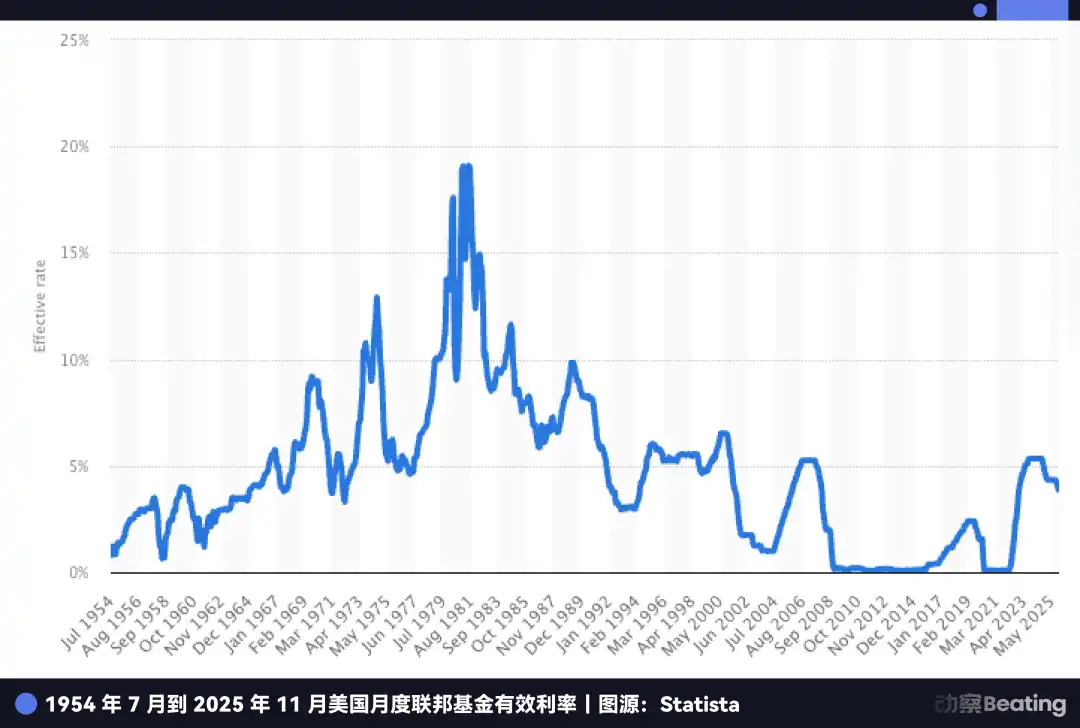
Even though the Federal Reserve has started cutting interest rates, the US benchmark interest rate still hovers around a historical high of 4.5%. This means that deposits themselves are a gold mine.
Look at PayPal's current awkward situation: it has a massive pool of 430 million active users' funds sitting in users' PayPal accounts, and PayPal has to deposit these funds into partner banks.
The partner banks take this low-cost money to buy US Treasury bonds with a 5% yield or to issue higher-interest loans, raking in profits, while PayPal can only get a small piece of the pie.
If PayPal were to obtain its own banking license, it could directly turn these idle funds of 430 million users into its own low-cost deposits, then buy government bonds with one hand and issue loans with higher interest rates with the other hand, keeping all the interest rate spread for itself. During these years of the high-interest rate window, this represents a profit gap of tens of billions of dollars.
However, if PayPal only wanted to get rid of WebBank, it should have done so a long time ago, so why wait until 2025?
This brings up another more urgent and deadly anxiety deep in PayPal's heart: stablecoins.
If the 'second-landlord' status in the lending business only caused PayPal to earn less money and worry more, then in the stablecoin battlefield, this dependency is evolving into a real survival crisis.
In 2025, while PayPal's stablecoin PYUSD experienced explosive growth, with its market value tripling in three months, soaring to $3.8 billion, even YouTube announced in December that it would integrate PYUSD payments.
But behind these lively reports, there is a fact that PayPal will not emphasize in the press release: PYUSD is not issued by PayPal itself but through a partnership with Paxos, based in New York.
This is another familiar "white-label" story, where PayPal is just the brand authorizer, much like how Nike doesn't manufacture shoes itself but authorizes the logo to contract factories.
In the past, this was more like business division of labor, with PayPal holding the product and traffic while Paxos took care of compliance and issuance, each minding their own business.
But on December 12, 2025, this division of labor began to sour. The Office of the Comptroller of the Currency (OCC) granted "conditional approval" of a national trust bank charter to several institutions, including Paxos.
While not a "commercial bank" in the traditional sense able to attract deposits or hold FDIC insurance, it signifies that Paxos is transitioning from a contract factory to an issuer with a badge, able to step into the forefront.
Add the framework of the GENIUS Act, and you'll understand why PayPal is feeling the urgency. The Act allows regulated banking entities to issue payment stablecoins through subsidiaries, concentrating the issuance rights and revenue chain more in the hands of the "licensed."
Previously, PayPal could treat stablecoins as an outsourced module, but now, once the outsourcing party has a stronger regulatory identity, it's no longer just a supplier; it can also become an alternative partner or even a potential rival.
The dilemma for PayPal is that it neither holds the issuance foundation nor the regulatory identity.
The advancement of USDC, the OCC's approval of trust charters, all serve as reminders of one thing to PayPal: in the stablecoin arena, the ultimate comparison is not who releases stablecoins first but who can grasp the issuance, custody, clearing, and compliance ropes.
Therefore, rather than aiming to become a bank, PayPal is more like seeking an admission ticket. Otherwise, it will forever remain on the sidelines.
What's even more damaging is that stablecoins present a de-escalation to PayPal's core business.
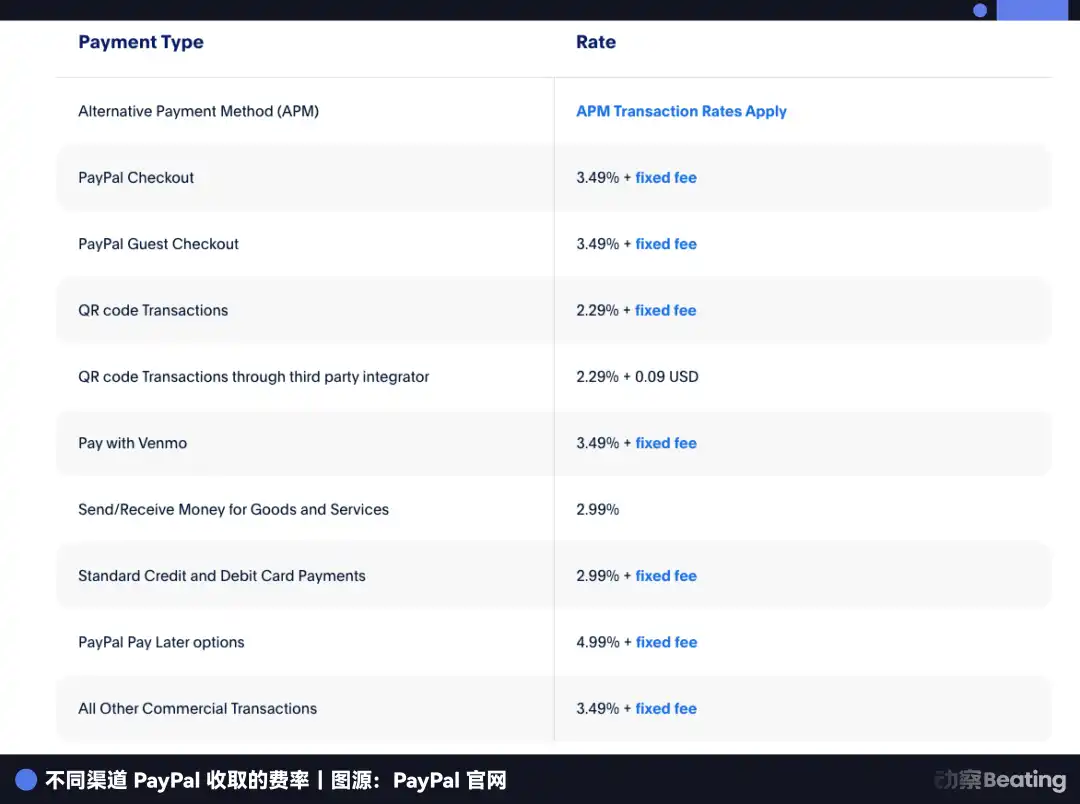
PayPal's most profitable business is e-commerce payments, relying on charging a transaction fee of 2.29% to 3.49% per transaction. However, stablecoins operate on an entirely different logic, almost devoid of transaction fees, earning revenue based on users' funds earning interest on government bonds.
As Amazon starts accepting USDC, as Shopify enables stablecoin payments, merchants will face a simple math problem: if they can use a near-zero-cost stablecoin, why pay PayPal a 2.5% toll fee?
Currently, e-commerce payments account for over half of PayPal's business revenue. Over the past two years, it has seen its market share drop from 54.8% to 40%. If it doesn't take control of the stablecoin initiative soon, PayPal's moat will be completely filled in.
PayPal's current situation is similar to that of Apple when it launched the Apple Pay Later service. In 2024, Apple, lacking a banking license, was heavily restricted by Goldman Sachs and ultimately shut down the service, returning to its core hardware business. Apple could retreat because finance was just a bonus for it, with hardware being its core competency.
But PayPal has no room to retreat.
It has no phone, no operating system, no hardware ecosystem. Finance is everything to PayPal, its sole livelihood. Apple's retreat was a strategic contraction, but if PayPal dares to retreat, what awaits it is death.
Therefore, PayPal must move forward. It must obtain that banking license, taking back the issuance, control, and revenue rights of stablecoins.
However, opening a bank in the United States is no easy task. Especially for a technology company with $70 billion in loan assets, the regulatory approval process is daunting.
So, in order to obtain this ticket to the future, PayPal has carefully designed a brilliant capital magic trick.
Now, let's revisit the contradiction mentioned at the beginning of the article.
On September 24, PayPal announced the sale of a $7 billion "buy now, pay later" loan portfolio to Blue Owl, with the CFO boldly proclaiming they want to "lighten up." At the time, most Wall Street analysts thought this was merely to dress up the financial statements and make the cash flow look better.
However, if you connect this event with the bank license application three months later, you'll realize this is not a contradiction but a well-thought-out combination.
If PayPal didn't sell this $7 billion receivable, its chances of obtaining a bank license would be close to zero.
Why? Because in the US, applying for a bank license requires an extremely rigorous "check-up," with the regulatory agency (FDIC) holding a ruler called "capital adequacy ratio."
Its logic is simple: the more high-risk assets (such as loans) lying on your balance sheet, the more collateral you must put up to mitigate risk.
Imagine if PayPal showed up at the FDIC's door carrying a $70 billion loan, regulators would immediately see this heavy burden and ask, "With so many risky assets on your books, what will happen if there are defaults? Do you have enough funds to cover it?" This not only means PayPal would need to provide astronomical amounts of collateral but could also result in the application being rejected outright.
Therefore, PayPal must undergo a comprehensive slimming down before the check-up.
This transaction sold to Blue Owl is known in financial jargon as a forward flow agreement. The design is very clever. PayPal transferred all future two years' worth of newly originated loan receivables (essentially, "printed money") and default risk to Blue Owl; yet astutely retained underwriting rights and customer relationships, essentially keeping the "printing press" for itself.
In the eyes of the users, they are still borrowing from PayPal and repaying within PayPal's app, and the entire experience remains unchanged. However, on the FDIC's regulatory report, PayPal's balance sheet instantly becomes extremely clean and neat.
Through this strategic maneuver, PayPal achieved a transformation, evolving from a lender burdened with heavy default risks to a passerby earning only risk-free service fees.
Such a deliberate asset reshuffle for regulatory approval is not unheard of on Wall Street, but to execute it so resolutely and on such a large scale is rare indeed. This demonstrates the determination of PayPal's management team, willing to give up existing fat (loan interest) to secure a long-term ticket.
Furthermore, the window of opportunity for this bold move is rapidly closing. The reason for PayPal's urgency is that the "back door" it is eyeing is being shut down by regulators, and possibly even sealed shut.
The license PayPal applied for is called an Industrial Loan Company (ILC) charter, a name that is likely unfamiliar to those not deeply involved in finance. Yet, within the U.S. financial regulatory system, it is one of the most enigmatic and coveted entities.
Looking at the list of companies holding an ILC charter evokes a strong sense of dissonance: BMW, Toyota, Harley-Davidson, Target...
You might ask: Why would these car dealerships and grocery stores want to open a bank?
That's the magic of an ILC. It is the only "regulatory loophole" in the U.S. legal system that allows non-financial giants to legally open a bank.
This loophole stems from the 1987 passage of the Competitive Equality Banking Act (CEBA). Although the law's name implies "equality," it actually created an extremely unequal privilege: it exempted the parent company of an ILC from the obligation to register as a "bank holding company."
If you apply for a regular bank charter, the parent company must undergo the all-encompassing oversight of the Federal Reserve. But if you hold an ILC charter, the parent company (such as PayPal) is not under the jurisdiction of the Federal Reserve; it only needs to comply with FDIC and state-level regulation in Utah.
This means that you not only enjoy the national privilege of attracting deposits and accessing the federal payment system as a bank, but also perfectly evade the Federal Reserve's interference in your business operations.
This is what is known as regulatory arbitrage, and what's even more enticing is that it allows for "conglomerate operations." This is the play of BMW and Harley-Davidson, vertical integration in the supply chain.
BMW Bank doesn't need physical branches because its business is perfectly embedded in the car-buying process. When you decide to buy a BMW, the sales system automatically connects to BMW Bank's loan services.
For BMW, it earns both the profit from selling you a car and the interest on the car loan. Harley-Davidson does the same, with its bank even being able to provide loans to motorcyclists who have been turned away by traditional banks, because only Harley itself knows that the default rate of these die-hard fans is actually very low.
This is exactly what PayPal dreams of as the ultimate form: handling payments with one hand, banking with the other, stablecoin in the middle, with no outsiders interfering at any stage.
By this point, you must be wondering, since this loophole is so useful, why don't Walmart and Amazon apply for this charter and open their own banks?
That's because the traditional banking sector loathes this backdoor.
Bankers believe that allowing a business giant with a massive amount of user data to open a bank is simply a low blow. In 2005, Walmart applied for an ILC charter, triggering a collective uproar in the American banking industry. The Bankers Association lobbied Congress frantically, arguing that if Walmart Bank used the data advantage of its supermarkets to only provide low-interest loans to people who shop at Walmart, how can community banks survive?
Under immense public pressure, Walmart was forced to withdraw its application in 2007. This event directly led to the "hibernation" of ILC by the regulators. From 2006 to 2019, for a full 13 years, the FDIC did not approve a single application from any commercial company. It wasn't until 2020 when Square (now Block) finally broke the deadlock.
But now, this newly reopened backdoor is facing the risk of being permanently closed.
In July 2025, the FDIC suddenly released a notice of proposed rulemaking regarding the ILC framework, which was seen as a strong signal of regulatory tightening. At the same time, relevant legislative proposals in Congress have never ceased.
As a result, everyone started scrambling for licenses. In 2025, the number of U.S. bank charter applications reached a historical peak of 20, with the OCC alone receiving 14 applications, equivalent to the total for the past four years.
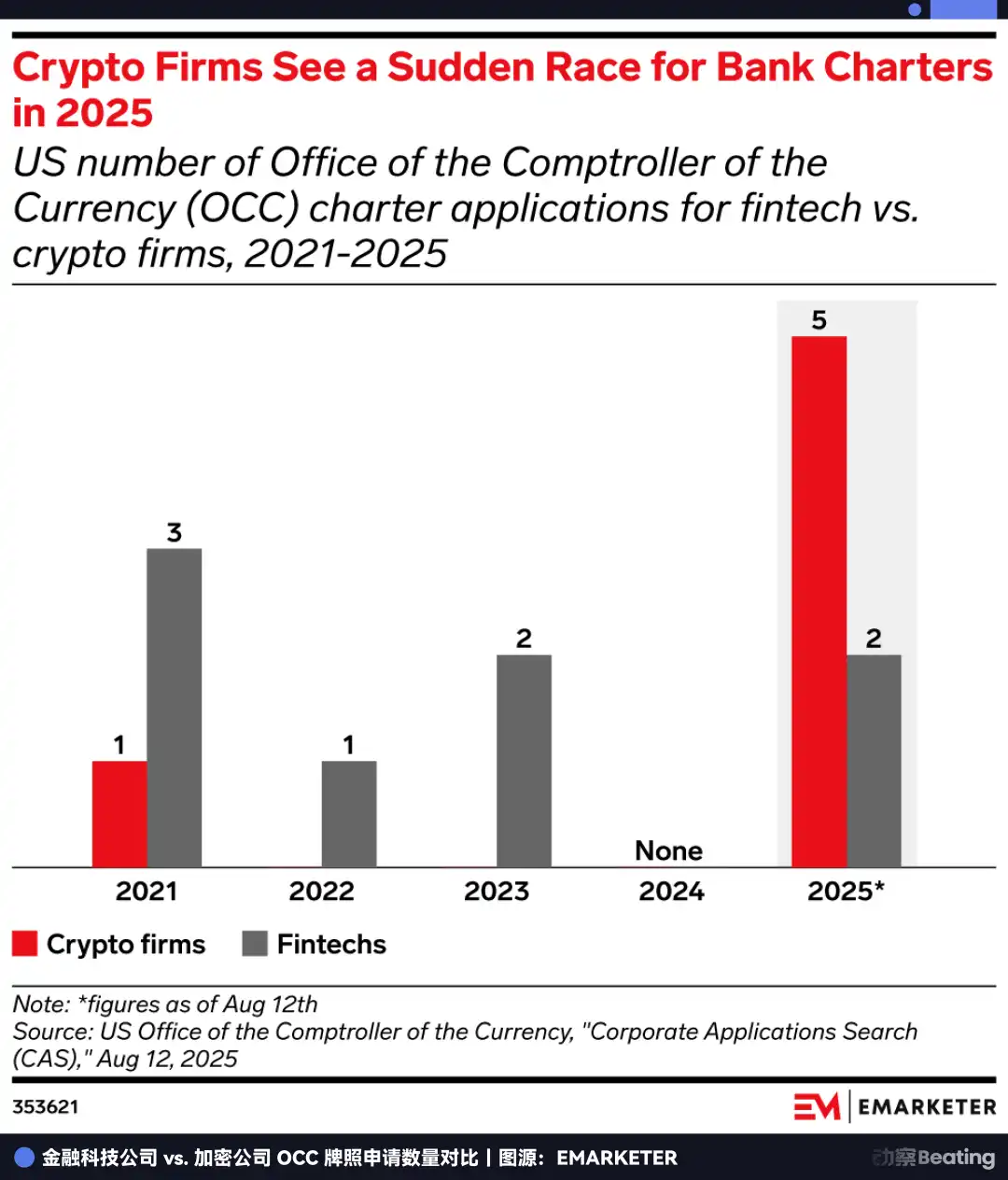
Everyone knew deep down that this was the last opportunity before the door closed. This time, PayPal was racing against the regulators. If you didn't rush in before the loophole was completely sealed by law, this door might be closed forever.
The license that PayPal fought so hard for is actually an "option."
Its current value is determined: issuing loans on its own and earning the interest rate spread in a high-interest environment. But its future value lies in giving PayPal the eligibility to enter those currently prohibited but imaginatively promising areas.
What is Wall Street's most coveted business? It's not payments, but asset management.
Before having a bank charter, PayPal could only act as a simple money conveyor, helping users move funds. But once it obtains the ILC license, it will have a legitimate custodial identity.
This means that PayPal can rightfully hold Bitcoin, Ethereum, and even future RWA assets for its 430 million users. Furthermore, under the future "GENIUS Act" framework, banks may be the only legally allowed gateway to connect to DeFi protocols.
Imagine in the future, PayPal's app might have a "High-Yield Savings" button, with the backend connected to on-chain protocols like Aave or Compound, and the unbridgeable compliance barrier in between being bridged by PayPal Bank. This will completely break down the wall between Web2 payments and Web3 finance.
In this dimension, PayPal is no longer competing with Stripe on payment processing fees but is building a financial operating system for the crypto age. It is attempting to evolve from transaction processing to asset management. Transactions are linear, with a ceiling, while asset management is an infinite game.
Only by understanding this layer can you understand why PayPal is launching this charge at the end of 2025.
It is very clear that it is being squeezed in the crack of the times. Behind it is the fear of stablecoins erasing the profits of traditional payment businesses; ahead is the urgency of the ILC backdoor about to be permanently welded shut.
In order to squeeze through this door, it must sell off $7 billion in assets in September to take drastic measures, only to exchange for that ticket that determines life and death.
If you extend the timeline to 27 years, you will see a cycle full of destiny.
In 1998, when Peter Thiel and Elon Musk founded the predecessor of PayPal, their mission was to "challenge banks" and use digital currency to eliminate those old, inefficient financial institutions.
27 years later, this former "dragon slayer" is doing everything it can to "become a bank".
In the business world, there are no fairy tales, only survival. On the eve of cryptocurrency reconstructing the financial order, continuing to be an "ex-giant" outside the system is a dead end. Only by obtaining that identity, even if it is through a "backdoor" approach, can one survive to the next era.
This is a life-and-death breakthrough that must be completed before the window closes.
If it wins the bet, it will be the JPMorgan of the Web3 era; if it loses, it will just be a relic of the previous generation of the Internet.
PayPal has little time left.
Recommended
The Wall Street Journal: How is AI Trading Stealing the Limelight from Cryptocurrency?
Aug 15, 14:00
Tencent Still Has a Dream
Aug 15, 11:27
To Catch North Korean Hackers, They Set Up a Fake Project
Aug 15, 10:00
From Litigation to Settlement: Positive Signal Released by HTX's Negotiation with FCA
Aug 14, 19:32
11,742 Shipping Addresses Exposed Alongside Trezor Orders
Aug 14, 19:01
Founder Interview: FOMO Creator Explains How They Added 30,000 Users in One Day and Became One of the Fastest-Growing Crypto Apps
Aug 14, 18:37