Brevis: Unlocking the Blockchain Infinite Compute Era

At the November 2025 Argentina Devcon, Ethereum Foundation researcher Justin Drake showcased a different block validation process, where his validation node used the zkLighthouse client and relied solely on a zero-knowledge proof from protocols like Brevis's Pico zkVM to efficiently determine block validity. This likely foreshadows Ethereum's future scalability direction, demonstrating that blockchains don't need to re-execute all computations but only need to validate externally generated proofs.
Brevis is not just a specific application but a verifiable computation layer. As an Infinite Compute Layer, it allows complex computations to be executed off-chain and results to be brought back on-chain through zero-knowledge proofs for smart contracts to validate at very low costs. This is crucial because Ethereum's default security model fundamentally relies on full network reruns, where each validation node often has to recompute all transactions in a new block to ensure the block's execution correctness. While this guarantees correctness, it also means that computational power and resource consumption will continuously escalate with heavier loads. Brevis is reworking this necessary redundant recomputation into a single computation for network-wide verification, conducting computations off-chain and generating proofs, requiring on-chain nodes to verify only a very small proof.
Unlike many zk applications that focus solely on privacy or scalability, Brevis aims to address structural issues in the Web3 industry. As on-chain computations become more intricate and frequent, must the system rely on each node's redundant execution to maintain trust? Brevis opts to move computations off-chain, executed by zkVM, and proof generation, enabling on-chain contracts to trustworthily utilize historical data, cross-chain states, or complex algorithm outputs without introducing additional trust assumptions. In pursuit of this goal, the ZK Data Coprocessor, Pico zkVM, and ProverNet currently form its three core technologies.
The initial technological breakthrough of Brevis was the ZK Data Coprocessor, enabling smart contracts to query any on-chain historical data, perform off-chain computations, generate zero-knowledge proofs, and provide computed results as trusted inputs to the contract. The ZK Data Coprocessor can query and compute on-chain historical transaction volumes or user behaviors, generating zero-knowledge proofs for contract verification. This capability allows contracts, which originally could only access the current block, to leverage long-term data and cross-chain states.
In 2023, after Brevis created the Coprocessor prototype, they iterated all the way to January 2025 when they launched v2 and went live on the mainnet. The key changes in v2, without getting caught up in the specific proof system's name, can be abstracted into three points: faster (completing the same task with fewer resources and in less time), more general (covering a wider range of data and computation needs), and easier to use (simplifying the process, encapsulating complexity).
Looking back at Brevis' technical roadmap before 2025, it was actually a single thread: first, understand the performance boundaries of the proof system, then make off-chain computing and on-chain verification usable as a Coprocessor and continue to iteratively engineer, and subsequently explore a more systematic operational form. What's even more remarkable is that it showcased the team's true colors, understanding both cryptography and large-scale systems engineering, not relying on paper deductions to win. In the early stages of the project, they identified industry pain points and were committed to the widespread adoption of the technology.
In 2025, Brevis completed the other two pieces of the puzzle in the three-horse chariot. One is a more general, more production-oriented proof execution engine, Pico zkVM, and the other is turning proof generation capability into an open supply through ProverNet, moving from provable to continuous, scalable proof supply.
Pico zkVM can be understood as Brevis' general-purpose proof engine, which takes zero-knowledge proofs from custom circuits and manual adaptation to a more software engineering-like form—developers write logic in a familiar development style, which is then turned into verifiable proof results by the underlying system. More importantly, from the beginning, Pico focused on real business throughput and cost. Under the same set of benchmarks, Brevis' comparisons show that Pico has a significant performance advantage in mainstream zkVMs while also being able to make specific types of computations more efficient through pluggable components/coprocessors.
In June 2025, Brevis released Pico-GPU, taking real-time proof generation speed to a critical turning point, impacting not only the protocol but the entire industry. Pico-GPU systematically moved the core process of proof generation to GPU parallelism, with the officially reported performance improvement reaching 10-20 times, marking a qualitative leap compared to previous solutions.
In October, Pico Prism was released, taking this direction to a very intuitive threshold. With a configuration of 64 consumer-grade GPUs, it achieved Ethereum's 45M gas block completing 99.6% of proofs in 12 seconds, 96.8% in 10 seconds, with an average proof time of about 6.9 seconds, approaching the Ethereum Foundation's goal. For the first time, real-time proof generation speed almost perfectly caught up with Ethereum's block time, and compared to competitors, it used fewer resources.
This progress has also received a direct response from the Ethereum core community. Vitalik directly mentioned in a tweet that Pico Prism entering the ZK-EVM proof track is an important step in proving speed and diversity. Justin Drake, in a previous tweet, used a very clear tone to assess the real-time proof of Pico Prism progress as extraordinary. Keep in mind that in May of this year, SP1 Hypercube required 160 RTX 4090s to prove about 94% of the L1 block in 12 seconds. Being so cliff-edge ahead in real-time proof speed, Brevis's Pico Prism has become the most anticipated solution.
After successfully developing a universal zkVM and real-time proof technology, Brevis began addressing the proof supply issue. In November 2025, Brevis unveiled the vision of ProverNet, which aimed to commercialize proof capacity. Any application could submit proof tasks and match to prover nodes in the market through an auction mechanism. The mainnet Beta launched in December further brought it into a usable product form, with the market continuing to operate, proof requests being able to be submitted directly, provers able to register and start bidding for orders, and applications no longer needing to build their own proof infrastructure.
Through these three pillars, Brevis has transformed proof capacity from a tool into infrastructure, providing both a scalable proof engine and an open proof supply network, allowing applications to obtain verifiable computation on demand. Its significance is not only in Ethereum—this off-chain compute, on-chain verify paradigm will spill over into the entire Web3, as well as other industries such as AI and gaming.
The technical value of Brevis is ultimately demonstrated in real-world applications. It is not a concept showcased in promotional materials but rather integrated into the protocol's daily operation, determining how data is retrieved, metrics are calculated, rewards distributed, and fees adjusted—things that were either impossible to do or could only be achieved through centralized script workarounds are now starting to follow a more protocol-driven path. In this process, Brevis has already generated over 280 million proofs for users, distributed over $230 million in rewards, and securely driven $25 billion TVL growth.
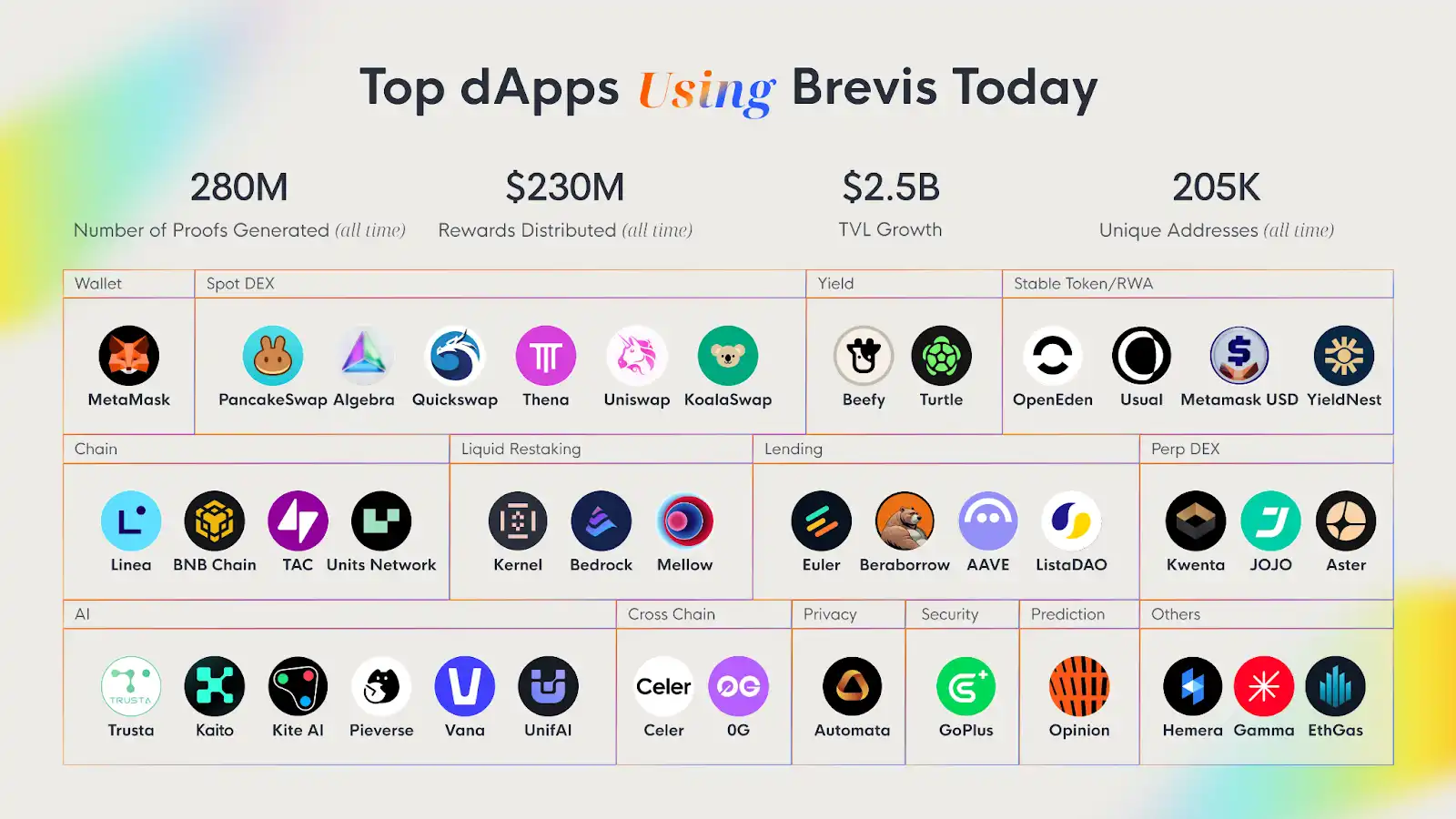
The most intuitive entry point to understand Brevis is through the transaction, which is the most familiar to users. Brevis can ensure data privacy and authenticity, allowing DEX to have CEX-like functionality, thus improving the trading experience for DEX users. PancakeSwap Infinity makes tiered fees possible through hooks, where factors such as holdings and historical trading volume affect the fee for each transaction. However, these judgments rely on aggregating historical data. Putting it on-chain is costly, while off-chain introduces trust issues. What Brevis does is clear the historical data off-chain, bring the data back on-chain through proof, enabling different fee structures to be written into the contract, rather than being handled in the backend script like a CEX.
If PancakeSwap is seen as a more CEX-like personalized experience, Usual showcases a longer-term growth mechanism, transforming incentives from one-time airdrops to a continuous CPI. Rewards are closely tied to long-term behaviors such as holding and interacting, with Brevis turning these metrics into verifiable inputs, making distribution automated, auditable, and eliminating the need for the community to trust a particular operational spreadsheet or centralized distributor. Through Incentra, reward issuance is turned into a standardized capability, where the protocol aims to provide LP, lending, or holding incentives, with the key being off-chain metric calculation and on-chain proof-based settlement. Euler's activity on Arbitrum serves as a representation — rewards are distributed not based on manual accounting and multisig distribution, but through rules and proof-supported continuous allocation.
When the scenario expands to the ecosystem level, Linea's Ignition Program better illustrates the issue: the challenge is not in providing incentives but in how to provide them. Brevis enables large-scale incentive computation to be completed off-chain and brings back trustworthiness through on-chain validation, thereby shifting incentives from centralized operational actions to reusable system capabilities. Similarly system-focused is Uniswap v4's Routing Rebate Program. Whether the route is taken, how gas consumption is tracked, and how rebate amounts are calculated, all form part of the data-computation-settlement chain. Here Brevis undertakes off-chain computation and proof generation, enabling the rebate system to be rule-based and verified, rather than relying on trust in a specific statistical entity.
Looking at these cases in sequence, Brevis's data acquisition, metric computation, and proof generation allow protocols to write back more logic that originally could only be achieved through centralized backends, without sacrificing decentralization. This opens up a wider design space for the entire crypto industry's protocols, enabling them to do more, while maintaining decentralization.
Brevis's core team is composed of top-tier academic researchers and frontline system engineers, with a distinctive feature: they can both engage in long-term exploration at the proof system and algorithm level, and compress complex technology into real production environments for iterative refinement until performance, stability, and cost meet the standards for scalable deployment. More importantly, they are not just a technically savvy lab team — they are equally familiar with how the crypto industry operates: understanding the real needs of protocol teams, the pace of advancing ecosystem collaborations, as well as possessing long-term accumulation at the capital and community levels. This enables them to convert engineering roadmaps into sustained partnerships and developer momentum.
This is evident from the long-term support Brevis receives from capital and the community. Brevis completed its seed round financing in November 2024, led by top-tier institutions such as Polychain and Yzi Labs, providing financial support for its ongoing advancement of zkVM, proof networks, and productization. At the same time, Brevis's community saw significant growth in 2025, alongside the Proving Grounds, role system, and task mechanisms attracting continuous participation from developers and users. Adding Vitalik's public acknowledgment and Ethereum Foundation's Justin Drake's attention to relevant progress in experimentation and discussions, these collectively form the external endorsement and trust capital for Brevis to continue expanding as infrastructure.
Ethereum's scalability has long been stuck in a structural dilemma: either all nodes perform redundant computations in exchange for security and trustlessness, limiting throughput and increasing costs due to the overhead of network-wide computation, or externalize computation to improve efficiency but introduce additional trust in a computation oracle. Brevis aims to provide a third way by offloading complex computations off-chain, then using proofs to bring trust back on-chain for validation, shifting the system from a model of redundant computation to one of verifying results. Its value thus lies not in a single product point, but in establishing an end-to-end verifiable computation pipeline.
Brevis is not the sole solution to Ethereum's scalability issues, but it showcases the significant value of a verifiable computation layer, decoupling computation from verification. This approach ensures both security and decentralization while alleviating the burden of on-chain execution. Moreover, the benefits of an infinite computation layer are not confined to Ethereum alone. For the entire crypto industry, it signifies that more on-chain applications can achieve a level of complexity and user experience close to Web2 without sacrificing security. In the broader traditional world, post-computation verification offers a new mode of collaboration — when multiple parties need to share results but cannot share trust, proofs can become a universal language. As open proof networks like ProverNet mature, what Brevis is building will not just enhance the capabilities of a single chain but provide a trusted computation supply accessible across ecosystems and industries.
Recommended
The Wall Street Journal: How is AI Trading Stealing the Limelight from Cryptocurrency?
Aug 15, 14:00
Tencent Still Has a Dream
Aug 15, 11:27
To Catch North Korean Hackers, They Set Up a Fake Project
Aug 15, 10:00
From Litigation to Settlement: Positive Signal Released by HTX's Negotiation with FCA
Aug 14, 19:32
11,742 Shipping Addresses Exposed Alongside Trezor Orders
Aug 14, 19:01
Founder Interview: FOMO Creator Explains How They Added 30,000 Users in One Day and Became One of the Fastest-Growing Crypto Apps
Aug 14, 18:37